I've seen some online cheering Stallman's resignation from MIT. I suspect they'll also be cheering about this resignation as well.
But this is nothing to cheer about.
Regardless of what low regard the man might be held as a person, he's being persecuted for having expressing ideas, demanding proof of claims, advocating for objective standards, and asking questions. These are all hallmarks of scientific inquiry.
It sets a precedent that will absolutely lead to self-censorship on a topic that really requires the disinfecting power of sunshine.
This strengthens the power of those who have no use for scientific inquiry and are more interested in inquisition.
I too, am a fan of Stallman's accomplishments and I am sad that debate on this topic essentially can't happen.
That said, I think Stallman's position really is fundamentally wrong and problematic.
Legally, sex with underaged people is rape regardless of consent. Morally, that stance really is justified in the most common circumstance - when the non-underaged person has more power and experience than the underaged person. In the case under discussion, you have that in spades, double spades.
The sad thing is that individuals interested in freedom, who make serious contributions to some things called free, don't notice that the massive imbalances of wealth today have produced a situation where simple "free choice" is made a mockery of.
And yeah, the thing about inquisition atmosphere, imo, is that it doesn't reveal the rot behind all the "mere" abuse of power.
He seems to have expressed a couple distinct arguments:
1. It isn't pedophilia if the person is sexually mature. Pedophilia is sex with prepubescent children.
2. He draws a distinction between statutory rape (can't legally say yes according to the law, but otherwise willing and sexually mature) and forcible rape (when someone says no). He made a point about how statutory rape wouldn't be considered rape if it happened in a different location (e.g. Italy) or if the person's birthday were slightly adjusted.
I agree with you that in the Epstein case you have a situation with a dramatic power imbalance. Stallman seems to consider Epstein a serial rapist (possibly for that fact?). He seems to be more pushing back on the pedophilia accusations.
Also - there seems to be a thread lost. It really looks like Epstein was a US Intelligence Officer filming powerful people having sex with young women (including foreign officials) to obtain leverage on them for the United States. This whole aspect of the conversation seems to have melted away in the various other controversies.
> Also - there seems to be a thread lost. It really looks like Epstein was a US Intelligence Officer filming powerful people having sex with young women (including foreign officials) to obtain leverage on them for the United States.
I agree that the reporting silence on this aspect of the case is odd. The federal prosecutor who worked out Epstein's plea deal (Alexander Acosta) appears to have told the press that the deal was done because he was told "Epstein belonged to intelligence". This was widely reported in July (https://www.google.com/search?q=acosta+epstein+intelligence), and then this revelation was almost completely dropped when Acosta resigned from his position as Secretary of Labor due to fallout from his involvement with the plea deal.
I'll note though that Acosta did not explicitly claim that Epstein was working for the US intelligence services...
> making it hard to accept your view that "it really looks like" that's the case
I didn't use those words, the parent poster did.
Personally, I think the possibility that Epstein was working for a government agency (domestic or foreign) merits further investigation, but is far from a certainty.
I agree that Acosta might have been lying. But if this is the case, I find it doubly odd that there has been so little follow up reporting.
Suppose Acosta started the lie, and refuses to talk about it. What would the follow-up reporting look like?
"I contacted 16 US intelligence agencies. 9 of them denied that Epstein worked for them, and the rest would neither confirm or deny that Epstein worked for them."?
Would you have seen that sort of reporting? Would it be convincing? How many relevant intelligence agencies are there in the US?
I agree that asking US intelligence agencies probably wouldn't produce anything worth reporting. I also agree that there is an asymmetry here, and that it would be very difficult to prove that he was not working for an intelligence agency.
The reporting I'd like to see would probably focus on finance and connections. How did Epstein make his money? Who were his clients? What did his business associates know about the sexual allegations? Who does Acosta claim told him? What were Epstein's internal motives?
I haven't seen any major news outlets focussing on these aspects. The simple explanation is that they fear that any explanation of Epstein other than "he's a monster" would reflect badly on them to the public. The more conspiratorial explanation is that the answers would reflect badly on people who have power over them.
But answering your questions: Yes, I probably would have seen that reporting if it existed; No, it wouldn't be convincing; I don't think the number of agencies matters, the connections he does have seem to lead to the CIA or Mossad.
You ask "What did his business associates know about the sexual allegations?"
The only known business associate is Wexner. He has declined to comment, says Bloomberg.
You ask "Who does Acosta claim told him?" He has declined to comment. Eg, the Miami Herald at https://www.miamiherald.com/news/local/article220097825.html says "Acosta did not respond to numerous requests for an interview or answer queries through email."
"The simple explanation" is that it was hidden well, protected by powerful people, and had not yet been figured out.
I have no doubt that "the answers would reflect badly on people who have power over them". That's how it has been squelched or diminished until now.
Other than the one comment, is there any evidence that an intelligence agency is really involved? Why can't it be a bunch of sexually abusive plutocrats supporting each other with their connections of power? Why can't the reference to "intelligence" be a convenient cover?
If it were the CIA or Mossad, do you not think that, perhaps, some time in the last 20 years they might have told him to tone down as he's going to get caught, and destroy their decades-long effort?
What are the connections between Mossad and Acosta? Any Epstein connections wouldn't affect the federal prosecutors' office, yet it was they who gave Epstein such lenient terms.
If Julie Brown, the investigative reporter who worked on the story for a long time for the Miami Herald, had been able to figure out any of these questions, do you think she would have reported it?
> He made a point about how statutory rape wouldn't be considered rape if it happened in a different location (e.g. Italy) or if the person's birthday were slightly adjusted.
I understand what RMS is trying to say, but this strikes me as an incredibly weak argument. All laws are arbitrary, but pointing that out isn't a meaningful defense of someone who broke one.
It's like contesting a parking ticket by saying "well if parking had been allowed on that street at that time then I wouldn't have done anything wrong."
While I don't know about this case, a common problem with people arguing right/wrong and legal/illegal is that one side picks right/wrong and the other picks legal/illegal and they talk past each other. If the law happens to agree with somebody's opinion, they'll use that to justify that they're "right" and if it doesn't, they'll use some higher moral standard and disregard the law.
Sometimes it's obvious which the sensible choice to make is. If you're arguing whether the GPL allows linking to a proprietary library or not, then it's the law that's more important. But if you're arguing if sex with children is OK then it's some higher moral standard that's important and appeals to the law are essentially appeals to popular opinion as support of some moral standard.
Luckily, people usually agree on what the law means, so they just have to make sure they're arguing about the same point that their opponent is actually making.
That is a poor analogy, because if you can't park where you want that is a moderate inconvenience at the very worst. If you find yourself "in love" with a 17-and-a-half-year-old, it's not so easy as finding another spot.
The point of an analogy is to be similar in some single illustrative way, not to be similar in all ways. If someone finds themselves "in love" then they could make some kind of argument based on that, but it wouldn't make the "but it would be legal somewhere else" argument any more compelling.
Thank you for making this point. It's somehow been mostly lost in the noise of this thread that the main reason RMS's comments are so unacceptable is because he gave this defense (theoretical or not) of someone accused of having sex with a child trafficking victim. Not because he happens to have socially unacceptable opinions about certain corner cases in consent laws. Fortunately in this case, there's a very very bright line, and RMS was way over it.
I mean, his defense was of Minsky, not Epstein. RMS believes that Minsky likely wasn't aware of of either her age nor the coercion so Minsky could hardly be blamed for not knowing. I haven't followed this too closely (except on HN) but I think that incident also predated Epstein's first trial (conviction?).
I suspect (and really really hope) RMS wouldn't have such a defense for Epstein himself.
I'm not going to argue one way or the other. But for those saying legally it's one way or the other.
In Germany (and I find this disturbing) the legal age under which a grown up (over 21 years) can have sex with a kid is 14[1][2]. Of course a judge can find that the child or their legal representative not having been capable of giving consent in which case it's still considered child abuse.
Western societies themselves have such vastly different legal definitions of consent. To be honest I find germanies version to be the weirdest I've seen although I don't know much about the other european countries.
> Germany (and I find this disturbing) the legal age under which a grown up (over 21 years) can have sex with a kid is 14[1][2].
It is not.
The general legal age of consent in German is 16 years. § 182 (3)
The special legal age is 14 and it's only legal if the other party is under 21.
Even then there are a lot of further exemptions that would make sex with a minor illegal.
Prostitution and/or pornography involving minors is always illegal.
In Germany, having sex with someone in the 14-15 range can be illegal if the other party is above the age of 21.
Relevant passage in German, from the parent's link:
"Über die Vorschriften des § 182 StGB Abs. 1 und 2 (Zwangslage, Entgelt) bezüglich des Schutzalters 18 Jahre hinaus, die auch für unter 16-jährige Opfer gelten, können sexuelle Handlungen von Erwachsenen, die über 21 Jahre alt sind, mit 14- und 15-jährigen Jugendlichen nach § 182 Abs. 3 StGB bestraft werden, falls ein gesetzlicher Vertreter des Jugendlichen Strafantrag stellt und im Strafverfahren das Gericht feststellt, dass der Erwachsene eine – etwa mit Hilfe eines Sachverständigen – festzustellende „fehlende Fähigkeit zur sexuellen Selbstbestimmung“ des Jugendlichen ausgenutzt hat. Der Bundesgerichtshof hat 1996 festgestellt, dass der bloße Hinweis auf das Alter der 14- oder 15-jährigen Person für eine Verurteilung des erwachsenen Beschuldigten nicht ausreicht."
(emphasis mine)
To summarize: Having (consensual, of course) sex with a 14 year old is always legal in Germany if you're under the age of 21 and not a teacher or some such, and can be illegal if you're over that.
yes, dejure it can be legal (not it is legal) for a 21 year old to have sex with a 14-15 year old, defacto it isn't. The BGH decision merely states that for the range 14-15 the court has to look at the maturity of the victim on a case by case basis, because that's what the law says.
That only means the court (not the defendant) will get an expert witness who in the very very vast majority of all of cases will say "well yes, not mature enough, normal/underdeveloped 14/15 yo".
The point of this is not, say the lawmakers (as can be read in the Referentenentwürfe), to give a card blanche to adults to have sex with 14-15yos, but account for the very rare case a 14-15yo actually has a far above average developmental maturity, to the point where a special protection by law is no longer necessary, thus making the age of consent less arbitrary and closer related to the actual state of development of an individual.
> yes, dejure it can be legal (not it is legal) for a 21 year old to have sex with a 14-15 year old, defacto it isn't. The BGH decision merely states that for the range 14-15 the court has to look at the maturity of the victim on a case by case basis, because that's what the law says.
> That only means the court (not the defendant) will get an expert witness who in the very very vast majority of all of cases will say "well yes, not mature enough, normal/underdeveloped 14/15 yo".
The wikipedia link directly contradicts you:
"Dieser Rückgang wird in der juristischen Literatur nicht etwa so erklärt, dass die Zahl der Sexualkontakte Erwachsener mit Jugendlichen zurückgegangen sei, sondern dass solche Kontakte gegenwärtig gesellschaftlich weitgehend toleriert werden und Erziehungsberechtigte nur noch selten Strafanträge stellen.[6] Verschiedene Studien rechnen damit, dass nur jede hundertste bis zweihundertste sexuelle Beziehung einer über 21-jährigen Person mit einer 14- bis 15-jährigen Person zu einer Anzeige nach § 182 Abs. 3 StGB (in aktueller Fassung) führt.[5]"
From everything I've read, the number of convictions following complaints by parents seem to be pretty rare. Unless we have actual numbers on that however, the discussion is rather pointless.
This is not a discussion about legality or facts. The fact is that a 18-old ex-sex trafficked girl approached Minsky and he turned her down.
There is no legal case here for that. And that's what Stallman was saying also. There was no rape.
He draws a distinction between statutory rape (can't legally say yes according to the law, but otherwise willing and sexually mature) and forcible rape (when someone says no). He made a point about how statutory rape wouldn't be considered rape if it happened in a different location (e.g. Italy) or if the person's birthday were slightly adjusted.
One can draw a distinction between rape by physical force and rape by coercion, manipulation and deception - but it's kind of undesirable to push any kind of line that a lack of force makes this a automatically a different kind of crime. For example, sex with police officer or prison guard when someone is in custody is in many jurisdictions automatically considered to be rape because the circumstances mean a person can't really consent - and that's entirely logical. In this sense, "statutory rape" and forcible rape aren't entirely different.
Maybe one might find situations where under-aged sex isn't rape by manipulation - where you can argue consent could reasonably given (an eighteen year old with sixteen year in the same High school is hard to argue against). But the Epstein situation is clearly the wrong place to look for this.
People's opinions and what they say have weight and actually affect people (not to mention they affect people's actions). He isn't defending pineapple on pizza, he's defending the victimization of women.
Whether or not this case crosses it there clearly is a line where expressing an opinion isn't okay. If he was spouting off racist stuff you would have very few people defending him being fired.
Being racist goes beyond having an opinion. I’m talking about what is clearly a much more limited viewpoint, about a specific situation. Racism is deeply held, applies (by definition) incredibly broadly, and is reasonably expected to affect how you treat coworkers.
By "having an incorrect opinion" I'll assume you mean "having and voicing an incorrect opinion."
Yes. There are laws against workplace harassment. Harassment may include repeated voicing of discriminatory opinions. The harasser may be fired to prevent the workplace from being a 'hostile environment'.
Even when the law does not require action, someone may be fired even after a single conversation with incorrect opinions (and I mean 'incorrect' in the factual sense here). Take Jimmy Snyder, a.k.a. "Jimmy the Greek". https://en.wikipedia.org/wiki/Jimmy_Snyder_(sports_commentat... .
> On January 16, 1988, Snyder was fired by the CBS network (where he had been a regular on NFL Today since 1976) after making several questionable comments about African Americans during a lunchtime interview on January 15, 1988 with Ed Hotaling ...
More directly, if it's the 1950s and I call my stridently anti-Soviet Union boss "a pinko Commie" to his face, that's voicing an incorrect opinion -- and I might easily be fired for it. (It's not hard to come up with modern-day examples, but I felt it best to use phrases which no longer have the emotional power they once did.)
None of these apply to what happened with Stallman. I instead wanted to address your broader topic of being fired for expressing an opinion.
>None of these apply to what happened with Stallman
That’s the point. If it were harassment, false accusation of a colleague, etc, it would not be merely expressing a bad opinion. But as you say, none of those apply.
And I think it’s clear I was not raising an issue of what is legal, but of what is right and just, and desirable for a university, for a workplace, for a society.
I gave two examples, one real ("Jimmy the Greek"), and one hypothetical ("pinko Commie"). Do you really want to get into a discussion of how it was not "right and just" to fire Jimmy the Greek for his racist comments?
To defend Minsky and Prince Andrew, there’s no evidence they knew she was underage. She also appeared in a photo with Andrew and Ghisline Maxwell. Perhaps he knew she was underage but for a member of royalty to fly to a private island and have underage sex with 8+ girls at once is a serious allegation which is what she claimed. Maybe it’s true but at least one of the accused by her (the famous lawyer involved) has claimed to have evidence that she is lying — or more precisely, exaggerating her story.
My ex-girlfriend dated Prince Andrew (she was in her late 20s). I’ve been around some of these people in South Florida and LA. A lot of allegedly good people will ignore red flags but people openly targeting underage girls seems to be isolated to only one or two principals.
Of course, all of this is wrong —- even this concept of pleasure parties where young (over 18) girls are brought to billionaire parties often by younger guys. Turning regular girls into “sugar babies” or prostitutes is a major problem.
> Maybe it’s true but at least one of the accused by her (the famous lawyer involved) has claimed to have evidence that she is lying — or more precisely, exaggerating her story.
Ah, Dershowitz. The one who says, yes, he got a massage at Epstein's Palm Beach place, but it was from a 52-year-old woman named Olga and he kept his pants on the whole time.
I'm sure we'll see his exculpatory evidence any day now.
> Legally, sex with underaged people is rape regardless of consent
Yes and no. With a 17 year old, in some jurisdictions, it's rape in such and such degree, but in other jurisdictions, it's a separate crime, and in other jurisdictions it's not a crime at all. I think the stronger argument is that it's illegal/immoral, rather than getting stuck on a single word.
So if I have sex with a consenting 14-17 year old on vacation (the actual legal ages of consent in Europe) people in USA can just call it rape/sexual assault?
Stallman has a point, even though he should've steered clear of this by 100 miles. People who don't travel internationally probably have a huge blind spot on this issue...
Yes, in fact, federal law makes it a crime for Americans to go to a foreign country and have sex that would be legal in that country, even Western European countries with typical laws. It's considered "sex tourism"
> a situation where simple "free choice" is made a mockery of.
I'm not so sure. "Free choice" today as defined by those on the left is "free to make choices independent of constraints imposed by personal capacity or personal resources", whereas it has historically been interpreted as "free to make choices independent of constraints imposed by other humans".
The problem with the former definition of free choice is that it requires encroaching on the latter definition of free choice.
If you have two people that are equally poor, both are equal in terms of having free choice under both definitions.
If one of those people becomes wealthy, they continue to be equal under the latter definition of free choice, but are unequal under the former definition even though nothing has changed in the circumstances of the one that became neither richer nor poorer than he was previously.
>That said, I think Stallman's position really is fundamentally wrong and problematic.
So you have the default opinion anyone in our society will have. I'm interested in what the heretic has to say why we are wrong.
However with what has happened to Stallman I doubt I ever will. A shame because something has gone hugely wrong when half of all children are thinking of suicide.
Er, sorry, no. A public mailing list is not the correct venue for this discussion. Supposing as you do that society currently holds the wrong opinion on "does sex with minors constitute sexual assault?", the right answer is unlikely to be hashed out on a MIT list for CS activities.
You also lend Stallman more weight than he deserves. His resignation will go unnoticed by all outside of our specific tech sphere and certainly will not "set a precedent that will absolutely lead to self-censorship" (???).
Should we cheer his resignation? It's undoubtedly a sad moment for him and his supporters, but Stallman's behavior quite likely has held back the FSF for some time. He's an ideologue, not a leader.
1. His post was not an out of context rant on an unrelated school mailing list. He was criticizing the words used by MIT students in connection with a protest at MIT, and that mentioned his ex-colleague. The MIT students posted this in the first instance, and it was a direct response to them. It seems to me like an appropriate forum.
2. Stallman's argument was simply to call a spade a spade, and not a defense of Epstein or Minsky. If you told 10 people (each unaware of any of the facts alleged) that Minsky sexually assaulted a girl, and then asked them to describe what they imagine occurred after hearing he sexually assaulted some, many might assume he violently assaulted someone. The degree of differences in guesses that you might receive makes the word functionally prone to tarnishing someone with a reputation for a different crime than the one they committed.
Stallman therefore asked for the incident to be described in unambiguous terms; for example, that Minsky had sex with a sex trafficked 17-year old 50 years his junior on Epstein's island. That does not mean he defends that scenario -- you can still view it as reprehensible, and condemn it, but at least you are not engaging in "accusation inflation", where you are condemning someone for a potentially worse crime than they committed.
3. I agree that Stallman is unnoticed outside this sphere, but this is part of a continued trend of threatening people's reputations and livelihoods for stating an opinion. I created a throwaway for the first time ever simply for this comment (which I think is relatively benign), so yes, I think this trend will continue to lead to self-censorship.
I think you should be aware that all non-consensual sex is sexual assault, and all sexual assault is violence. Sexual assaulters have committed violent crime.
How old were you when you first had sex? How old was your partner?
If you were both under the age of consent, as is often the case, in many jurisdictions [0], neither of you were able to give consent, and your sex act was technically non-consensual on both sides. This is not just theoretical -- there are many cases of prosecutors charging consensual underage couples with statutory rape, or with child pornography charges for sexting a picture of themselves to their boyfriend/girlfriend, and often using these laws in unjust ways (e.g. charging only the black boyfriend with statutory rape, but not equally charging the white girlfriend).
Let's assume you and your first love grew up in California, had sex for the first time just days prior to your 18 birthdays (when you both became legal), and are now 30 and have been happily married for 10-years. By your definition, you both committed violent sexual assault, and I'd be correct to go around your workplace saying things like "oh zzzeek? you know he's committed violent sexual assault. Some sort of rape. I don't know the details, but just wanted you to know."
This is a contrived example, and I'm in no way equating this with Minsky or Epstein. I'm not defending either of their actions whatsoever. But I think that Stallman is correct that using words in this type of manner, deliberately ignoring such qualitative differences in degrees, is unfair. It doesn't matter what the legal or dictionary definition might be -- it's creating a misleading impression in someone else's mind as to what you are guilty of, rather than simply stating in clear terms what you did and letting that person decide for themselves how culpable or abhorrent you are.
> If you were both under the age of consent, as is often the case, in many jurisdictions [0], neither of you were able to give consent, and your sex act was technically non-consensual on both sides. This is not just theoretical -- there are many cases of prosecutors charging consensual underage couples with statutory rape, or with child pornography charges for sexting a picture of themselves to their boyfriend/girlfriend, and often using these laws in unjust ways (e.g. charging only the black boyfriend with statutory rape, but not equally charging the white girlfriend).
> Let's assume you and your first love grew up in California, had sex for the first time just days prior to your 18 birthdays (when you both became legal), and are now 30 and have been happily married for 10-years. By your definition, you both committed violent sexual assault, and I'd be correct to go around your workplace saying things like "oh zzzeek? you know he's committed violent sexual assault. Some sort of rape. I don't know the details, but just wanted you to know."
Minsky was not even close to the age of the victim, though. You're creating a false equivalence, and you're even stating this yourself at the last paragraph, so why even talk about these things?
He's not creating an equivalence at all, though. He's constructed that scenario as a direct counterargument to this...
> I think you should be aware that all non-consensual sex is sexual assault, and all sexual assault is violence. Sexual assaulters have committed violent crime.
That definition isn’t so cut and dry (different depending on jurisdiction). Violent crimes frequently depend on use of physical force or threat of physical force.
... No? Well, at the very least Stallman wrote that he doesn't think 'sexual assault' is a meaningful term. He uses the wrong (by which I mean, not the legal) definition for 'sexual assault' and implies that there are no other definitions by rejecting the idea that that phrase can be used in an accusation.
It's funny that Stallman is just being Stallman but since the context is suddenly around a word people are sensitive to, it's somehow suddenly not appropriate behavior.
He is just trying to create public conversation about clarification of the term "sexual assault" when it comes to murky areas of consent. If it came out tomorrow that Minsky indeed raped an underage child, Stallman wouldn't deny the truth. The truth is all he's after.
Then it would be nice if he used the standard legal definition of "sexual assault" rather than use his own definition.
34 U.S. Code § 12291 (29) - "The term “sexual assault” means any nonconsensual sexual act proscribed by Federal, tribal, or State law, including when the victim lacks capacity to consent." - https://www.law.cornell.edu/uscode/text/34/12291#a_27 . It does not require 'force or violence', as Stallman implies.
Stallman stated: "Whatever conduct you want to criticize, you should describe it with a specific term that avoids moral vagueness about the nature of the
criticism."
How is "sexual assault" not the specific term for sex with a coerced minor? Where is the moral vagueness in the accusation?
>> Where is the moral vagueness in the accusation?
The legal definition is wide enough to encompass a broad range of acts that people have differing moral intuitions about (even if they are all bad acts, some are markedly more heinous in a lot of people's minds). That leads to moral vagueness. Pointing to a legal definition doesn't change that.
If I went around calling you a killer, because you kill insects, or a criminal, because you had an alcoholic drink when underage, or a producer of child pornography, because you sexted your girlfriend a photo of yourself when you were 17, and then pointed to a dictionary or legal definition to show that I was technically correct, would you not still object that I'm using terms that are overly vague as to the morality of what you have done?
By that logic, every law leads to moral vagueness. What's "child abuse"? If you spank your child, in some jurisdictions that's fine. In others it's illegal. For all I know, there may be some where it's okay so long as you don't leave bruises. Does that prevent us from making justified accustations of child abuse?
What's spousal rape? In some jurisdictions there is no such crime. In others it is a crime.
What's copyright infringement? Again, the details differ by jurisdiction. Different jurisdictions recognize different fair use or fair dealing considerations, and have different lengths of time for copyright protection.
> calling you a killer, because you kill insects
If I killed someone, and you call me a killer because of that, by pointing to the dictionary and legal definitions, can my friends defend me by saying that the definition is overly vague?
FWIW, I am a killer of insects - Killer is a not-uncommon nickname, https://en.wikipedia.org/wiki/Killer_(nickname) - I am a criminal because I've been ticketed several times for breaking traffic laws, I believe there is a strong argument against defining sexting as the production of child pornography, similar to the argument allowing some minors to have sex with adults of similar age.
I do not believe there is a strong argument in saying that sex with someone who is unable to grant consent is not sexual abuse.
> What's "child abuse"? If you spank your child, in some jurisdictions that's fine. In others it's illegal. For all I know, there may be some where it's okay so long as you don't leave bruises. Does that prevent us from making justified accustations of child abuse?
How does it not? I was abused as a child, physically and psychologically tormented and coerced into taking drugs and participating in weird religious things I wanted no part of, and many people I've encountered, including my own mother, don't view what I've been through as abuse. I consider it child abuse but even the multitude of police who visited my dwellings growing up in rural Louisiana sided with my abusers.
This is an example of the independence and often disparity between objective morality and law. Law wants to emulate morality, but it never will. And thus we cannot use law as a roadmap for morality. That is what people are doing in this case, clinging to the arbitrary laws defined in their section of the earth instead of only making safe moral assumptions based on scientific inquiry.
Stallman has just lost a position that he has spent his whole life working towards in a misplaced attempt to play the devil's advocate for a friend whom he has trouble imagining a dark side of. For what, so we can be morally vindicated? After everything which Stallman has helped give us? What kind of purist authoritarian hyper-reactive world are we living in? Without Stallman the two of us wouldn't even be able to have this discussion.
That's all fine and good, but Stallman argued that it was absolutely wrong to use "sexual abuse" in an accusation, not morally wrong.
Stallman's position appears to be that you absolutely cannot call what happened to you "child abuse."
Stallman doesn't seem willing to learn what others mean by "sexual assault" before making up his own definition and claiming that's the definition they were using.
Stallman has also spent his adult life as a sexual creep. This is an open secret. Your moral calculus appears to be that people are free to creep on others so long as the good they do outweighs the creep, and Stallman's good means he can be as creepy as he wants to, with no direct consequences?
If after 30 years the free software movement can't survive and thrive without Stallman then the movement has failed. The indirect consequences include all the people who left or never joined the movement because of his creepiness. Is that in your calculus?
Stallman gave the wrong definition of "sexual assault".
He chastised people for using the wrong phrase.
Legally speaking, it's the right phrase.
If the argument is really about "objective morality" and "absolutes" then those cannot be decided, so your interpretation of Stallman's text would also have Stallman object to calling Epstein a pedophile - something he rejects. Therefore your interpretation must be wrong.
Are you paying any attention to any of the cited claims in the last few days? It's not like these deep dark secrets. Searching HN for "Stallman creep", for example, finds:
"There are many valid criticisms of Richard Stallman: ... he has creeped out some women by making passes at them (or so they tell me). - https://news.ycombinator.com/item?id=2327849 (2011)
I also know a woman who worked down the hall from Stallman, and she found him to be a creep this way.
> He flirts with anyone who is female, even if they are underage. He is creepy in person, in a way that I cannot adequately describe. I have absolutely no doubt in my mind that he kept women out of open source and free software, and many of his ideas stayed even after he left.
> I remember being walked around campus by an upperclassman getting advice during my freshman year at MIT. "Look at all the plants in her office," referring to a professor. "All the women CSAIL professors keep massive amounts of foliage" s/he said. "Stallman really hates plants."
Coercion is one thing, but Stallman is suggesting that, if it were the case that there was no coercion, then the age alone of the person does not make it sexual assault considering the globally varying age of consent. Stallman is understandingly quick to assume there was no coercion given his past with Minsky but was not suggesting that we do not give the case due process. He was just advocating stricter language around the issue.
I believe I understand what Stallman suggests. I'm saying that it has no merit.
Do you believe it has any merit? His emails suggest that he doesn't have an idea of what the existing laws regarding consent actually is - even the ones which are not ambiguous.
> considering the globally varying age of consent
That's why it must be a merit-less argument. 1) It's a distraction because age-of-consent isn't the issue here, it's the inability of minor coerced into sex work to give consent, and 2) there are regional differences in just about every crime, so if Stallman's argument has merit then it means almost no laws are moral, so talking about the morality of laws isn't that meaningful in the first place.
> He was just advocating stricter language around the issue.
He did not demonstrate that the term was used incorrectly for this case.
He made up his own definition, which requires 'force or violence', then asserted that it is "absolutely wrong to use the term “sexual assault” in an accusation" ... when people are using the term correctly, in its strict legal definition.
Why do you think the use of "sexual assault" for this case is not the correct strict language?
BTW, Stallman doesn't seem to know that "no coercion given his past with Minsky" may be irrelevant to the question of if sexual assault occurred. Some sexual assault laws have strict liability. If 73-year-old Prof. X has sex with a seemingly willing person under the age of consent, with no coercion on X's part, then it doesn't matter if X truly believes the underage person is of the age of consent. In most US jurisdiction, "I honestly thought she was old enough" is not a way to avoid a statutory rape conviction.
For Stallman's argument about coercion to be effective, he needs either 1) to demonstrate that the the laws regarding the Minsky situation require knowledge on Minsky's part that the sex was coerced - and I don't know the relevant laws, or 2) present a strong argument for why strict liability is wrong for that case. He didn't.
I assert it's because he didn't know the basic issues on the topic, but is only arguing what he feels should be the case. Which is not a good basis for complaining that others are being insufficiently strict in their language.
(BTW, why does at 73-year old Minsky think that a young woman wants to have sex with him? Did he consider it might be part of a blackmail plot? Or does he thinks he's so famous that of course a teenager wants to have sex with him? We'll never know.)
There are two issues here, one being Stallman's hesitance regarding the use of the word "child" depending on which country this all took place in, and two being Stallman's comment that there may have not been any coercion at all.
While it's vanishingly unlikely the latter was the case, to vilify Stallman for these statements instead of making scientific inquiry is absurdly reactionary and unempathetic towards someone who is very naturally trying to make rationalizations towards the behavior of someone whom they hold in high regard, as is typical in during the doubting stage of grief.
>but Stallman's behavior quite likely has held back the FSF for some time. He's an ideologue, not a leader.
On this last point, We have to agree to disagree. His firm and unwavering stance on many issues is a flag planted in the sand - "This is how things should be" (whether or not its practical). It is a point of reference which countless engineers, designer, entrepreneurs in tech (including in big companies in FAANG, etc.) have been influenced by (whether or not they were able to live upto his ideal) when building their systems and companies.
Everyday, living in the dystopian nightmare that the modern world (both real and virtual) is becoming, oftentimes enabled by OSS, 'Stallman was right' is something that keeps coming back. Its not just a glib meme.
> ... Supposing as you do that society currently holds the wrong opinion on "does sex with minors constitute sexual assault?", the right answer is unlikely to be hashed out on a MIT list for CS activities.
I expressed no opinion either way on that topic. I don't even consider the topic relevant to my position, which is that once we agree that merely asking some questions will result in harsh punishments, we're hosed as a society.
Today, it's the question you hate that gets punished. Tomorrow it will be the question you hold most dear.
The punishment is not the result of asking questions. The punishment is for his poor judgement of where to ask those questions - namely a mailing list owned and operated by MIT on which he served as a representative of while posting to that list.
So your premise is flawed and thus your position is (ironically) irrelevant to the topic.
Who decides which are the questions that a representative of the university can ask and which will lead to punishment?
As far as I can tell, the discussion was on-topic given that a former professor, Minsky, was being accused of "assault." Stallman's questions and statements revolved around the use of that term and the trouble that its lack of specificity brings.
The university is (ideally) full of scholars holding controversial views, asking uncomfortable questions, and being accused of all manner of crimes. If one of them (Minsky) can be tarred and feathered without a trial, any of them could be.
I don't know what kind of world you want to live in, but I enjoyed my university experience where most of my professors were scholars holding more or less banal views and, to the best of my knowledge, not a one being accused of "all manner of crimes." I don't think professors being accused of crimes is either common or beneficial to the spirit of learning and scientific inquiry.
>but I enjoyed my university experience where most of my professors were scholars holding more or less banal views
If their views are banal, then there is likely nothing novel academically coming out of them. That’s literally the opposite point of professorship, tenure, and academic inquiry.
I recommend you look up the definition of “banal” because you either used it wrong or you don’t know what the point of tenure is.
Technically we don't know for sure what the punishment was for. Especially given that he's said much worse things in the past without resigning, it's possible that these resignations were forced because of some yet worse comments which haven't become public. And even if all of the relevant material is public, it seems likely that this is just the culmination of many issues and the FSF board and supporters simply ran out of patience for rms's antics at last, and that the tone-deaf and bizarre defense of Minsky was just the last straw.
>>I expressed no opinion either way on that topic. I don't even consider the topic relevant to my position, which is that once we agree that merely asking some questions will result in harsh punishments, we're hosed as a society.
Imagine a person emails a large distribution group at their office with the following question: "I notice we have many black employees: does anything think it might be beneficial if we return to chattel slavery and own them? Could lower our bottom line"
Would that person be fired? Should that person be fired? Are there questions that shouldn't be asked? Is everything fair game?
It's crazy to see people taking this stance on a public forum for tech companies. He's talking about Minsky just like you're talking about Stallman. What makes this the correct venue for you but not that for him?
In its most literal form I don't know if I would say I disagreed with the core of what Stallman was saying in the email (that "sexual assault" should perhaps be revised in its usage), but Stallman was tone-deaf at best to have pontificated on such a comparatively minor (and highly arguable) matter when he did and where he did. Worse, with what he wrote, there is a reading of the email where the subtext is that Stallman was trying to mitigate Minsky's culpability. I won't comment on whether I think that was indeed what he was trying to do, but it's not a good look, regardless of whether that is indeed what he was trying to do.
Many people will acknowledge the value of Stallman's stubborn, iconoclastic opinions. I'd count myself among them, and it's a little sad to see Stallman go from his pulpits. But on the other hand, I'm relieved: it might be in Stallman's constitution to be at all times a rational reasoning machine, impervious to emotion and sentiment, but this is not how most people are, and on many occasions Stallman has shown that he either doesn't understand or doesn't care about this. There are times when one should refrain from saying something that is merely correct because of the symbolic meaning it would have, or the emotional responses it would elicit.
> In its most literal form I don't know if I would say I disagreed with the core of what Stallman
You qualify this, but that is basically the core of what Stallman supporters are looking at.
Saying something that is literally true, in an industry which is known to be stuffed with some very literal minded people, should not be grounds for anyone resigning. It should be grounds for doing nothing, apologising or clarifying depending on what was said.
It is risky to punish people for what they did not literally say. Particularly if they are the sort of person who is well known for striving to be literally correct.
It is rather hard to support his statement of his "I am skeptical of the claim that voluntarily pedophilia harms children. The arguments that it causes harm seem to be based on cases which aren't voluntary, which are then stretched by parents who are horrified by the idea that their little baby is maturing."
Forget about the content of the statements for a moment.
Imagine a person expresses skepticism of an idea you consider "settled." Do you:
1. demand the person be let go from his/her current position
2. provide evidence that counters the skepticism
If the correct response is (1), then you yourself are at risk of a Stallman exit. Every one of us holds at least one point of skepticism that one or more groups will be deeply offended by.
The liberal idea, under assault form all shades of the political spectrum, depends on (2) being the correct response.
This may be an appealing idea in the abstract, but there are people who sincerely hold the view others are subhuman and deserve to be raped and killed, and there are people who believe it’s fine to have sex with kids.
Society can absolutely decide not every point of view is worth debating.
If there is a belief that is backed up by evidence (and in this case there is) then the first response should always be to provide that evidence.
Just because someone sincerely believes that others are subhuman doesn't mean the conversation ends immediately. We could try providing evidence and clarifying whether they are dead-centre wrong or just dealing with a technical detail before turning to exclusionary tactics.
I mean, seriously. If the choices are (1) end the conversation, try and get someone to resign and (2) try and convince someone to take a different view through conversation over a few days then (2) is far superior. We have a lot of people working in, eg, law and the upper echelons of business who are fantastic contributors to the general good despite having extremely questionable moral stances.
Is that also the second response? And the 100th? It isn't like Stallman provided new arguments or new evidence here. This wasn't the first response. It was the 100th.
> Just because someone sincerely believes that others are subhuman doesn't mean the conversation ends immediately.
Holocaust deniers used this very tactic under the banner of "skepticism".
They wrote books, they gave speeches. They participated in "academic debate" as if the authenticity of the holocaust was something to be debated.
And they caused a lot of pain to those that did live through the holocaust -- only to hear from someone making false claims that it did not, in fact, happen.
Thanks to people that instead of refusing to debate the deniers choose to show proof of why they were wrong, nowadays, 74 years after the horrors, we have readily available proof to counter the lies of whom, with malice, try to deny it again. If people had chosen the first tactic of refusing to debate the most probable thing would be that we wouldn't have this amount of proof to counter them today.
We should always explain why something is wrong and try to convince to avoid future trouble.
The problem of course being, that Holocaust victims were asked to be more logical about genocide while denialists defended the notion that it didn't happen at all.
If someone using a tactic in bad faith means we can't use the tactic any more, we're going to be in a lot of trouble. People talking about things they don't understand and being in need of correction goes a bit deeper than "well, Holocause deniers ask questions too!".
Stallman is not a serial Holocaust denier. He is a software philosopher.
And insofar as he is an agitator, on most of his pet topics time has proven him to be right rather than to be a troll.
> Society can absolutely decide not every point of view is worth debating.
We could have decided that three hundred years ago too, in which case the divine right of kings would still be a thing.
EDIT: A lot of people seem to think that the divine right of kings would not have been a thing worth strongly defending back in the early 1700s - and certainly far more than they would have defended the rights of people in the west indies or far east to not be "raped and killed". Do you have any argument to back this up? Would bumping things to five hundred years change that?
If banning discussion of things outside the overton window wouldn't have had results you'd like then, why would it do so now? There might be reasons! But I haven't heard people bringing them up.
Most of us are at risk for losing our jobs over far less. Our boss can decide he doesn’t like the way we dress, and we’ll be looking for a new job before the end of the day.
Millions of workers labor under threat of starvation just for standing up for themselves a little bit. Expressing a straightforward opinion like “it is illegal to work off the clock” or “a 30 minute lunch break is mandatory in this state” can be enough to provoke retaliation.
Why are people so eager to spend so much energy defending a guy who, at the very least, wrote a bunch of inappropriate things in a completely inappropriate place?
What’s the slippery slope here? “If a man can’t rant about the unfairness of statutory rape laws on a computer science mailing list, then....” I don’t know how that sentence is supposed to end.
There are so many more important things to worry about. A kook is losing his platform. He’ll have to shout into the void like the rest of us. Oh, the horror!
I think the purported slope is that currently you can be fired at the whim of your boss (who presumably knows you well), but in the future you might be fired at the whim of a blogger (who has never met you). You have only one boss to keep happy, which is stressful but substantially under your control. Giving equivalent power to myriad bloggers scares people because there is less accountability and more possibility of false accusations.
Maybe some ideas are in fact so "settled" that anyone being seriously skeptical of them is either trolling (and not worth our time) or frighteningly unethical (and should not be in a position of power).
For example:
1) Men should be dominant over women. Women should have no rights, and be little more than property.
2) Certain races are inferior and should be put back into chattel slavery.
3) Eating toddlers is fine, actually.
Would you bother trying to counter those ideas in good faith? Or should the people expressing those views maybe be fired/punished/etc.
Well, if their job involves serving female customers, managing sub-human employees or providing day care, then yes they absolutely should be fired. Otherwise, no, of course not. Because while it may be "obvious" to you that eating toddlers is bad, it is self-evident that large numbers of people can be convinced that e.g. blasphemy is just as bad. What protects us there is this principle that people can mostly say whatever they want without fear of punishment. What you're suggesting is that only popular ideas should be protected. Popular ideas do just fine even without protection, so this is tantamount to not protecting any ideas at all.
It's not just about free speech, it's about his position of leadership in those organisations. He needs to either moderate his public viewpoints in order to look out for the best interests of the people there, which is what a good leader would do, or he needs to resign because he clearly doesn't understand his job.
When you're the head of the FSF, or any other organisation really, you can't just be some kind of agitator, throw out a bunch of controversial nonsense, and then expect it to not look bad for the people you're supposed to represent. It's not an "assault on free speech" to get kicked to the curb for making your organisation look bad, it's cause and effect.
How would you respond if someone said something like:
"The literal-minded personalities we often encounter in the engineering profession are just not cognitively capable of handling leadership positions. They suffer from autism, a form of mental illness, and while they are fit for highly logical and problem solving tasks are not fit for tasks that involve social or political decision making. It's important that they be kept away from positions of influence or outward-facing communication and properly managed."
Would you call for that person's resignation? I sure as hell would.
If Stallman thought UFOs were clearly alien spacecraft or that Bigfoot was a real surviving prehistoric hominid, I don't think anyone would care. If he took some positions that were more politically charged, like denying evolution or climate change, people might get mad or call him names but I doubt they'd call for his resignation from the FSF or MIT over it.
There is no broad based "witch hunt" against divergent opinions, but there is a new-found extreme intolerance for a certain narrower set.
The opinions in question are those that denigrate other human beings or deny them equal rights or dignity, such as the choice to engage in pedantic hair splitting to defend the sexual exploitation of children.
Other well known cases of "cancel culture" follow the same pattern: Brendan Eich apparently funding campaigns to deny rights to homosexuals, a Google engineer taking the time to write a wall of text explaining why women are "on average" less suited for engineering work, and so on.
So the question becomes: do you think it's right for society or our peers to react so strongly to those kinds of opinions? Is there value in debating them?
P.S. As for the extreme reaction: sexual abuse of children and adolescents is fairly prevalent. Statistically it's pretty likely that at least a small double-digit percentage of free software authors and people involved in the free software community are victims. Seeing Stallman go out on a limb to defend or at least apologize for that kind of thing probably angered quite a few people for reasons that are entirely understandable, especially in the context of his past comments about pedophilia. Sometimes it's tough to see what the big deal is when it's not about an issue that directly relates to you, hence the artificial example I wrote up above.
I've argued couple of people into doing things my way; the typical pattern is that they disagree vehemently in conversation for a few hours and then a few days later start doing what I asked them to do. On rare occasions it takes a few months. And I've occasionally been on the receiving end of that treatment.
Minds don't change in seconds, particularly around what language to use to describe an issue; it usually takes a few days of thinking.
It might be damage control, but realistically this whole blow up is absurd for a few emails on an academic mailing list. Academic mailing lists are supposed to be the best place in the world to encounter views that will change people's minds.
He does it using his alternative to singular they: "Through personal conversations in recent years, I've learned to understand how sex with a child can harm per psychologically." Doesn't really seem sincere when he's grinding another axe at the same time. https://stallman.org/articles/genderless-pronouns.html
Another variant of his invented nomenclature besides per is perse which I'd rather not be called. It sounds like a child of purse and hearse.
you must not be very familiar with rms if you think he's not being sincere for "grinding another axe at the same time". stallman has been grinding all of his axes, at all times, without exception.
this is the only time to my knowledge that stallman has ever gone back on one of his fundamental positions.
Perhaps the "issue at hand" can be as simple as software for you.
Most people kinda rank pedophile apologia--and, yes, I did read what he wrote, and yes, the chinstroking "most plausible scenario" is pedophile apologia--above that, though, and I would hope that you would at minimum grant that the level of understanding you seek to demand of everyone else.
> Perhaps the "issue at hand" can be as simple as software for you.
Ok. You're actually right. I regret saying that software is the only important thing.
Honestly, I guess that part of my comment was a post-rationalization, but what actually bothers me is the hypocrisy of the media and society in general, because they don't apply the same rigor when an institution or person does or says much more despicable when they like those things. But that has nothing to do with this specific issue.
>the chinstroking "most plausible scenario" is pedophile apologia.
Nope, it isn't. Many of his comments actually are, but if you analyze the "most plausible scenario" quote, it has nothing to do with it.
The FSF is foremost about community, and only incidentally about software. He is, to put it absurdly nicely, not the sort of people person who should be leading such an organization.
> The FSF is foremost about community, and only incidentally about software
I fear that this has become true, but the only reason anybody gives a damn about the FSF and the only reason this is even newsworthy is because of the software and licenses produced by the FSF.
If you take the software away the FSF is nothing, so I don't understand how you can claim it's primarily a community.
Right, the foundation produces community, and the community produces software. RMS’s role is almost entirely about leading that community, not producing that software.
Ironically if everybody had done that, things wouldn't have played out this way.
When at work, confine it to work stuff folks. There's a genius to it. It automatically renders you incapable of things like gossip, harassment, gaffes like this, and most other trouble. The only trouble left for you to get into is saying stupid things about the work itself, which I can't help you with. But remember you're working in a complex world with different people who don't share your opinions and ideally aren't your friends and you ideally don't need them to be, because you've got a vibrant life outside of work, and you go to work, to work on work, and talk about work, and when the work's done, you leave.
I don't know if I want to live in that world, a full day around people with which any kind of normal conversation is strictly forbidden.
In the majority of my career I've been in workplaces with colleagues, many like-minded but plenty not, to whom I felt I could say more or less whatever the fuck I want. That seems much better to me, but who knows.
Did I say forbidden? I'm talking about self-discipline. The ideal would be to be so engaged and absorbed with work, that that's the thing you want to talk about. Ideally you're enjoying it. And anyway, just because some Angry Poo-Poo Face Boss Guy made me mad by telling me to focus on the work long ago, doesn't mean it's a bad idea for me to do it now, on my own, for my own reasons. Kind of like how lifting a heavy-ass weight, which sucks, actually is a good idea because it makes me stronger.
I also feel like your saying whatever you want, and having it be fine, depends on certain things, like both people being okay with it. For example (and I'm not saying this is you), a lot gets said and taken for granted between white males in software, that wouldn't be okay for non-white non-males and shouldn't be taken for granted. What's normal conversation for one person might not be normal for others. That is absolutely what happened with Mr. Stallman here. Questions of right or wrong should be hashed out with people you trust and share a foundation with, and upon whom you don't depend for rent money. Because everybody else is too fucking crazy now. AND, anyway, more to my main point, ideally you're too busy getting shit done!
Edit: Again, that's until work's over, at which point you make a clean break and go do whatever else. I'm a fan of the dividing line.
'Nuther edit: This case is actually more of a gray area because the Epstein thing affects the Media Lab and the whole Institute. It's all intertwined. So, ironically, it's a quasi-work-related conversation. But you can still say that the topic was more thrust on everyone, as opposed to being and having always been a natural part of the work. In fact, whoever caused the two things to mix in the first place [Epstein's money and MIT] done fucked up. Which is what everybody's saying, obviously, but they're saying it because of the moral murk of it, whereas I'm saying, my simpler philosophy about not mixing things, also would have prevented it just as effectively. My objection can simply be that Epstein and his horseshit have nothing to do with the work and have no place at the Institute. Somebody smart could've seen that right off, of course, but they were tempted by the money. Upton Sinclair bla bla "...when his [gittin' PAID] depends on his not understanding it."
> The ideal would be to be so engaged and absorbed with work, that that's the thing you want to talk about.
Sure, but aren't breaks necessary at some point during a full workday? It's just nice to work with people with whom it's fun to get lunch, coffee, beer. I also suspect it makes for stronger teams, because humans are naturally more inclined to go out of their way for people we're friendly with. But that's just conjecture.
As for RMS... it seems to me that his statements are being intentionally and loudly distorted, and that in itself is very concerning. But it's also beyond obvious that the FSF is better off without him. Its leader cannot be posting irrelevant stuff that they fully know will be emotionally divisive in the community. His job is to grow the free software community, not divide it. If he can't make his feelings about statutory rape subordinate to that, then he cannot be its leader.
But I don't think this extends all the way to "remain silent at work, it can only be used against you" attitude, especially among peers who respect each other and not situations with junior employees or even a public audience of thousands or millions.
Yeah this is definitely a multi-leveled and rich situation, no question. And you're right that my suggestion isn't like, universally applicable. Sometimes an ideal is just that, an ideal (which is just an idea).
I don't think the many people who have experienced his abuse directly, or the victims he is trying to minimize, would agree with your assessment of what's important.
Demanding the same standard of evidence we demand in court and science to disrupt human power structures helps those with power retain it and use it against those who have less power.
Also what he said is fully public, so I don't understand what you, or he, is objecting to.
> Demanding the same standard of evidence we demand in court and science to disrupt human power structures helps those with power retain it and use it against those who have less power.
Okay sure, but you're talking about loosening a standard for accuracy of conviction... This means that you can decrease failures to convict truly guilty people—but in equal proportion you will also increase convictions of innocent people.
This does not sound like a well thought out strategy.
The standard of evidence is lower in civil cases than criminal ones. Taking away someone's bodily autonomy is different than saying you can't have a prominent role at a prestigious institution. You don't (or shouldn't) have an inalienable right to power.
> The standard of evidence is lower in civil cases than criminal ones.
That's probably because the standard of accuracy is tied to severity of punishment (they're will to pay more for a higher standard in cases where it's more damaging to be wrong). Are you arguing that someone losing their job or other position of influence is low-enough severity that we don't need a high standard? That seems reckless to me.
> Taking away someone's bodily autonomy is different than saying you can't have a prominent role at a prestigious institution.
Agreed. Putting someone in jail is more severe than taking someone's job. I don't think this is controversial.
> You don't (or shouldn't) have an inalienable right to power.
Nobody has claimed this.
> And, again, the facts aren't even in dispute.
This entire thread is a massive contradiction of that claim.
Their exact words are "court and science"—and the bigger point from the gp comment was about evaluating these things in the spirit of "scientific inquiry".
Yes — they are saying that we should require a lower standard of evidence to disrupt human power structures (e.g. ask someone to resign) than we should for court and science (e.g. convicting someone of a crime or accepting a scientific theory).
The comment they are replying to isn't requesting a similar standard to that for accepting a scientific theory—it was pointing out the danger of punishing people for assessing controversial events with an attitude of scientific inquiry.
> he's being persecuted for having expressing ideas, demanding proof of claims, advocating for objective standards, and asking questions. These are all hallmarks of scientific inquiry.
And the reply to this is that we shouldn't have such high standards for deciding to punish people in power? If nothing else it's a non-sequitur.
Any my original comment still stands: if you do that, you're going to punish more innocent people too.
> Any my original comment still stands: if you do that, you're going to punish more innocent people too.
Is this a bad thing? Different courts also have different standards of proof. Are you saying that you should have to prove your case beyond a reasonable doubt in civil court? If your friend tells you an acquaintance said something mean to them, are you going to gather evidence and do cross-examinations before you'll believe them?
There is some optimal standard for any class of cases. (At the very least varying the standard will produce better/worse results in relation to particular classes of cases.)
So, no—
> are you going to gather evidence and do cross-examinations before you'll believe them?
—that would be a very bad choice of standard.
I have not claimed to know what the optimal choice of standard is (I will claim that no one else knows it either though), but I do think that changing the standard would have a huge societal impact, and so it shouldn't be done on the basis of a hunch that the outcome would be better. I pointed out one possible complication (convicting more innocent people), though of course the possibilities there are endless.
So to be absolutely clear: I am not advocating for a tighter standard, I'm suggesting that there are complications entailed in lowering it, so it should only be done on a much firmer grounding than some vague notions about catching more bad guys.
"Asking questions" that deny people's humanity over and over isn't exactly a positive intellectual exercise.
We pretty conclusively decided that race based chattel slavery was wrong a while ago. But why? Can we keep expressing ideas and demanding proof of these claims? Can we do it forever? Can we do it while holding positions of power at institutions that are attended by black students?
Because the abolition of slavery is one of the greatest achievements of our civilization.
New generations of humans are constantly being born, and until we teach them, they don't know why this is. They don't know why slavery was such a black mark on our history. They don't understand what it does not just to the people involved, but to a society. They don't know why it proliferated so easily (and this is still very relevant today; when our society turns a blind eye to illegal immigrant labor, it's an echo of the same economics that made slavery easy for past generations to accept).
You should be able to sit down with a 9th grader and explain to them, this is what slavery was, this is how common it was for most of history. This is why it was so tempting and these are the benefits people reaped from it. But this is how we realized that the costs outweighed the benefits, and how we created a better world at a great cost to many people.
Crucially, it's important to explain to someone how slavery would be bad for them and their community, even if they themselves were not a slave.
It's important to teach all of this to the new humans we raise. "It was bad, end of story" is not enough. The best way for them to learn is to reason through the arguments on both sides, explore the history, see how we got to where we are, and draw their own conclusions. Because you can't force a belief on someone. They need to get there themselves.
If you ban the discussion they are going to reach their beliefs without guidance. And the isolated, the lonely, the angry will end up with some very dark beliefs. It's happening now as a direct response to censorship culture.
I completely understand that slavery is a difficult and very personal topic for a lot of people. These are hard conversations to have. But for the sake of future generations we need to have them. Beliefs are stronger when they're justified. They are strongest when they are challenged, defended, and the challenges are defeated. We should never stop doing that.
Explaining why slavery is wrong and why its proponents were monstrous is not the same as "lets have a continual public debate about my right to own you until the end of time".
Not only does this distract from productive intellectual discussion, it carries an implied threat that if a historically oppressed population ever slips up and fails to defend themselves that they'll be forced back into oppression.
Any explanation of why slavery is wrong falls flat unless you examine why it has been a part of so many human societies for most of history. You have to look at why so many people supported it, not just write them off as monsters.
Inevitably, that requires you to play devil's advocate. I agree, it's callous, insensitive, and unproductive if someone runs around telling other people that he has the right to own them. I don't think we should encourage that. But how can you understand a point of view if you're not allowed to state it?
That's exactly the ability we've lost as a society. The single most powerful thing you can do to bury the practice of slavery and everything like it is to sit someone down and tell them to write an essay explaining an argument in favor of slavery, then to defend it.
Slavery has been justified with many arguments. Some race based, some economic, some paternalistic. But what they all have in common is that when you explore them in depth and you see where they lead, you end up in a dark place. A place you realize you personally don't want to live in, that feels fundamentally wrong and detrimental to all the best things a human being can be.
That experience is personal, it's transformative and it's how a person develops a fundamental sense of justice which they then carry with them for the rest of their lives.
I think there is a lot of really bad discourse out there about controversial and sensitive issues (for instance, very little good comes out of having this type of discussion on Twitter, where everything is a reaction and people rarely think before they tweet). No that stuff is not productive, but there is a way to have these discussions which makes us better people. They used to be the subject matter of high school Civics until they were deemed too insensitive. We have moved backwards as a society by moving them to Twitter.
> We pretty conclusively decided that race based chattel slavery was wrong a while ago.
Unfortunate that you should use this example since slavery was finally abolished precisely because people kept "asking questions" contrary to the prevailing zeitgeist about why slaves did not enjoy the same rights as other humans.
Never has then been a clearer demonstration of why the "stop asking questions" stance advocated by progressives is intellectually bankrupt.
> We pretty conclusively decided that race based chattel slavery was wrong a while ago. But why? Can we keep expressing ideas and demanding proof of these claims?
Obviously yes? How else would we know that we are right?
Bypassing for now the merits (or not) of his arguments, which will certainly get a deep philosophical treatment on a site where long comment threads are impossible to navigate and are really only active for a day or less anyway...
RMS's de facto role in the FSF has been spokesperson and public figure. This isn't the first time he's put his foot in his mouth [1][2][3] (figuratively or literally, according to some accounts). That's simply not a role to which he is suited, and that at least should be an argument most can agree with, if reluctantly.
We all make allowances for bad behavior from our favorite people, as long as that bad behavior isn't too repugnant or doesn't undermine the role we appreciate them for.
In RMS's case, at the very least his behavior keeps distracting people from the issues that the FSF was formed to address.
Let RMS return to roles for which he is better suited, and like Eric S Raymond's frequent bouts of insanity, we can all go back to appreciating that at least he manages to stay out of the news cycle.
> It sets a precedent that will absolutely lead to self-censorship on a topic that really requires the disinfecting power of sunshine.
This incident doesn't change anything since much more chilling precedents have been set so many times before. RMS's position is way too extreme here, 99.9% of people would probably find it despicable. Meanwhile, lives (including at least one Nobel laureate's) have been destroyed for contentious, merely politically incorrect statements (or less). The ship has long sailed, RMS just didn't get the memo, maybe due to the peculiar way he uses the Internet.
> This incident doesn't change anything since much more chilling precedents have been set so many times before
Your not wrong, but in this case he is 2 degrees of separation away from someone that we know was guilty. It feels like the witch hunting has moved onto those who are guilty by association.
> RMS's position is way too extreme here, 99.9% of people would probably find it despicable.
I'm not cheering. I would much rather live in a universe where Stallman didn't "I'm just saying" himself out of his own organisation. I don't even like him that much, but I think he represented an important voice in software. It's not good that he's out, but I think it is right.
I am dumbfounded anew every time I see a smart and analytical person twist themselves around to the point that they become too smart to believe in analysis. Saying Stallman was persecuted for "expressing ideas" is about as sophisticated as "my program crashed because the electrons were in the wrong place". You wouldn't be satisfied with an understanding that shallow in any other circumstance.
Meaning. Words have it. Questions have it. Ideas have it. "Etsy for houseplants" is an idea, as is "figuring out your home address from information available online and breaking in to your house tonight while you're sleeping". Why is one of them creepier than the other? I can't believe I'm being persecuted for just having ideas!
The meaning of Stallman's argument is that he doesn't think Minsky did anything wrong. Why doesn't he think Minsky did anything wrong? Probably because he was a friend, a good guy, a peer, who knows. Because of these entirely scientific feelings, he makes a series of arguments:
1. She only said she was directed to have sex with Minsky, not that she actually did
2. Even if she did say she had sex with Minsky, she may have been confused and answering the wrong question
3. Even if she did actually have sex with Minsky, she probably made it appear consensual
4. Even if she was not legally capable of consent, that is not morally equivalent to rape
5. Thus, it is "injustice" and "wrong" to say Minsky is accused of sexual assault
Is this your science? Is this the altar of rationality you're worried will be torn down by the rabid inquisitors of the new dark age? Because to me it sounds a lot more like The Dragon in My Garage. How far must our credulity stretch to believe that Minsky foresaw most of modern AI, only to fall for "hot willing 17-year-olds in your area"?
And how does a man like Stallman look at open source and see politics, look at dynamic linking and see politics, look at javascript and see politics – and look at science and see nothing but science? Like you, I do not believe Stallman is malicious. I believe he is naive. That is a fine quality in a revolutionary, but not in a leader.
RSM did not say 1 or 2. There are other people in that thread besides him... all names have been redacted except his.
He did say 3.
He did say 4, but (perhaps I misunderstand?) you seem to have colored it. Epstein as a coercer remains a factor; the assertion is that this cannot be morally on Minsky if one assumes he didn't know about it.
4.2 He also argues that, morally speaking, rape is rape, and not-rape is not-rape, irrespective of location and whether a girl was 17 or 18. This is also not part of his primary argument; it was a response to someone else (a student, I've heard?) bringing these exact legal details to the table.
5. The thing is, depending on whether you say that "Minsky is accused of assaulting one of Epstein's victims", and "Minsky is accused of having sex with a 17-year old victim of Epstein's sex trafficking", or even some other title besides, people are going to have different reactions. Some people might have the same reaction to both, but other people might envision something different when presented with the former title, than when presented with the latter. RMS argues for a more specific title, arguing that the original is prone to accusation inflation.
> How far must our credulity stretch to believe that Minsky foresaw most of modern AI, only to fall for "hot willing 17-year-olds in your area"?
Well, I imagine the figurative advertisement was probably more like "hot willing 18-year-olds in your area", possibly coupled with an exchange of money.
I'm not saying you don't have any points. I can follow most of your reasoning. But maybe you might adjust your 1-5, then re-evaluate your position from there? Is it possible that you don't arrive at an identical conclusion?
I want to agree with you in some aspects of this, but the history of this topic has been so severely lopsided that the current cleansing was due and is helping. As a man, I can only imagine the shit women put up with on a daily basis.
Here's a direct quote from one of his recent emails:
> “I think it is morally absurd to define “rape” in a way that depends on minor details such as which country it was in or whether the victim was 18 years old or 17.”
Is this really a topic that "requires the disinfecting power of sunshine"? Do we really think we've gotten the topic of statutory rape so wrong that we need to rethink it from first principles?
His point, as far as I can tell, is that in different countries legally define rape in different ways, but that shouldn't change what we find morally wrong.
To extend on what I think he is saying, he thinks it should be possible to say a thing was morally wrong regardless of which country it happened in.
If we're discussing if we think a person did something morally wrong, I'd rather talk about why we think that rather than pointing out there is a law against it (especially when the laws are different in different places).
I concur with your thinking on this. I'm no fan of Stallman, and I think both the FSF and CSAIL are probably better of without him ghosting around, but the way in which this happened is deeply problematic. Stallman's opinion in this case was clearly a bit out of whack, but the tone and style of the message was completely on point for his character. And therein lies the problem here, I'm fairly sure Stallman's points could have been formulated in a way that would not have provoked such a visceral reaction. Stallman tends to be unable to empathize with his interlocutors (or at least unable to express such empathy in writing), turns everything that happens into a case study in moral philosophy, and is a bit terse and snippy in his emails. All that makes him not a pleasant debater for sure, but are we as a society really willing to take somebody's livelihood because of their poor rhetoric style?
The next thing that happened was that the news picked it up, but got most of the details wrong, taking the problematic statement out of context, mischaracterizing his relationship with MIT, mischaracterizing what he did exactly, etc and as a result whipping up an angry mob demanding his firing.
Now, of course many people have wanted Stallman gone for all sorts of reasons of his general unpleasantness for many years, so this seems to have been as much a convenient excuse to rally those efforts as anything else. Nevertheless, one must ask at what cost - the blade of public outrage is sharp and hard to control. At no point at no point in this process was their any room for fact finding or reasoned debate among the people aggrieved and affected by this.
We've let Stallman spam csail-related for many years to the point that it was a common joke for it to be called stallman-related in the lab ("Where'd you find your aparment?" "Oh, I posted on stallman-related - I half expected to get a moral lecture from him about the immorality of private ownership of real estate, but looks like he was busy"). Was it a mistake to let that happen so long on a list that everybody at CSAIL is automatically subscribed to, especially the new incoming students? Probably. Because of aforementioned rhetoric challenges his emails are not the best first impression of the lab community. I think banning Stallman from csail-related could have been a perfectly proportionate response here (as well as making him take down that stupid door tag). This all-or-nothing witch hunt, deeply concerns me.
>Regardless of what low regard the man might be held as a person, he's being persecuted for having expressing ideas, demanding proof of claims, advocating for objective standards, and asking questions. These are all hallmarks of scientific inquiry.
Defending the rape of trafficked children is not a "hallmark of scientific inquiry".
I read the full thread, and I didn't see anything that I would consider "defending rape". It seemed pretty clear that he thinks Epstein was a bad person and that what happened to Giuffre is not good. The closest thing to defending rape is him trying to give Minsky the benefit of the doubt (e.g. stating that Minksky may not have known Giuffre's age or situation, and IIRC in her deposition she was careful to avoid saying whether or not she actually had sex with Minsky, only that Epstein wanted her to).
Are sexually mature underage people prepubescent children now? It's ridiculous that people continue to willfully conflate the two just because they want to continue to have the moral high ground.
I guess I'm not up to speed and haven't read everything he said, can you quote his exact words he said on Thrusday that led you to conclude he was "Defending the rape of trafficked children"?
Stallman has just said he's having to resign after being accused over a series of misunderstandings and mischaracterizations, is this an example of a mischaracterization of what he said or did he really say he defended raping trafficked children?
It's 2019. Social justice and "cancel culture" are intrinsic values to open source now, at least as much as sharing code and collaboration.
The situation with Brendan Eich shows that if you have the wrong political views, you are not considered fit to serve as the leader of any open-source organization or project. especially not one with corporate backing. It's too much of a risk of PR disaster.
So be careful. Coraline Ada Ehmke and Sage Sharp are watching you. They will find and expose your crimes.
Thinking about how your actions affect your coworkers and customers isn’t some giant imposition, my dude. It’s a minimum baseline of professional competence. Any barista in the country knows better than to act like that in a professional setting.
Programmers aren't baristas, broseph, and few if any baristas are as deeply on the spectrum as Stallman is. It's fundamentally ableist to hold everyone to a high standard of social functioning in order for them to be permitted to work. Especially if it's their life's work, at a nonprofit foundation they established.
If you were talking about Eich, he should be free as a private citizen to support the political causes he chooses to, even if those causes are disagreeable. He did not interfere with gay members of the Mozilla community, nor make his anti-gay-marriage contributions in a capacity of representing the Mozilla Foundation. He was literally as low-key about it as he could possibly be.
Using “autism” as an excuse is insulting to autistic people and ignores the autistic women who were forced to accommodate his behavior over the years. “Autistic” does not mean “asshole”.
It must be nice to imagine the rules of society don’t apply to you, but eventually society disagrees. If you are bad at your job, you might be fired from it, and “not making the entire industry a more hostile place” was at last part of the job description of an MIT professor.
Also note that there are actual laws about it in the USA, so not only is it part of the job description, it is a legally required part of the job description.
I wasn’t thinking about Eich, but that is another good example: it doesn’t matter how low-key you oppose some of your employees’ marriages, doing it at all still makes you a shitty CEO who makes it harder for your company to recruit and retain talent. Given that that is one of the core job requirements of a CEO, it made him unqualified for the position he held.
We don't know what Eich supports or opposes, all we know is that he contributed money to a campaign to oppose a particular law. Maybe he thought the law was unconstitutional or that, as written, it would cause more harm than good.
And even if he were opposed to gay marriage, if you cannot imagine how someone can philosophically oppose something, even if they are wrong, and yet still practice tolerance for that thing in their own life, then you cannot be reasoned with and should probably delete your account.
I’m gay. Brendan Eich ACTIVELY supported an institution attempting to keep me from being equal. So yeah, if you have the wrong political views, like ones that consider some people unequal, you absolutely deserve to be shitcanned. I’m sorry if I have a hard time feeling bad for people like that. I hope we find and weed out every last bigot, because people like me have fought too long and too hard to still be subjected to this crap. We don’t deserve it. Nobody deserves it.
If it's open season on anyone with undesirable political views, to prevent them from doing good work in areas unconnected with their political activity, what's to become of you when your political views are in the crosshairs? Once you embark on purges of people you don't like or disagree with, you've changed the rules of engagement. Your enemies will then feel justified in turning those same rules on you once they have a taste of a little bit of power.
Roper: So now you'd give the Devil benefit of law!
More: Yes. What would you do? Cut a great road through the law to get after the Devil?
Roper: I'd cut down every law in England to do that!
More: Oh? And when the last law was down, and the Devil turned round on you — where would you hide, Roper, the laws all being flat? This country's planted thick with laws from coast to coast — man's laws, not God's — and if you cut them down — and you're just the man to do it — d'you really think you could stand upright in the winds that would blow then? Yes, I'd give the Devil benefit of law, for my own safety's sake.
he's being persecuted for having expressing ideas, demanding proof of claims, advocating for objective standards, and asking questions.
I don't think it's quite that simple. Most likely, the real issue is he failed to know when to shut up about a sensitive topic after being basically told to shut up.
A crux of the issue is that men expect to be deferred to. They expect to have privilege and rights. They expect their views to be respected. They expect to have a right to express themselves.
And women generally cannot expect the same. Which is a foundation stone of what gets called "rape culture."
There are a lot of subtleties here and I'm sympathetic to some of Stallman's points, but I suspect the thing that people are bristling at is that his failure to shut up is a failure to genuinely respect the feelings and boundaries of women.
This is the real problem women face in life. This is the essence of the disregard that culminates in sexual harassment and rape.
Without that baseline fundamental respect, women have no choice but to quibble about bullshit details like legal age. Because it's all we've got to say "He shouldn't have done that to me" in a world that seems hell-bent on utterly ignoring baseline respect for women, especially when trying to demand it from a powerful and wealthy man.
Good luck with that sister. The exceptions are very few and far between.
It's funny seeing all the Stallman apologists coming out of the woodwork trying to justify what he said and decry this as a form of censorship. As if having more people dumping their opinions on every subject is a good thing. Sometimes it really is better just to shut up. Otherwise if you're going to air out your thoughts on touchy subjects, be ready to find yourself up against others who disagree in a profound way. Now he can make his career in social political issues instead of technological ones.
"So much depends on your reputation. Guard it with your life."
This is a terrible response IMO. We should take responsibility for what we say and be sensitive but we should let things like our career prospects affect our freedom of speech. That’s a chilling effect.
Your statement is pretty conflicting. I'm not even sure what your point is. Are you saying Stallmam was being sensitive by downplaying rape and sexual assault? That seems pretty insensitive to me. I'd say it's a good reason for others not wanting you to represent an organization anymore.
He’s being forced to resign from an advocacy organization for being a shithead who defends child rape. It sets the precedent that you can’t defend reprehensible acts and still be considered a community leader. We are all better off for it.
That precedent creates a stigma when discussing such topics. Let's say that you don't quite understand a particular viewpoint (doesn't have to be this - another good topic is racism & discrimination). Where do you go to learn more about the topic? Especially when you're aspiring to be a leader, this stigma incentivizes holding on to half-baked ideas that you simply can't discuss with anyone. That, in turn, creates a culture of double-speak.
So, in other words, good first-order effects, but bad second-order effects.
I find this argument to be so bizarre it’s hard to imagine it’s sincere. In what world is writing dumb and offensive rants to a CS mailing list a good way to learn about the legal, psychological, and moral aspects of sex slavery?
Where do you go to learn more? Maybe you could go to the library. You could enroll in classes. MIT is famous for technical subjects but I’m sure they have good classes about psychology, law, and ethics too. Or you could find stuff online, I’m sure there are plenty of good resources out there.
Legitimate questions to understand and active defense of a specific viewpoint look remarkably different. It’s possible to write in a way that successfully communicates something like “I want to understand racism more” and not “what if white people were like the dominant race tho?”
He's being pushed out for decades of being creepy, and especially so to women. At some point you have to say "enough", and that point is always going to look somewhat arbitrary. It's too bad MIT had to wait so very long to do this.
> he's being persecuted for having expressing ideas, demanding proof of claims, advocating for objective standards, and asking questions.
> The announcement of the Friday event does an injustice to Marvin Minsky: “deceased AI ‘pioneer’ Marvin Minsky (who is accused of assaulting one of Epstein’s victims [2])” The injustice is in the word “assaulting”.
Saying that sexual assault isn't assault is scientific inquiry?
It's also unjust to say that he was accused of assaulting one of Epstein's victims, when the only accusations are from people who inferred from "she was sent to Minsky's room" that "he said yes".
For what it's worth, those are also hallmarks of crankery. A creationist will happily express ideas, ask questions, and demand proof of claims until the Second Coming. An anti-vaxxer will argue for more research and more caution and advocate for what they themselves regard as objective standards before letting their children be vaccinated - and all the time be effectively telling people that it's better to be dead than autistic. Supporting them for their apparent scientific interests is merely supporting their message. A homeopath has an entire field of professional associations, licensing, and regulation to point to.
What determines whether you're advocating for scientific inquiry is whether you're arguing in good faith for positions that are in genuine need of inquiry, not whether you have the trappings of scientific research.
It’s pretty clear to me that the subtext of his “precision” is to make it clear that one is less bad than the other. Just look at literally every other person on twitter/hn/Reddit who has made the same helpful clarification.
Also, even if I’m willing to accept that precision is the reason he made that point (and I’m not), it adds nothing and at best serves to show how smart he is.
Like I mean honestly what changes once you realize it’s technically hebephilia and not pedophilia?
> It’s pretty clear to me that the subtext of his “precision” is to make it clear that one is less bad than the other. Just look at literally every other person on twitter/hn/Reddit who has made the same helpful clarification.
True, I'm not sure I really agree with that either. Pedophilia or any other sexual attraction isn't something you can control, as far as I'm aware, so as long as you don't actually act on it, they are not really better or worse than another.
> Like I mean honestly what changes once you realize it’s technically hebephilia and not pedophilia?
Actually, I had forgotten which term meant what, I was thinking of ephebophilia.
Are you going to tell me that you view sexual intercourse with a 6 year old as being the same as sexual intercourse with a 16 year old? If so, we can stop here.
If not, then here's what changes: if you tell me someone is a pedophile, I'm going to assume that their primary sexual interest is pre-pubescent children. That's the definition of the word, and I tend to generally assume that people mean what they say. It bothers me when you use the wrong word here, because it conveys the wrong impression. It's not about showcasing intelligence. It's about calling things what they are, to facilitate accurate communication. RMS is by all accounts even more pedantic about words than I am, so it's hardly surprising to me that he would make this distinction.
But hey, even if you don't believe in a difference in severity, there's still a difference between saying "this guy is sexually interested in pre-pubescent children" and "this guy is sexually interested in teenagers". Even if both are deemed equally offensive they are just flat out different --- and one is mis-information.
Because it's applying the terminology of scientific discourse to casual conversation, kind of like nitpicking a minor spelling, typographical, or grammatical error and using that as an excuse to negate an otherwise substantive comment.
Demanding a certain level of precision when the loose terminology isn't being used in bad faith comes off as an attempt to exert control over the terms of the conversation like a teacher or debate judge. It's insensitive at best and obnoxious at worst.
Obviously if the conversation is an actual legal or scientific debate precision and rigorous consistency are more acceptable, but that's by mutual agreement of all participants.
I understand that it's annoying if someone does this all the time but I don't see how it would be offensive. I'm pretty sure RMS is autistic, and he's known to be obsessed about using words as precisely as possible.
There isn't a lot of point distinguishing the categories unless you want to bang minors (or defend people banging minors, or defend/consume certain subsets of child pornography, etc, etc), so arguing about the category difference just makes you look like a pedophile or at best an idiot.
I'm sorry, did you read his blog post? It was disgusting. He was trying to argue the subtleties of child rape. There are no subtleties. Minor's cannot consent.
Ok. I am not sure that I should be writing this response...but with the madness prevalent in the world today, I don’t care anymore that this is on some random online nook..because I want to heard.
To say that minors cannot consent is absolutely horrifying to me. I would have felt ‘raped’ of my free agency to choose if I had been told as a minor that I ‘cannot consent’.
I was a minor. I consented. I was a sexual being just as I was a human being. Minors have to do non sexual adult things ALL the time. I still see adults well into their 40s and 50s who are immature compared to me when I was a minor. So age is a non-factor.
While I DO acknowledge that child sexual abuse occurs as does trafficking and that paedophiles exist out there, when my thoughts and actions and consent when I was a minor is ERASED and my decisions deemed irrelevant, I don’t know how to feel about it.
Reactions in the exact order of how I felt when I read ‘Minors cannot consent’ : Confusion. Anger. Understanding. Annoyance. Anger.
Some minors do adult non sexual things and make adult non sexual decisions all the time..sometimes because they don’t have a choice. Why is it that when it comes to sexual consent, the same minor does not have any agency?
I am trying to understand. It is difficult for me to accept that I am a non-being as a minor.
Please don’t start a flame war. I really want to understand why this is so and communicate as to why the blanket ‘minors cant consent’ is disempowering and has not really made the world a better safer place.
I also want to know what is a better and more effective solution to child sexual abuse(or any kind of sexual abuse) to replace ‘minors cannot consent’.
Minors cannot consent because they, in general, have a mental deficiency called "being young". They also, in general, are in the lowest power position of any potential relationship.
It isn't that minors are non-beings - it is that they're not fully developed yet, so they need protections. Where we draw that line is up to the law and culture of any location, but it exists.
It sucks to be the female of this species, let me tell you.
When we are minors, we are mentally deficient to be sexual beings. When we are adults, we are also told that we have no control or reproductive choice over what we do with bodies.
I hate to sound like this..because I don’t think of myself as a vocal feminist..I have always considered myself a rational being.
With that hat on, it seems to me that the female human being has no choice or agency and their physical bodies are mere vessels for the male of the species to fornicate, procreate and to be generally unobtrusively abiding by the rules made by the opposite gender.
The power and experience imbalance on average is the problem. Minors can't consent not because there aren't intelligent, mature minors, but because on average they are less mature and experienced than an adult.
I could tell a five year old that if they do something Santa will bring them gifts. That could be something completely reprehensible but they have no sense of right and wrong besides what I might tell them at that age.
At age ten, they are more capable of deciding that on their own. As you get older you become better at that and more autonomous. But at a young age the only things you know are what adults tell you is true. That's an extreme amount of power the adult has.
At some point we call people adults because we expect them to now have this responsibility and decide for themselves what they think is best for them because at a certain age we believe a majority of those young people should be autonomous. But that age is a guess and fairly arbitrary. Is it 17? 18? Probably somewhere around there. Is it 5? Nope.
So you have to draw the line somewhere. It sucks if you're an incredibly mature 16 year old, but if you are, then waiting two years to have sex with someone much older than you shouldn't be an overwhelming burden if the social benefit is greater for those less mature or in potentially abusive situations.
Why do you feel being a vocal feminist is at odds with being rational?
I see no problem at all with a rational, vocal feminist. Many people enter the latter category after considering the issue with rationality. It would be insulting towards those people to assume they didn't enter into it rationally.
Something being insulting to someone is not the same as them being offended. I am saying, you are insulting those people, disrespecting them, because they are not irrational. Have a good day and hopefully improve your awareness of other people's faculties.
Minors cannot consent because they, in general, have a mental deficiency called "being young".
Being young is not a mental deficiency. There are 17 year olds smarter than a legion of 70 year olds will ever be. Saying all young people have a mental deficiency has no bearing on reality.
I don't event want to weigh in on the age of consent debate here, I've just always hated the constant shitting on young people and their intellect just because their young. I hated it when I was young and grown adults who weren't that smart were clearly threatened by me, and I still hate it now that I'm older.
As a layperson I know no better than what I get in popular articles, however, my understanding is that the state of the art in neurology now says you are actually not fully formed mentally until your mid twenties. See: prefrontal cortex.
So you can say that 17 year old exceeds some adults and it may be true, but current neurological science suggests that 17 year old has not yet reached their full mental capacity.
I'm not saying some is fully developed mentally as a teenager. But people constantly dismiss ideas or suggestions from people younger than them... because they are younger. I really wish I hadn't let 'grown ups'(family, public school teachers... people who were neither very smart nor successful) brow beat me into thinking I was stupider than I actually was.
You are right. I guess the ideal is a bit of a balancing act. To embrace the advantages of youth - you are not so solidified, you can try things your elders might not dare or consider - but to remain humble and know that you have a lot of growth ahead, admitting that you haven't yet reached the peak.
Suddenly I remember why teenage years were so hard.
Nearly all of human history people were having sex, getting married, and having children while still being considered minors in the US today. Please let's not be ridiculous here.
Minors cannot consent because they can be convinced by someone more mature. Here's a simple example: let's say a 20 year old wants to have sex with a two year old. Would you accept that the two year old consented because the 20 year old got them to say "yes"?
The natural next question is, "where's the line?" A 20 year old and a two year old is obviously wrong, but a 25 year old and a 75 year old seems okay, if a bit weird. And yes, not every person the same age has the same amount of experience and maturity.
But here's the thing: the law can't take that into account. The law needs a bright and clear line, so you can know how not to break it. And so even though there's not really a difference between 17 years 364 days vs. 18 years, one can consent to sex with an adult while the other cannot. Just like one day makes the difference between being able to vote, or drink, or get a driver's license.
Right. I hear you with the 20 year old wanting to have sex with a 2 year old.
Is a measure of puberty sufficient to give consent? I am not saying that it is..but perhaps it’s closer to a better situation.
Older societies had coming of age ceremonies and welcoming pre pubescents into young adulthood. Perhaps there was more value in the old traditions and rituals that we have given up in our modern times. It clarified to a young adult the changes that happen physically and hormonally..an opportunity to talk about things and take personal responsibility. A responsibility that means freedom as well as risk.
I am just throwing this out there..we have handed over societal bonding over to the state and legal system. It has certainly made us weak. And allowed more predation of the truly vulnerable while curtailing the freedom of those who are aware of risks and responsibilities.
Cool, we're on the same page with "minors cannot give consent" for at least some definition of "minor".
> Is a measure of puberty sufficient to give consent? I am not saying that it is..but perhaps it’s closer to a better situation.
The problem is, how do we measure "sufficient"?
If we just mean people's opinions, we can be more nuanced — for example, I think a grown person who has sex with an 18 year old is just as gross as one who has sex with a 17 year old, but I don't have an exact line in my head as to when it would become okay. Everyone's exact line will differ, and that's okay too!
On the other hand, if the law is trying to measure "sufficient", then we need something objective because people need to know when they would be breaking it. "Puberty" is pretty squishy — for example, do we count when a boy's voice deepens? When he starts growing facial hair? Whereas if we measure an objective fact like age, then if I know that fact I can be 100% sure whether or not I'm allowed to have sex with this person.
I agree with you that age an imperfect measure of maturity, which is what we really care about. But it seems to be the best measure we can come up with that's both objective and correlated.
> But here's the thing: the law can't take that into account.
Why?
> The law needs a bright and clear line, so you can know how not to break it.
Why does that need a "bright and clear line"? There are plenty of things that are illegal where there is no "bright and clear line" in that same sense, and that seems to work just fine, and actually even better in many cases. Like, I dunno, tax fraud is in principle tax fraud even at a single cent, but it's absolutely not "you paid all the taxes you owed, you are fine, you under-reported one cent of your income, now you lose your job and go to jail".
> And so even though there's not really a difference between 17 years 364 days vs. 18 years, one can consent to sex with an adult while the other cannot.
Which seems to be the case. Now, why is that a good approach?
> Just like one day makes the difference between being able to vote, or drink, or get a driver's license.
So, maybe we should fix those as well? Why shouldn't you get a fractional vote starting at age 10, increasing linearly to a full vote at 18, say?
> Like, I dunno, tax fraud is in principle tax fraud even at a single cent, but it's absolutely not "you paid all the taxes you owed, you are fine, you under-reported one cent of your income, now you lose your job and go to jail".
There is absolutely a bright and clear (albeit very complicated) line for tax fraud. The IRS probably won't go after you if you underpay by a penny — but you're still breaking the law if you do it intentionally.
>> And so even though there's not really a difference between 17 years 364 days vs. 18 years, one can consent to sex with an adult while the other cannot.
> Which seems to be the case. Now, why is that a good approach?
Because — with regard to statutory rape — if I know someone's age I can be 100% sure whether or not I would be breaking the law by having sex with them.
> There is absolutely a bright and clear (albeit very complicated) line for tax fraud.
In other words: There isn't a bright and clear line?
> The IRS probably won't go after you if you underpay by a penny — but you're still breaking the law if you do it intentionally.
In other words: There isn't a bright and clear line?
Like, you are claiming that there is, and then provide the evidence that there isn't. All you are showing is that there is something that you want to call a "bright and clear line", but then you don't show anything in reality that actually matches that description in any meaningful sense.
> Because — with regard to statutory rape — if I know someone's age I can be 100% sure whether or not I would be breaking the law by having sex with them.
OK, so suppose we were to make the rule that if you under-report your income by any amount, whether intentionally or not, whether knowingly or not, you go to jail for ten years. That would be a bright and clear line, right? If you know that you reported all your income, you can be 100% sure whether you are going to jail. Why wouldn't that be a good approach? Or would it be?
>> There is absolutely a bright and clear (albeit very complicated) line for tax fraud.
> In other words: There isn't a bright and clear line?
There is. A “bright and clear line” means a test is objective, not that it’s simple [1].
>> The IRS probably won't go after you if you underpay by a penny — but you're still breaking the law if you do it intentionally.
> In other words: There isn't a bright and clear line?
There is. Just because something is not consistently enforced doesn’t mean it’s not clearly illegal. Cops may not fine you if they see you jaywalking, but you’re still unambiguously breaking the law if you cross the street outside of the crosswalk.
> OK, so suppose we were to make the rule that if you under-report your income by any amount, whether intentionally or not, whether knowingly or not, you go to jail for ten years. That would be a bright and clear line, right? If you know that you reported all your income, you can be 100% sure whether you are going to jail. Why wouldn't that be a good approach? Or would it be?
Most crimes (although not statutory rape) require intent to be shown [2]. No justice system is perfect; innocent people get convicted and guilty people go unpunished. A good law should allow people to unambiguously know when they would break it.
> There is. A “bright and clear line” means a test is objective, not that it’s simple [1].
Except you were obviously not using the phrase in that sense? There is absolutely no contradiction between "objective" and "taking into account many details of the individual case". There is absolutely no problem with writing a law that objectively specifies that the punishment for "17 years and 364 day" is going to be only marginally worse than for "18 years", for example, which you used as an example for why a "bright and clear line" would be necessary, and that that would mean that you have to have to have a strict cut-off point between hard punishment and no punishment at all.
> There is. Just because something is not consistently enforced doesn’t mean it’s not clearly illegal. Cops may not fine you if they see you jaywalking, but you’re still unambiguously breaking the law if you cross the street outside of the crosswalk.
In other words: There isn't. If you are breaking the law, but there are pretty reliably no consequences, in which sense are you then breaking the law that would be relevant to this discussion?
> Most crimes (although not statutory rape) require intent to be shown [2].
In other words: For most crimes, there is less of a "bright and clear line", and things generally seem to be working well, or even better. So, how is that a justificaton for having more of a "bright and clear line"?
> No justice system is perfect; innocent people get convicted and guilty people go unpunished.
Well ... sure? I am not sure why you mention that?!
> A good law should allow people to unambiguously know when they would break it.
I am not sure I would agree with that. I mean, yes, ideally, people should be able to know in advance what would constitute breaking a given law and what would not, sure. But the problem I see is that this ideal goal is in conflict with other goals of a legal system, such as being just. And "bright and clear lines" in the sense in which you are using the phrase tend to have very nasty side effects in that regard, because they massively increase the probability that honest mistakes that harm noone are punished the same as premeditated harming of another human, but also that someone intentionally doing harm that just so happens to be on the legal side of the "bright and clear line" goes unpunished.
So, I would agree that laws should be as objective as possible in describing what is illegal. But at the same time, circumstances should always be considered so as to avoid injustice that results from overly simplistic rules being applied. That doesn't mean that judges should make arbitrary decisions, though, in that there is no problem with at least attempting to codify the details of how to justly judge individual cases rather than settling for the simplest rule possible. While you might never be able to codify all the possible things to consider, that does not mean that the only other option is to make a simplistic rule.
I’ve meant “bright and clear line” in the legal sense this whole time, yes. Try googling it: basically every result uses to it in the sense in which I’m using it, and none use it to mean “simple”.
> I’ve meant “bright and clear line” in the legal sense this whole time, yes.
Let me quote you:
> But here's the thing: the law can't take that into account. The law needs a bright and clear line, so you can know how not to break it. And so even though there's not really a difference between 17 years 364 days vs. 18 years, one can consent to sex with an adult while the other cannot.
So ... your argument was what exactly? That the law could not possibly spell out a more complicated rule than "below 18 is illegal", because ... it is impossible to do so in the English language? Or what?
That the law needs an objective way to determine whether or not one can consent to sex. It can’t be e.g. “has reached puberty” as another commenter suggested, because there’s a huge gray area where it would basically be up to the whims of the jury whether or not you were breaking the law. We use age because it’s an objectively measurable proxy for maturity, and it’s more or less correlated.
As it happens, statutory rape law is already more complicated than a cutoff at 18. There are often exemptions for people who are married, or close in age. But the line is still objective — a “bright and clear line”, so to speak.
So, you would agree then that it would be better to have a law that, say, made the transition from "illegal to have sex with" to "perfectly legal" gradual, as long as the rules are clearly spelled out? That is, a law that tries to avoid the situation where a very minor difference in objective reality corresponds to a massive difference in consequences?
If that is what you meant to say, you really didn't explain that well in your original comment, as you explicitly claimed that the law could not take details into account, rather than that it should specifically avoid subjective criteria. After all, it is perfectly possible to take into account the fact that not all people of the same age have the same maturity without resorting to subjective criteria--such as by making the transition from legal to illegal sufficiently smooth in terms of possible punishment that the punishment statistically scales with the probability of the sexual interaction being with an immature person: While that obviously does not perfectly match the consequences to the actual maturity of each individual, it would give a much better correspondence between punishment and the abusiveness of the relationship overall than a hard cut-off, while still being based on objective criteria.
Now, you are right that the law is actually usually more complicated than a single hard cut-off, but it seems that it's often still doing a poor job due to lack of nuance.
As parent said, there needs to be a "bright and clear line."
We don't give 12-year-olds a 2/3 fractional vote because a) that introduces a ton of complexity for not much gain, and because b) children are essentially legally "owned" by their parents so the odds of their compulsion to vote a certain way rise dramatically. (Some people didn't want to give women suffrage last century because they figured it would just double the exact ratio of the existing men's vote tallies. And now a century later we have wives that still vote only to please their husband.)
Some things might work -- I don't think this would fly in the US but maybe you could allow 19-year-olds to buy beer (not liquor) like in some states in the 70s.
But how does that work for kids and sex? You want to embed the "first base, second base" junior high sex metaphor into the LAW? A 19-year-old can fondle a 16-year-old's breasts but not her genitals?
Again: "bright" and "clear" have legal and common-sense context here.
> We don't give 12-year-olds a 2/3 fractional vote because a) that introduces a ton of complexity for not much gain
Which might be true or not, but in any case does not support the claim that it is somehow inherently impossible.
> and because b) children are essentially legally "owned" by their parents so the odds of their compulsion to vote a certain way rise dramatically.
Well, no, children are not in any sense of the word owned by their parents. Compulsion should not be possible in any sane voting system, as elections are secret. What remains is that chances are that the younger a person, the more their parents tend to have influence over their decisionmaking, which might be a reason to limit their ability to vote accordingly. But you might have noticed that people don't switch from "no clue how to make an independent decision" to "completely mature and independent" on their 18th birthday? So, if your goal is to limit their political influence according to their independence/maturity, why is a hard cut-off at 18 the best solution?
> Some people didn't want to give women suffrage last century because they figured it would just double the exact ratio of the existing men's vote tallies.
Which is obviously a bullshit argument? You don't want to change who can vote because you fear that it won't change the result of the election? And the solution is to make sure that the result of the election doesn't change? Wut?
> And now a century later we have wives that still vote only to please their husband.
See above, secret ballot and all that.
> But how does that work for kids and sex?
Well, the claim was that the difference between "17 years and 364 days" and "18 years" was not a meaningful difference in reality (I would agree), but that somehow it was impossible to make a law that takes that into consideration, and so we don't have any other choice but to have a law that maps one of those to no consequences at all while the other is life-ruining. Which is obviously bullshit, as you obviously trivially can make a law that specifies that the punishment, say, linearily increases from none at 18 years to whatever the maximum is at 14 or whatever. That would be perfectly objective criteria that statistically map much better to the actual lack of maturity of the victim, without any hard cut-off where insignificant differences in the facts of the matter (and thus honest mistakes) result in massively diverging consequences.
You didn’t address the case where two kids of the same age had sex. If the law cannot take that into account, both are responsible of a crime. Also many states have age difference exceptions as well (so an 18 year old can have sex with a consenting 17 year old); the federal government most definitely has this (4 year delta).
I'm not trying to comprehensively define what does and does not qualify as statutory rape, just explain the general logic behind "minors cannot consent".
I'm sure there's plenty I've omitted; again, I'm explaining why "minors cannot consent", not trying to comprehensively describe statutory rape laws in the U.S.
> The law needs a bright and clear line, so you can know how not to break it.
But that isn’t true in reality for kids/adults close in age, nor is it a fixed line for every jurisdiction in the states. You actually have to know the law.
>> The law needs a bright and clear line, so you can know how not to break it.
> But that isn’t true in reality for kids/adults close in age, nor is it a fixed line for every jurisdiction in the states. You actually have to know the law.
Of course you have to know the law. But the law is well-defined, and you can figure out with 100% certainty whether you'd be breaking local statutory rape laws given your age and your partner's.
I suppose it's possible that there exists an unclear statutory rape law somewhere in the world, but most laws are written to avoid ambiguity. Can you cite a U.S. statutory rape law where it would be ambiguous whether or not sex qualifies as rape given the parties' ages?
Many states have exceptions for people who are married, also age isn’t the only factor that is taken into account (mental ability is as well). There are a lot of little things like that in these laws, but the biggest one is if you go inter jurisdictional (or even extra territorial) and federal law becomes involved (must be under 16, 4+ year age difference).
Anyways, given that the girl Minsky allegedly slept with was 17, I’m not sure why the underage argument came into play at all given what I know about federal law, at least. But then IANAL. Anyways, all the articles I’ve read about Minsky in this affair say trafficking was involved but not specifically child trafficking, so I wonder if the fed’s case was based more around the trafficking and coercion aspects and not the ages of the girls involved
Also, another thing to consider: age of consent is often different when prostitution is involved, so guy could have legal consensual sex with a 16 year old, but not if they or someone else paid for it.
This doesn’t really have anything to do with the discussion we’re having, which is that given a specific set of facts about two person it is possible to objectively deduce whether or not they are allowed to have sex.
If you have an example of a set of ambiguous statutory rape laws, please cite it. Otherwise, I think this conversation has reached a stalemate.
FWIW, “bright and clear” means that a law is objective and unambiguous [1], not that it’s simple or easy to apply. These laws may not be clear cut in that there are many conditions to evaluate, but they are clear cut in that you can deduce with certainly whether or not you’re breaking them.
Ok, I can agree we that. You might still need to be (or have knowledge of) a lawyer to determine if you are breaking the law, but at least it can be determined. I was just against the idea that these laws were somehow simple and easy to understand.
Here, two 15 year olds can have sex, legally. 15 year old and 17.9 year old can have sex. 15 and 18 can't, but do, because the law is demented - if you have two partners, say 15 and 17, as they age, they will first be able to legally have sex, then for a few years they will not, until again, they will.
It should have been "Minors cannot consent, with few limited exceptions", or "minors below the age of consent for the sexual relationship they are having cannot consent."
Two common exceptions are: 1) similarity in age, and 2) sex with spouse, if married.
Exceptions can have their own exceptions. For example, if a 17 year old has sex with a 25 year old, it may be legal for an exception based on similarity in age. However, the law may also prohibit that exception if there is sex between a teacher and a student in the teacher's class.
So martinky24 was wrong in writing "Minor's cannot consent". It's an understandable wrong, as those exceptions aren't really that relevant to the topic at hand.
But jelliclesfarm is also wrong in thinking the argument is that minors are "non-beings". Minors are beings with fewer freedoms than adults. Depending on their age, they can be forced to attend school and to follow juvenile curfew laws. They can be prevented from purchasing alcohol, and from driving vehicles, or having a full-time job.
All of these remove some of their free agency. Just like restrictions on who minors are free to have sex with.
Parent didn't address it because it doesn't need to be addressed.
In most states, the law is not written "it's illegal to have sex with a 15-year-old PERIOD." Instead, the law is usually "it's illegal FOR AN ADULT to have sex with a 15-year-old."
You are correct that -- for states that a) don't have the "for an adult" clause and b) don't have "Romeo & Juliet" clause -- the law as written DOES imply both kids are guilty. And I'd bet the cost of a nice dinner that, in some of those jurisdictions, both kids in a case like that WERE charged.
I think your response is very self centered at best. Feeling of being "`raped` of your free agency" is not enough to make a law unjust. It certainly doesn't outweigh the actual exploitation that was what led to these laws to be written to begin with.
The bottom line is that your agency wasn't removed as a minor, you were just left with the same choice as many other minors, to obey the laws regarding drinking, smoking, pornography, etc. Or to break them in order to gain whatever you felt you were being denied. The laws were written to punish people who exploit minors, and the consequences of those crimes pretty much always fall on the adult in the situation (for good reason).
When I was 17, and unable to vote or see certain movies, or 20 and unable to legally buy alcohol, I definitely felt like my freedom was abridged, but it didn't make the laws behind those immoral, it just made them slightly unfair. And that was for some low stakes stuff compared to sex trafficking or adult exploitation of children.
1. I don’t want anyone to be ‘raped’ by ‘free agency. I was speaking of consent. Can someone be raped while being a minor? Of course. Age has nothing to do with whether one can be raped. One can be raped as a minor just as a 50 y/o ..dare I say..male can be raped. Age also has nothing to do with sexual desire or urges either. A 12 year old boy can be horny and a post menopausal woman can snap shut at the rumor of sex.
Rape should be about consent. Not age.
2. It is infantalization of young adults and taking away their instincts and consequently the ability to provide consent that is confounding to me. Biologically, sexual instinct begins way before puberty.
3. Creating ‘laws’ is a symptom of a society failing to manage itself. Shame and shunning used to work before. Every law automatically includes a legal loophole. Laws make society weaker, not stronger. It is the mass handover of power to the state..power we should have over ourselves as citizens and society.
Human beings may be holding super computers in the palms of our hands, but our instincts are still cave man instincts. The human instinct that seeks sexual pleasure also seeks justice and revenge and disgust.
How many rape victims have been screwed over by the ‘system’ that the law is supposed to uphold?
4. So something is wrong with the legal system that lets more people slip through the cracks by ‘failing’ them. I am not condoning rape.
I am just saying that it is wrong that minors should be deemed ‘mentally deficient’ to give consent.
5. When my body says that I am ready for sex and the law says no, I am being denied my right.
6. Jewish infants are circumcised without their consent. Is that sexual assault or rape? Young girls suffer genital mutilation in the same name of religion. Why doesn’t the law step in and make it illegal?
7. Voting or alcohol consumption are not biological imperatives. Children are..to an extent..property of parents until they can fend for themselves. To curtail freedom to consent by law is actually also curtailing freedom of ownership of their instincts. When did the courts and the state start taking over the role of parents?
8. Let’s take Greta Thurnberg. She is a child instructing adults. Some of us are ok with that. Others aren’t. The same girl if she had consented to have sex with a non-minor while she was a minor in the USA would have been considered ‘mentally deficient’ to give consent.
9. I am not..for even a second..condoning rape. I am just concerned that the advent of an biological instinct when it is earlier than the age of consent is a handicap to a young adult.
What are you thoughts and I hope I had clarified my position.
Laws are made to apply to everyone, not the exceptional person who is sexually mature well in advance of her peers.
Your argument might well be that the age of consent is too high. That's fine, it's arbitrary. But there does need to be one to prevent all sorts of horrible things from happening.
And no, the laws don't prevent everything but that's not an argument that they shouldn't exist at all.
There are no laws against minors having sex. There are laws against non minors having sex with minors.
I am not arguing that.
I am just saying that a minor not being able to consent due to their alleged ‘mental deficiency’ due to age(as suggested by another poster above) is dodgy.
Ok. Let’s take an example of an actual ‘mentally deficient’ person...even an adult. Don’t they have sexual urges and biological needs? Are they capable of consent? What does the law say about that?
Sexual urges are no different than hunger or thirst. I want to know why sex has a more special status than food or water?
I feel like your position would have more traction with me if we as a society were better about enforcing the existing laws regarding sexual assault and consent. Adults in that situation are willing to go on the record and state that the acts were not consensual and no one is willing to believe them. At least not enough to investigate and put their rapist away in a majority of cases. I can't imagine a child would have an easier time of this no matter how mature they seem, but at least with the consent laws, they wouldn't be forced into the same thing that seems to happen with a number of victims where a lawyer puts them on the stand and tries to make them look like they are lying about everything.
That does not mean it is ethical to accept willingness (or whatever) as evidence of consent or capacity for consent. Perhaps in cases like this it is simply impossible to know if that person has given consent. And these laws provide a boundary where that uncertainty becomes overwhelming. So whilst an underage person may have the maturity to give consent. A person in a position of power should never actually accept that.
Wow, wait. I get what your point is, but minors will continue doing it, and it is only with adults who they can’t consent with. Obviously minors can consent in some contexts, otherwise it would be a huge mess morally and legally (if two 14 year olds have sex, do they both go to jail because neither can consent? Also see the mess we’ve got into with kids sexting each other).
Let’s not criminalize kids being kids because of some strict morality code.
Minors having sex with themselves is basically out of scope here. Yes, it varies state by state and some states punish kids for things they absolutely should not be punished for. But we don't need to litigate the nitty gritty details of statutory rape laws.
The case under discussion was a minor and some guy at least a decade older; not two minors.
You pulled that quote out of context; preceding it is:
> He was trying to argue the subtleties of child rape. There are no subtleties.
Virtually everyone knows there are subtleties around statutory rape in general! But you're missing the forest for the trees here. We're not discussing statutory rape in general but the specific instance that Stallman was defending. You're technically correct in that the very last sentence of martinky24's comment was literally inaccurate, but you are wholly incorrect in your understanding of the spirit of the comment and subsequent dismissal of the rest of it.
The subjects Stallman was discussing are not ambiguous first principle pseudo-persons of nebulous or similar ages. They are an old guy and a coerced, underage girl. Period. There is no subtlety here.
I admitted to getting the spirit of the comment in my first one. But the path the comment went down by being so general exceeded the context if Stallman’s point.
Alternatively, the 2 14 year olds can’t consent to the act, but are also not liable for the act?
I think this way of describing it expresses more the position that the occurrence is unfortunate, and all else being equal, best avoided.
To say “two 14 year olds had entirely consensual sex with eachother” seems to possibly express that the occurrence described is not unfortunate.
Also,
If a 12yo and a 15.5 yo did, I think we very well might say that the 15.5 yo committed rape, even though neither person was an adult,
Yet if both were 12, people wouldn’t call it that.
So, I don’t think it is only if one party is an adult. Also if one party is substantially closer to being an adult.
> To say “two 14 year olds had entirely consensual sex with eachother” seems to possibly express that the occurrence described is not unfortunate.
Isn't that just a misreading though? You're applying a connotation that isn't there. Many of us don't associate "consensual" with "A-ok" (e.g. I'm anti-pornography).
Good point.
Though, I didn’t mean to say that there was a clear connotation, just, like, a possible/weak one.
Maybe the insertion of the word “entirely” is what creates the weak connotation?
And that word wasn’t used in the comment I was replying to, so my comment is probably moot.
Except it is also possible for a 14 year old to actually rape another 14 year old, so there is a difference between “cannot consent” and “did not consent” if you believe a 14 year old actually cannot consent.
Though the topic is beginning to cause me more discomfort than it was. Guess I wore through my “discuss uncomfortable topics without feeling uncomfortable” reserves.
Edit: That isn’t a complaint about what anyone else is doing though. I am merely noting my own limitations, and no one needs to do anything to accommodate them in this instance. Continue on as if I hadn’t mentioned them?
If one of those 14 year olds sends nude pictures to the other one, is that not distribution of child pornography? I've certainly read that minors have been charged as such, but I'm not capable of verifying the veracity of those charges (I just honestly don't want to Google for this shit).
And it's especially horrifying because she got convicted because she wanted to try to stop someone else from spreading it all over the school. It was just supposed to be seen by a few close friends.
I don't have answers or solutions, I rarely do. I think this particular debate lives in water that is far too murky for me to want to wade into. All that I'll say is that I think my answer to your question is something close to, "No. Maybe? I don't know. It depends..."
All that I really know is that I am grateful, once again, to have been a teenager in an age before the proliferation of smart phones and social media.
This is an interesting topic that has become more prevalent with rise of smartphones, but has absolutely nothing to do with an adult statutory raping a minor.
There are subtleties about what constitutes a minor. The age of consent varies from 12 to 21 depending on the country [0]. That appears to include variation even in the US.
On the one hand, the law is very clear because there needs to be a clear line in the sand to decide if people get sent to jail or not. On the other hand, there are clearly open cultural questions about what we should get angry about. Pick any standard you like, and the majority of the world currently disagrees.
In my country of Australia we seem to be using 16. So in Australia maybe there was no crime at all. I dunno, I havn't looked in to this sort of law very deeply.
I mean, the assault in question was non-consensual trafficking in addition to being statutory rape. So like, maybe we don't need to first principle this quite so hard? Don't rape people?
I get what you're saying, but minors can and do legally consent under various close-in-age laws, and the age of consent is usually lower than the age of legal majority anyway. I certainly don't agree with Stallman's comments, but the law is subtle.
A 'minor' is a societal construct that varies over cultures and time. In Biblical Jewish cultures this was set at puberty ~ year 12. In some modern Islamic cultures its may be ~ year 9. In japan it used to be 13.
Minors cannot consent because society has removed that right from them.
Now I suspect we may agree on the general outcome of these rules, but I do find these 'religious' arguments distasteful, regardless from which camp they get issued.
> A 'minor' is a societal construct that varies over cultures and time.
Agreed. And if a war, plague, or comet wipes out 80% of the population tomorrow, suddenly "minors" will be 13, and no one of these people so adamant here will bat an eye.
Here's a chance to have a reasoned debate about an important issue, where constructive conversations and solutions could be devised. But instead, the conversation devolves into a flame war.
If anyone is interested in spitballing some type of new novel restrictive grammar to enable having constructive conversations about hot-button issues, I'd love to help: https://github.com/treenotation/jtree/issues/52


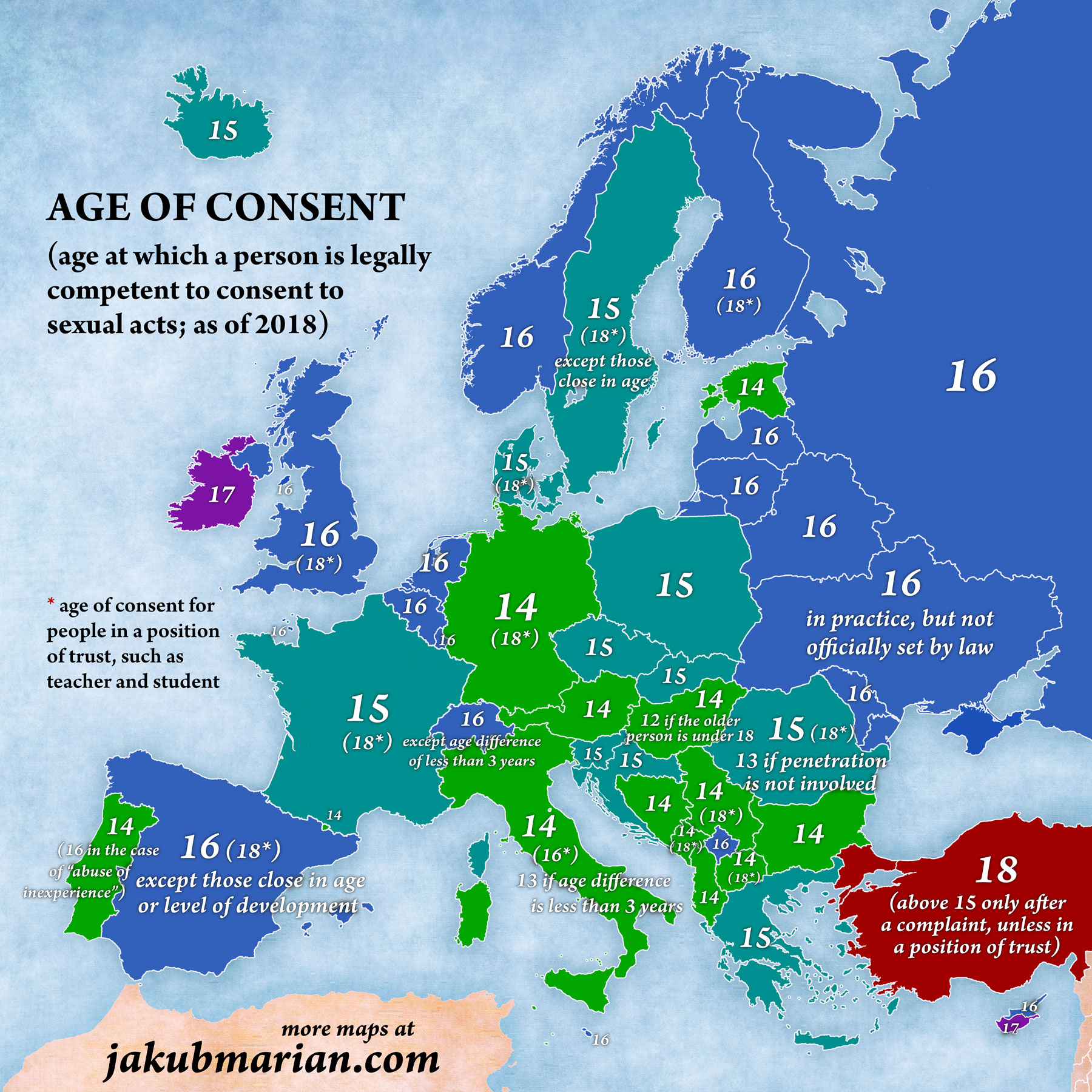

But this is nothing to cheer about.
Regardless of what low regard the man might be held as a person, he's being persecuted for having expressing ideas, demanding proof of claims, advocating for objective standards, and asking questions. These are all hallmarks of scientific inquiry.
It sets a precedent that will absolutely lead to self-censorship on a topic that really requires the disinfecting power of sunshine.
This strengthens the power of those who have no use for scientific inquiry and are more interested in inquisition.