If you recall Boyle's Law from high school physics - Temperature is proportional to pressure. Aircraft wings generate an intense area of low pressure over the top of the wing (which is what essentially generates the lift). This low pressure area is magnified when flaps and slats are deployed.
On a humid day, the lowering of the pressure over the wings can basically force the air temperature at that point to lower and reach dew point temperature, essentially forming temporary clouds that are whipped around by the moving air vortices.
Once the aircraft has passed that point, the temperature generally stabilises and conforms to surrounding air temperature, which usually dissipates the temporary condensation.
The 'twirly' bits on the wingtips is basically spillover from the high pressure under the wings to the low pressure above the wings, creating that mini tornado vortex. This is also the reason that many modern aircraft have those 'winglets' on the wingtips, to try and minimise these spillover vortices which can cause problems for trailing aircraft, as well as induce extra drag on the source aircraft.
Every once in a while I have to re-realize how amazing this phenomenon is. The only thing in nature that flies are birds which weigh a few ounces. Nothing human-scale flies. Cars don't fly. Yet, the flying machines we decide to build weigh a million pounds and fly simply by going fast until the air lifts them up. That is some ludicrous black magic.
A lightweight paragliding set can be as light as 3 kg these days, and experienced pilots can travel 200+ kilometers regularly with a tiny bit heavier set (say 8 kg).
Paragliding requires ascending currents to maintain or gain altitude, IOW you're always going downwards relative to the surrounding air mass. Birds don't (although they obviously do know how to use it for the cheap).
I think maybe the GP is more amazed about the (self-) generated lift and assorted scale. Seems like humans have a thing for hurling self-propelled heavy metal boxes at ridiculous speeds, whether on ground, in the air, or in a vacuum.
Close, but slightly backward. The saturation temperature (dewpoint) is lower at lower pressures. So the lower pressure air reduces the saturation point. The air is not being cooled by the wings. If the sat. point is close to the current air temperature, water vapor will condense.
Similar phenomenon to boiling water at high elevations. Walking up the mountain isn't heating the water, but the boiling point drops as air pressure drops.
Wings generate lift primarily by deflecting air downward. There is an area of low pressure over the wing where air is taking a longer path than under the wing, but that is only responsible for a small fraction of the lift.
That's a meaningless correction, and technically not correct. Aircraft are lifted up by air molecules hitting the underside of the rigid body with more force than the top side, by definition. The net integrated instantaneous pressure at the surface of the aircraft IS the lift.
The fact that air gets deflected downward is a necessary (c.f. conservation of momentum) effect too. So it's not incorrect to do the analysis that way. But it's absolutely wrong to correct someone saying that "lift is pressure" with "lift is actually deflected air".
Air does not behave like a bunch of bullets hitting a wing. It's a fluid with velocity and pressure everywhere, not simply in the vicinity of aircraft surfaces. A wing is a pump that sets up circulation in the airflow, upward of the leading edge and downward off the trailing edge. The downward momentum of the air flowing off the trailing edge produces an equal and opposite reaction by Newton's third law which is the lift.
This is clearly demonstrated by this incident. Many tons of air deflected downwards by the A380's wings had enough force to flip the unfortunate plane below several times.
> Air does not behave like a bunch of bullets hitting a wing
Yes it does. And those bullet impacts are the very definition of pressure.
The aerodynamics snobbery that you're trying to invoke is that those bullets also hit each other, so you can't make ideal gas assumptions and must model the whole system as a giant system of differential equations (c.f Bernoulli) if you want numbers out.
That doesn't change the fact that air pressure at the surface of the body is what causes the force on the body. That busybodies feel the need to argue against this bleedingly obvious point says some very bad things about the way the aviation community has tried to teach aerodynamics.
Yeah, that site is indeed one of the worst offenders. Try a fluid dynamics textbook. I genuinely don't think you understand what I'm saying. Air isn't magic fairy dust that pushes on airfoils from a distance. Pressure is impact.
If you hit a slice shot in tennis, the ball will travel considerably further because the backspin produces circulation which generates lift. If air was a bunch of bullets, the effect wouldn't happen at all. If you raise a spoiler on a Grob's wing, its lift-producing capabilities drop considerably because the spoiler interferes with the circulation. If air was a bunch of bullets, a spoiler wouldn't do anything.
> Air isn't magic fairy dust that pushes on airfoils from a distance.
No. Like I said, it's a fluid that has pressure and velocity everywhere. At low enough Reynolds numbers, like for model gliders, you can even get away with treating it as a non-compressible fluid with decent results.
> Pressure is impact.
And contact between two objects is really about Pauli exclusion surfaces at the atomic level. So what?
No, the effect is negligible if it wasn't planes wouldn't be able to fly upside down. It's the pitch of the wing that generates most of the lift. That's why helicopters don't alter the rotor RPM they adjust the pitch of the blades to take a larger bite.
The poster wasn't talking about the 'curved upper surface' myth. You can understand the lift to be a consequence of the pressure differential, and that is not inconsistent with planes flying upside down.
And the pitch of the wing causes one side of the wing to be hit harder by air molecules than the other, just like GP said. Maybe you hit reply on the wrong post?
The 'air molecules impinging on the airfoil' theory of lift is not wrong, but does not account for a large fraction of the lift generated either. In a dense enough medium such as air at normal flight altitudes, you have to take into account how those air molecules interact with other air molecules and not only the airfoil. Sum up all those interactions, and you get fluid dynamics rather than a molecule hitting a surface in vacuum.
Better for what? Fluid dynamics is actually great for a huge number of stations. For pure realism you can use Quantum Mechanics, but good luck simulating that for a protean let alone a 747.
My point was you can still find a lot real world issues for example wing icing. So, that you need to be aware of what you are and are not simulating.
No, the correction is valid. The main component of lift is an upwards reactive force produced by pushing a mass of fluid downwards, in accordance with Newton's third law.
That is the only component of lift --- unless you think that Newtin's laws can be violated on a macro scale. But owing to the way that pressure is defined, the same phenomenon can also he understood in terms of a pressure differential.
this is just an argument in whether you want to explain the phenomenon mechanically or in terms of thermodynamics.
pushing a mass of fluid downward is equivalent to creating a net downward pressure. its the same thing, just expressed in different terms. the unit of pressure is force per square inch, for you americans. by integrating over all the area, you get the force that you are talking about.
The Coanda [or "coma daily" as my iPad helpfully autocorrects] Effect also contributes to lift.
The air "sticks" to the surface of the wing and leaves the trailing edge in a partially downward direction i.e the air is deflected downward by the top of the wing not just the bottom.
For a quick demo of this, hold the bowl of a spoon
under a running faucet and see how it pulls the spoon into the stream.
>There is an area of low pressure over the wing where air is taking a longer path than under the wing, but that is only responsible for a small fraction of the lift.
The "equal transit time" theory that you appear to be referencing here (air over the top takes a longer path, thus it must go faster and air under the bottom takes a shorter path thus it goes slower) is a complete fallacy. There is no mechanism in physics that requires the air to "meet up" at the trailing edge of the wing.
Thanks for this. I read a million explanations of how airfoils worked as a boy and they all said the air had to travel faster over the top surface to catch up. Why does it have to catch up? I would scream internally. I'm stunned to find it was never true.
Probably like the Bohr model in Chemistry, it's an easy way to introduce the concept. Frankly I was under the impression it was true, too, and my dad was a small-plane pilot.
The Bohr model at least has simplicity going for it, and it's close enough to explain most things that are relevant to chemistry.
For aircraft lift, "equal transit time" is not easier to understand than "an angled wing pushes air down, because of conservation of momentum that pushes the aircraft up".
"Longer path" has no bearing on reality. A flat plate can generate plenty of lift even with both sides the same. It's also hard to define "path," as the air starts convecting well ahead of the wing in subsonic flow.
While you're on point about flat wings, in wind tunnel tests on profiled wings, you do in fact see a velocity difference between top flowing and bottom flowing streams. It's not enough of a difference, however, to cause coincident streams on the leading edge to line back up at the trailing edge.
Sorry, but I don't subscribe to the 'flat plate' theory. There is a reason that almost every commercial (and most military) aircraft have leading edge slats to generate lift at lower speeds (by making the top of the wing more convex and the bottom of the wing more concave).
If pure 'flat plate' theory was valid, then all those aircraft speeding down the runway with the leading edge of their wings canted downwards 20 or so degrees would result in the airplanes simply being pushed towards the ground and never lifting off...
And Boeing, Airbus et al would build planes with flat slab wings mounted at a 45 degree angle to the airflow, because that would give the maximum lift by the 'flat plate' theory, wouldn't it?
Not that I disbelieve that a flat slab cannot generate lift - but that it is probably a very inefficient way to generate lift compared to the standard aerofoil shape.
And as I have mentioned elsewhere on here - I have flown inverted a few times, and to do so take a tremendous amount of forward pressure on the control stick to even try and attempt to hold altitude while inverted, in order to counteract the wings natural (slight) positive AoA and the tendency for the wing to move towards it upper surface. In fact, most of the aircraft I have flown would not be able to sustain inverted flight at all. The fact that full aerobatic and military jets do, is because they (as I explained earlier) usually don't have that curved 'fish' shape cross section, but are usually symmetrically shaped on the top and bottom of the wing.
To whit, I've had the fortune to fly an old DH Tiger Moth biplane - on that little baby, when you approach the stalling point, you can actually see the the canvas on top of the bottom wing bulge and contort with pressure differential, and you can hear the sucking sounds as the airflow struggles to 'stick' to the wing. There is a little movement on the bottom surface of the top wing too, but not as pronounced.
I'd be interested to see in this thread, who here has actually studied aeronautical engineering, or flown actual aircraft, and who is relying on YT videos or a pure theoretical approach to come up with these theories?
Also interestingly, I believe most of the textbooks I used at flight school were filled with data from NASA and other US military branches with regards to flight dynamics etc., and here on this thread we see articles from NASA (albeit aimed at K-12 audience rather than trainee pilots) basically disproving their earlier academic research.
> I'd be interested to see in this thread, who here has actually studied aeronautical engineering
I studied Aerospace Engineering (PhD in Aerodynamics), and I stay out of internet conversations over "how" lift is generated. For me it is one of those topics that is just not worth debating. It seems that people get _really_ attached to their personally preferred theory of lift.
Seconded. Masters in ASE, written my own vortex lattice code from scratch.
"Wings generate lift by changing the velocity of the flow around them" seems general and correct but the why part is pretty tricky without notions of continuity and conservation laws. And vorticity helps a lot, too.
You should write a blog entry on current theory, and post "I'm an expert, here are the current theory(ies), I will not debate about it", or point to a wikipedia page that is accurate in your opinion.
Flight is a complex system, there are multiple variables effecting it. And yet half the responses here are regurgitated from grade school without references.
Its a somewhat common joke in our office that if you ask 3 researchers "What is lift?" you'll get 5 answers (and probably a bit of an argument).
I think "It's complicated" and "Why do you need to know?" are often the only appropriate answers, as context is important. I've read some "aerodynamics for pilots" type books that from a research point of view I considered to be, to some degree, wrong. But ultimately they were _right_ in that they taught the pilot exactly what they needed to know.
In a way it reminds me of electricity. I know enough to design and make simple circuitry, but I know electrical engineers and physicists that could run rings around me at both the circuit design level and the "That's not how electricity works, you idiot!" level.
> I have flown inverted a few times, and to do so take a tremendous amount of forward pressure on the control stick to even try and attempt to hold altitude while inverted, in order to counteract the wings natural (slight) positive AoA and the tendency for the wing to move towards it upper surface.
I don't think that is right. The tail wing has a different angle of attack than the main wing. On the order of one degree I think. This is so to give a self stabilizing effekt. When flying upside down you have to compensate heavily to avoid what would be a destabilizing effect.
The horizontal stabilizer of most aircraft has a negative angle of attack and produces downforce, not lift in straight and level flight. This allows the center of gravity to be forward of the wing's center of lift by moving the overall center of lift forward. The result is a tendency to pitch down if airspeed decreases without other control inputs, countering the reduced airspeed.
Flying inverted in a relatively stable aircraft requires a lot of forward pressure because for the inverted aircraft's wing to have a positive angle of attack, the horizontal stabilizer has an even larger positive angle of attack. The pilot must counter this with the elevator to establish a stable ratio of lift to downforce.
As an aside, modern aerobatic aircraft are often rigged 0,0,0 (wing incidence, tail incidence, dihedral), so level flight will need equal elevator deflection in the appropriate direction.
Less efficient - but makes for symmetrical performance.
> The fact that full aerobatic and military jets do, is because they usually don't have that curved 'fish' shape cross section, but are usually symmetrically shaped on the top and bottom of the wing.
Fair enough, it is symmetrical, but still has a lot of shape to it - only time I've been inverted was in a grob 103, and was a passenger for that part of the flight, here's the cross section of it's little sister which is also fully aerobatic:
Agreed, that's why I said it'd still work. But the shape does contribute to its efficiency, otherwise manufacturers wouldn't spend money trying out different shapes, adding winglet etc...
A bit late to reply, but I had to think of your post while spending some hours idly staring at at the top of an airliner wing today. Slats (and non-flat airfoils in general, I suspect) are there to allow a harder angle of attack ("amount of pointing up relative to the direction of movement") without stalling.
You can push the air hard on the underside, but on the top side, you have to gently accelerate the flow downwards, or else it forms vortices and you suddenly lose a significant fraction of the amount of air you would otherwise deflect downwards.
If I remember right the "longer path" thing was in Encarta, there was a guy that used Encarta to prove to me that the theory is right and I believed it m it made sense I am wrong and not the encyclopedia.
Additionally, the paths don't meet up/join at the trailing edge of the wing. There's no reason air above and below needs to separate and meet up into the same flow.
Well, the same Venturi principle applies if you look at it in terms of laminar airflow over the wing. The top of the wing (via curvature and downward deflection) is essentially creating a widening venturi tube, whereas the bottom of the wing is creating a closing venturi tube. (Oh, ok, it is planar rather than a tube, but the principle is essentially the same).
Hence the high pressure under the wing and the low pressure on top of the wing. The very act of 'deflecting' millions of cubic metres of airflow generates high/low pressure points. Hence at the end of the day, we could argue that the pressure differential is what is causing the lift?
Disclaimer: Not an aeronautical engineer, just a former commercial pilot.
Yes to pressure part and no to the venturi part. Well, it's not enough. You still have to generate a downdraft to conserve momentum and the venturi idea doesn't explain that.
Or we can just go to the demonstration that our flight instructor did in the first 5 minutes of our Aerodynamics 101 lectures.
Get a piece of A4 or Letter sized paper and try this experiment with it [0]. For best effect, hold both the edges closest to you in each hand and twist the front edge downwards to keep it straight and prevent the paper twisting which could inadvertently straighten it. (i.e. Not with one hand like he is doing in the video).
The Bernoulli principle with postulates the Venturi effect is about the only theory that can explain why the trailing edge of the paper moves UPWARDS when you blow across the top of the curved paper.
Sure but now try the same thing with a piece of metal.
No one questions whether the Bernoulli and Venturi effects actually exist. But airplanes are heavy and it's pretty obvious that the Bernoulli effect does not produce sufficient lift by itself.
As proof that most of the lift comes from deflecting air, I offer the fact that airplanes can fly upside down.
Haha this is a fantastic answer. Also, not most of the effect, all of the effect.
Do the same experiment with the paper, but rest the trailing edge on a table. The air can no longer be deflected downwards, so the paper will not rise.
Another one to think about, at the air metal boundary the air is stationary on both sides of the wing. So why is there a pressure difference? Bernoulli's law is valid only along flow lines and is a consequence pressure difference required to accelerate (or decelerate) a fluid. Since in the laminar situation flow does not occur from the top surface to the bottom (minus around the tips), direct application is nonsensical. If you integrated all flow lines from all surfaces however, you would get the correct answer.
Well, I just instantly disproved your hypothesis by holding a piece of paper against the front edge of my desk with it curving up and the trailing edge resting on the flat of the desk, then leant down and blew over the top of it... and the paper lifted at the back. QED.
Not sure why people are looking at the situation as ONE Venturi plane. What I am trying to explain is that there is effectively TWO - and expanding one over the top of the wing leading to a low pressure effect, and a constricting one below the wing leading to a high pressure situation. I wouldn't say that both provide equal amounts of lift, but the paper experiment, and the 747 in the boneyard proves it to a point.
Well, scale up the wind according to the weight of the metal (and the overall surface area of the metal) and it can happen, as evidenced by this 747 in a boneyard 'rotating' under heavy gusty winds [0] (taking into account the massive weight and CoG difference without the engines on).
Extend the flaps and slats on that aircraft and I am sure the effect will be all the more pronounced.
And yes I've flown aircraft inverted too - it take a tremendous amount of forward stick to try and maintain level flight in that config to counteract the wings natural tendency to move towards the top surface.
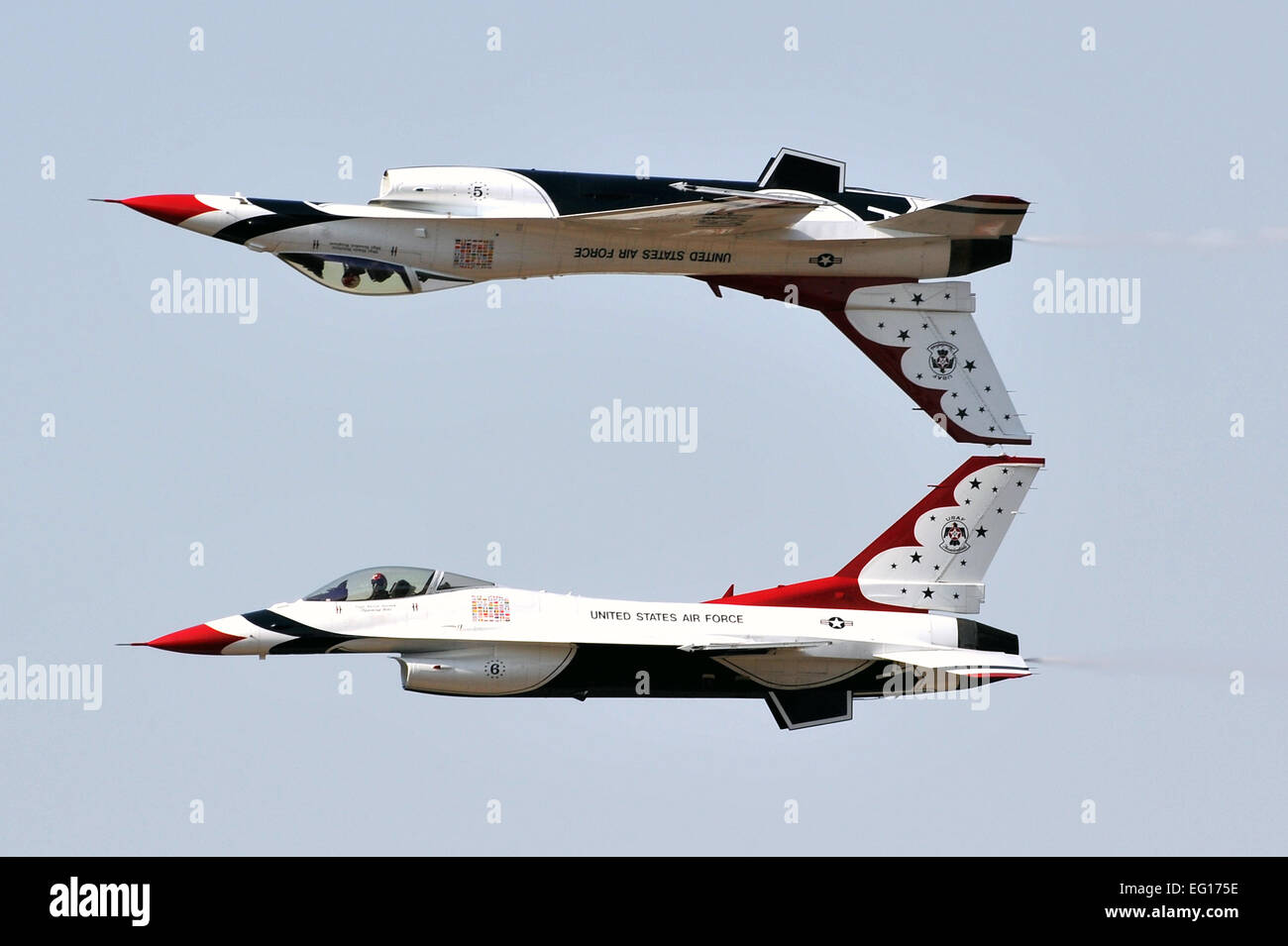
People have pointed out the "Thunderbirds" F-16s flying in the "mirror" formation [1] and not displaying much difference in AoA between the upright and inverted aircraft, but supersonic fighter usually have a straighter, almost trapezoidal shaped wing cross section rather than a curved 'fish' shape. I am willing to bet the inverted pilot has a fair bit of forward stick on though.
BTW the low pressure generating the lift thing is a myth. The lift is caused by the fact that the air is being deflected downward and good ol' Newton's Third Law.
The common explanation of lift for laypersons contains a number of non-sequiturs and even falsehoods, but this is not one of them. Newton's laws applied to the situation play out in complicated fluid dynamics, and result in a pressure difference over the wing, with a reduction above. That difference, summed over the wing, is the lift (and also the source of the induced drag, I believe, but that is a step beyond.)
Fun fact: One of the weirdest things about heavier-than-air flight is that upon posting any explanation for it online, several people will tell you you're wrong. Each of them will also disagree with one another. All will have sources.
Yes, but by making the air move you introduce a low pressure where it moved from, and a high pressure where it moved to. They are interconnected, just like how you can determine speeds through conservation of momentum or conservation of energy.
There are myths related to low pressure (such as the infamous "equal transit time" theory), but low pressure generating lift is not one of them.
The pressure explanations and the Newton's Third Law explanations are not different theories of lift. They are just different ways of looking at the same thing underlying thing.
The motion of a wing through a fluid has to conserve mass, energy, and momentum. If you analyze lift by focusing on conservation of momentum, you get the Newton's Third viewpoint. If you analyze by focusing on conservation of energy, you get a pressure viewpoint.
It's just another way of framing the same phenomenon (albeit one that makes much more sense to me than high school fluid dynamics). What gets left out of the pressure explanation is what pressure is, which is a statistical representation of Newton's third law applied over huge numbers of tiny things moving in random directions in a given frame of reference
The NASA article discusses a deliberately simplistic model that does not consider the deflection of airflow over the top of the wing, but it would be easy to overlook the caveat if you don't already know the answer. Further down the page there is a link to a correct Newtonian flow-turning model.
You're both right. When Newton's third law is applied to a wing, the equal and opposite forces are pressure. No one tends to think about the pressure of the wing on the air, but it happens.
The Bernoulli equation is a valid description of what happens to the airflow pressure and velocity around a wing (at least at speeds well below sonic), but the problem is that it is not much of an explanation - it leaves you with something else to explain, namely the change in velocities. Attempts to do so without invoking calculus have resulted in the propagation of fallacies, such as the 'equal transit time' one mentioned above by tzs.
The "Newton's 3rd. law" explanation treats the wing and its immediate surrounding as a black box: air flows in, and exits deflected downwards, so there has been some downwards-directed acceleration. It does not address details of that process, such as why the above-wing airflow usually generates the larger part of the lift, or even how the deflection occurs, though it is fairly obvious that some sort of deflection will result from driving an inclined plane through the air.
To add to jacquesm's response, the footage in [2] is definitely from a humid day. That makes condensation happen very readily.
If I remember correctly, the trails from the outboard edges of the flaps are just like wingtip vortices. The airfoil's geometry suddenly changes, acting like a wingtip and creating a vortex.