Cue the libertarian versus non-libertarian mudwrestling.
It has become increasingly clear to me that the ills of the U.S. pogroms against some recreational drugs are due in no small part to the conversion of the criminal justice system to a for-profit industry. As long as the jobs and budgets are tied to the number of criminals processed rather than the peace and order produced, cop cadres will titrate the frequency and severity of their enforcement actions with the aim to ensure for themselves steady jobs and pensions.
There is a positive feedback loop in there somewhere that must be broken before it destroys the concept of justice completely.
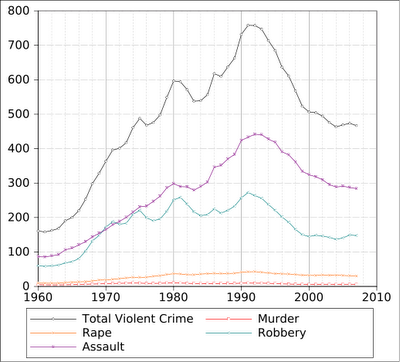
Violent crime increases almost 5x from the mid 1960's to the early 1990's. The number of state and federal prisoners consequently increases 5x during that period. That's not the result of "for-profit justice." That's the result of people supporting aggressive enforcement and incarceration in response to skyrocketing violent crime.
The real problem is: what happens after 1995? Violent crime drops by over a third. Yet, prison population continues to grow until it plateaus in the mid-2000's. That's where jobs and budgets come in. They make it difficult to dismantle the whole apparatus, and indeed, to really convey to the public that crime has in fact dramatically decreased.
That said, I think the solution to this is time. U.S. prison population has been trending down for the last several years. The baby boomer generation's attitudes towards crime were forged during the 1970's and 1980's as crime skyrocketed, but that attitude will start to die out as the boomers do.
The strongest-correlated single factor to violent crime is, in fact, lead pollution. When lead antiknock compounds were abolished in gasoline, and lead pigments abolished in paint, lead pollution peaked and began a long, steady decline. Violent crime followed. The prisoner incarceration rate has stayed high, despite the decline in violence, because of the money interests.
For-profit prisons are the ratchets that prevent the wheels of justice from turning backward. Sweden consolidates prisons and mothballs the emptied ones. America tricks the ignorant into fencing stolen bicycles and selling weed to informants.
Remove the profit, and you also remove the paradoxical idiotic behavior that generates it.
My outsider's perspective would first segregate all revenues from fines and forfeitures from justice budgets, perhaps exclusively dedicating them to public education and pollution abatement and cleanup. Then I'd abolish incarceration in any facility that was not entirely publicly owned and state-operated. I'd also abolish plea bargaining, as it seems a perversion of due process. After that, I'm not sure what else might help; keep following the money and pushing the Nash equilibrium toward "everyone respect the law and each other".
I've thought about a way to have a for-profit prison system that would work better. First, give the convict the right to choose which prison to go to (possibly with a particular security category). Then they (the prisons) would have to compete based on how the prisoners are treated. Now, after the prisoner is released, if he reoffends, then the prison that he "attended" would have to foot the bill for the additional incarceration (potentially at a competing prison, if the convict so chooses).
This should cause the prisons to achieve (via market forces) an optimal balance between humane treatment, and proper rehabilitation.
Interesting idea. Many crimes are committed due to a lack of options caused by poverty (theft most directly, but many other crimes are correlated strongly with poverty levels), so if a prison has to pay if a released prisoner re-offends, perhaps it's in the best interest of the prison to pay directly to the ex-prisoner, to get them on their feet. Give them a place to live, food budget, whatever. Probably still cheaper than incarceration.
Yeah, some kind of outcomes-based incentives for the prisons seems like a good idea -- it would have to be fairly small, though, to avoid gaming. See that case this past year where a judge (in PA, I think?) had a corrupt relationship with a private prison and sent thousands of people there for minor offenses.
I'd love to see "Private Prison" phased out in favor of "Rehabilitation Contractor." But it would require legislation be crafted in favor of extremely careful balancing of incentives, in the teeth of pressure from the powerful private prison lobby to turn the whole thing into either a NOOP or a private prison subsidy.
Not just "people," that corrupt POS judge sent 4000 juevniles as young as eleven to be abused at a "for profit" detention center while he accepted cash for every child he sent there.
That's interesting. Is your issue with the for-profit criminal justice system that it's for-profit, or is it with the laws it upholds to bring the profits? In other words, would this still be a problem if all laws upheld were, to your mind, reasonable?
Not the OP, but I'll take a crack at it. The problem is that creating order (or, more generally speaking, rehabilitating unorderly parts of society) and making money can sometimes be adversarial processes, thus creating a conflict of interest.
Since it has become profitable (for private jails/prisons) to put people in jail and keep them in jail, there is a clear incentive to punish lesser crimes more severely and to not rehabilitate jailed people fully with hopes of them becoming a repeat offender.
Therefore, the problem is that privatization of the criminal justice system is at odds with what a criminal justice system should hope achieve: order, appropriate punishment, and rehabilitation of those who break the law. In fact, I would argue that it incentivizes almost the exact opposite.
I don't think the laws can be meaningfully separated from the system. Reasonable laws would simply be enforced unreasonably. It certainly doesn't help that unreasonable laws exist, but fixing that would not entirely solve the problem.
watch http://www.thehouseilivein.org/ it is really worth your while. the best film on the war on drugs and the "prison-industrial complex" :-) i have seen so far. big thumbs up.
available on itunes and amazon instant, "free" streaming versions can be found with a simple google search.


It has become increasingly clear to me that the ills of the U.S. pogroms against some recreational drugs are due in no small part to the conversion of the criminal justice system to a for-profit industry. As long as the jobs and budgets are tied to the number of criminals processed rather than the peace and order produced, cop cadres will titrate the frequency and severity of their enforcement actions with the aim to ensure for themselves steady jobs and pensions.
There is a positive feedback loop in there somewhere that must be broken before it destroys the concept of justice completely.