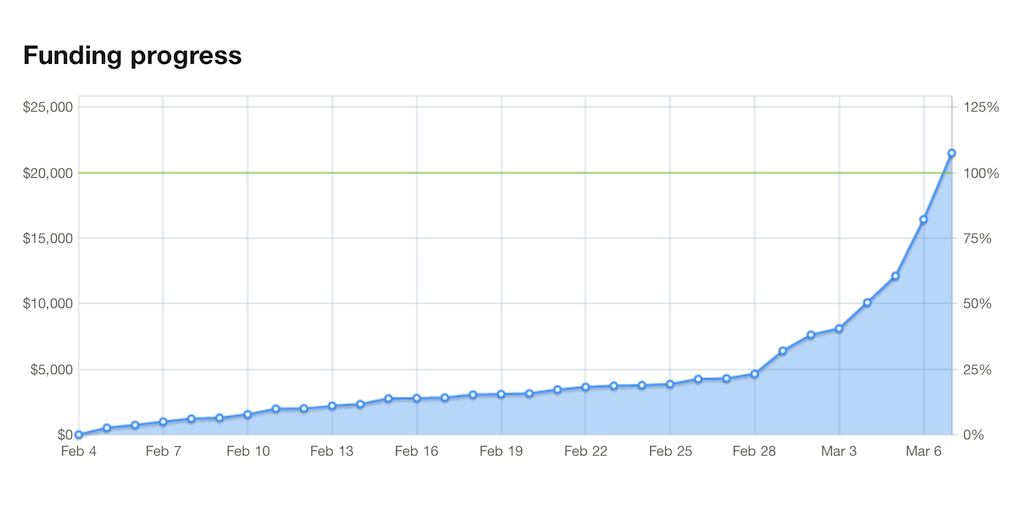
This doesn't take into account the typical shape of crowdfunding curves, which are almost always steep at the beginning and even steeper at the end, and relatively flat in the middle. This is very well documented by a bajillion kickstarter campaigns. Here's a typical curve: http://www.sneakattackpress.com/images/KickBrokenProgress.jp...
Basically, these things always spike at the end (if they have any traction), and I'd be willing to bet all the money in my bank account that this will spike at the end. The only real question is whether that spike will get them to their goal.
I would assume the steep end of the typical Kickstarter curve occurs because projects start to approach their funding goals, drawing in a lot of new backers because they believe the project will actually get off the ground. If the Ubuntu Edge fundraising already stalls $20M before they reach their funding goal, I yet have to see if they are able to create a spike in their backing just before their deadline...
I think the problem is that the Edge campaign flattened out so early. The link you provided seems to go flat at about the 50% funding mark. The Edge (appears to have) stalled at 20%. Unless it's just a transient bump, that seems far too soon.
I have no idea if it'll hit the mark, I just think the analysis doesn't hold water because it doesn't acknowledge the real dynamics of these types of campaigns.
This campaign could go so many different ways. The safest bet is that it won't succeed, simply because it is so groundbreakingly large. However, how many times have crowdfunding campaigns surprised you with their level of success? For me, the answer to that question is "tons of times". So I'm not taking a guess on whether it'll succeed. I'm just saying, "Good luck!".
That flat line is a lot closer to 100% than they are though, I wonder whether flatlining around 20% and then funding would be precedented, I suspect not.
I didn't back them for two reasons. The first is that the hardware will be late. Not their fault, but rather that hardware is always late. The hardware shouldn't be compared against what is on the market now, and not even on the purported release date, but rather a few months after that. I suspect it won't be that extraordinary.
The second is that Ubuntu have deliberately alienated me as a user. They are under no obligation to do any different - actions they have taken have been a different direction than suits me. The phone is ultimately not for a free(dom) software community, Linux community or collaborated UI community device - it is a Canonical/Ubuntu (Unity) one. In the AMA "So in this first generation Edge, no, we didn't look for open hardware specifically"
Examples of where they have gone different directions: keeping upstart versus systemd, not trying to play nice with Gnome 3, CLA, Amazon on by default, bzr, launchpad, a general preference towards writing new code versus fixing the many issues languishing in the bug tracker etc. They did do good stuff with trying to make a community, fresh software packages, PPAs etc.
If Fedora, Arch, Gentoo, SuSe, Mandrake etc users had a reason to buy the phone I'd bet it would be a lot more successful.
What I'd like to see is a very basic cheap open mobile device.
It might even have to shun making calls because of the proprietary hardware/software stack. Is it possible to make an open/free mobile phone right now?
Alternatively you could use wifi, wireless and peer to peer. A very cheap instant grid/alt internet would be nice.
Interesting the way that Google have opted for their HDMI dongles. I'm surprised we haven't seen a similar offering from the Ubuntu camp. Do we really need the display?
> What I'd like to see is a very basic cheap open mobile device
Raspberry Pi and a battery?
> It might even have to shun making calls because of the proprietary hardware/software stack.
The cellular side can be on a separate baseband processor that talks to the outside world using good old fashioned AT commands[1] pretending to be a serial device. At that point you don't care how proprietary it is since any kernel and userspace can work with it. The current proprietary problem area is graphics (binary blobs abound) and often some other pieces (eg bluetooth, system initialization and bootloaders)
OpenMoko[2] did do open phones, although IIRC there was one proprietary piece.
I'm not exactly having high hopes of edge getting the money but I seriously doubt the value of simple regression model on predicting if it's failure or success.
Previous projects had a peak at the start and the end - more like an inverted-U of activity. That all said, although the regression is probably not useful, the graph definitely helps indicate how much work is ahead of them. They've done a huge amount already (I believe they've broken some records already?) and to be so far off just indicates how crazy the target was. They're probably going to raise more than any other crowd-funded project, but it's a ways a way off.
Anyone bookmaking? My money's on $15 million (linear + mirror flip at the end).
The key thing here is that phone-like devices replacing desktops is inevitable. It's straightforward historically-supported Christensen + Moore. Phones are already powerful enough for almost all desktop purposes, just connect keyboard/mouse/monitor.
The question is, who will "lead" this revolution? Maybe Canonical.
You forget about the cloud thing. Your phone can be used as an authenticator (partly not all) and if your data is in the cloud then whatever is sitting there will work just fine. What is it about the hardware you are carrying that requires it to be used as the desktop computer?
Also, surely the point of this is to develop a sustainable model, as they said they want to repeat it each year. So if there is no demand, then it should be abandoned, or rethought.
I'm led to understand the majority of money tends to come at the start and end of fundraising efforts for these things. Though I can't recall where I heard it. Chris Taylor talking about the funraising effort for GPG I think -
Would it not be greatly dependant on how far the project gets in that initial funding. The projects that overshoot in the final days are generally ones that are 60-80% funded.
Yes - things that are U shaped would depend heavily on how great the initial and final funding is. In terms of $/t, rather than donations/t, it'd look more like - well assuming you got all your money on the first and last day you'd have two sheer cliffs with a perfectly flat plateau between them. But in reality it's likely to be somewhat smoother than that and the plateau is unlikely to the perfectly flat.
Assuming that the linear model holds until the last few days and then you get an upturn equal to the initial contributions, then you'd be looking at something like $22-23 million. Well, I'm just measuring it on my screen with my hands to get that, but that'd be my prediction based on what little I know of these sorts of fundraising thingies, assuming it behaves in the same manner as they did. ^^;
They need to do more international media events, interviews, articles - highlight the fact that you can reserve your very own "Formula 1" phone, plenty of non-techies will be interested by that, specifically the market with the most money who are likely to want the latest, unique, luxury item. If they were doing a TV interview on, say, Bloomberg Business about the uniquely absurd crowdfunding model and bespoke high-end possibility they would likely see another spike in sales.
I think it would've been successful at $600, for whatever storage they wanted to give at that price. But they're being very stubborn about it having 128 GB, no matter the cost (which is a quite high $830). And I think they've done a very poor job explaining why you need to get a phone with 128 GB of storage, too. They need to really "sell" that feature, so people think the price for the phone is worth it.
Personally, none of my friends or family, have ever bought a phone outright. We've always done some 'pay over x months' type of plan.
I'm particularly hesitant to pledge a large sum (and yes, for some of us $775 is a "large sum" to drop at once) to a Kickstarter, even a Canonical Kickstarter. But, I understand and believe in the idea.
I'd be much more willing to kick in a sum in the range of $20-80, to get a reward of my name on the founder's page and a discount of the same amount once the hardware is sold to the public.
This means I can actually afford to make a contribution that is reasonable for my budget, and that if the hardware doesn't see the light of day the I'm only out a month's cell phone payment. More importantly, if there are others out there like me, it means that Canonical's Kickstarter would be getting a little bit more of a financial boost, and people like me would be buzzing about it a lot more.
A $775 phone is so 2012. This year, the big innovation will be Motorola selling a not-bleeding-edge phone that runs Android just fine for a cheap price, as many other 2nd tier OEMs are already doing for the prepaid market.
That's really too early to reach such a conclusion. It just got under the median line, well, it's a median line.
And the graphic should show major marketing events and press article to be relevant : we may just be at the farest point from last event, and one new may happen soon to boost donations again.
Given that the rate of funding is well observed to decrease over time, hitting the median line this early on (and especially at such an angle as it has) is a disaster for the prospects of hitting the target.
Do you think that with new marketing, they can reach lots of potential backers who haven't already been reached? Bear in mind that the target market is highly geeky and highly connected. And so are likely to have seen the articles on HN and reddit already.
From TFA:
> The model used was a rather naive linear model: y \sim \beta_0 + \beta_1 x ^{1/2} + \beta_2 x^{1/3}
That is not a linear model. Also, note the dent at ~July 21, when it became possible again to buy phones in advance after the first "batch" had sold out.
What I want to know is how much Canonical is kicking in. I mean, this isn't an indie game, this is a company that while different compared to say Apple or someone in that they deal with FOSS, they DO make money.
They haven't mentioned it, but I hope they're not just relying on the Indiegogo to pay for it all, considering they stand to gain a Lot from it going forward.
Of course, they probably are. I'm guessing it takes more than 32mil to make a new phone and OS.
I surmised something similar on day 1, i.e. the interested audience will mostly be highly internet-connected early-adopter geeks. They will have heard about it very quickly, so it's not going to "go viral" and reach a much wider audience later on in the campaign.
The enthusiastic early adopters are more likely to pledge in the first few days and so a steeper than usual drop-off is likely. It's also a very ambitious target amount.
This is senior high school analytics and stating failure as a certainty with this simple model is over-reaching, not to mention, Mark Shuttleworth's money.
I've always assumed that perks overload the viewer from a usability perspective. If your goal is to sell bleeding edge phones and you hide that ability with a load of miscellaneous merchandise, then you might end up losing those high value purchases.
You're completely right - to me the phone is worth $600-650 because that's what I could have bought it for early on.
There's no way they'll get me to shell out +$200 now. The reward system feels like penalising those who back late, rather than rewarding those who back early.