Turns out people just wanted a more refined iPhone with 4G.
Who would have thought?
Seriously though, I remember naysayers about the iPod back when it was first released, bemoaning the interface, design, and pointing out dozens of other mp3 players with longer feature lists at better prices. Yet the iPod still won out because it offered a consistent and predictable user experience, from the purchase to the day-to-day use—looking at the quality of experience holistically and end-to-end, including fashion, features, and fun.
You could pick up any iPod and know how to use it, and that trend continued throughout new releases and new iPods for years on end, with the only major interface change being the shift to touch, which was (arguably) even easier to use.
The tech crowd tends to look at devices as bricks with feature lists attached to them, but consumers don't. And consumers are the ones who buy things and use them, not just us. The iPhone 5 is exactly what people want with just enough "new" to make them want it. It will be moderately successful for a refresh, and most importantly, people will continue to enjoy using their phones and will continue to want to upgrade in the future. Apple nailed it.
> The tech crowd tends to look at devices as bricks with feature lists attached to them, but consumers don't.
That's one unusual conclusion. One could argue that the main difference is that the tech crowd knows what they're buying better than average misinformed consumers.
We have a saying where I live. Billions of flies eat shit every day, but that doesn't mean so should we. Apple certainly doesn't sell shit, their products are great for sure. But there are also a lot of valid criticism to be made. And breaking record sales doesn't mean, in any way, the criticism is any less valid. You're confusing two very different things.
I understand here at HN people can get very personally offended if I even hint that Apple's sales success might not be exclusively a result of technical engineering or design innovation. But doing so would be unfair to Apple's sales and marketing team. Who are genius at what they do, and deserve a lot of recognition for their important role in driving sales.
> That's one unusual conclusion. One could argue that the main difference is that the tech crowd knows what they're buying better than average misinformed consumers.
Or people just don't care about the "other stuff." Most people just want something that makes calls, sends text messages, surfs the web/facebook/twitter, and plays games. I see the latest Samsung commercial about the S3 and I really don't care that I can bump to share playlists (1. because I barely listen to music on my phone and 2. who actually makes playlists anymore?) or the list of 20 other features that I'll never use. I don't even care about 4G/LTS because 3G is fast enough and I'm not going to pay more for less data from the carriers.
I disagree that it's an unusual conclusion... it's been my general experience, which is why I brought it up. Tech-savvy people tend to undervalue user interface and holistic design quality and overvalue individual features and overall feature count, in particular features that they're specifically looking for often without fully realizing how that feature fits into the larger picture.
In other words, nerds tend to have tunnel-vision. This isn't surprising, they're usually specialists. I'm just sayin, it doesn't lead to accurate predictions of the larger market.
Furthermore, this fact is valuable in determining your own (perhaps nerdy, myopic, or short-sighted) biases in your own market or business strategy.
I agree that the criticism of the iPhone 5 was overblown, but I don't think these figures are a tremendous validation of the iPhone 5, either. The simple fact is that the vast majority of people are on two year cellphone plans, and it's been two years since the iPhone 4 came out. They took the upgrade in front of them.
The iPhone 5 was good enough that people didn't want to switch to Android, but that isn't the strongest compliment out there. IMO, Apple is simply benefitting from no-one else doing anything very interesting. I'd like to think that the Windows Phone devices from Nokia and HTC will change that, but at this point it may be too late.
Another user posted an article[1] where an analyst suggested 10 million, with a "worst-case scenario" of 6 million. Obviously, no-one has any idea what Apple's target/expectations were.
In any case, I didn't say that 5 million devices wasn't impressive. It is. But it isn't necessarily evidence that the iPhone 5 is earth-shatteringly great, it's just good enough for people to upgrade.
> A calculated decision to "stay on iOS" or "switch to android" is about the 6219th most important thing in most people's lives
So true. I'm a tech person, and even I get overwhelmed. I look to see what the "correct" new Android phone to get is, start looking at my daily-use apps to see if they're there and usually give up after a couple of hours of research. I'm sure one of these times it'll be there, but frankly it's easier just to support the retirement plans of all my friends and former coworkers now at Apple (so far as I can tell, none of my friends or former coworkers at Google directly make money if I buy an Android phone).
Just remember that not anyone buying is in USA and people in EU don't usually buy phones subsidized on a 2 years plan (that amounts to ~30% of sales, probably). I think, also, that iPhone 4 sold less than 5 million pieces in the first week. (disclaimer: I don't really understand of "upgrade eligibility" works for US carriers so I could be mistaken here).
Actually, people in the UK usually buy on 12-18-24 month contracts too, though I don't. The total saving that you get is relatively minimal (£40 across 2 years?), but you get shackled to the one provider. So I just buy the phone separately.
However, you're right that, e.g., in Switzerland, people don't tend to buy phones with contracts.
Isn't more a case of Apple is simply benefiting from no-one doing anything very interesting. There is nothing really interesting about the iPhone 5. It continues the grand tradition of being a little better than its predecessor, but not much else. It certainly isn't going to cause waves in the Android community, just as nothing going on in the Android community is going to hurt it.
There is nothing really interesting about the iPhone 5.
Compared to the feature churn over in the Android space, I'm not sure the iPhone has ever done any one thing that's particularly interesting. Never done a 3D screen, years behind the rest of the world to get 4G, hasn't done that stylus thing, behind the game on voice recognition, etc. Compared to Android, it would be fair to say that, considered all by themselves, iPhones are downright boring.
And I think that's maybe a big part of their success. (disclaimer: wild speculation ahead) For most people, the consumer electronics space is this big confusing morass of acronyms that nobody understands and subtle distinctions of feature set and whiz-bang gimmickery and just general confusion. It's a horrorshow combination of making people feel confused and inferior ('cuz they don't really understand all those acronyms) and the paradox of choice. And then someone in a blue shirt (polo, not tee) walks up, and it manages to go downhill from there.
Compared to that, Apple's a relief. You want a phone? OK. The new one, last year's model, or maybe the one from two years ago? Now you want a computer? OK. Laptop or desktop, and big or small? After that it's just a couple minor customization options, and you're done with choices. The whole experience is downright pedestiran - the products are pedestrian, the store is pedestrian. And that's perfect, because y'know what? For most people, a phone doesn't need to be interesting. It's an appliance. People may want their appliances to be pretty, but they also want them to be boring.
Well, the Nokia 920 is a genuinely better alternative: better screen, better camera, better OS. And, the HTC 8x is close. But, the awareness is not there.
Not trying to be a troll, but untill I can install OmniFocus, Instapaper, ReaddleDocs, Numbers and a few other key apps (that I use and depend on), I can't switch to any other platform. Even if they're 5 times better than iPhone.
Other people's mileage varies of course. Just wanted to remind you that app ecosystem is maybe more important than camera, wireless charging or bigger screen (or even Android "intents").
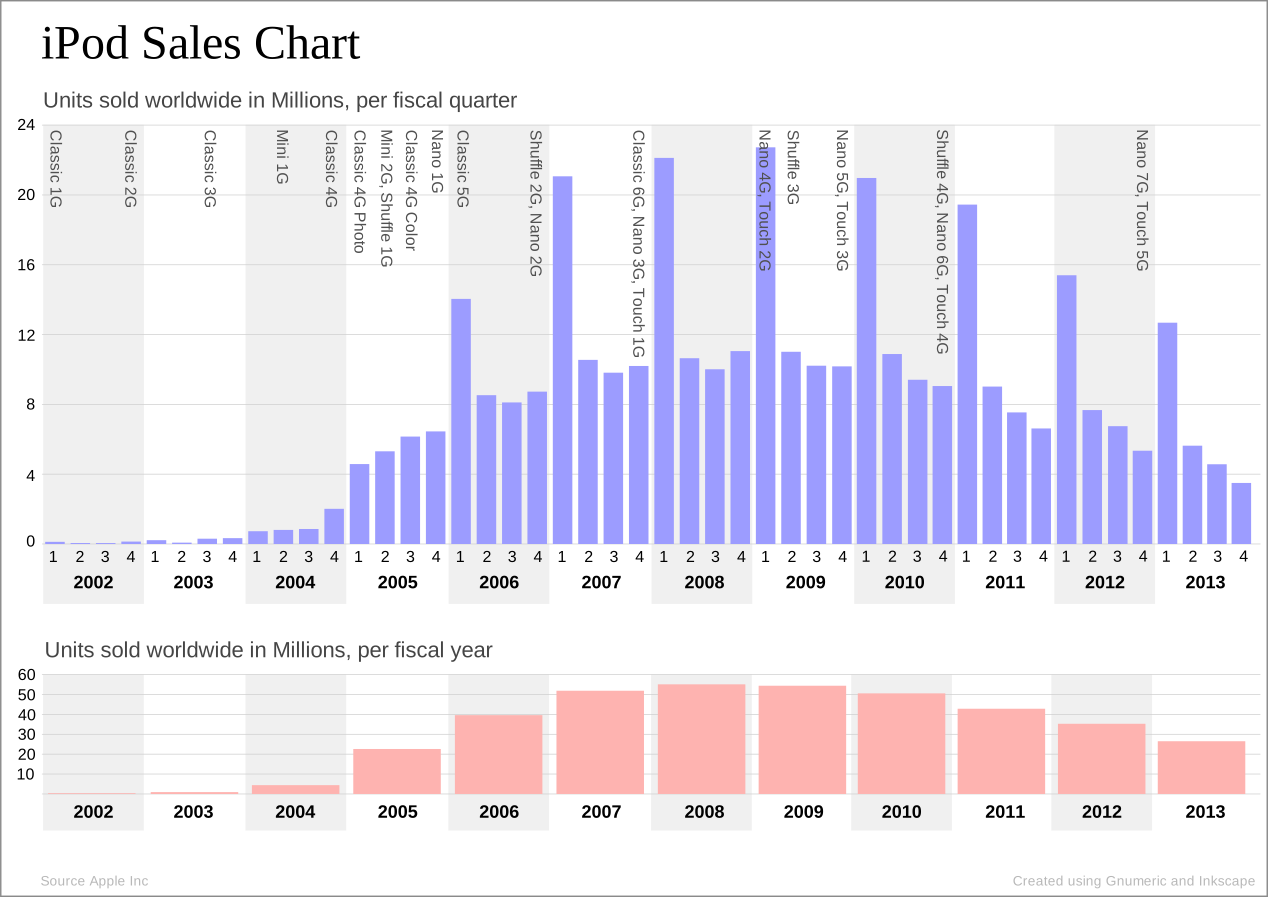
I think iTunes was probably the bigger motivator for customers purchasing iPods. Before iTunes, there weren't a lot of places to legally purchase digital music, and ripping CDs was kind of cumbersome.
I don't think you remember that time period very well. The iTunes store wasn't launched until over a year AFTER the iPod!
The original iPod, chunky by today's standards was by far the smallest and easiest to use mp3 player that could carry more than a few hundred MB of data. At the time there wasn't any Windows support but I think 3rd party software became available if you had Firewire on your PC.
From Wikipedia: iPod
"The iPod line was announced by Apple on October 23, 2001, and released on November 10, 2001."
From Wikipedia: iTunes Store
"It opened on April 28, 2003, as the iTunes Music Store"
AFAICT, people weren't talking about the success of the iPod until 2004, and a bunch of people showing sales figures and historical analysis concur with that: the iPod was even described as "a flop" until the calendar year following the release of the iTunes Music Store. Of course, that also might not be causative: it was only in 2003 that they caved on supporting USB, and in 2004 they came out with the mini.
They didn't sell many iPods before iTunes came out. I think it's true that what drove the large numbers of iPod sales was probably iTunes, and the ability to legally download mp3s.
As someone else mentions Windows support was a big factor.
Pricing also was an issue, they were very expensive.
Another factor is that the market was smaller, Apple dominated the market very quickly (at least if you count the market as large capacity devices until they had the shuffle).
They also didn't sell many iPods before they added full support for Windows and for USB. I suspect that was a bigger driver of initial iPod sales than the iTunes music store.
The iTunes Music Store was probably a big reason why people upgraded to new iPods, though.
But getting greater CPU power than, and equivalent GPU power to the iPad 3, into a tiny, smaller, lighter phone, is a pretty impressive feature. Because the CPU power isn't spread over 4 cores, it's easier to utilise than Tegra 3 phones. And... 2x in a year even beats Moore's Law.


Who would have thought?
Seriously though, I remember naysayers about the iPod back when it was first released, bemoaning the interface, design, and pointing out dozens of other mp3 players with longer feature lists at better prices. Yet the iPod still won out because it offered a consistent and predictable user experience, from the purchase to the day-to-day use—looking at the quality of experience holistically and end-to-end, including fashion, features, and fun.
You could pick up any iPod and know how to use it, and that trend continued throughout new releases and new iPods for years on end, with the only major interface change being the shift to touch, which was (arguably) even easier to use.
The tech crowd tends to look at devices as bricks with feature lists attached to them, but consumers don't. And consumers are the ones who buy things and use them, not just us. The iPhone 5 is exactly what people want with just enough "new" to make them want it. It will be moderately successful for a refresh, and most importantly, people will continue to enjoy using their phones and will continue to want to upgrade in the future. Apple nailed it.