This is the actual source of the article[1]. The methodology does not support the claim the title makes.
>LendingTree used U.S. Department of Labor and U.S. Census Bureau data to determine whether owning or renting a home is affordable to a person working a full-time minimum wage job. Assuming a person could afford to spend up to 30% of their gross monthly income on housing, LendingTree calculated how much in monthly housing costs a person working 40 hours a week for 52 weeks a year at an hourly wage equivalent to their state’s minimum wage could afford. Researchers then compared that figure to the median monthly homeowner costs for homes with a mortgage and the median monthly gross rent payment in each state.
So, to recap. This study assumes you must spend less than 30% of your income on housing and assumes that all housing costs the median homeowner/rent payment. These are both independently terrible assumptions but combined you get total nonsense. People earning in the bottom 5 percentiles of the income distribution do not rent places that charge 50th percentile rent. They also are not arbitrarily constrained to follow good budgeting guidelines which specify not more than 30% of income to housing. I know this because according to this methodology, the arrangement which I very comfortably made it through grad school in is apparently not possible.
The title doesn’t make sense at all to me. If the statement was literally true, what would happen to the millions of minimum wage earners? They literally couldn’t afford rent and would be literally living on the street, or in shelters.
And I’m using the word literally literally.
You can make a case for some sort of relative poverty where they find hardship in renting which is absolutely true, but this clickbait title is just bullshit.
Unaffordable means you cannot pay. It doesn’t mean it’s hard to get by.
> Unaffordable means you cannot pay. It doesn’t mean it’s hard to get by.
That statement does not make sense in the case of housing. For most people, housing is their top priority. Not only is shelter a necessity in the survivalist sense, but there are cascading consequences for those who don't have housing. This ranges from it being extraordinarily difficult to secure and maintain employment to driving up the cost for other necessities such as food and clothing.
Put in other terms: if you have the choice between food and housing, your money goes towards housing. Technically speaking, food is more important since it is literally impossible to survive without it. Realistically speaking, food is still available from other sources (e.g. food banks). While there is a loss of dignity, there are fewer cascading consequences.
Even if a person can pay for their housing, I would argue that the word unaffordable still applies when they have to accept handouts for other necessities. I would also go a step further and suggest the unaffordable label applies when it impacts any socially imposed expense that will contribute to a downwards spiral that can lead to homelessness.
Furthermore, since this article seems to be in support of raising the minimum wage, if there is literally no place to rent then raising the minimum wage doesn't do much. There is literally-literally no marginal housing stock available to rent.
It is like if a merchant has 4 saucepans and 5 people who want to buy a saucepan. It doesn't matter how much money the people have. They cannot all get a saucepan. The housing market is much more complicated by but $15/hr isn't going to fix that sort of problem; if it exists. Where would the extra housing stock for the workers come form?
Perhaps the title is using the colloquial definition of “unaffordable” rather than the literal? Colloquially, “unaffordable” often means it’s hard to pay for something, not that’s it’s impossible to pay for something.
They live with roomates or they live in vehicles. In the bay area there are tons of beat-up old vans and RVs with people living in them all over the place.
>They also are not arbitrarily constrained to follow good budgeting guidelines which specify not more than 30% of income to housing.
poor people are not arbitrarily constrained to spend only 30% of their income for housing? Well that's true I guess, but I mean there's a reason why 30% is assumed as being good budgeting practice.
>the arrangement which I very comfortably made it through grad school in is apparently not possible.
yes, I think the arrangement I made it through on grad school would not be possible now that I am adult with a family. but sure if the conditions that held true for me then, age, no dependents, stayed true for all my life I could live as a poor person and only be a little bit desperate at times.
hey, did you ever like have a bad patch in grad school but think it's ok this is only for a few more years?
"It seems to me to be equally plain that no business which depends for existence on paying less than living wages to its workers has any right to continue in this country. By "business" I mean the whole of commerce as well as the whole of industry; by workers I mean all workers, the white collar class as well as the men in overalls; and by living wages I mean more than a bare subsistence level-I mean the wages of decent living." - Franklin Roosevelt 1933
Personally I including having a family in a "decent living", and given the standards of the 1930s where women were generally expected to be homemakers I doubt Roosevelt intended this quote to suggest two working parents.
I realize that a segment of the population has been working to redefine the minimum wage and what it's for, telling us that it's for teenagers who don't need a living wage, but let's be clear: at it's inception minimum wage was supposed to provide a family a comfortable living.
If that were true, it would be legally specified as "the minimum wage you can pay to someone without a family."
Minimum wage was always intended to be a living wage. It just hasn't kept pace with inflation for the last several decades.
There is absolutely nothing that makes it harder to pay someone with a family minimum wage, or easier for someone with a family to get a job with a better wage.
also people who have families will never lose jobs and have to take minimum wage jobs, or condoms fail, or anything else inconvenient, so everybody better plan their lives well, because good planning keeps accidents from happening. Just look at any software development project!
> This study assumes you must spend less than 30% of your income on housing
I'm not saying the study is good, but the lower the wage, the smaller the percentage of income remaining to spend on rent, because of basic cost of living, after a certain threshold all flexibility with income dissappears and cost of living dictates rent.
For high earners the cost of living is a small dent against their income, so percentage of income to spend on renting is a desicion about savings - this is not true of the lowest earners, it's a choice of eating.
>This study assumes you must spend less than 30% of your income on housing
As long as I can remember a reasonable budget has been assumed to be 1/3 on housing, 1/3 on living expenses and 1/3 on savings.
I never really saw that as unreasonable. Are there people who think it's reasonable for an average household budget to be 40% living expenses and 60% housing?
The 1/3 figure is from a different time. For people who don't have tech (or equivalent) income I think it's frequently closer to 50%, of course depending a lot on location, too.
An average household budget doesn't have a single earner. When you're broke, you have roommates. In more expensive places, until you find a partner to live with you often have roommates.
Our society right now is an outlier. Throughout most of history, people lived much more communally than we do now, and there is good reason to be trying to move back toward that; however, that's a pretty major shift, and it's not going to happen overnight. It's also probably outside of the scope of this discussion.
Sometimes you're forced to live with some truly awful people. It's not always practical to stay with family, e.g. many people moving to the city for work.
I had the same thought. It's a reasonable choice for a definition of "to afford rent". Ya you can spend all of your money on rent, but then you'll have nothing left.
> They calculated how much in monthly housing costs a person working 40 hours a week for 52 weeks a year at the minimum wage hourly rate in their state could afford. They then compared that to the median monthly homeowner and rent costs derived from the U.S. Census Bureau’s 2019 American Community Survey.
This … signifies nothing? Take a hypothetical state that consists of three people and three houses, one rented by me at my minimum wage job for $350 a month, and the other two rented by Bill Gates and Warren Buffett at $55m/month.
The median is way unaffordable to me, yet I have a comfortable rent payment.
Comparing minimum to minimum would be a more useful metric.
Because many, many people are paid minimum wage: wages are not the same kind of distribution as prices.
I don't know exact figures, but I'm absolutely certain that if you plotted the distribution of wages, you'd see a hugely disproportionate number at or just above the minimum wage. Y'know, because there's an artificial pressure (the law) preventing anyone from paying less.
Housing prices, meanwhile, are not subject to the same kinds of constraints. They likely follow a much more normal distribution (though not, I suspect, a normal distribution in the statistical sense).
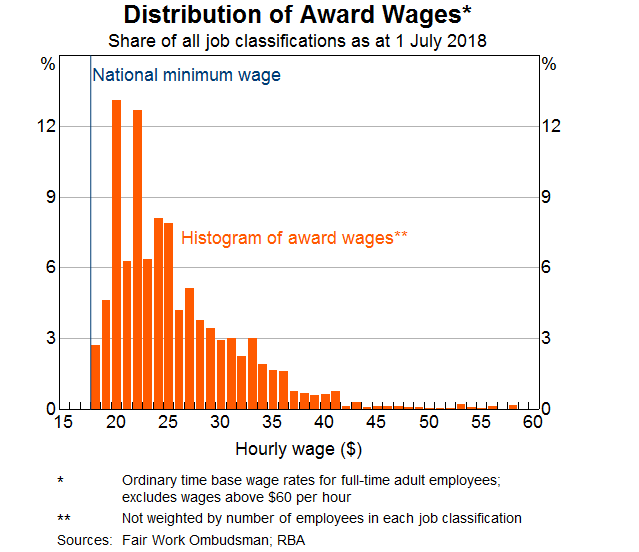
Everything I'm seeing indicates there's a "hump" starting at minimum wage and increasing to an amount around $20 an hour, where it begins dropping again, but I've only found state-wide graphs such as https://www.rba.gov.au/publications/bulletin/2018/sep/images... (Australian)
I guess a minimum of 15 and a hump at 20 would be "at or just above" but 25% is a decent amount.
>Comparing minimum to minimum would be a more useful metric.
Nope. This is minimum wage and sadly there are plenty of people with an income lower than that. You have to chart both progressively and simultaneously.
Bottom %1 income to bottom %1 rent, 1-2, 2-5, 5-10, 10-20 etc. I'm not familiar with the data so those bucket sizes and positions are almost certainly capable of being greatly improved.
The next question, and the one clearly being examined is raising the minimum wage. Seeing how it affects everyone all the way down is informative there.
So it’s a bad metric, because if you used it to measure your imaginary unrealistic state, it would fail? If you want to argue that it’s a poor choice, argue from something that’s a little closer to reality.
Yep, it’s still not affordable in 93% of US counties for full time minimum wage workers to afford a modest 1BD apartment.
Full time work even at minimum wage can be hard to get in many places, where employers like Walmart deliberately schedule workers less than full time to avoid paying benefits.
That shows modest two bedroom but is still a much better dataset than the one originally posted.
Interestingly enough around here they’re advertising double to almost triple the legal minimum for entry-level service jobs such as McDonalds or gas station clerk and apparently are not having many takers.
Sorry I pulled a quote from an article that referenced that link, but in retrospect that landing page wasn’t citing my claim very well. The full report on page 17 shows hours needed to work per week to afford a 1BD apartment at minimum wage. The 93% number came from a prior year.
> No local minimum wages are sufficient to afford a one-bedroom rental home at the Fair Market Rent with a 40 hour work week.
Even their infographic doesn't align. You can see plenty of shades for the 40hr workweek. Note that they don't break down the state by state summary for 1BR.
I personally know people living alone in low minimum wage major cities who defy this suggestion. Sure, not always in glamorous places. But I'm willing to bet across most of the east coast of the US you'll find counterexamples.
You can also see something interesting - at least in my state it shows a four bedroom as being about twice a "zero bedroom" - hence roommates likely are occurring.
This is only true in places like the UK or, I understand, the US, where renters do not enjoy the same protection they would in other countries. My brother rents a flat in Germany, he can't be evicted (unless he stops paying rent) and rent increases are pre-determined and tied to inflation (ie, the landlord can't ask for a 5% rent increase each year). In Italy contracts have a minimum 4 year duration, during which rent increases are capped at three quarters of inflation.
Which,,,is the reason that probably 99/100 people get evicted in the US. The remaining is generally due to property destruction or neglect of the property specifically counter to the lease agreement.
A landlord not renewing a lease to a tenant at the one of a lease term is not an eviction.
I don't know renting at reasonable price, doesn't feel more stressful to me than owning.
I could and probably will take a loan for apartment. But if there is market downturn and I lose my job and the value drops I might even lose the place and still have debt left over... Also I'm on hook for any large scale maintenace that housing corporation decides collectively to do. And this can be like half of the value of appartment. Plus as it is corporation I'm possibly also on hook if other shareholders(owners) fail to pay their share...
Interesting you say that, I'm trying to buy a house right now and that's the big variable I just have accepted I won't know the proper weight of until I do it myself. I've decided to just take the plunge, it's the only way to truly learn.
Homeowners have the same fears, they're just pushed a little further out. Even if your house is paid off, you still have to worry about property taxes, basic upkeep, insurance (unless you go without and risk losing it all, which leads right back to that stress), possibly large HOA fees... the fact is, unless you have a lot of savings or are 100% certain you'll always have money coming in, no one's safe from anxieties about being able to stay where they live. I agree that it's worse for renters, but owning a house is not what it once was and definitely doesn't make the stress go away.
I have thought for a long time now that basic housing (your own private room with a door, heating/cooling, water and electricity) should be considered a fundamental human right and guaranteed as such by the powers that be. Without such a guarantee, the vast majority of us are going to continue to feel existential dread over the possibility that losing our ability to generate income could lead to being homeless.
Minimum wage is not the problem as this article seems to imply. People move up from those starter jobs, they don't stay there forever.
The problem is that the politicians and local governments have enacted strict building and zoning laws which disallow for new housing construction. This, in combination with market forces has driven up the price of housing artificially fast.
> People move up from those starter jobs, they don't stay there forever.
The domain of “starter jobs” is rapidly expanding. It used to just be fry cooks at burger chains as well as newspaper boys, and before that we had farmhands, but now everything is a “starter job” that barely pays enough for rent if it does at all.
Basically the entirety of retail is a starter job. Even retail management barely pays enough to live. Delivery jobs are starter jobs. Customer support jobs are starter jobs. Work at a retirement home? Starter job. Many repair jobs are starter jobs. And plenty more.
You’ll see people 30, 40, 50 years old working these jobs. Still struggling.
> Minimum wage is not the problem as this article seems to imply. People move up from those starter jobs, they don't stay there forever.
[citation needed]
The phrase 'starter job' may indicate where you're coming from, attitudinally. For many people, of all ages, there aren't starter jobs - they're the only attainable jobs. And I suspect many people bounce around between different similarly-poorly-paid jobs, without significant moves up. We're talking about people for whom 'the grind' is just surviving, and for whom the American dream of self-improvement through hard work has died - if it was ever alive in the first place.
> For many people, of all ages, there aren't starter jobs - they're the only attainable jobs.
Citation?
I have family members that weren’t very ambitious and they work in these jobs. However, they don’t make minimum wage because nearly every company offers some raises for people who just consistently show up for 6 months+ straight.
In order to be stuck at minimum you have to additionally have stability issues or issues in general that cause you to consistently get fired or pushed out. These habitual min wage earners are not even a meaningful portion of the people earning minimum wage at any given time.
> I have family members that weren’t very ambitious and they work in these jobs. However, they don’t make minimum wage because nearly every company offers some raises for people who just consistently show up for 6 months+ straight.
But what kind of raises? Starting at minimum wage and grinding out a 25c/hr raise each year for a decade is still going to leave you in poverty. No one starts at $8/hr and is making $35/hr for the same position 6 months later.
Minimum wage is absolutely a problem. Maybe not "the" problem, but it's a massive and highly solvable problem which only the profoundly ignorant could possible believe has no effect on low earners ability to rent a roof over their head.
> People move up from those starter jobs, they don't stay there forever.
Please explain to me how that's different from a serf paying off their ownership debt, or a slave winning his freedom by defeating 10 consecutive gladiators.
Why would there not be a market for housing people with low wages? There are markets for cheap food, cheap clothes, cheap entertainment, ... Everything except lodging.
There's a hiccup somewhere in the "free market" of many countries that prevents it from providing cheap housing, even though there's clearly a huge business opportunity.
Maybe there is a bare minimum on comfort what people are willing to accept? I lived in Asia for a while. There were some many options. From a 3m2 room (if you wanted to sit, you had to open the door and sit on your bed) to a full mansion. I'm back in a major capital in Europe and there is pretty much nothing you can rent under 1000EUR (70-80% of minimum wage)
Yes, the problem with those bare minimums is that they're imposed from rich people (legislative class) onto poor people.
This results in a cut-off point, below which you lose the security of a stable, regulated, lodging situation, and are instead forced to operate outside the protection of the law, into a variety of more or less precarious situations.
Everyone has different priorities and aspirations. I personally would have preferred securing a stable space, even if it's closet-sized, than carrying my luggage between temporary accommodations or sharing my living space with strangers. Some people prefer the later options. There's no fundamental reason the basic freedom of having agency over your living accommodations should be denied to those below a certain level of wealth.
The US housing market has been a parking lot for global capital, some of which isn’t always clean money. I saw it first happen to Vancouver BC when Chinese stock market winners started buying up condos until prices were insane, but it continued to expand to the states with little to no resistance. Now Mexico and Columbia are in the top 5 countries leading foreign investment in US real estate. It’s a cash flow positive way to park drug money, along with a generally stable asset for any global investor.
The supply issue is very real. Per the article linked below, 1 housing unit is being created for every 6 new jobs. It’s absolutely unsustainable.
Market forces = unprecedented liquidity injections into the economy increasing inequality faster than ever the past two years. Of course the lower classes are going to struggle. The most ironic part of this is we've had demonstrations against everything except that, yet almost every country in the world has been affected.
In other news: Investing in real estate has never been better! Just buy couple of properties and money starts flowing from every direction. Dont want annoying tenants? Dont even bother renting long term. Airbnb that bitch or just sit on it and watch house prices go up and up and uuuuup.
>By that measure rents are unaffordable even to SV workers.
The rents in MV are $4K ballpark for 2/2 which is a minuscule part of all those $300-600K+ compensations around. Today for tech workers the situation is much more affordable, be it rent or buy, than it was 20 years ago when i first came here. 13 years ago i bought townhouse at the peak for almost 6x my salary back then at 5.25%, and it was a bit of uncomfortable stretch. Today a tech worker for 6x yearly comp at 3% can very comfortably afford a pretty nice house here. In the recent years a bunch of tech neighbors and acquaintances have already bought their second [town]house. Of course the tech workers with these money sloshing around have been the major factor making it much less affordable for everybody else.
Yeah that's really low. I just moved to Hamburg as a postdoctoral researcher and our international housing office said to expect to spend around 60% of our salary on rent. Then again rent here includes heating which changes it a little
Don’t compare things like that. 60% of your income is going straight into funding someone else’s investments and you have no choice but to pay. It is a sickness, a malaise of society.
I'm not sure what you're getting at. Sure, I don't like landlords as a "profession", but on the other hand it is not unaffordable, which was the point in the article. It is a mistake to conflate whether or not it is morally okay to whether or not it is affordable. Even if it were affordable that doesn't mean that it is okay. Then again, in terms of my own life and living situation, I honestly can say I do not mind renting.
My life is comfortable and my work is fulfilling in itself. I'm not working _just_ to pay that. Trust me, I don't want to not have to work at all. I am a scientist though so of course for many it is nothing like that; I am in a very privileged position.
I understand that the relationship between landlord and tenant is inherently predatory, I just don't see how exactly this is related to whether or not I can afford it. I think it's predatory whether I can afford it or not, but since you don't seem satisfied by me saying that I assume you only think it's predatory in cases where it cannot be afforded, which honestly is morally deplorable of you.
I’m not entirely sure how we got to this place but it definitely feels this way in the UK too at times, though the circumstances might be different.
Housing as an absolute expense has risen faster than income in nearly every developed country that I can think of.
But, something that I always bring up when minimum wage is mentioned as a panacea: Sweden does not have a federally mandated minimum wage, but people are paid relatively handsomely.
This is because of strong union protections.
The solution could be unions but I guess the American people have a dim view of unions and companies aggressively crush them.
Me neither, but I'm 100% sure it has a lot to do with golden circles teaming up to fuck the majority. At least it 100% for sure is in Ireland.
We have captured newspapers and TV completely reliant on government spending to stay afloat running glossy, thick, full-colour property pull-outs and programs.
At the same time our own government argues that building social housing would negatively affect the ability of property vultures to capitalise on their tax-free earnings.
We have a concrete cartel, protected by our government and courts for decades.
We have openly captured regulators, who stifle complaints and drag proceedings out for years or decades only to do nothing.
We have lawyers who are perfectly content to make bank off the above, and the tribunals that come when someone's actually caught taking bribes.
* We have > 230,000 unoccupied homes, at the same time as record-high homelessness and child deprivation. *
We have politically connected assholes making huge sums of money offering hotel rooms as emergency accommodation to homeless families.
I could go on and on. And, a huge amount of this is widely known among the population.
But what the government has here is an easy scapegoat. Every time they get caught bribing newspapers for fake news, or throwing crowded golf parties during a pandemic with vulture fund owners and judges 100 to a room, they just point the finger at Sinn Fein - a political party that has never once been in power - and talk about things that happened 40 years ago to rile up their aged base.
Oh, and our unions are weak and spineless. Not nearly as bad as American unions, but pretty bad all the same.
I live in Sweden and I can tell you that it's not so clear-cut. Rent control means that people have to queue for many years for decent rental apartments.
We also have a lot of black market labour. The unions have historically had a strong grip, but are under attack by political forces that want to undermine that market with unskilled workers.
And on top of all this I think that people simply always prioritize living expenses above all else. As long as there is less supply than demand, prices are going to rise until some are out-competed.
People will have to pay, either with their time or with their money.
Imo some level degree of rent control is needed to prevent forces like housing speculation from causing housing prices to spike wildly in certain market conditions. Otherwise you end up with SF where it's impossible for anyone but the highest income earners to even exist.
I think the vienna model seems to have been fairly successful: if you build lots of high-quality public housing, the incentive structure is good for putting roofs over people's heads in an affordable way.
Speculation is a problem for sure. I think USA is experiencing the burn for not being the number one financial power anymore. If the global market is hurting you, you'll need to protect yourselves by regulation. It's easy to be pro-globalization when you're king of the hill, but not always so great when you're getting the short end of the stick.
Oh, and I didn't know about the Vienna model, but Stockholm tried to massively expand housing in the 60s in something called the Million Program, as so many others did. Although that solved the immediate problem, it has been a catastrophy for the cityscape.
Isn't lack of housing sort of a side-effect of the very concept of a city?
It should be noted that in Swedish cities, especially Stockholm, there is also a completely dysfunctional housing market.
I have personally rented long-term flats in a bunch of cities: Cologne, Stockholm, Oslo, London, Hurghada, Moscow.
Out of these the housing market in Stockholm was by far the worst experience (with the easiest being Oslo & Hurghada). There's nothing on the market because of rent control, official queues are impossibly long (O(years) for anything) and second-hand (third-, ...) apartments are an absolute mess (few tenant rights, tons of short-term contracts, lots of random small issues).
In Stockholm this hits foreigners especially hard as lots of Swedes have inherited a bostadsrätt or hyresrätt (the official equivalents of owning/renting property) and rarely deal with this directly.
In comparison megacities like Moscow and London are much easier to deal with. The market is rough due to often fierce competition but there are tons of properties available for renting and buying at any quality & price point.
Money laundering. It’s as easy as that. International organised and serious crime is buying up real estate to clean their money flows, typically from wholesale meth/cocaine/opioids and human trafficking.
Then they started buying up businesses and politicians and now we are here.
Construction companies build huge towers full of huge apartments nobody can afford, yet they are all bought up, and nobody lives in them.
How exactly are those people managing to survive? My country has welfare that allows people to pay rent and food. I'm not really aware of how american welfare works, but I guess it varies a lot between states?
Work multiple jobs. Or a full time job and gig work on the side. Share rent with others. Rent a room. I believe a chunk of the flooding deaths in the NY flooding was from people living in illegal arrangements (basements setup as rental space.) People find ways as part of a story which stats don't tell.
ETA: Where there's a demand, markets open up. In the Philippines, many people live in "boarding houses" which is a small single room and shared bathroom. In one place I visited, it was a dirt floor, light bulb hanging from the ceiling and a bed which was little bigger than a cot.
Below the federal poverty line people can receive food assistance, and sometimes there are state or local programs that help with rent. In general people just work more, borrow more, and live in a perpetual state of financial peril. It’s awful, and even if the situation improves, living like that leaves a lasting blow to the psyche.
I have never had these benefits but I imagine this isn't something which happens on short notice. One of the issues with unemployment was that people would sometimes have to wait for months to get their assistance. When employers received pandemic loans for payroll, the choice was to brush off the employer (against unemployment rules) or take your chances that the employer wouldn't just have to let you go again after X months only to face the unemployment process all over again. The narrative around this was that people would rather stay home and get paid rather than working for their money, but the reality was a bit more complicated.
That is one solvable group, they just need reasonably priced housing in reasonable locations.
The mentally ill and substance abusers(including alcohol), is much more complex issue.
And then there is probably small group you will never house, because they prefer to be homeless. Still doesn't mean the two other groups should not be solved. It is just that there is no political will to build enough housing or solve the systematic issues.
They compared minimum wage to median housing costs, and found that minimum wage is not enough to afford median housing.
But isn't this exactly what we'd expect? You can't have everyone able to afford housing that is in the top 50% of housing costs (except possibly in Lake Wobegon).
This seems like the housing equivalent of those periodic "richest N% have M% of the wealth" where M > N stories that present that as something obviously bad when in fact in any population where there are variations in wealth it is mathematically necessary that the top N% has more than N% of the wealth.


https://news.ycombinator.com/item?id=23863899
https://news.ycombinator.com/item?id=27841355
https://news.ycombinator.com/item?id=27852220
https://news.ycombinator.com/item?id=27850918
https://news.ycombinator.com/item?id=27852875
https://news.ycombinator.com/item?id=20225313
https://news.ycombinator.com/item?id=23854403