The model described in the book does work. Spend less than you make, invest the excess in long term assets that have compounding interest rates above the inflation rate. It does produce millionaires. It also requires tremendous discipline over a long period of time. The math is relatively simple, the behavior is not.
While the millionaire described in the story had $8 million in assets, you will find almost no one "next door" with 10 to 100 million or a 1 billion. That level of wealth requires a return on investment that can't be achieved using the earn and save model. It usually requires creating/controlling an assets that can grow in value many orders of magnitude faster than the stock market (real estate, businesses, intellectual property).
> Spend less than you make, invest the excess in long term assets that have compounding interest rates above the inflation rate.
It does work. But the cost is your life.
My issue with the whole idea is that the wealth comes in the latter years of your existence. Decades of work have dulled your curiosity and desire to enjoy your wealth. You don't need much to exist and could survive off a more humble nest egg.
Wheelchair wealth is considerably less valuable than wealth when you are young.
... not really. savings is a percent, you can set it wherever you want. the math works out just the same only over more/less time.
you don't have to be a frugal miser, and you don't have to spend like it's burning a hole in your pocket. saving a responsible amount isn't going to dull your curiosity for decades.
whether you consider it intentionally or not, when you choose how much to save you're also _directly_ setting your future wealth. the most prudent thing to do is optimize _both_. how 'well' do you want to live vs how much wealth do you want and by when.
what actually costs you your life is spending unnecessarily in your youth, which implicitly sets your future wealth nearer to zero and burns the time to fix it.
“But the cost is your life”: cultivate less-expensive tastes and hobbies, and live a great life while saving up for when the silly tech money stops rolling in (by your choice or not).
In fact, I’ll be so bold as to say that the more mind-expanding ways to spend free time involve spending less money than their competitors.
Want to fly? Join a gliding/sailplane club instead of getting a powered flight license and buying a Cessna. Love good food? Learn how to cook new dishes instead of finding exciting new restaurants. Into high-performance luxury cars? Rent a different one for a long weekend a couple times a year instead of leasing the same one to sit in traffic for your boring commute. Like to regularly update the look of your living space? Learn how to lay tile and do upholstery instead of shopping for more crap.
My husband chose the first one (gliding vs. powered flight), and I’ve fallen into the second one. Both have significant financial benefits, but also health - gliding club involves a lot of scurrying around the field to help the other pilots, and just about anything I cook at home is healthier than a similar dish from a restaurant.
I still have one stupid money-sink hobby, downhill skiing, but have found less expensive ways to enjoy it — day or weekend trips by train to an ok ski area instead of a week at higher-end resorts.
You are absolutely correct. It sounds like we have different ideas about the amount of free time required.
When retired or semi-retired (thanks to youthful wealth), you can do a lot of cheap but time consuming things like backpacking overseas, hiking the pacific coast trail, spending a summer diving in Cuba.
Indulging in my hobbies one day a week in between running errands and going to the gym just feels like a watered down version.
I makes less than 100K usd per year. I have a wife (who also makes less than 100K), a car, a kid, and hobbies. I don’t live in the valley, or even the United States. I work 8 hour days, employed by somebody else.
I should be a millionaire by my mid thirties unless the stock market explodes. I don’t think I’m all that frugal, but we do try to save more than we make and live within our means.
I do recognize that I’m extremely fortunate - I have not suffered any significant setbacks in my life, my health is relatively good, and I have a good family structure, all of which have been immeasurably helpful.
Doesn't ring true for me. Some of my favorite things to do are free or very cheap. Biking around town or on local trails, taking the dog for a walk, changing the oil in the car - yes, really.
I love to travel, too, but you can go amazing places for hundreds or a couple thousand dollars. You don't have to spend much to have an amazing life and go amazing places.
It frustrates me to see my peers who earn far more than me feel stressed about money and feel that they have to do very expensive things or else they're not living, but what can you say?
The question is: do you need money to live a happy life?
My opinion is that you don’t. But to each their own.
Maybe some people are saving because it makes them happy. In the article Nassim Taleb is quoted saying something about how it’s dumb to accumulate so much wealth but still live in a starter home (not sure if this was directed at Buffet or what). But sometimes people just feel happier having a cushion, or it Buffets case, feel happier having investments pay off.
I think it is possible, but not if anything goes wrong.
For instance, I used to live off of ~300 / month in the US by living mostly in forest. However, after having a kid my wife demanded regular housing. I could divorce her and go without housing again, but then the state would impute my income and order child support at 20% of the income I _could_ make (which is very high) even though the actual cost of the necessities for a child is minimal (maybe 200 a month maximum). If you fail to pay you will be charged a felony and go to debtor's prison.
So the answer is in many occasions you and your family could live a happy life on basically nothing, but you would have to live with the fact you will be imprisoned and lose all your professional and driver licenses and have all your land and assets seized because you don't earn at your imputed income.
For this reason I abandoned a fairly happy life living off almost no money and instead slave away at a keyboard dreaming of the life that once was. Just don't make mistakes.
> They say money can't buy happiness, but do you know what money can buy? A jetski! And when have you ever seen someone not happy on a jetski. You'd be smiling as you ride that thing into the pier!
> The question is: do you need money to live a happy life?
IMO you need a certain baseline amount. There are some necessities that you need to be able to afford (hard to be happy when you're starving). In the USA, I'd say you also need to have a cushion in case of some unforeseen medical emergency, in other places that may not be as necessary.
At some point the question is - "is it really worth it?" Sure, if you save 10-20% on a regular basis, you're just being prudent. But if you go out of your way to save 50-80% of your income and lower your quality of life significantly, just so you can have more money in your investment account, or so you can not go to work (but still live that same extremely restrictive lifestyle)... it really doesn't seem worth it to me. But some people obviously disagree.
I'm one of those that save/invest 70% of their take-home income. It's not about frugality at all - I would gladly pay for an increased quality of life - but it's simply not on offer.
Past a certain threshold, a threshold well within the reach of western upper-middle-class households, the exchange rate between money and the quality of life becomes essentially zero.
What's left are pointless status seeking games, scams and useless trinkets. The Bible's Book of Ecclesiastes describes it poignantly:
> I denied myself nothing my eyes desired; I refused my heart no pleasure[...] Yet when I surveyed all that my hands had done and what I had toiled to achieve, everything was meaningless, a chasing after the wind; nothing was gained under the sun
Fully agree with you. I believe a few years ago there was research stating that roughly speaking, 70K per year (in spending) is the happiness threshold.
Any spending above it leads to no, marginal, or only temporary extra happiness.
I put that bar far lower, personally. We already have the stuff we need and don't enjoy shopping. We're basically stuck at a particular spending level whilst income grows over time. Saving a large portion of our income is effortless, and not at all a sacrifice of quality of life.
The secret to life is to not want so much. It makes life so much easier and better.
The study is cited frequently but it’s misinterpreted frequently or in a disingenuous way. It merely says that among people earning so much, more money does not contribute as much for happiness. This has some sad realities: by and large the wealthier / higher income are much happier than our poorest, and giving money to our poorest have the largest gains in aggregate happiness. This is consistent with other studies on happiness - money makes everyone a little happier at least, and not having enough is a big problem. Sure, other studies also show how our poorer may be fairly happy and connected to communities and all that, but if you take a look at the data they are from decades and decades ago and include retirees as well.
There is certainly an argument that diminishing returns is true in terms of happiness, but at the same time incomes explode beyond a certain point and data points become a lot more sparse and difficult to correlate back to the population.
It’s quite difficult to not want so much given much of social pressures in developed countries are around consumption. This, the criteria to me is more broad than merely not wanting much - the question is about resisting social pressures and to be comfortable and thankful, and this seems to be inline with the data so far on happiness and social relationships as a whole (happy couples tend to have certain habits and innate drives prior to marriage like being selfless, gracious, etc for example)
I think the direct implication of saying that 70K is the point of diminishing return is that people making less than it are less happy? I think the study therefore is consistent with what you're saying?
For very high incomes, even without research data, I still find it only logical that excessive spending doesn't add much to happiness. This is due to almost every product/service not linearly improving as you spend more on it.
A sports car is awesome but after 2 weeks you realize it still only takes you from A to B, and you internally normalize it. You can buy 30K worth of audio equipment but it will not sound 30 times better than 1K equipment, more like 5% better.
Note that I'm purely looking at it from a spending perspective.
As for societal pressures, I disagree. There's a lot of room for a compromise here. For example, our expenses on daily consumables is zero. We don't do Starbucks, going out for lunch, or any of it. Zero.
Nobody is pressuring us to make those daily expenses and by looking at us, you can't tell whether we do or don't. This alone is a considerable monthly savings.
We may use our clothes and shoes twice longer than a typical person, yet the wardrobe is large enough that absolutely nobody would be able to tell. Or care, for that matter.
When you enter our house, you won't see some stripped down project by a frugalist. In fact, it is above average luxurious. We have furniture that is of such quality that it is effectively ever lasting. We have very high end electronics, not budget stuff. And so on.
We may even appear richer than average whilst spending less than average. So the societal pressure is zero, because we don't appear poor or poorer compared to our peers.
Cut daily expenses, buy quality and utilize the longer lifespan, put this delta into additional savings. Spend part of savings to lower cost of living (mortgage, energy bill), and get even more savings.
The difficulty isn't for folks like you and myself - curtailed, very conspicuous, TCO-conscious consumption is not that hard if one has the brain cycles and will to defy a lot of social norms. But given the efficacy of advertising campaigns and how spending tends to go up with income it's clear that people spend more on average when they make more money even with more time and brain cycles to spare.
As someone that's had a great deal of difficulty justifying a lot of longer lifespan timeline consumption patterns due to moving constantly weighing living circumstances and career I'd say that difficulty varies considerably for households even when one's aware of the TCO. I'm not going to tell an undocumented migrant family that they can just save more and spend less with more conspicuous consumption like buying a reliable econobox car like I did. Decisions and habits are also much easier when one has a partner or support system aligned with one's longer term goals and habits. It seems quite tone deaf to outright declare all of these factors are simply "easy" because it is easy for one's own intrinsic and extrinsic factors.
With "easy" I mean that our strategy does not deny quality of life in any significant way. That's what got this conversation started: the perception that saving a good portion of your income is painful. A massive sacrifice. It isn't.
I started saving at age 6, on a 1 guilder (I'm from the Netherlands) weekly allowance.
When I landed my first job, still single, low income, I still saved 30%. I save significantly regardless of income. This to say that I'm not some privileged armchair commenter. I come from the lowest of the lower working class, and have plenty of experience with poverty.
So it's not tone deaf, it's an attitude. Which indeed most people don't have. That's a lack of education or awareness. Not a matter of it being difficult. A few minor tweaks do wonders.
I do agree with one point: it won't work if you don't have a partner that aligns with such a strategy.
Maybe, but most people who do have the option to save 70% of their take home pay don't. Perhaps our definition of what it means to live comfortably is partially to blame. I know a family of 10 that live very comfortably in a small 3 bedroom home, but most people wouldn't define it as comfortable for themselves.
same experience here. i can afford everythihg but i dont need much. i dont think people understand what kind of stress relief is to say that u can live the life you want for 30-40 years without having to work.
A lot of truth to this comment. I can’t believe the amount of money I wasted in my early 20s on…junk. Things that, with the benefit of hindsight, actually brought me no pleasure at all.
I’m glad I realised this, and I totally agree - once you realize that consumerism doesn’t materially improve your life, your “minimum income threshold” drops considerably.
For me, the biggest exception is travel, which really adds up if you want to take a couple of overseas trips per year.
There's a saying on the fire subreddits 'live the life you want, and save for it'. No one is suggesting one should live a miserly, miserable life just so they can retire in their 30s.
For me, FIRE is a side effect of trying to live a fairly simple life with little impact on the environment. I don't deprive myself. I genuinely struggle to find things worth spending money on.
Very little gives me more pleasure than seeing my investments and net worth grow. Certainly very few things I could buy. The sense of peace and security it gives is worth more than any gadget.
The easy way to increase your savings rate is to save most of your raises. Most people working in decent jobs will get raises as they gain experience or increase their billing rates. Certainly, I expect most people on HN working in tech to make significantly more in year 5 than year 1.
If you can save most of that, pretty soon you'll have a good savings rate and pretty soon have some good savings.
Also, when you start thinking about retirement and look at rules of thumb about savings amount vs income, you can discount your income significantly if you have a high savings rate. (Looking at needed savings vs predicted expenses is a better methodology though)
No one says you have to save 50-80% of your income. The savings rate in the US is 5-10% historically (ignore the 33% spike in 2020). If you're saving 10-20% you're well ahead
I suspect that 5-10% number is actually a bit deceptive - a huge number of people are saving 0%, so among those who do save, the average must be significantly higher.
And I tend to agree with the conclusion of the article - what's the point in saving that money if one has to live on a shoestring budget to acquire it? Specifically the "work all your life, end with $8 million" case. FIRE is different, with the value being the option to stop working much much earlier than 65 years old.
Hard in the "lots of elbow grease" sense of the word. Maybe also in the "unlikely for you, personally, to have the perseverance for" sense, for a given person.
Not hard as in conceptually difficult to implement.
Security. Knowing you have the wealth to subside on if need be is really nice. Some people call it “fuck you money” which is freedom.
It’s funny they reference Taleb here but he also makes the point that can’t be “cancelled” and is “anti-fragile” precisely because he’s rich and depends on no one.
Depends. There’s a fair bit of value in knowing you have more than you could ever possibly need your whole life.
Like say you spend $500,000 a year and have $10 million, which earns about $700,000 in returns. And you’re happy at that level of spending.
You then have massive security your whole life. Whereas if you time it to run out on time, a reversal could leave you destitute when you’re least able to recover.
Past a certain point it’s hard to think of what to spend on unless you step up to much more expensive things like personal jets etc.
The point of dying a millionaire is that it is really hard to plan your finances such that you die with exactly zero dollars. Because investments are so variable, you want to choose a plan that will likely end up with too much money because that avoids complete disaster in the bad cases.
When I'm dead, all the money is going to charity. Generational wealth is a cancer.
There are financial instruments if you want to die with nothing while having plenty of money when you are alive. If you think it is a terrible thing for a grandparent to want to leave money for their grand child's college tuition, then I'd encourage you to make sure you don't help your grandchildren, but it is important to some people even if it isn't something you want to do.
> Annuities require more starting wealth than safe retirement with equities.
How would you create a "safe" retirement (meaning you won't outlive your money) and still end up with zero at the end. A "safe" retirement implies you are going to have money left when you die unless you spend you last dollar and then commit suicide.
Annuities are the only option if you want to end with zero. But you can instead obtain an amount of money that will almost certainly not go below zero when invested in equities and then donate the remainder upon your death. This amount of money is lower than the amount required for an annuity.
Thus, the distinction between "I want to die with precisely zero dollars" and "I don't want generational wealth transfer".
People loudly decry inherited wealth because it is anti-meritocratic and we're raised with delusion that our system is ostensibly one where wealth is related to merit.
I suspect that most people decry subsidized inherited wealth through things like stepping-up the cost basis for inherited wealth. Generally, I don't think people have a problem with parents giving their kids gifts in some form - though I do acknowledge that there probably is some notion of what is considered a (un)reasonable upper limit.
Most peoples biggest asset is their home which just costs more in property taxes and doesn't provide much benefit because they still need a place to live, preferably near their workplace.
I don’t get what you mean. I have no children, am in my 50s, and still try to maximize my wealth to the extent possible while still having the particular lifestyle I like. I work hard because it’s fulfilling and I work to generate wealth so I’m not screwed over after one health mishap.
Your second paragraph hits the nail on the head. Income is scalable, saving is not. Expand your income, and invest. It's all a lot easier when your income is pumping.
In my country (Germany) afaik a little over 10% of the population are at least millionaires. So I think the likelihood to have a millionaire living next door is quite high.
Anecdotal (but nevertheless true): I have (at least) two millionaire neighbours (less than 3 doors/gates away). Both won the lottery - one euromillions and one national lotto draw.
And if we are talking average income, then everyone on this side of the village is a millionaire simply because of those two. However, most of the rest of us seem to struggle daily.
There is some chance that the bank owns their house, or at least some sizeable fraction of it. Mortgages are more common than houses that are paid off.
A friend of mine "retired" from the military at 38. She joined right out of high school. The Navy put her through med school, then she served as a ship doctor for over 10 years, traveling to dozens of countries. She "retired" with a military pension and an MD, having never spent a penny on med school. She works basically part-time now at a local healthcare provider.
Did that come across as jealous? Well, I am. We all told her she was stupid to join the military, and now we're all still paying off student debt, and she's livin' her best life. :(
If it makes you feel better it sounds like your friend got the golden path; VERY few people hit the milestones and get accepted into the programs that allow that career path. STA-21 and/or the Public Health College were in that path if she got retirement credit for going to school and there are very few spots in those programs.
I know the feeling. But that doesn't mean that you were wrong, or that your advice was bad. It's safe to recommend your friends not to play the loterie if the goal is to derive predictable revenue. It doesn't mean that everyone lose at the game.
Your friend and people drawing conclusion from her anecdote will end up with beliefs typical of the Gettier problem.
Correct me if I'm wrong in my understanding on vocations, but didn't it also require quite a bit of luck that she got to take on this vocation in the Navy?
If you are a decently talented software engineer and you can't match or exceed a non-specialist MD in earning power then you are doing something wrong. Especially in the current market.
Excellent comment. I’m now 70 and well-to-do. But I was a fool to go into private enterprise with all its interpersonal dishonesty. Government jobs at the national labs had superior NPV’s— the pensions are absurdly expensive taxes on struggling workers when carried out to the 85-year typical lifespans of workers. There were layoffs, true. But I understand the psychology and passivity of persons who managed to get themselves laid off.
You also have the choice to take action to avoid risk. That choice is not available in the military. You're trading a lot of freedom over those 20 years. (Did I mention how expensive getting divorced is?)
you guys are kind of using NPV ambiguously. You mean that when you retire at 38, the NPV of your retirement plan at that point (for when you are 39, 40, ... etc.) is $1.3M, and if you haven't retired yet then it's really a FV? what discount rate are you using?
or did you mean the NPV when joining at age 18 is... see what I mean?
Military retirement is worth like a minimum of ~$700k for an E-7, before tricare. It's worth like $1.3M for an O-5. People who seperate from service at like 12 years astound me.
Edit- People who seperate thinking they can earn more money on the outside. People who seperate for family, mental health, or similar reasons make total sense.
I separated at 11 years from the AF as an air traffic controller; September 2023 would have been 20 for me. For the past three years I have been working for home as a senior data scientist - my life has been far better as a civilian.
RPA / Drone flying community is the exception. literally doubled income overnight trading a uniform for polo and khakis, same job, same trailer, same airframe, different airspace
Wait, so are you saying there's non-military people flying drones that are flying in other countries? Although I suppose that last bit is an assumption.
Yes I always considered reenlistment to be committing to 20 years minimum. I got out after 4 years, but some of my friends stayed in because they were lazy and institutionalized lol. Then of course they decide to get out later because they hate it. Two of the worst decisions they’ll make.
It works out pretty well I've been told. But there are plenty of dead ends in Federal service, where people are underutilized and undervalued, but last it out for their pension. Some jobs just don't exist in commercial settings, and it can be really hard to re-adjust to new work.
You can start drawing a DOD pension after you've worked for 20 years (so potentially as young as 37). That also gets you tricare (health insurance for you and your family).
It's not rare for people to double-dip: do your 20 in the military, then go work as a teacher or DOD civilian or something that'll give you a second pension.
If you don't blow all your expendable income on a sports car financed at 30% APR, it's also possible to build up a good nest egg by the time you retire. You can also take advantage of other veterans benefits. A friend of mine got more money from his GI bill benefits (tuition + stipend) than from the actual salary he made during his army years.
Quick edit: the military has a mishmash of different retirement plans depending on when you signed up. I think the most recent one is more defined contribution focused and makes it harder to get money before you're in your 60s
>If you don't blow all your expendable income on a sports car financed at 30% APR
Or knock up a stripper, or lose half your net worth when you divorce your dependa, or all the other bad life decisions that tend to plague people in that line of work.
If you can get through the first 4yr unscathed you're probably on a good path.
There's also the risk you could get sent to a war zone and get your legs or other parts blown off. Though i have the impression that's national guard work now.
This. Of course, you can mitigate the danger by choosing an appropriate job. I did four years as a Grunt and fortunately didnt sustain any injuries, but I've been in a truck and watched the guy in front of me lose three limbs. I've watched a friend who was next to me on patrol take a few rounds and die while we tried to get him out of there, and I've seen a truck roll over in a shit trench and the gunner drown in feces. Fast forward 11 years, 10 people from my company have committed suicide.
So, for anyone just chasing DoD pensions and GI bill benefits, make sure you end up as a lithographer or some shit.
My wife's grandfather did almost exactly this: navy pilot (I forget the exact details but he had at least one of those "firsts" like "landing on an aircraft carrier at night"), survived WWII, got out, was a teacher for 20+ years, and developed a keen interest in equities at exactly the right period for that.
As I understand it, the flipside of this was that not very many people in his (very early) cohort survived, in case someone is thinking of this as "easy government money".
Might not even need to do 20. There was a time around a decade ago when they allowed an early retirement after 15 years. I don't know the details, I guess the pension was less. I believe the early retirement option comes up from time to time, possibly when the military is looking to down size.
That was the force draw down after the end of the Cold War. It did not go well for the Army, at least, and they had to boost recruitment in the late 90's to keep up with normal attrition.
There's still occasional early retirement for certain MOS's I believe. Earlier this year I believe some USMC tankers got hit with a reorganization and at least some were allowed out under the early retirement authority.
Under the old system your retirement pay was 2.5% per year served. So 37.5% instead of the 50% you would get at 20 years. Last I know of early retirement happening was after the Gulf War in the mid 90s when everything was downsizing. Wouldn't be surprised if it was happening now too though.
I looked it up, it was 2012 to 2018 (unless it was cancelled before the date in the ALARACT). Not sure if it was all the military or just the Army, though. Being in the Army, I didn't concern myself with the lesser branches ;)
20 year mark is key. Sign up when you're 18, do 20 years, you're now only 38 which is < 40.
Edit: if you're super ambitious, you take the skills from your military specialization (pilot, nuke engineer, etc) to the civilian world and work another 20 years. you're now 58 which is still younger than the typical 65 for retirement, but now on 2 pensions or 1 gov't pension plus a really nice portfolio.
At the national labs, you can basically walk out with proprietary technology, as long as it’s not classified, with many modules and processes dual use, where the civilian use has yet to be exploited. I’ve seen this done many times. Proof of concept is extremely expensive for the gov’t: rack mounted heavy-duty modules, premium subsystems bought from market leaders. A good engineering team can whittle costs by 90%.
depends on if we're in an entrenched shooting war on the ground needing frontline infrantry. usually, that type of service doesn't come with a sign-up bonus
It used to. As soon as you retired you started getting paid every month for the rest of your life. At 20 years you make 50% of your base pay, so you say you join at 18, 20 years is 38. You make it to E-8 and now you retire. That's currently around $2750 a month.
If you join now there is an age it kicks in I think, rather than immediate.
Plus you still have access to things like the commissary if you live near a base. As well as medical insurance for life.
About to execute this right now and I see some interesting numbers being thrown around for the NPV of my pension.
The numbers you are seeing are really the top of the iceberg; my actual take home as a retired E7 is likely to be about twice what the pay numbers would tell you due to VA disability.
So after a take home of around $72k/year and essentially free medical for my family for life, as well as my children’s college paid for (my degree was paid while on AD so they get my GI Bill), we still need to factor in Space A flights, tax free shopping, cheaper gas, gym access, beach accesses, cheaper groceries, etc. etc.
The most recent numbers I saw were something north of 2 million for anyone E6+ who gets 100% VA disability, which is pretty common.
That said, I rarely recommend the career to people. The costs incurred really aren’t worth it unless you get the equivalent of a lottery ticket.
All of that is conditional of course; you are correct in suggesting that those benefits end at those times typically.
Some situations change that; one of my children is special needs and may never be independent so would stay in my healthcare for life. The transfer of GI Bill is relatively recent but if your father was even 0% disabled (I don’t think there’s a vet that isn’t) California would have waived your tuition to any state school after you became a resident. There are other situations that result in free college.
Having been in the military myself (albeit a short stint) it's absolutely a viable option, but just be sure you choose the right path for yourself. And be aware of the obvious downsides.
Too many people just don’t understand what car ownership costs. If we had decent public transportation a lot people currently at the margins would have their lives greatly improved. Far too many people are slaves to the debt servicing their cars and the costs of gas, insurance, and maintenance.
Cars can cost a lot but a lot of it is avoidable - especially if you are just replacing public transport. I estimate that a cheap used car has a total cost of ownership of ~$3200/year or ~$266/month.
Looking at places with public transport, a good average might be ~$130/month between the regular cost and a few special costs like going to the airport, etc.
Saving $136/month is pretty good. On the other hand, public transport costs about 50% of owning a vehicle and has a lot of limitations including only covering a single city & one person.
If not having a car means you have to buy groceries at more expensive/closer stores then the savings are not as much. If you spend more time each day on public transportation then the savings might not be worth it. If you do recreational activities that require a car then rentals/ride-shares will quickly cost more than you save.
Even in places where public transportation is used extensively it seems to be driven by factors unrelated to cost:
1. Parking is limited or very expensive
2. Traffic congestion is very high
The high cost of vehical ownership seems to be driven by consumer preferences. It's a trope that many low-income areas of the US are filled with expensive trucks. People have the option to buy luxury & new vehicles but public transport doesn't have that option.
Essentially, comparing public transport to the typical vehicle in the US isn't fair since the vehicle is more functional - wether the average American needs that extra utility is a different question.
I lived in Germany for a while and used a car twice. Both times it was a rental. Was able to take public transportation to almost every place including national parks. The U.S. needs to make investments in public transportation. It would greatly benefit the environment, our health, and our pocketbooks. In 1995 there were 0 miles of high speed rail in China and today there are tens of thousands of miles of high speed rail. We could have made similar investments into our people and the environment but haven’t.
Cars do have a utility and car sharing programs coupled with good public transportation can obviate the need for everyone to own one. Most cars spend most of their time not being used. We collectively are a nation of people who by and large spend our lives driving a car from to go from one building to another. We have people who drive somewhere for the purpose of going on a walk.
We’d be much better off without such a car centric focus.
If the U.S. could shift from a car centric culture then population density would go up. Of course having bus routes to every national park is not feasible in the U.S. but we can have a robust public transportation system beyond urban centers.
There is a cost to not having a good public transportation system. Overall, I think we and the world would be better off if the U.S. transitioned from a car centric culture.
As I see it people in the U.S. can live in spread out cities because of cars. If cars were somehow to be made undesirable then we’d want to live in more compact spaces.
Urbanization in the US has consistently increased throughout the entire time the car has been in existence.
> If cars were somehow to be made undesirable then we’d want to live in more compact spaces.
Poor people, mostly. Wealthy people could continue to live where they want. Forcibly making car ownership more undesirable seems like an extremely regressive choice.
I would rather see the trend towards mega-cities reverse. Not to rural, but to small & medium sized cities that are more livable, which are then connected by good transportation.
A livable city means a city that is not car centric. Such is my opinion. Far too much land and resources are used for parking spaces and those spaces are largely unused. Our cities are hostile to pedestrians as well as our law enforcement. Our car centric culture is regressive due to the large cost of car ownership, mandatory land usage for parking spaces and subsidies to pay for roads.
Public transportation in Prague, Czech republic, costs $15/month subsidized or $60/month if you include the taxpayer money. Also, the quality is quite good - underground, tram, bus, waiting times between 2 - 10 minutes and a dense network.
Similar for Berlin - 60 EUR/month, not sure about subsidies on top of that.
The cars in Europe cost the same or more than in US, so financially the public transport within a city is a no-brainer here. Cars are used mostly for convenience or status.
I think your costs for public transit might be a bit off. It cost me over $150/month just to commute via BART, from not too far into the East Bay, when I was doing that.
It looked like the Bay area's public transport is a bit more complicated & expensive. A NYC metro card is $127/month and from what I could fine most places in Europe were a bit below or a bit above. Currently I consider the Bay area cost to be an anomally but it could unfortuently be a indicator of much new public transport would cost in the US.
I tend to agree. A few years ago someone totaled my car, and I decided to try living without it. At the time I calculated the cost of ownership, and for a 5 or 10 year old car, it really isn't all that expensive. Part of the problem is that external costs (road, parking, etc) are amortized over everyone whether or not they own a car.
That seems high, although I don't know how you are amortizing purchasing cost.
It's worth noting that there is the middle class used car market and car repair market, and a lower class used car market and car repair market, and the lower class one is much cheaper and more grey market.
As a senior with three cars, I’ve looked at this in depth. The inconvenience isn’t worth it until I’m a hazard to myself. So I’m certain it’s unfeasible to prime young workers without a mass transit situation.
I specifically talk about people at the margins. It costs an average of $5,000 per year to own a car. There aren’t enough junk cars for everyone to own one. Roughly $0.50 per mile driven.
Bringing up owning a junk car is not relevant if there aren’t enough to make that feasible. I suspect there aren’t enough to make that a feasible options except for a small percent of the people at the margins given that junk cars are likely already prevalent for such people. I quote an average cost of ownership because I have no other stats. Junk cars do cost more to maintain and a person at the margins likely ends up paying credit card debt to service repairs.
Car ownership is expensive. It would be much better for a lot of people if we have good public transportation. It would also be healthier for the nation.
>Bringing up owning a junk car is not relevant if there aren’t enough to make that feasible.
All cars go through that phase eventually. It's a simple problem of economic friction. If more people who could afford much nicer drove those kinds of cars more of those cars would be on the market because there would be demand and people would sell stuff private party rather than taking stupidly low trade in values.
> Junk cars do cost more to maintain
More than a car under warranty, sure. If you don't maintain them to "subdivision of McMansions in a good school district" standards they are quite cheap. <Insert pearl clutching and low effort comment about road safety here.>
If you wanna drive junk you have to go all in and really play the part. Driving junk and trying to maintain it like it's not junk is a fools errand. I don't really want to go into specific examples because people will just hand wave it all away as anecdotes but basically if you buy any old running and driving shitbox for $1k, keep all the fluids topped up and changed on some semblance of a schedule and only fix the things that will imminently (like next week) keep the vehicle from operating you'll probably be out no more than the purchase price in a given year. That leaves a hell of a lot of money to buy gas before you even get close to your $5k average number.
To put real numbers to things, a 90s/00s economy car that runs some sort of 14" tire will cost you under $300 to put new tires on. A transmission replacement (which you probably wouldn't do, you'd just get another shitbox) using a medium-low mile junkyard transmission (say $250 used) will likely be under a grand after shop labor (unless you live in a HCOL urban area). A lot of crap has to break to get you to your $1k/yr cost.
Plus, if you can do the work yourself it often becomes more than worth it. A mechanic's time is expensive—yours probably is not. If you have alternative transport to get to work or fetch parts and can work on it in the evenings, stuff can be done very cheaply.
For example, paying a mechanic to repair an air conditioner (replace compressor, condenser, drier, and associated parts, with a flush out and refrigerant recharge) is prohibitively expensive. I was quoted $2000 plus labour to do this work last month by a reputable mechanic. I did it myself for about $600 with parts from rockauto.com and very basic tools (socket set).
Hyundai i10s are reasonably inexpensive and you get them new for a fair price. There are good enough options at the margin. The bigger issue is that cars not only cost the driver money but also the city. Roads are expensive and sprawl can't finance them.
It really doesn't have to be "junk" though. My last 2 cars have been 5 or 10 years old, and they both drove great, and didn't have any maintenance issues I wouldn't have expected in a new car. Both were in the 5 - 10k range, with pretty limited depreciation. The costs were gas, and a few oil changes.
You also assume that someone that's poor pays the same amount of money for a junk car than you do. Poor people pay 2-3x more than the value of a car over its lifetime, due to credit issues and predatory lending.
Why are cars terrible? Don't you think people have an innate desire to move and go places? Our ancestors moved a lot before they settled down because of farming.
Cars create suburbia which is depressing, isolating, land engourging, and plain ugly. Cars mean traffic. Traffic means going nowhere. Cars crowd out alternatives like a gene drive. Cars also contribute to obesity.
I never said transportation is bad. Take rail at all scales, and ride bikes and schooters.
Cars/bikes offer unprecedented freedom of movement. A lot of people would still own cars even if they didn't need them for driving to work. You could say the same thing about Netflix subscription, dishwasher, holidays, sports, coffee, cigarettes,..., they are all expensive and unnecessary and yet they make life nicer.
Not owning a car in a car in the US / Canada, your taxes are probably disproportionately going toward maintaining car-oriented infrastructure as opposed to public transit (depending to some extent on where exactly you live, I guess). So you're kinda screwing yourself in a sense.
Where he lives - i.e my hometown - public transport is absolutely non-existent. Twice a day you can take a bus if you need to visit neighboring towns, but that's it.
Cars are expensive. Some people enjoy buying new cars every 3-4 years, but that's also money that could be spent on retirement funds.
Didn't say that he didn't have a car - just that he didn't splurge on buying a new car every 2-4 years, like many of our peers do. I understand their rationale because they want the warranty, but still, trading in your car for something newer ever x years will cost money.
If you can "survive" driving a 10-15 year old car, and have some mechanical aptitude to do regular maintenance, then that's A LOT of money saved.
Not sure how that would work out. Contributing $30,000 per year to a fund that averages 8% per year for 20 years only gets you $1.4 million. If he lives to 80, this is only $35,000 per year, which will be next to nothing eventually due to inflation. If he left it in the market and drew 5% per year, he could get $70,000 per year, but that becomes extremely risky as you would have to draw during market downturns, which would quickly deplete the account.
The problem with early retirement is how many years you still have left. It requires far more than a normal retirement. Everyone has their own standard of what is acceptable, but IMO a comfortable retirement at 40 requires somewhere in the neighborhood of $5 million. You could do with less if you want to eat ramen noodles for the next 40 years because you can’t really afford to enjoy retirement.
Rule of thumb is withdrawing 4% per year is a safe rate that will weather market turmoil if your assets are returning market average rates. A $1.4M portfolio will allow for a safe $56,000 withdrawal per year.
The problem is that a rule of thumb is about averages, not edge cases. For a really long retirement, you are going to hit a lot of edge cases.
The 4% rule was based off the Trinity study, which looked at 30 year retirements and assumed the retiree would deplete their principal. It is not a safe basis for a long retirement.
“ Notably, it appears that the safe withdrawal rate does not decline further as the time horizon extends beyond 40-45 years (given the limited research available); the 3.5% effectively forms a safe withdrawal rate floor, at least given the (US) data we have available.”
It should be mentioned that this is not in the USA, and that even if he chose to just start burning through his investments, he will also receive a (at least minimum) pension when that time comes around, as well as not having to worry about any healthcare costs.
With that said, he's not 100% retired in the sense that he's just doing nothing - last time we spoke he was doing contracting work as an Engineer. I guess the retirement meant more "free to you want - possibly nothing if you don't feel like it"
In California a $100k salary results in the take home pay of a little more than $5k/month. So saving ~$30k/year is roughly equivalent to saving half of your take home pay of a $100k salary in California.
That's pretty good. Please keep in mind that other people do things such as support a family or go on dates. They have expenses and may live in costly cities. Even on a salary of $200k a year that's decent.
> He didn't splurge on excessive travel, electronics, cars, etc. lived a modest life.
This, I think, is the biggest hurdle for most people. Everyone wants to be a millionaire, but few are willing to sacrifice the short term pleasures and status of their consumption. See also the infamous "avocado toast" debate, which, from my personal experience with fellow millennials, had a lot of merit as a criticism.
The working/middle classes are getting screwed by housing, childcare, education, and healthcare costs that are a greater proportion of income than past generations. Avacado toast is not the problem.
In Australia, I find the Childcare is interesting. Federal government subsidises childcare significantly, like 90%.
But commercial real estate hunts out childcare providers like gold mines because you can't move your childcare to just any building. At a rough guess, $20 a day of almost every child placement is going to the landlord.
Say you want to start a childcare business. You can't just run it in any old shopfront. Some kids match their parents 40 hours a week.
So there are standards regarding kids in daycare, including the requirement for an outdoor space for play.
Now this can't be achieved in all cases but you better have a good reason. And if your competitor has an outdoor space you know where parents are likely to take their kids first.
Well, the needs are similar even if the reason is different. Parents want to know their kids will not go wandering, so yeah, it very much is a "detention" centre in the sense the kids will be detained there until pickup.
If you've ever been to a daycare centre... it pretty much is a prison. For little kids. With hopefully caring guardians and an exercise yard. :-P
And if you've ever known a 2 year old, some of them can be little sociopaths at times.
In southern California, a starter home goes for $800k or more. Which means it will be a jumbo loan, which means you will likely need the full 20% down. So around $160k plus $3,500 a month. ($1,000 of which is for property taxes and insurance).
Just for the down payment, that's 73 years worth of avacado toast at a slice a day. Millennials must be eating so much avacado toast.
And that's for a house that was built in the 80s and the boomers selling it paid $75k and whose property taxes are still capped at a max growth rate of 2% a year.
So don't live in Southern California? This is exactly the type of sacrifice people refuse to make to which I refer.
"Avocado toast" is a metaphor for conspicuous consumption at the expense of savings and investment.
Ex: $20 avocado toast at a brunch restaurant is absurdly unnecessary given the available options for sustenance.
No one actually believes avocado toast alone is what prevents younger people from getting ahead. Show me a young person making over $40k per year and I PROMISE you I can find savings opportunities in their spending habits. This, coupled with long term compounding of returns, does make a real difference over the course of a life.
Millennials are far more likely to change cities than their boomer or gen-x parents.
Avacado toast or not, I'm not sure the data is settled on whether millennials waste more money than boomers or gen-xers. They just waste it on different things.
Show me an older person making over $40k and I promise I'll find savings opportunities for them as well.
The price of a median house has gone from 3.6x the median salary to 5x. The ratios are worse in the cities that have added the most jobs. Framing this as a failure of personal behavior is missing the point. The current generation has to work harder than previous generations to achieve the same thing.
The biggest hurdle is rent followed by health care.
Most people could live like a monk and not save anything substantial.
If everyone did suddenly adopt those saving habits, it would crash consumer spending and launch the economy into a death spiral, and those exact "frugal poor" people would be the first victims.
The infamous "avocado toast" debate has absolutely no merit as a criticism.
I see a bunch of people who are so disheartened with their prospects of buying a house etc that they are YOLO/FuckItAll regarding money.
There was a HN story a few onths ago saying they are borrowing big to gamble on the stock market. And why not? They have little money. To go bankrupt is not much of a loss compared to a potential financial lotto payoff. I wouldn't try it, but I see why some think that way.
It's possible to live a very comfortable lifestyle and save a lot if you're not consumed by the idea that you need to live in SF or NY to enjoy your life. I always see these stories about how it's impossible for millenials to own a house etc. I bought my first house at 24 and sold it for 80k profit 5 years later, paid off my student loans. I'm on my second house now and it's appreciated considerably in the last few years. Both houses were below 250k with and over 1400 sqft. My wife and I have pretty modest incomes and only bring in about 100k a year together.
While there are certainly things I would like to buy that I cannot afford I can buy most of the things I enjoy when I want to without having to worry and still save a lot for retirement.
You bought your first house at the absolute bottom of the real estate market following a global crash, sold it at a profit, and bought another house during what continues to be a rapidly appreciating market.
Would a 24 year old today in the same financial position you were in at 24 be able to afford that same first house?
You applying this personal anecdote as some kind of geometric proof that living outside a major city is a pathway to simple financial independence is to me a bold-print example of how the very same people who had to fight their way up the ladder of success will promptly become oblivious to the fact that the rungs are becoming further and further apart every year, advising those behind them that "climbing it isn't that difficult, just try as hard as I did."
Okay, after reading that reply I will respectfully bow out after this reply, rather than try to force a rational conversation into an emotionally driven one.
For your information I do work very hard and afford a comfortable life, but feel great empathy for the people for whom working hard is not enough to achieve basic comforts. I did not grow up in as challenging an environment so maybe I am overinclined to that empathy, because I feel lucky my own pathway up the ladder was aided by privileges others are not afforded. But that is not relevant to the original point, it is just the reply I feel obliged to make in response to your attack on my character.
I didn't say I want anything for myself in my original reply. Broadly, I want equal opportunity for all. It was harder to get a job to repay loans in 2009 than today, but in the last 12 years college tuitions have continued to balloon while college graduate earning power continues to drop relative to the size of loans.
I do not particularly understand or appreciate your decision to season your explanation with personal attacks but that certainly accomplished nothing as far as educating me (or anyone else) about your perspective. HackerNews can be a great place to learn from a diverse set of opinions. Nobody has the opportunity to see those opinions if they are getting downvoted to grey for bad community conduct. If you are new to this community, you may find you are more successful at communicating your perspectives if you do so respectfully.
I don't want to poopoo on your point about you and your wife having "pretty modest incomes" at about 100k together.
However the median household income is only $68k a year[0]. That is 50% of households in the US earned less than 68k/year. You're actually in the top 30%[1] of US households if your income is about 100k together.
I wouldn't call that modest by any stretch of the imagination.
The median income is brought down by two factors: 1) people completely out of the workforce (the labor force non-participation rate is nearly 40%), and 2) single-earner households. Neither of these are relevant to what we'd expect to be "reasonable" or "modest" for a married, employed couple.
$100k/year for two full-time workers is $25/hour. This is a pretty reasonable wage for someone with a modicum of stability and employment consistency. For example Bank of America tellers now start at $20/hour and move to $25 in a few years.[1]
I hate to be the person to quibble about the semantics of words but when one says the word modest one doesn't usually imagine a situation that is more than 70% of all others.
I agree, it's a reasonable expectation that two people working should have a lifestyle that something like 100k/year would support.
That being reasonable doesn't change the fact that it's still more than what 70% of other situations get, regardless of how those situations came about.
If you want to compare that on an individual level then it's still not modest. The median Individual income is only 36k/year. Even on an individual level they're still doing better than 70% of the population on that level.
Yes, it's possible to be comfortable and live a nice life no in NYC or SF. But let's not delude ourselves into thinking that just because it's reasonable to expect that level of income for a household, that it's modest, or even the norm.
Imagine a world in which everyone has exactly the same income and the same expenses, saves up the same amount of money for retirement, and lives exactly the same amount of time.
In that world, someone just about to retire would in one sense be somewhere in the top 1-2% of wealth holders and in another sense be exactly average (and median, and mode), as regards their consumption patterns.
The point being, lifecycle effects matter a _lot_. In the US, ~17% of the population is 65+ (not all of them retired, of course, but many retired and living partially off their savings) and ~6% of the population are college students. Let's assume that "individual income" does not include children (though it might, depending on how it's measured. It certainly includes various people who only work part-time, but let's ignore that. If we assume that college students and retirees are all below-median (not entirely true, but no worse than the other assumptions we just made), 70th percentile of individual income is something like 60th percentile of "income of non-students and non-retirees".
> That being reasonable doesn't change the fact that it's still more than what 70% of other situations get
The point is, if you look at actual consumption (as in, how people actually live), not everyone's consumption comes entirely from income. So it's extremely misleading to look at incomes and say anything about what people "get".
It's modest for coastal people which is where most of the users on this site are from. This is pretty easy to spot when they're discussing not being able to buy homes for under $600k.
Had you not bought the first house, would you be able to afford you current house on your salary? People who bought houses in the last 10 years were lucky enough to get in when the market was historically low. People currently shopping for there first house are not so lucky.
Exactly.. I couldn't afford to buy before but for a brief window my salary allowed me to buy a home in the area of my city most people were choosing to avoid. I wouldn't qualify the following year and I would be very far off now as my salary did not rise at the same level.
What I see smart young people doing is moving away from bigger cities. They get a decent house / lot compared to a condo in a bigger area.
Every generation has to move further away (or make more than others) if a city is growing. You don't have to live in a growing city.. you could move to a declining area or a neutral area. There are advantages to living in a declining city.
> Every generation has to move further away (or make more than others) if a city is growing
I mean... maybe to some extent, but ultimately not really. Growing cities becoming unaffordable is a result of our choices. We can make different choices.
I don't know why but people love the idea of scarcity and exclusivity. If we had a star trek like post scarcity society in 2031 and transported people from 2021 to it they would try and figure out how to reintroduce scarcity back into the system.
that's kind of a weird strawman. I don't think people (in general) love scarcity, but you don't have to think too hard to realize that some desirable things are inherently scarce. even in star trek, there are only so many penthouses with a view of central park.
The market is always "low" in the areas I've lived in. That's my point. My brother also just but a very nice house for 180k. There are plenty of affordable places in this country.
>People who bought houses in the last 10 years were lucky enough to get in when the market was historically low.
You realize those same people also had to deal with a shitty job market and college loans to pay off as soon as they graduated right?
> You realize those same people also had to deal with a shitty job market and college loans to pay off as soon as they graduated right?
I think this is a good point that's worth repeating in these conversations. It's easy to forget in better times, but economic crashes are really scary. The financial crisis scared the shit out of me; my job situation was tenuous and our finances were shaky, but my wife and I took a big gamble and bought a foreclosed house at what turned out to be the bottom of market.
It seems like an obvious choice in hindsight, but it could easily have gone very badly.
Growing up in the midwest prior to working FAANG in the Bay Area, this is my exact experience. With a graduate degree and making ridiculous money, I and my peers had no realistic path to homeownership on any reasonable time-scale in the Bay. Family members working HVAC, plumbing, electrician or other skilled blue-collar jobs in low-cost of living areas bought beautiful craftsman bungalows within walking distance to a decent school for $80K. Professionals with either no student debt or a few thousand from land-grant state university degree paid off in 5-7 years. This has knock-on effects to family formation and number of children. Many of my high school classmates had their first kid at 24-25 and have 3-5 kids now, versus Bay Area average of what seems like 1-2 starting in your late 30s. When you feel like you can finally afford it. I started making plans to leave as soon as I got there, it truly was "structurally hostile to families."
You make a very good point. People dramatically underestimate how much more you need to make in the Bay Area to have the same quality of life as living in low cost of living areas.
Not that this is entirely wrong in principle, but it sounds like you got into the market for a house right around 2009. "Happen to enter the market at the exact bottom of a historic crash" isn't exactly a strategy. It's just luck.
I think it will be fascinating to watch the FIRE movement and the broader trading communities through the next crash. It is easy to feel like a genius when the market is going up 30% in a year.
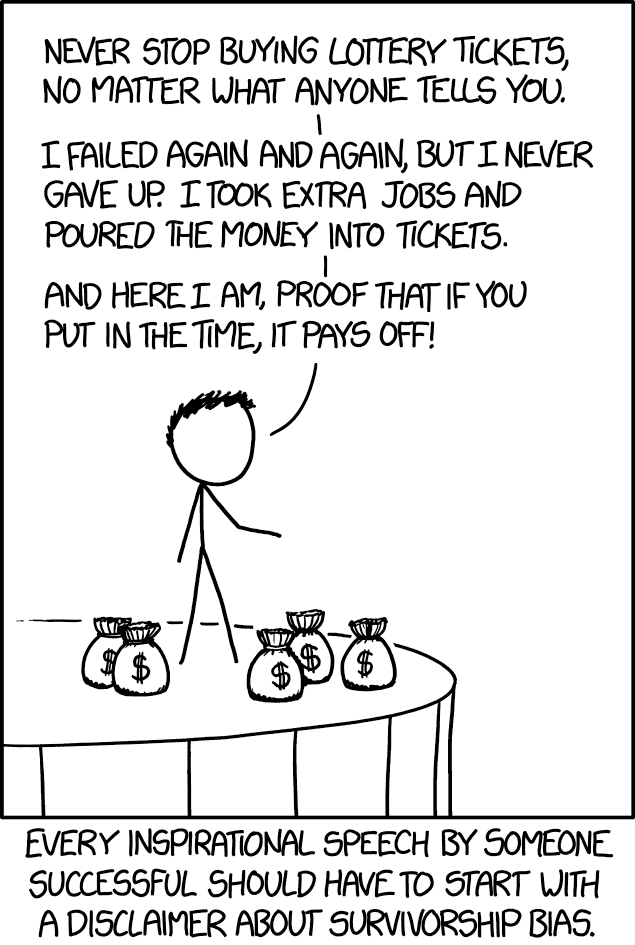
Well sure, but perhaps also it's just survivorship bias. It sure seems like there is always somebody that just got lucky, no matter what is going on. 10 years from now, there will be a group of people that "just got lucky" with something they did right now.
I guess what I'm saying is that the right attitude is to decide that no matter how terrible everything is and no matter how stacked against you the world is, there is an opportunity - somewhere, somehow.
Oh you mean the same time I graduated into a shitty job market with thousands in college loans?
No, I made smart decisions about purchasing a house in a good low col area and fixed it up.
Honestly, this whole idea that anyone who's achieved some success is just down to luck is pretty disheartening. Do you think this is a good approach to improving your life? I don't see any advantage to thinking this way.
I think it's a perfectly fine approach to life to acknowledge the role played by luck. I don't pretend I'm completely in control and all my success is solely due to my superior grit and intellect (and, of course, even having those traits at all is still just luck). Nonetheless, I've done perfectly fine. My life has improved fairly consistently for about 20 years to the point it is better than I ever reasonably expected it would ever be.
So no, I don't think you need to buy into myths to improve your life. By all means, make the smartest moves you can with the hand you're dealt, but you have absolutely no control over what hand you're dealt. If you got lucky, good for you. Plenty of others got lucky and squandered it. I'm not saying don't feel proud of yourself. But don't forget the many people who never even got the chance. You're not better than them and neither am I.
> superior grit and intellect (and, of course, even having those traits at all is still just luck).
I don't think this is true. Sure, it's trivially true that we don't earn the traits we're born with in any way. But it should be equally obvious that people can and do cultivate these same traits deliberately throughout life. People cultivate grit (i.e., discipline, persistence, courage, etc), and everyone has to fulfill whatever innate intellect they were given with knowledge and experience, which don't come for free.
There's certainly a lot of luck involved all along the way, but labelling it all "just luck" is a pretty broad stroke is it not?
> You're not better than them and neither am I.
"Better" is a heavily loaded term. I suspect you're angling for a "worthy of life, liberty, and the pursuit of happiness" sort of meaning, which is dangerously close to a strawman. But if "better" is given a more specific and practical "better steward of their resources" meaning, then I assure you there are lots people better than me.
Oh boy this so much! I'm fully aware of how lucky I've been. Grit and intellect are pretty much down to luck in choosing your parents.
It's so easy and so natural to look down on other people. Everybody does it, and the best we can do is try to fight against it by having some humility.
I think you might be catching too much flak on this thread but to add to the discussion:
>Oh you mean the same time I graduated into a shitty job market with thousands in college loans?
I think this is actually to the same point. Compare what you stated with someone who, say, graduated in the 1960s where they could have a middle class lifestyle without even graduating college, or if they did graduate, without mountains of debt or relatively high home prices.
Both points can be true. There can still be paths forward while also acknowledging it can be more difficult. Exceptional people will always find a path to success; that's what makes them exceptional. What worries me is when we (as a society) make it exceedingly difficult for large swaths of people to succeed at achieving something as modest as "middle-class".
Also a millennial. Also bought my first house at 24. Sold it 6 years later for a loss of $90k. Timing is important. Not everyone was fortunate to buy at the beginning of a huge bull market and right after a historic crash in real estate prices. (Bought my house in 2006)
> if you're not consumed by the idea that you need to live in SF or NY to enjoy your life
And yet some people enjoy big cities more than they'd enjoy living in a small town and it is not a moral failing or a sign of stupidity or weakness.
Many people enjoy the multiculturalism found in cities, and many immigrants or minorities feel out of place in small towns while major cities offer them the opportunity to connect with people like themselves.
Obviously owning a big residence in a city will never be affordable but as a society we should ensure that people can affordably live where it makes sense for them.
Why bring multiculturalism into it, or minorities feeling out of place? the parent comment never mentioned it, and I have been to small towns that were extremely welcoming to all groups. I agree with his statement, why live somewhere where housing is astronomically expensive, unless you enjoy it so much that living somewhere else would bring you sheer misery, be prepared to either rent forever or hustle your life away to afford that lifestyle.
Because that is one thing i know that people mention a lot in moving to cities. Maybe part of it is american perspective. Is there something WRONG with talking about multiculturalism?
eg. gay people leaving their small towns that don't have other gays, immigrants moving to a city full of people of their nationality (eg. "china towns, little italy").
No amount of "is renting forever not bad?" will rectify this advantage of a city for many people.
Having a preference for multiculturalism is something mostly expressed in the west. People in Nigeria, Iran, Iraq, Peru, India, etc. Live just fine with it without it. They don’t feel inadequate living in a city or village that is monocultural.
Neither is right or wrong. Cities develop over decades and they will have their unique histories. But seldom do people in other places say, oh my town is so monocultural, I wish it were a stew of cultures. No, mostly they are okay with their towns character. Interestingly besides Singapore, we have Beirut, Teheran, Khartoum, Baghdad which have lost multiculturalism over time, but those are mostly due to civil strife caused in part by the different cultures at violent odds with each other.
Cities have always collected people from further outside the local area than suburban or rural areas. If you have lived in cities with a monoculture and cities with significant minorities, the multicultural city has more dynamic options for food, drink, music, everything. New York is one of the only places in the world you could probably walk from fantastic bagels to great Italian food to a real HK-style diner. This is a great privilege that residents of these cities value highly.
Really, I would suggest you read up about Peru. They're one of the more multicultural countries in the Americas, they've got multiculturalism enshrined in their constitution.
They have indigenous, mixed race, Japanese and others, that’s not in dispute. What I’m saying is I’m sure in the hinterlands the locals aren’t saying “oh, woe is us, we aren’t multicultural like those folks in Lima”
Multiculturalism can be good, it can be neutral or like Beirut or Baghdad it can lead to violence. What I’m saying is most people overseas are totally okay with it, with few exceptions, but they don’t bemoan it’s absence.
honestly if they enjoy it that's their call and they make the choice to live in a place that is not affordable. If they struggle due to that decision that is on them. If they could move somewhere else and live in a much more comfortable financial position the long term outcome is their choice. I am not denigrating their decision just saying that it is their decision.
"we should ensure that people can affordably live where it makes sense for them" It makes sense for people to live in an area they can afford, not where they decide they should be able to afford. Its simple economics, supply and demand.
"Many people enjoy the multiculturalism found in cities, and many immigrants or minorities feel out of place in small towns while major cities offer them the opportunity to connect with people like themselves". Not to be rude, but so what? I want to live in Napa Valley but I cant afford it, is it society's job to get me an affordable house there?
The calculus is a bit more complicated than you make it out to be. People have to live where they can afford to live -and- get a job. Many lcol areas do not have many jobs. Especially if you have an expensive education that you are trying to pay off.
Some people might be able to take a pay cut and move somewhere cheap and come out ahead. But those options don't always exist. If you have $200k in student loans and a degree in biotechnology, good luck finding a job within 100 miles of cheap housing. More remote work opportunities might change this, but at least in the past, those were very rare. Housing is expensive in hcol areas for a reason. It's because there are lots of good paying jobs nearby. There is also a reason some areas have very cheap housing.
You make good points but the comment I was responding to was very focused on people choosing to live somewhere based on what they like regarding the social atmosphere and feelings as opposed to economic concerns.
Living in a big city isn't much of a problem, only real difference is that almost all your equity will be in your house / real-estate assets. And that can be just fine - in certain areas the real-estate market has performed as well as the stock market, for the past 20-30 years.
But it's difficult to retire on that - unless you decide to sell your house, and move somewhere cheap.
Heh, I don't understand why you are getting downvoted (well I do, but it's not a charitable interpretation). Yep, totally agree - people are not entitled to buy a house wherever they want. At least before the money printer went brrrrr, housing prices as compared to income in the US (median) were one of the lowest among the developed countries. Even now, median house is $375k [1]. Get out of your bubble.
And I say it from the position of someone who actually made this mistake - I bought in Seattle and regret it. A much better decision would have been to buy a cheaper, better house somewhere else. Still, I'm not going to be mad at people telling me this truth :)
Lol, now I'm getting silently downvoted. Come on, tell me which specific statement from my post (or the GP post) is false, or non-factual and doesn't contribute to the discussion :D
The book's claim is something like "most millionaires are people who own ordinary small businesses without a luxurious lifestyle".
This article seems to be trying to refute the different claim that "even a low-income person can easily become a millionaire". But I don't think that's ever been true, and it's not really the book's message. Someone making $130,000 as a small business owner isn't "low-income" - the book is mainly contrasting this group with highly educated doctors, lawyers, MBAs, etc, who also have high incomes but spend much more.
And in the context of becoming a millionaire through investments, adjusting by more relevant factors than consumer goods inflation result in the following:
* Residential real estate inflation: $355k [1]
* Stock market inflation: $770k [2]
* Dollar supply inflation: $712k [3]
You'd have to earn between $350k and $700k/year for your dollars to have the same asset buying power as $130k/year in 1996.
> You'd have to earn between $350k and $700k/year for your dollars to have the same asset buying power as $130k/year in 1996.
This is absurd. There has certainly been inflation, but the value of the stock market (and dollar supply) are not directly relevant to a person's buying power.
The residential real estate price rise is a real factor, but even that is offset by the fact that most people buy homes with mortgages and mortgage rates are so much lower today (7.8% in 1996 vs ~3% now). I can't find the numbers now, but as I understand it the median home is more affordable now for the median income than it was in 1996 (again mostly due to cheap mortgages).
To come at this from another angle: in 1996, $130k was not in the top quintile of earners. Today, the top quintile starts at ~$250k[1]. People earning $350k-$700k are well into the top quintile of earners and likely into the top 10% or beyond; they are much richer than someone earning $130k in 1996.
Summary: $130k is still a relatively solid income (top 25% of earners), but $350k-$700k today is not the equivalent of $130k in 1996.
But in this case they are simply stating the truth, so I don’t think they need to say much. Rising prices for an asset cannot be called inflation, since the owner of the asset benefits from the rising prices. Inflation is specifically the opposite: the loss of value. Words need to have some meaning or we will have no way to communicate with one another.
Why would you switch perspective when describing assets vs consumer goods price rises?
When considering the price of assets, a generalized rise in prices has the same relative effect as inflation in consumer goods; the decline in the purchasing power of money relative to other assets.
The fact that some people benefit from assets inflation because they owned outsized amounts of assets compared to the rest of the population, is orthogonal to that base mechanism. Someone with a huge stock of oil would also benefit from an increase in oil prices following consumer goods inflation.
Beware using convoluted gymnastics to hide simple truths. "Inflation" is first and foremost an English word. Human languages are abstract and powerful, there's more value in generalizing words to understand other realities, than restricting their use to a single "dictionary of economics" definition pointing to a single metric with predefined inputs.
That is incoherent. What are you talking about? This is completely untrue and doesn't even make sense:
"When considering the price of assets, a generalized rise in prices has the same relative effect as inflation in consumer goods; the decline in the purchasing power of money relative to other assets."
Someone owned the asset before you bought it and that person became wealthier as the asset prices rose.
If I buy a house for $250,000 and suddenly it is $500,000 then I am suddenly $250,000 wealthier. If I buy 2 liters of milk for $6 and a week later I want to buy more but now it is $12 then I am poorer because the things I consume cost more.
Economists use the term "inflation" to refer to the loss of value that some consumables suffer as the money supply grows. But the concept doesn't apply to assets because the owner of an asset can sell the asset and reap the rewards. By contrast, if I buy some milk, and keep it in my refrigerator for 20 years, I can't then sell it and benefit from inflation.
When we talk about economics, inflation refers to a loss of value. Rising asset prices refer to a gain in value.
Under your crazy definition, where inflation applies to assets, there has been no gain in wealth since the beginning of time, since the rising prices of all assets are thought of as a loss instead of a gain, under your definition.
About this:
"than restricting their use to a single "dictionary of economics" definition pointing to a single metric with predefined inputs"
Every profession uses certain words in specialized ways. If you don't like the way some topics are discussed in a given branch of knowledge, then just don't participate in those conversations. I will assume, since you are on Hacker News, that you don't have a problem when engineers give special meaning to "message" or "bus" or "event" or "queue" or "broker".
So your definition is exclusively from the PoV of an asset owner, and denies that there are also producers, and people who own nothing.
> If I buy a house for $250,000 and suddenly it is $500,000 then I am suddenly $250,000 wealthier. If I buy 2 liters of milk for $6 and a week later I want to buy more but now it is $12 then I am poorer because the things I consume cost more.
If I have a milk factory selling bottles at $6 and suddenly it is $12 then I am suddenly twice wealthier. If I save $250,000 to buy a house but a week later it is $500,00 then I am poorer because the things I want to buy cost more.
In any case, the proof is in the pudding as they say. If you chose to witness the successive explosion in dollar supply > asset prices > manufacturing costs > consumer goods prices, attribute it to simply "COVID-19 and supply chain disruptions", and call people seeing correlations "crazy", then good for you. There's not much argumentation possible.
> Every profession uses certain words in specialized ways. If you don't like the way some topics are discussed in a given branch of knowledge, then just don't participate in those conversations. I will assume, since you are on Hacker News, that you don't have a problem when engineers give special meaning to "message" or "bus" or "event" or "queue" or "broker".
It's one to give special meaning to words in a particular context and it's another to refuse their use in slightly different contexts because it differs from the most common usage.
Not really: there were billionaires back then as well (the first billionaire was Rockefeller in 1916.) By the CPI, $1 in 1920 would be about $14 in 2021. Nominal (non-real) GDP was around $900 nominal per capita. So a millionaire then would be have one thousand times the per capita GDP. Per capita GDP in 2020 was $63k, so as a multiple of per-capita GDP a millionaire would have $63 million. So a 1920s millionaire is the equivalent of somewhere between $14M and $63M today.
My friend's grandfather worked as a meter reader for the electrical company, and maxed out at $30k/year back in 1990. He retired a millionaire by investing as much as he could and never buying anything on credit, even his house. Most of the growth happened in the electrical company he worked for who's stock didn't grow much, but paid great dividends, which he always turned into new stock purchases.
Buying things with cash and not credit works against you unless interest rates are very high. Let’s say you have $200,000 and could buy a house with it. Alternately, you could finance the house at 4% and put the $200,000 in an index fund that makes 8% per year. In the end, you’ll end up with far more money if you take the second option.
Credit is a tool for creating financial leverage and realizing larger gains, if you know how to use it. The problem is that most people use it to buy things they just can’t afford in the first place.
Interest rates were high enough in the late 70s/early 80s that my grandmother bought a $10,000 20-year US Treasury bond in 1981 that paid her $1500/yr. My parents’ mortgage in 1979 was also somewhere around 12% - I remember my mom gleefully refinancing it in the 90s.
Yeah - “affordability” in most people’s minds stops at the monthly payment. It isn’t whether they have $200K to invest in a house or invest in the market. It’s “I can afford a $200K house with the rates they are today. But if they go up, I can only afford the payments on a $150K house”.
I think we will have a rude awakening when, for every % we move up in interest, we add ~$200 per month on people’s payments on a $200k house. At 6%+ mortgage rates we will see a lot of people stuck in their current house and a lot of the people who look at affordability through the lens of a monthly payment will suddenly be able to afford a lot less house.
Yes, I've read the book and see this article as slanted just as you say.
When I saw the author's name at the end I was like "oh, that explains it" -- I used to live in LA and I'd wonder why this LA Times business columnist seems to hate business so much.
The linked piece about that book has a different idea of its claim:
> The book “stands today as a sort of promise that everyday people have a shot at accumulating true wealth through habits and not just outsize risk,” wrote Ron Lieber at the New York Times. Wall Street Journal columnist Jonathan Clements called it “a roadmap for everyday Americans who want to accumulate significant wealth.”
> When Thomas Stanley and William Danko published their best-selling book in 1996, they made much of the statistic that “80 percent of America’s millionaires are first-generation rich.” The majority, they pointed out, were entrepreneurs, many working in blue-collar professions.
> Anyone could make it big, the two authors all but proclaimed; all you need is frugality and a few tax breaks. Don’t live in a pricey home. Put a cork in the Cabernet, and pop a Coors instead. But most important, open your own business. When it came to the secret sauce for scoring a million bucks, “a very big factor is self-employment,” Stanley said.
> The ensuing years have not been kind to the working-class millionaire.
> A little-noticed marketing report released last month by U.S. Trust contained the disturbing statistic that while almost a third of Baby Boomers worth more than $3 million claimed to have grown up in lower-middle-class homes, the number fell precipitously for younger cohorts, with 18 percent of Gen Xers and a mere 6 percent of such Millennials saying they came from working-class stock.
If you're measuring by net worth, that's super confounded - making $3 million by growing a small business is a lot slower than being born to wealth. So the former will be disproportionately old regardless of generational cohort.
> A little-noticed marketing report released last month by U.S. Trust contained the disturbing statistic that while almost a third of Baby Boomers worth more than $3 million claimed to have grown up in lower-middle-class homes, the number fell precipitously for younger cohorts, with 18 percent of Gen Xers and a mere 6 percent of such Millennials saying they came from working-class stock.
Millennials: age 18–32
Generation X: age 33–48
Baby Boomers: age 49–67
Socio-economic status growing up among the wealthy:
Age 18-32: 0% Poor, 6% Lower Middle Class
Age 33-48: 4% Poor, 18% Lower Middle Class
Age 49-67: 5% Poor, 31% Lower Middle Class
Age 68+: 7% Poor, 24% Lower Middle Class
This is almost entirely due to the fact being wealthy (to the tune of 3M+ net worth) is a far more exceptional outcome for younger people than it is for older people, especially given how much asset prices have gone up over the past few decades. Also these rely on self-assessments and my personal experience is that there's been a class inflation of how people describe themselves and their own upbringing. I suspect older people are more likely to describe their own upbringing as "Lower Middle Class" than younger people.
The counter argument, and why I’ve never been bent out of shape by books like this, is: these strategies are no guarantee that you’ll live to become an 8-millionaire at 92, but they’re not likely to make your life’s financial outcome worse and even if you die at 75 with “only” $200K and a paid-off house that you lived in for 40 years, you probably experienced less financial (and overall) stress than you would have with your same life conditions but a YOLO attitude, leasing a new car every 3 years for every driver and taking big vacations every year because “you deserve it”.
> “I certainly do not see the point of becoming [a millionaire] if I were to adopt Spartan (even miserly) habits and live in my starter house.”
I can’t help but think of Warren Buffett here. He seems happy in his (well-chosen) starter home.
It's also one of several homes. While it's very nice (I've been to it), he has nicer properties elsewhere. I sometimes think he maintains that house for novelty more than anything else.
Indeed: I think it's important to remember that Warren Buffett is a genius at personal marketing. That's why he appears in so much public media, so often. Being an aw-shucks, down-to-earth guy from Nebraska is part of his brand, and the house is part of that. Maybe the idea is that you want your fund manager to be frugal and not flashy.
> Warren Buffett is a genius at personal marketing.
It helps when the American press is as obliging as it is in continually portraying him as a sort of billionnaire Mr. Rogers. They'll happily print his folksy wisdom and relatable outrage about how his secretary pays a higher income tax % than he does.
Yet he hasn't lifted a finger to support efforts that would reduce corporate tax loopholes.
I was once peeved at a company's CFO driving a Porsche. Eventually I convinced myself that it's okay, because a Porsche is almost the only non-depreciating asset that you can drive.
I think the strongest point in the story is his final quote. "I'm happy there. I'd move if I thought I'd be happier someplace else."
If more people would realize that happiness can be had on $3000/mo of household income, even if they bring in $10000/mo of income, more people would be both happier and wealthier.
I think the key is that Buffet knows what makes him happy and isn't running around spending money on random things trying to figure out what expensive thing would make him happier.
If you think a 7ksqft 5-bedroom home with fences and security is within reach of the working class, you have no idea what working class is and/or how much a 7ksqft 5-bedroom home costs.
Buffet probably only needs the fence and security because of his success. If he were an average Joe of no notoriety, he could live there without the security.
If we go off the 4x income to debt ratio a poster above used, a household income of about $162K is needed to be able to afford Mr Buffett's home. That income places you in the 95th percentile of Nebraska household incomes.[1]
That's a pretty narrow slice to be even "upper" middle class.
Like everything, class follows power law. So 0 to 90% is lower class, 90% to 95% is middle class, 95% to 99% is upper middle class, and 99% to 100% is upper class.
Nah. The term is "middle class" where class is defined by the lifestyle/societal-position on a class ladder, not some statistic mean regarding income.
You can have societies with 90%+ population in low class or 50% population in middle class.
History buffs generally know more how it looks for a society to have various levels of classes. I wish we all looked at history more, especially myself if I only had the time to stop rat racing...
A working class person owning a 6700 sqft home? I live in a MCOL area and that would be a $1,000,000 home at a typical price per square foot. In a suburb of a major city that is going to be much more expensive.
The article estimates the value of the house as 652k USD. That is about 470k GBP.
A working-class couple earning the average UK salary (31.5k GBP) could conceivably afford that with a 4.5x salary mortgage if they save 5-10 years for the deposit. It would be enough for a 5-bedroom house in most places in the UK outside London. It is not a guarantee and they could be facing other costs that prevent them from saving up, but it is also not necessarily out of reach.
Cities (usually, but not always, smallish 4th-tier sorts of cities, like Omaha—no dig intended, I actually like Omaha quite a bit) with huge, nice-looking houses at shockingly low prices in the US exist because the jobs there pay like shit, so there aren't many locals competing for them.
There are tons of cities like this where a half-million to $750k can buy you something that's practically an honest-to-god mansion, and isn't even falling apart. (you can do even better out in certain truly rural largish towns, but... well, see below, and imagine all the down-sides are significantly worse, and you've got the idea)
"But I work remotely, so this sounds great!"
Yes, but your best options for education for your kids will likely be a not-even-that-good (probably Catholic, from what I've seen in these cities) private school (there will likely not be multiple even-decent private options, just the one, though there may be other bad private options) because the local public schools are fairly poor. If any public school district in the area is at all good, decent chance it only covers an area with overpriced new-build McMansions, not the beautiful well-tended 40s-construction budget-tier Queen Anne style mansion with the incredible landscaping, that you had your heart set on. If you ever need/want local employment and you're not a doctor, lawyer, or high-tier manager (or maybe car lot owner), you're screwed (software developer? LOL, hope you like $65k/yr to sling PHP for an abusive manager while your hair prematurely greys and falls out). Also, few of these types of cities exist in places with nice outdoor environments and/or weather (those tend to see prices driven up by vacation homes and tourist activity).
IOW it's not valued that way because it's not an extremely nice house for that city. That's standard ultra-rich (by local standards) housing prices in those cities. The prices are that low because so very few people locally make enough money to afford that kind of house.
In fact, one of the most common things heard when you inquire about private schools is "Sure, but why pay twice for the same education?"
And trust me, there are many many developers in NE who are making far more than 65K. Companies like Hudl, Spreetail, FiServ, more banks and insurance companies you can imagine, all needing good IT people. Sure the pay isn't as high as FAANG, but business isn't as volatile either.
The same can be said for many "4th-tier" towns like Madison WI, Des Moines, IA etc etc.
Hey, I'm in a city that sits either on the tail end of 2nd tier or the high end of 3rd, I suppose, so I sincerely don't mean to dig at Omaha too hard, and I have no problem whatsoever with Nebraska (it's not the kind of basket-case on public policy that certain other states are—hell, mine's probably worse, as far as that goes). I actually find cities about Omaha's size more pleasant than larger (or smaller) ones. I've just noticed in looking into moving to some cities about that size (including Omaha, specifically, in fact) certain patterns—but, yes, there exist better jobs than the stereotype I mentioned, in Omaha, and, in fact, jobs that bad exist here, too, which I know because I've accidentally interviewed for them a couple times, but higher-paying ones are in much better supply, too.
The housing thing's just a kind of indicator for a certain kind of situation, which is that, pretty much by definition, either upper-quintile earners are very rare in a city, or the house happens to be somewhere (as in, a specific region of the city) that kinda sucks for, usually, multiple reasons. Or both.
Typically, you hit up Zillow and start getting excited about the abundance of crazy-cheap, gorgeous, giant houses in a smallish city... it's time to check the city's household income curve, and look into the schools where all these great houses are.
> In fact, one of the most common things heard when you inquire about private schools is "Sure, but why pay twice for the same education?"
On that topic specifically, I think it's an under-appreciated fact that most private schools are kind of bad. How can that be, even when you exclude the ones that exist mainly to teach the kids creationism instead of evolution? Fuck if I know. You'd think the market would put them out of business in a hurry, but, nope. I mean, the best schools in an area are also not-uncommonly (but far from always) private schools, but lots of them are, at best, on par with the public schools nearby.
I'm with you on a lot of your argument (there's a reason 3rd and 4th tier city real estate is inexpensive compared to big cities), but, sidebar:
What do you mean by a "bad" school?
As far as I can tell, most people mean one of three things:
  - The test scores aren't as high as I'd like, or
  - There are students who are more rowdy than I'd like
  - I disagree with the syllabus
Plus a dollop of:
- My kid is profoundly gifted and the school doesn't offer challenging enough material
I empathize with this last one, at least, if that's what your situation is, but I know a lot of rich families that think their kid is profoundly gifted and actually they're just bog-standard moderately-gifted, which usually doesn't require nearly the same investment by the school as parents seem to think.
The other three barely matter for your kid's educational attainment. They seem much more about parents being super invested in having a certain social class for their kids peer group. If so, fair enough, but I don't think that's a "bad school" so much as "undesirable peer group".
About private schools. At least where I live, people either send their kids to the Catholic schools, or to the creationist type. There's a decent bunch of Lutheran schools as well, but I don't know anyone who sends their kids to those.
It's not that the jobs and pay in Omaha (or wherever) are shit. It's that there's no money printer industry like tech or high finance dumping stupid amounts of money into the local economy causing a bidding war between the direct beneficiaries and a rat race between everyone else trying to "make their cut".
If you have to save 5-10 years for the deposit, you can't afford the house in a meaningful sense. "It is literally possible for them to risk their finances with a huge loan on a mortgage they will struggle to pay if anything goes wrong" is not really the same thing.
Such a defeatist attitude. I saved for my down payment for 17 years - because I started when I was 15. It wasn't much of a hardship because my lifestyle didn't need a house before that. And it was just normal, 100-400 per month when I happened to have a job (which was probably only half of that time).
> If you have to save 5-10 years for the deposit, you can't afford the house in a meaningful sense
In the UK, people are already having to save for 8-10 years for their deposits. The difference is that for a £470k house, a couple on an average salary will have to save more each month (by aggressively cutting expenses). It may not be acceptable in some countries to wait for so long, and many people may find the lifestyle sacrifices not worth it. Even for those prepared to go through with it,
> "It is literally possible for them to risk their finances with a huge loan on a mortgage they will struggle to pay if anything goes wrong" is not really the same thing.
That is not what I said or even implied. The monthly mortgage repayments a 5-bedroom house will most likely be cheaper than rent on even a smaller house, so the couple should be able to still build up an emergency reserve.
The hardest part is getting the deposit together, which takes sustained discipline over a long period of time living below their means while everyone else is living it up, and can still be disrupted by life events (job loss, family needs, etc.). Only some working-class people earn wages that are high enough to do this. But once they have the house, not having to pay rent anymore will actually increase their disposable income, not even considering possibility of renting out the house if they face financial difficulties.
> This is the home of billionaire Warren Buffett. Located in a quiet neighborhood of Omaha, Nebraska. He bought the house for $31,500 in 1958, $250,000 in today's dollars. It's now worth an estimated $652,619. He calls it the "third-best investment he's ever made."
And what does a working class person make in Omaha, $35,000? Less? A 30y mortgage at today's low interest rates with a 20% downpayment (how is this person going to save $160,000 for the downpayment?), you are spending $18,000 on a mortgage plus property tax. Add $8,000 for maintenance and suddenly a very very large portion of a working class income is going entirely to this house.
Yep. When you see places like this in the US it is basically always the case that local incomes are shockingly (to a coastal or mountain-west sort) low, maybe coupled with stagnant or very slow population growth. You end up with decades worth of high-end house construction—some likely from better economic times—being competed over by only a tiny sliver of the local population who can afford the half-million to one-million range, for housing.
When population and economic growth go negative, you'll see whole areas of amazing, beautiful houses rotting where they stand, because no-one wants them or because they've gotten so cheap that people who can't afford to keep them up can afford to buy them.
While that is technically accurate, a "working class" person living in an area where there is $128/sqft homes is not making enough to afford a 6,700 sq ft home...
So sure you may be able to say working class in some other area makes enough to afford a similar PRICED home in their area, but that similar priced home in say LA would be 1/3 the size
The median income in Omaha is 32,305 (USD) going off even 4x income to debt ratio that would be a home price $129,220 or about 1,000 sq foot, not too far off the average home size of 1300-1500 for a normal ranch home
Buffet is in the cohort of people who buy double-digit million dollar properties next to their residence just so they are not bothered by neighbors. From that altitude a mere 6ksqft house is hard to tell apart from working class.
Bathroom expectations in the US have definitely risen. Not just in terms of the individual bathroom amenities but the number. I actually have a medium sized house (1800 sq ft or so) and I have one small bathroom. But then that was carved out somehow from existing space in a house built before indoor plumbing.
> But the real secret to his success was catching the asset wave that Taleb mentioned. In other words: luck. The period in which he invested started with extreme undervaluations in the equity market
If anyone is curious about the actual returns of the market, I made a sheet [0] with S&P 500 returns over 10, 20 and 30 years at every possible starting point. Note that this excludes dividend yield which is about ~2% today and higher in the past, which should cover inflation for the most part.
type 10yr; 20yr; 30yr;
min -3.57%; 2.80%; 6.94%;
max 17.05%; 15.49%; 12.74%;
median 8.54%; 10.21%; 9.86%;
So for instance, if you invested over 10 years since 1929, the worst you could have possible done is a continuously compounding return of -3.57% (invested in 1927 and sold in 1937). The next worst is invest in 1938 and sold in 1938 for a 0% return. Everything else is positive.
The worse 20 year return is 1927-1947 for an annual return of 2.8%
But of course no one invests like this. They invest over time and dollar cost average. For instance you may invest $100 a month, in which case your returns would be positive and likely very high regardless of when you start, as long as you invest for long enough (more than a few years)
I don't know why a journalist would quote someone without doing 5 minutes of research as to actual stock market returns and important timing is.
I still don't understand why its so fashionable to have these garbage articles come out about how everyone working hard and saving is an idiot and everything is futile. Does the author believe this crap? What else is there to do but to work hard and save? Would you teach this stuff to your children about how they're destined to be destitute?
This article is from 2015 and one of the author's key points is that we're never going to see the equity market booms of the 80s, 90s, and 2010s ever again. The example is that $100 in 1979 turned into $2000 in 2015... but that's only 8.5% annual RoR. I'm not sure whether it's real or nominal; depends on whether their dollar amounts are inflation-adjusted.
IMO it was tempting at that time to say the next few years are going to look different than the past few. I, not at all an economist, also thought in 2015 the top must be in because, come on, just look at the graph! And the P/E, the CAPE, the Buffet indicator! That was wrong, of course. S&P 500 is up 125% since then, for a 17% nominal RoR. Which is double that 8.5% in case it was also nominal.
random statement: "the millionaire next door" in 1996 is "the $1.73-millionaire next door" in 2021. Or more: CPI numbers just came in at 5.4% an hour ago.
But there's a survivor bias in picking US blue chips. Wouldn't it make more sense to look at the rate of return for equity markets around the world? For example, the Japanese blue chip stock market has been stagnant.
It is the “buy asset on margin without having to worry about margin calls” with special incentives and protections from government that makes housing special.
also the fact you can legislate away (via zoning) access to more housing in a way that is hard for the market to correct compared to exchange traded assets
They don't cover the exact same date range (20y has 10 more years of 20y returns than the 30y), plus it's a median so it could be randomness that skewed it towards a higher return vs. the 30y. (The 10.21% return happened 1 year before the first 30y return is recorded.)
Interesting that if you take the mean you get:
10y, 20y, 30y :: 8.87%, 9.67%, 10.23%
Increasing mean returns as you increase holding period, and the mean 30y is almost exactly the median 20y.
Something tells me this author went to an expensive school to study journalism and went on a trip abroad (or 2), and now doesn't know how to pay back all those student loans. Building wealth is still very much possible, there are many different communities online (FIRE, Dave Ramsey, and so on) where people are doing it, it just involves living a lifestyle that's abnormal for today's standards because consumerism has properly messed up our baseline.
Or you could look at who the author is and see they got their BA and MS in the early '70s and conclude they probably don't have any outstanding student loans 50 years later.
Max out you're tax-advantaged retirement accounts.
If you're young, invest a non-small portion into high-growth, "risk-on" assets, preferably in an industry you know a little bit about and can imagine where the trajectory of growth will lead to.
If you're staying put for the foreseeable future and don't mind limiting your optionality, consider buying a home (basically a 5x leveraged bet).
I hadn't read the book itself, but had got a different message.
I thought that most of these people happened to run successful businesses in poorer communities (often immigrant) where their peers were all relatively poor. They therefore didn't get caught on a treadmill where expected gifts and living standards drive everyone to spend all their money on keeping up with the Joneses. Most of the community have little money, not because they're stupid or wasteful just because they're starting from very little. So the outlier has no real need to spend the money and just banks it in their business against downturns and over time it builds up.
Interesting as a phenomenon, but it sounds they were drawing very broad conclusions from that for their book.
Thomas Stanley was a marketing by professor who made a name for himself teaching others how to sell to the rich.
The Millionaire Next Door was largely written to dissuade people of the notion the hyper consumerism and associated advertising was an effective strategy for reaching a majority of upper wealth households.
Wealthy households are generally frugal compared to their level of net worth. This is particularly true for wealthy households at the lower end of the scale (e.g., the millionaire teacher who got that way by investing 15% of their net income consistently over 30-40 years).
Immigrants and business owners do have an advantage, and he goes into detail about how living in less wealthy neighborhoods is a wealth building advantage, but his main argument is that thrift, savings, and simple math are the main drivers of wealth.
That, and also I think communities setting consumerist standards (houses this size, cars this make and year) are mostly suburb type. In big cities it's easier to hide your real worth since people mostly socialize outdoors and for example the car-show-off effect is minimal. When you meet someone in a big city chances are they won't even see what type of car you own. These things become less relevant in this type of environments, at least from my experience.
The big city is the place where you can save on things you probably don't need. Move to the city, find reasonable accommodation which I believe is possible even in places like London and Paris, and just don't buy or do things that you don't see contributing to your life goals much. Just enjoy the vibrant and inclusive environment that's a big city. Socialize, exchange ideas, and save save save.
Another aspect not touched upon by either the author of this article nor of the book is multigenerational thinking common in immigrants. You KNOW you aren't getting that rich but you are trying to make a better life for your kids. Your kids will benefit. If your kids are industrious then your grandkids will be even better off.
There are whole cohorts of Chinese blue collar people who bought houses in lower middle class neighborhoods who sent their kids of to UCs. Those kids then become doctors, engineers, investors, etc... Some of the grandkids are more laid back but some want to climb further.
A number of people in the FIRE subteddit claim they saving big money living with parents who pay most living expenses until 30 or later. I know my ethnic would not tolerate perpetual adult children tenants. But this is encouraged in other groups.
Someone who is retired, has a million dollars invested in the stock market, no debt and no income today is not rich. They are middle class.
Assume they are collecting an average Social Security check. That's 18K per year.
If the person draws 3.5% of their net worth each year, that will give them an additional 35K per year. (I picked 3.5% because if you look at the history of the stock market, that's a safe rate to draw money for a long period of time, even during past historical market downturns.)
So they can spend a grand total of 53K per year. That's very close to the average US salary, 52K per year.
It's true they don't have to work. But they're not rich. They are middle class.
That is a poor comparison. The 52k is taxed. But even beyond that, your expenses can be way lower if you don't have to work - to earn good money you might need to live in a more expensive place than you would if you had total freedom; you might have daycare $$$expenses; spend more on commuting and food out, and frankly might just naturally spend more due to being more stressed from work and having less self-discipline to avoid a lot of discretionary expenses.
If I had 53k/year just to SPEND - no debt!! - I'd be extremely happy and consider myself rich as I wouldn't have to worry too much about almost anything I'd want to spend on, if I chose a reasonable COL city.
Completely agree with this as it very closely mirrors my current situation. I am retired, zero debt, live off modest investments. It is easy to minimize my taxes. I do not have the cost of a car. I select places to live that are interesting and affordable. It's quite easy to go a month and spend less than 3000 USD.
There's several websites that provide cost of living information by city on an international level.
Not sure if this is in the scope of the discussion, but there are many countries in the world where capital gains are taxed at the same rate as salary. The US is a bit of an outlier there, assuming a relatively small annual withdrawal.
In the old days class meant where your money came from.
The poor got their money from church, government poor houses. They do what they want when they want.
The working class was the manual labor class. Their nose is to the grindstone when they're at work, but they do no unpaid work.
The middle class was skilled trades, some sweaty like electrician most desk jobs like accountant, but all very month to month. They are perhaps the hardest working class in that they are required to work "for free" on salaried weekends and nights and so forth.
The upper class got all their money from investment. They do what they want when they want.
The main thrust of your post is correct, but your characterization of the classes is... misinformed.
The poor and the upper class do what they want when they want? The middle class works harder than the working class? ...What?
In reality, the working class were terribly abused in the "old days." Their days were long and hard, and wage theft was (and still is) rife. For them, there was no such thing as a vacation, which is something the middle class could enjoy. The poor were much too sick and weak to do as they pleased. They had to continuously toil in things from begging and scavenging to odd jobs in dangerous places.
It is better to think of it like this. Your class depended on ownership.
Poor own nothing and in general doesn't have any way to benefit from their own labor.
Working class did not own their jobs, but did receive income from their own labor, though only a fraction of its value.
Middle class own their own jobs, keeping most of the value of their own labor.
Upper class own the means of production, keeping all of the value of their own labor, as well as the value of most of their employee labor.
Your class breakdown describes someone's "working life".
You wouldn't use it to ascribe class to a person aged 12 - you'd use their parents.
Likewise, it doesn't really apply after retirement (which the OP was describing). Anyone who is retired "gets all their money from investment". That doesn't make them upper class.
You present a coherent class framework, but it's worth noting the person you reply to isn't wrong. "Class" has always been an overloaded term, and even when you try to split it into Social and Economic Class, there are competing methods for defining it.
If they were able to save a million, they wouldn't be getting an average social security check. They'd be getting probably the max, at 40K or so a year.
Plus, they could safely draw 4%. So that person would be at around 80K a year.
To your point, that's still firmly middle-class, but with a paid off home, it's not nothing, either.
Rich is an overloaded term. For this context, to me, rich means you can live the lifestyle of your choosing without having to be employed in any capacity.
The "lifestyle of your choosing" just scales up and down with your own desires and resources.
Someone who has accumulated a million likely has had a above average salary and SS pension, i.e. probably $30K a year. A spouse will make that $45K to $60K total. Thats a decent place to start, with additional retirement savings income.
I dunno. My GF rents a house for $950/mo, granted it's the smaller cottage on a $2M property. The owner of the property is a 26 year old optometrist. The guy next door has a $1.5M mansion and runs a septic tank company with two trucks and a bunch of stinkin hoses. (He also doesn't believe in covid and he's afraid to come over since we got vaxed because he thinks spike proteins are gonna sterilize him). The bartender at my local place has upwards of $100k in the bank in savings, and his mom owns a $2M house. I'm still not a millionaire (inching my way there) but a million dollars isn't what it used to be.
OTOH, my brother in LA owns a condo and can't find a new place to move into for love or money. Shit's always bleak at the LA Times, but, they don't get to other parts of the country much.
About 1 in 10 families are worth more than a million in the US, 1 in 20 for 2 millions.
So essentially, in the US, millionaires are the 5%, the upper middle class rather than the "rich". Most millionaires don't fly in private jets, they can afford business class, but there is a good chance for you to seat next to one in economy class. Millionaires have budgets too, and in fact, that they are flying coach may be the reason why they are millionaires, they don't spend all their money on luxury.
This describes most working people I know, who mostly with houses and assets would be worth $100k-$1M or so. But they do range across a wide strata of society, from nurses and medical workers to comic book artists to programmers [edit: Those would be my artsy friends. Apart from them, guys in HVAC are buying new houses left and right]; a nurse anaesthetist friend of mine just celebrated her and her husband crossing the line to $1M (including her house equity). Had a little party =D But these are hourly, wage working people, not speculators. If you have $1M you can't live off the interest if you have a house, a car and kids, especially if it's mostly tied up in the house.
In theory, you can sell your house to a landlord without leaving it. You can then invest the money you got by selling the house into stocks and use the dividends to pay the rent. By doing that, you didn't change your lifestyle, didn't become richer or poorer, you just moved money from an account to another, but if net worth calculations didn't include the primary residence, you would have created wealth out of nowhere.
Also, what about mortgages? Are they excluded too? If you don't consider the primary residence as an asset, you can't reasonably consider the associated mortgage a debt.
FIRE (financial independence retire early) is the new thing. If the millionaire next door isn't possible, what are all these FIRE people doing? Oh right, I know one that's planning to retire soon - in his 40s. Don't worry, that means one more good paying job will be available for someone else ;-)
We know many people who are either on the path towards early retirement or will have the opportunity of do so. They make good, but not great salaries, live frugally (e.g., use public transportation), and save.
Not hard as a rule, but it has one fairly difficult (for many) yet deciding factor: getting that high earning job when you are young, in a FAANG (or comparable company). Working for these type companies is a luxury limited to a very low percentage of people indeed (I have interviewed for them).
We know one couple who makes FAANG level income. They have a very nice apartment, but otherwise are as reasonable with their spending (from what we’ve seen) as everyone else.
The rest of our social circle is decidedly middle income. We also live in a very high cost of living location that isn’t California or NYC.
Guess what guys, you can have a good life in all but a small handful of places while saving towards retirement and making median wages.
"It's simple. If you don't want to be poor, earn more money".
God I'm such an IDIOT. Why had I never thought of that...
Seriously though, I love reading the comments section of HN, a subsection of a subsection in a high-growth, high-value industry talking about how easy/simple it is to make a ton of money and use that money to do things they want.
Where my Eastern European hackers at? Where my Indian code-factory guys? Anyone want to chime in on your experiences?
I make ~100,000 euro yearly in eastern europe and invest maybe 90%. I can already retire, but think I'll do this for a few more years (job good, coworkers good)
Suppose that wasn't the experience you were looking for?:)
FWIW, I'm in indentical position as EEREPRESENT. I've even already "retired", but will probably come back to the contracting market for a year or three more, just to earn extra cash.
FWIW, the original point I was trying to make seems to have gotten lost which is that tech workers (a high earning cohort relative to the rest of the population) extolling financial advice that amounts to “make more money than you need to survive and save the excess” isn’t helpful to the vast majority of the population.
As someone in a less financially prosperous section of world than the US, do you think that advice is particularly helpful to your countrymen? Is the problem that people are wasteful and unwilling to make obvious choices, or that those opportunities aren’t as widely available as HN’s commenters might make them out to be?
You really need an income considerably above average to be able to think about FIRE in Poland (whereas in US you could probably retire early on an average salary). In that regard, it's less applicable.
I think this really gets to the crux of my original point: What is "average" (average for our industry, average for the country as a whole?) and retire "where" (I assure you, if you make an average US salary and want to retire early in the US, you have to have front-loaded a lot of financial sacrifices and been extremely lucky)
That is until they wake up in their mid forties/early fifties and realize the entire life passed them by.
The problem of being relatively rich and living like a poor person is that it is a life of a poor person. Spending money provides access to experiences. Having gobs of money at fifties or sixties won't reset the clock and unlock what one missed in twenties, thirties and forties
Frugality here is distinct from cheapness; I don't think the FIRE advocates would say to live like a poor person in the Sam Vimes' Boots sense. Ideally it's more about avoiding the hedonic treadmill as much as possible, where you'd be spending money without getting any meaningful experiences.
FIRE is exactly that. It is living like a poor person on a well off person income and banking the difference to retire early.
For example, my very nice apartment in NYC costs me about $4500/mo. I get a 35-40 minutes commute to my office door to door. I have a co-worker who lives in PA. His one way commute is 2h-3h ( depending on a day ) one way but he pays only $1300 for his apartment and $1000/mo on the commute, making his cost $2300/mo. He says it is a great deal because he saving all that money and he is going to retire before me.
We also have a custodian. The custodian is paid much, much less than either of us. The custodian happens to live next to my co-worker. In fact, it was the custodian who told my co-worker about that place.
Because of how much an average American works, including my co-worker, life of my coworker pretty much matches the life of our custodian.
>FIRE is exactly that. It is living like a poor person on a well off person income and banking the difference to retire early.
No, it's living below your means, saving and investing, because you value your time more than you value stuff. Your anecdotes are exactly that. The average person saving for FIRE is no miser.
> FIRE is exactly that. It is living like a poor person on a well off person income and banking the difference to retire early.
Here's the thing though, it's easy to live a fun fulfilling life while 'living like a poor person'. You just need to figure out what you enjoy and how you maximise that enjoyment while minimising spending.
Your commuting example is an example of saving the wrong way, commuting time has been shown to have a massive impact on happiness. A better property example would be looking at extra features you don't need. My flat's a one bed, with most of it being one big room about 390 square feet in size. I could easily afford a bigger one with a lot more features but I've got what I need, so why waste the money?
Let's break down all the things that could be better.
- It has very limited storage (I could convert a bit of loft space if I really needed to)
The limited storage makes me consider whether I really need things when I buy them, reducing impulse spending and encouraging me to keep a semi-minimalist home, which I think is nicer.
- It only has one bedroom
I have a big comfy couch so friends can crash easily enough but I'm never folks first choice which is actually convenient. The lack of an office has sucked during covid but even if I had one I wouldn't want to WFH so hopefully it won't be an issue going forward.
- No Garden
I live in one of the greenest prettiest cities in the world and there dozens of parks and walks close by. If I want to sit in the sun it's a very short walk and it encourages me to get out and about.
- No Bathtub
I rarely took baths when I had one so not having one isn't a big deal. Actually now when I go on holiday and get one I'm really excited and enjoy them a lot more as a treat so overall I'm actually happier than when I had one.
- Expensive to heat
In non-covid times I spend most winter evenings out and about and a flat with cheaper heating generally costs a chunk more, so the extra expense is still less.
For some people those might be deal breakers and that's fair enough. Everyone is different. The point is to figure out what makes you happy and get it as cheap as possible not to be as cheap as possible regardless of happiness.
A person in their mid forties is not looking back on the prior 20 years of adulthood as their "entire life", I can assure you. Nor are they regretting the dollars they've saved so far.
> A person in their mid forties is not looking back on the prior 20 years of adulthood as their "entire life", I can assure you. Nor are they regretting the dollars they've saved so far.
How many people in their mid-40's have you talked to? I know a lot who regret wasting their 20's and 30's grinding at academia and work. They feel like they fucked up and lost very many valuable years of their life to the grind.
For some - the grind didn't even pay off. They are still working and have a much lower NW than they expected.
> That is until they wake up in their mid forties/early fifties and realize the entire life passed them by.
This is more fitting to people who have spent their entire life up into their fities in jobs. Esp. so in US, where there's very little vacation. From what I've noticed, people who work non-stop since leaving college are pretty dull - they just didn't have time to have many varied experiences. Also, the job often becomes their identity and they have problem seeing that there are many other things to life. I've genuinely felt sorry for some managers that I've gotten to know better in my career - they're 20% of what they could be, if they didn't just work all the time.
> That is until they wake up in their mid forties/early fifties and realize the entire life passed them by
This only happens if you equate life satisfaction with your car brand or the size of your house.
A depreciating 50k USD car and a large mortgage changes the math for the worse. One or two vacations a year or a hobby that takes up a relatively small percentage of your income is easily doable at median wages while saving 15% of pretax income.
I can eat on $4/day, probably less. That means giving up the pleasure of eating at Jean-George. Both feed me. One is just more enjoyable than the other.
Not going to the MET saves $20.
Not going to a bar saves $5 a beer, vs. getting a beer at a bodega.
Not going on a date saves hundreds.
And yes, after living that life for thirty years one would save a lot of money. It will be paired with his or hers mental health crisis in the fifties.
Let's take NYC as an example. At median rents for a one bedroom apartment, living in Queens instead of Manhattan saves approximately 1K USD a month, which equates to 60K USD over five years.
Going with an annual Metro card costs 1.5K USD, while a loan payment on a BWM 3 series costs approximately 7.4K USD. Over five years, the Metro card saves 29.5K USD. This is before you factor in parking, insurance, taxes, and fuel.
Together, living in a slightly cheaper, but still expensive area and using public transportation saves you 90K USD over five years.
There are no one bedroom apartments in Queens that are $1K USD a month that exist where the apartments reachable by the public transportation from Union Sq for under 2.5 hours one way when everything is running ( so most often ~ 3 hours ) . So that's basically living in Poconos.
To get there for 1.5 hours one would have to buy a car and pay for insurance and find parking by the subway.
Dave Ramsey who peddles FIRE is a charlatan who makes money not of following his advice but of selling his advice to his followers.
If the average one bedroom apartment in Manhattan costs 3.5K USD a month, and the average one bedroom apartment in Queens costs 2.5K USD a month, the average one bedroom apartment in Queens costs 1K USD - less - than the average one bedroom apartment in Manhattan.
You can - save - 1K USD a month by living in Queens instead of Manhattan.
I like the idea of FIRE but so many of its practitioners developed their passive income by becoming parasitic landlords. It just leaves a bad taste in my mouth.
There's definitely a lot of Airbnb flob house owners that are outspoken in the fire type communities. But in the coastfire/leanfire groups there's more interest in steady savings and living frugal which is much more palatable to read.
I think it's also worthwhile to consider not just whether you can amass several millions from frugal spending and steady-hand and sober-minded investments into the market, but whether you should.
I think most people set themselves goals such as working at FAANG, having millions in their accounts, driving expensive cars, not because it'd bring them happiness but because that's the societal expectations that they have unknowingly adopted and never noticed the switcheroo. It makes sense why society as a whole would value this "work to the bone at the cost of everything else" behaviour - it creates good workers whose work benefits the society. It is not clear how it benefits the worker.
At the end of the day, what's the point of having those millions in your bank account when your 75, have bad knees, arthritis and crippling back pain. Decide what you want to do with your life, and work your hardest to achieve that. Don't dance at the tune of someone else's fiddle just so that maybe at the end of that long ride you can get a handshake and a pat on the shoulder.
> Decide what you want to do with your life, and work your hardest to achieve that.
This is precisely the "American Dream" mindset that the article is calling out as a fallacy. Most people are not in a financial position to do what they want, much less achieve lifelong success (financial or otherwise) doing it.
No, this obsession with "financial" is exactly what is the American Dream, not what I'm talking about.
You can live on so much less than minimal wage - it is because people go along with societal expectations do they consider it not enough. You pay the rent to live in an apartment, in a city, and work an official, recognised job. Why do you necessarily need to live in an apartment? Why in a city? And why do you need to work that menial job to pay off all of it barely having anything left at the end of the month?
Look up dirtbagging, a movement rock climbers came up with to dedicate their lives to climbing instead of the 9-5. You can get by fine with living in a tent and eating from expired cans and free McDonalds ketchup packets if that gives you the freedom to pursue what you find meaningful.
I believe the OP is actually living in Eastern Europe (see his comment above). FWIW, it's perhaps easier to FIRE in EE than in US - thanks to geographic arbitrate, you can earn $10k after tax per month and easily save 90% (or, say 80% if you want kids and very comfortable living). We don't have access to $400k FAANG jobs, but we make up for it with $100-$150k remote jobs and low costs of living.
I completely agree with the article and I still think that if you read Millionaire Next Door and it helps you get a perspective on living below your means and investing regularly, that could still be really useful.
I feel similarly about FIRE - retiring early is one of the most unappealing goals that I can think of and the FI part of it is an outright lie - but if you read something on a FIRE blog and it helps you manage your money a bit better, I'm all for it.
I used to read a few of those blogs and for some (most?) of them even the RE part was a lie. They rented out property and had to take care of it and had some side hustles here and there. Some even went into the direction of being "part time farmer". Granted, they retired from their old dayjob and worked way less than before and with more freedom - which is totally a valid lifestyle - but it's at least a bit disingenious calling this retirement.
What I don't like about FI is that it pretends to be able to quantify the expenses that you'll need in the future with models like the 4% rule which make so many assumptions that the model is useless in practice (or at least the model is dishonest about the risks - one story of early retirement discussed on HN - https://news.ycombinator.com/item?id=26543527)
So when you challenge the idea that those people are genuinely financially independent, the argument that usually comes up is "it's still better than not having that nest egg at all" or "you don't need to stop working, you need to be able to" - which is just another way to say that it's better to have more money (duh).
There is a busy subreddit- financialindependence- comprised of people hoping to retire by 40. Its a mixture of a frugal lifestyle and high savings. The rough formula is you a financially independent when you have 25 times your annual expenses saved. That is a million if you can live on $40,000. Some single people in professional jobs can fairly easily do this.
I find it sad when some posters go overboard by denying themselves vacations and families just to feel rich.
To clarify, “retire by 40” is definitely not a component of /r/financialindependence.
The subreddit is about building a life you want and living below your means until that life is sustainable independent from employment. There is no specific age involved, and everyone’s means and goals are unique.
This article pretends that there no longer undervalued assets to be found and that these guys just got lucky to be there when apparently everything was cheap. The article doesn’t consider leverage was really difficult then due to interest rates. In addition there are always undervalued assets to be bought.
But patience and discipline are required. The first million is the hardest and takes the longest to make.
I've always wondered why we don't see more people with $50M-$100M saved up over a lifetime. The average person can't do it, but there are plenty of doctor/lawyer or tech manager couples in the Bay Area or NYC that can save $100k-$150k per year. Max out retirement accounts, invest in index funds, assume 7% return, assume a long life of 90 years, and... that ends up being a lot of money.
Not saying that couples who are capable of saving that much per year are actually doing it, but rather, you would think it would at least be more common than it is.
Anyone who isn't a business owner or high level executive would retire far before they reach the amount of money required to have $50M when they die. Most people aren't trying to just accumulate wealth. Even those that do accumulate massive wealth are doing it because they enjoy the job/power that comes with the job, not because they need more money.
Some of it's keeping-up-with-the-Joneses, some of it's that living anywhere that's particularly pleasant to live and also near your employment, is usually expensive because other people want to live there, too, and some of it's that those with the means tend to spend a ton more directly on their kids in hopes of advantaging their kids in life—college tuition, say, so this comes out of the parents' savings rather than being debt on the kids, or tutoring, or "experiences" that their prep school councilor said the admissions guy he's friends with at Stanford really likes to see, or whatever—and, especially in the well-off-but-not-rich range (so there's a kind of trap here where people tend to get stuck moving "up the ladder", burn lots of cash in zero-sum competition with each other over housing that hits the sweet spot between commute time and quality of public schools (those above this level just send their kids to private schools).
Then there's the tendency of US medical or elder care (say, for your not-rich parents) to put a huge dent in one's savings in a relatively short span of time.
$50M is a lot. Unless you assume the person is working 40 years with $10k/month invested at 7% return - you're not even cracking $25M. And 40 years would mean you've been investing $10k/month since the early 1980s at this point. So, yeah, of course almost no one was freaking doing that back then.
Very few people are investing that much and very few are interested in working for that long when they do have that much.
Most people here with $10M+ in NW didn't get it through hardwork over 40 years - they got it through an IPO or some big lawsuit or whatever.
Probably because people want to spend what they make. If you live in SV, you see people driving Teslas, and you think, "I want to do that too." So, next time you fly first class for the family vacation, and stay at the pricey villa. On your next trip, you add a couple of private tours, and can't find a good return flight, so you buy some NetJets credits. Next thing you know, you're spending 65k/year for a nanny (to support those high-paying Google T6 jobs), and it's eating into the 200k/year savings it would take to reach that level of wealth.
Most people end up spending close to what they make. Most people don't save like what 100M would require you to save.
> Probably because people want to spend what they make. If you live in SV, you see people driving Teslas, and you think, "I want to do that too." So, next time you fly first class for the family vacation, and stay at the pricey villa. On your next trip, you add a couple of private tours, and can't find a good return flight, so you buy some NetJets credits. Next thing you know, you're spending 65k/year for a nanny (to support those high-paying Google T6 jobs), and it's eating into the 200k/year savings it would take to reach that level of wealth.
Don't forget to blog about the struggle of being a working parent in tech, but how great it is that you manage to make space in your schedule for plenty of quality time with your kids anyway, while forgetting to mention the double-median-income amount of money you're dropping on child care every year ("newborns are so hard you guys LOL #blessed #stressed" has a "night nanny" and sleeps great most every night).
Bonus points if post it while a startup founder or "CEO".
One thing is, the benefit of IRAs and 401Ks are capped so that you can't put more than (20-25K?) in them each year. Anything else you want to save comes from after-tax income. Still, even with only half of your income available after tax, a lot of professional couples would be able to put aside 75-100K or so if they really stretched and maybe lived a bit below their means.
But I think the real reason you don't see people with 50MM, is that long before that you'd not need to work anymore. Why would you keep going to work every day if you had 10MM in the bank? It's more than you could spend in the remainder of your life. You'd need to spend 700K per year just to keep up with your passive earnings, and that's with a paid-off house and no debt.
Also, if you're a person who has been happily frugal for your working life, you're not going to change into a spendthrift overnight. You already came to the realization that an expensive car is meaningless, you're probably living in a place you are happy in already, near friends and family, etc. You're a person who will be making more per year than they ever could in a job, so why try to make more?
IRAs/401ks are top out at upper middle class. They assuming you are deferring 15% of income until you hit $26,000, i.e. and income of @173,000. Employer match and HSAs save you some more.
Then you start using rich people tax breaks like long term gains, insurance products, real estate, etc.
If they were simply workers, and not business owners, my guess is they would have bailed out long before. Being the owner of a successful business is a far cry from being a 9-5'er. I'd imagine it's intrinsically rewarding to grow your own company
Fairly sure there's a lot of people at amazon and elsewhere who've passed that threshold and are still working. Sure, maybe they "love what they do", but that seems like a relevant point, much more so than the US$10M.
An irony here is that after a lifetime of frugality, the hospital and library this man bequeathed his fortune to will spend it flagrantly on pet projects, staff perks, political turf and tail chasing IT projects (and sure, a bit of the mission as well). Such is the way of the world.
There is no hope. Do not try to manage your finances in any way. The only way to succeed is by pure random luck. Your actions make no difference at all.
By the way the LA times has some ads to show you for some shiny things you should buy instead of saving your money.
It's someone you wouldn't even realize is wealthy, because they don't demonstrate wealth visibly. They take care of needs and (some) wants based on their own internal compass rather than the image it would convey.
Certainly, low income and high cost of living is not a recipe for success. But moderate income and moderate cost of living (less than income) can be. The article says investment returns like those can't be replicated, because inflation is too low. But being able to make enough money to invest isn't possible because inflation is too high. Well, you can't have it both ways!
Lets throw some assumptions in... 7% return on investments after inflation.
> If you contribute $834.85 every month over the next 40 years towards your goal, you will have $2,000,000.00 in savings.
> If you contribute $1,764.39 every month over the next 30 years towards your goal, you will have $2,000,000.00 in savings.
$2 million (given the 4% safe withdrawal rate derived from the Trinity Study) would give you $80k annual income. Everything will be in today's dollars, since inflation is already factored into your ROI.
If you started at age 25 and wanted to retire at 55 with $2 million dollars, with the assumption you're spending $80k every year, you'd need an after tax income of $101,172.68 each year. In other words, save just over 20% of your income, and pull off early retirement in 30 years. (If you keep the $80k and $2 million at a perfect 1:25 ratio, this math works for any income/spending, for example ~$63k income, $50k spending and $1,250,000.)
Who thinks someone living an $80k lifestyle on a $101k (after tax) income is hating their quality of life? Drive 3-5 year old cars for 5 years, paid cash. (At the oldest they are 10 years old just before you sell them.) Don't buy more house than you need, with "tiny exaggeration syndrome" where you need the "best" school and the "best" walkable score and the "best" etc... Balance eating out with the joy of cooking. And so forth. Your neighbors will not think you are poor, but they also won't suspect you're getting rich. You will become a millionaire next door.
Thomas Stanley and Sarah Fallaw (Stanley's daughter) published an updated book in 2016 called The Next Millionaire Next Door: Enduring Strategies for Building Wealth. They argue the conclusions from the Millionaire Next Door still hold and directly address Taleb's survivorship bias claim.
Remember that Thomas Stanley had a PhD in finance and didn't do garbage research.
There is a leanfire subreddit if you're looking for real world stories of people that are currently living the high savings lifestyle: https://www.reddit.com/r/leanfire/
Millionaire Next Door might not be possible for minimum wage workers in HCOL areas anymore, but seems to me like lots of folks are still figuring out how to make it happen and become financially free at a young age.
Combine the rule of 72 (compound interest) with a historical 10% return from the S&P and I don't see how it couldn't work. All it takes is a bit of willpower, and the desire to "get rich slow"...
This article doesn’t make sense - it’s basically says here’s a guy who worked hard, was frugal, and invested for the long term - but he was just lucky (because the past 60 years of asset price returns were amazing) - except how many other people were in his relevant cohort…tens of millions more or less who have had this same opportunity? Not saying the next 60 years will be anywhere near as good, but I think it’s folly to dismiss this “strategy” as most people would be quite happy with an outcome that was 25-75% of that.
It's not dead at all. With the mega-trillions in more government spending causing massive inflation, we'll all be millionaires shortly. Everyone will be inflated into the "wealthy" tax brackets.
I was going through some old financial records of mine from the 90's, and was surprised at how much less things cost then.
one of my main gripes of the boring route to wealth is that it's so disincentivized in our society. By saving money you miss out on the present opportunities of consumption, but in many ways we subsidize those who choose present over long term choices. Ex: if you choose to work overtime to save for your future (above 401k money), you pay a greater marginal tax rate on those earnings... Ex2: there are many programs that come in times of disaster to support those who did not have any foresight to be prepared. Those who took present opportunities are subsidized in their lack of foresight, while those with foresight are denied the same resources.
It's an inversion of logic because above average intelligence will never be understood by the democratic masses, therefore the best a politician can do is reward average behavior.
This is a frustration for those who see themselves as planning for the future. The obvious renter vs. landlord issue going on right now is a huge talking point. Many renters haven't paid for over a year because they were "protected" even though many of them didn't stop working and even if they did they got unemployment benefits that more than made up their income. Landlords are not oblivious to this fact and are frustrated at having to subsidize the renters...but the government is rewarding it because "think of the poor people".
>Dejonae King, 33, held back tears after she lost her eviction appeal. King was laid off from Walgreens and has been without a job for most of the pandemic. She had not paid the $253 weekly rent on her one-bedroom apartment since July 2020.
So where did her unemployment money go? $600/week extra initially and now "only" $300/week extra. She is $14K overdue in rent...and seems surprised that she will eventually be kicked out.
And a big part of my point is that baseline responsibility is to have 6 months of money in the bank. Those who are financiall responsible and sat on 6months money instead of getting a $1000 iphone or a instagrammable moment still paid their rent. But those who were marginally able to save that money up, but chose instead to burden themselves with one time or recurring costs? Those irresponsible people got say they couldnt pay their rent and someone else had to bear the burden for their irresponsibility in the past.
Now here's the kicker that I am really confounded by -- irresponsible people are by far the majority, and democracies are (basically) majority rules. So how can the government do anything but continue to create rules that create an optimal experience for irresponsible people, meaning the responsible ones are incentivized to being irresponsible too.
It was entirely possible, at least until a few years ago when housing skyrocketed beyond reach. The younger generations will not build wealth if they continue paying >50% their take home pay on rent.
“Fewer young people starting their careers today have had even the middle-class upbringing or family resources of so many of Stanley’s quiet millionaires.”
Note that divorce is one of these family resource affecting occurrences. More and more people are growing up in families of divorce, and divorce decimates current and future wealth potential.
Say nothing about the ethics of divorce, a culture that does more of a resource destroying thing will inevitably have a “death” of some downstream consequence.
True should have been more clear that breakups and resulting kids being raised by single parents are not accurately under the umbrella of divorce because low income people aren’t even getting married anymore, since it’s become a status symbol more and more.
Visit Bogleheads.org, you'll find plenty of people who are doing quite well simply by living below their means and investing the slow, steady way.
Also, as near as I can tell, a lot of the FIRE people are younger folk. Don't be fooled into not taking part-- you can be relatively wealthy, if you can just save a little and exercise patience.
As much as everyone likes to discredit traditional values, such savings and thrift, they win out in the long run.
The 'millionaire next door' is nothing more than consistently living on less than you earn (Elizabeth Warren has great savings guidelines), investing what you save (read John Boggle), and taking advantage of compounding interest.
It's simple and doable for a large majority of western society. It's not easy though, but that was as true in 1996 as it is today.
> As much as everyone likes to discredit traditional values, such savings and thrift, they win out in the long run.
Are those 'traditional values' still relevant in today's economy ?
For example:
> taking advantage of compounding interest.
In my savings account, interest is set at 0.01% for accounts with less than €100k in them, and for accounts with more than €100k the interest is -0.5%. Yes, that's negative interest.
So if you're saving up each year, you start losing money, not making it.
Don’t put your money in low interest savings accounts.
You can average 7.5-10.5% a year by investing in low fee index funds. Even with the market as inflated as it is, you should still see returns significantly higher than what you will get from a bank.
Most pensions aren’t going to give you more than 1-2% over the risk free rate. You’re better off aiming to save another x% more of your after tax income and investing through your pillar 3 equivalent (IRA in the states) and, once your tax advantaged plans are maxed, through your own account.
If you’re saving for some purpose more than five years out, putting the money into a productive asset (most commonly stock of one or more companies) will beat inflation handily over time.
It’s still using the power of compound interest; it’s just not using a passbook savings account.
Who are the “everyone” in your first sentence? Being out of debt is a goal for most people — but it’s not true that it’s just as doable as it used to be, particularly in the United States.
Middle-class wages started falling behind in the Reagan-era, and a number of costs are more daunting than they used to be: education is both more a requirement and far more expensive than it was then, in many areas housing is hard for younger people to get into with a lack of affordable starter housing and commute costs are significant due to the transportation system having been rebuilt around expensive mostly single-user vehicles which spend 90% of the day idle (15% or more of the average American’s income). Healthcare costs are an especially American barrier to savings: far higher than anywhere else in the world, and they tend to carry over disproportionately to non-rich families — maybe you’re young and healthy, but you end up helping older relatives instead of saving or you inherit nothing when they die.
I’ve always lived well below my means but I’m also appreciative of how much that depended on advantages not everyone has. That can be small things (e.g. as a white male programmer, I didn’t have to spend many hours of work on business formal clothing as did many people I’ve known in various office and sales jobs) to big things: I became a homeowner with no family assistance at age 20 thanks to the dotcom economy - people I know who weren’t in tech at that point or who lived in a place like SF where public policy has favored keeping housing expensive instead spent years paying a higher percentage of their income in rent or paying significantly more time and money on long commutes.
I mention all of this because there’s a key factor to savings: a realistic chance of seeing real benefits from doing so. There are always people who are irresponsible or have problems but quite often when you see something you think is irresponsible there’s more going on than you might think. For example, I heard people of my father’s generation comment to the effect of “black people spend too much on their cars” – which was true from what they saw because the invisible part was redlining and less structural racism meant that they were competing for fewer houses and paying higher mortgage rates to do so, and if you are frozen out of the housing market a car is probably the biggest thing you can invest in.
Stagnant median household income in the US is largely a myth. It hasn't increased as fast as it probably should have (54k in inflation adjusted 2019 Dollars in 1984? -> 69k in 2019), but it has gone up a fair amount.
Expenses have increased, but the bulk of the impact is on higher income households. If you're lower middle class or middle class and stick with CC -> state college, your healthcare insurance premiums are capped by law and college is still comparably expensive, but certainly not the debt trap it's made out to be.
What has changed is how much easier it is to make stupid financial decisions. You didn't have access to easy debt in the 60s and 70s. This is a structural issue, but it's also a behavioural issue. If you make the right choices, you still can absolutely succeed financially.
there have never been more millionaires and there have never been more children of millionaires, to say nothing of the fact that the average laborer can afford things today that the average millionaire could not afford ten or twenty years ago.
There have indeed never been more millionaires, because the bar keeps getting lower and lower. A million today inflation adjusted backwards was $143k in 1970.
A 32 inch LCD TV was $15,000 when I was in high school; today it is $79. Encyclopedia Britannica was $8000; today Wikipedia has more content and is more accurate and is instantly and universally accessible to everyone everywhere through a pocket-sized device obtainable for $100 and $20/month.
Education is essentially free on the internet. You cant get a diploma from a fancy university, but the knowledge is available.
Housing costs are high in some areas, but still incredibly low in others. The internet has enabled knowledge workers to work remotely so they can live in low cost areas.
“Do not let your fire go out, spark by irreplaceable spark in the hopeless swamps of the not-quite, the not-yet, and the not-at-all. Do not let the hero in your soul perish in lonely frustration for the life you deserved and have never been able to reach. The world you desire can be won. It exists.. it is real.. it is possible.. it’s yours.”
The book isn't a recipe, but mostly a warning. Many of the people who think of themselves as millionaires are not. This hasn't changed even the tiniest bit.
It wasn't just his thrift, it was his very standard knowledge of financial markets.
I agree that the economic gap has widened and that our most famous and moneyed capitalists of today "borrowed" large sums from their business owning parents.
However, Read was an outlier in many ways. His discipline likely stems from his military service, and without a basic value investing understanding of markets he would not have amassed his fortune.
He may have been humble, but he was anything but the average guy. What's most impressive is not the building of his fortune but his giving in death.
In a way he embodied both the old American work ethic and the American promise of economic opportunity.
"If Read suffered from poor health during his working years or required long-term care, his estate would be a fraction of what it was."
So don't bother saving or trying to get rich, because you might become ill and have to spend the money on your health?
The whole article seems weird. What is their point? So 300$/Month is not enough, but 500$ would be? Surely that is something many people could at least aspire to?
I think the poverty discussion often overlooks the fluent nature of the economy. People who have low paying jobs today (say pizza driver) don't necessarily have the same job forever. But new "poor people" (often young people) will enter the market and become pizza drivers.
Should pizza drivers give up all hope and just "live"?
Also afaik the markets had good returns in the long run pretty much always. If it really would not be worthwhile to invest anything anymore, some serious questioning of politics would be in order.
I only recently read "The Millionaire Next Door", and while I didn't really like the writing style, I think it still made some good points.
What an unhappy author, who goes to such trouble to throw whatever cold water he can dream up in order to disparage captialism, without ever making a solid point. It comes off as envy, without any concrete points beyond well, luck was maybe part of their success. Multi-generational business or wealth accumulation is invalidated, because not everybody has that, so therefore it's inherently unfair. Sigh. Yeah, capitalism is bad m'kay.
The LA Times is writing stuff their readers like, so everything is actually going as it should.
I really hate this quote. It's always trotted out by certain types of people in every discussion about wealth in the US.
It presumes that one should only support a cause that they themselves would benefit from. It also implies that the American poor are too stupid to understand what they're voting for, but only the poor that vote against a certain party of course.
That whole idea always seemed like a meme.
Just work hard, go to college, save your money!
For some of us this has worked out. For the large majority of people in the west, however, this has resulted in modern day slavery.
Well it works better than Just work hard, go to college, don't save your money!
No matter how much you dislike the system you do have to live in it. Choices you make an an individual might well be in conflict with your views on the aggregate.
in the US college loans are backed by the federal government so there's minimal risk to the lender, that's why the interest rate is low. Remove the federal guarantee and they can be dischargeable in bankruptcy. However, then the interest rates go sky high (like credit card rate high) because now all the risk of the loan is being taken on by the lender with no federal backstop.
>>What’s interesting to me is plenty of immigrants prove it’s still true.
I've witnessed it. I know a couple of people who's net worth is more than a million dollars by simply working all the time, saving their money and buying their three family home. The more savvy ones even own more than one.
And these are people that knew no English, had an elementary education, worked at jobs that lots of people would not work at.
I guess the point is that you can make it, but you have to be willing to work for it.
Yep, but that "lower quality of life" can be surprisingly good. My father had a friend that was an El Salvadoran immigrant, as a teen in the 80's this guy was an illegal farm worker in California. He got his green card, then citizenship, and through all this (teen to adult, to family man with 5 kids) he lived in a trailer park outside Palm Springs, CA. His wealth building method was super basic: he purchased shipping pallets and re-used to wood to create picture frames and bird houses his kids painted in various themes. These items were then sold in the dozens of little knick-knack shops around Palm Springs / Coachella Valley. Little by little he purchased the entire trailer park his family lived, and when my dad met him his family owned a dozen trailer parks near Palm Springs and their 3rd generation has kids at Ivy League schools. They still live in the same trailer park lot, but it is probably nicer than many walled communities, from the actual friendly community aspect this family cultivates.
well it's called the "American Dream" not the "American Entitlement". Dreams are dreams, you can make them come true sometimes and other times it doesn't happen. I think the "American Dream" is more about the possibility and not implying it's inevitable.
I wonder if there's some model that could explain it using static friction. If you and everyone around you is and has been at the same socio-economic situation for a long while, it would take something big to make you move, but if you have just immigrated, then obviously there's no static friction and you don't have any particular baseline anymore, so you have a higher likelihood of just keeping in motion, due to the lower dynamic friction.
Maybe he was missing a couple things, but it's not far off. Go to college for a major that has high economic value. Continue building your skills after college. Live below your means. I'd like to see data on people who do all of those things and how they end up.
Chattel slavery, where you were bound, by law, to your owner, under penalty of death.
vs.
My student loan payments are too high, I am having a hard time building my net worth.
vs.
Serfs is a different thing, not slaves, but still vastly worse than 21st century ills.
Chattel slavery was relatively rare, and my understanding is that in most systems of slavery the slave was either working off a debt or could buy themselves out of bondage. Like you might with a student loan.
Consider this scenario (i back it up at the end with direct evidence)
You don't have any education due to whatever circumstance, bad family, abuse, shitty neighbourhood that dragged you down. Doesn't matter.
You have a kid(s) that you need to provide for, or you will fuck with their future.
Your minimum wage job is barely enough (minimum wage is just a label that doesn't provide the minimum to live off), you need to have a second one just to buy stuff for you kid.
Due to this saving are never going beyond $100 - no safety net for you.
If you loose a one of your jobs your family is at risk of getting kicked out of house, no water or electricity etc.
You have no options, but to get by day after day hopping the money you make will let your kids will do better then you.
There is no need for kidnap, torture, rape, and murder. All you need to do is to cut all the 'out options' for a man so that he is forced to work for you and not complain.
Sure this is not slavery with capital S, but one with a bit of imagination can see how hopeless situation can get for people with no other options. No fallbacks.
Evidence for this is current situation with workers shortage in US. People finally got a fallback option - The stimulus cheque. And guess fucking what? They did improved their lives, got better jobs and now they don't need minimum wage labour.
Why did all of those people not do it before the stimulus cheque? Why didn't they just find a better job before?
Modern day slavery is a system of economic bondage: one cannot change their job, improve their car (if they have one at all), live somewhere better, or other essential items in their lives because they can't afford the economic risk: one misstep and they have no backup, cascading poverty.
Modern day slavery is human trafficking, forced prison labor, re-education camps… you know, actual slavery. Having no social security net is a real problem, but let’s not be hyperbolic.
It's not slavery, but it's a certain amount of Unfree labor.
Unfree labor is a more apt term to describe what you are talking about since it includes: "destitution, detention, violence including death, compulsion,[1] or other forms of extreme hardship to either themselves or members of their families."[1]