One of the theories behind the massive rise in student loans is "let the market decide!" But I think this shows why it's not a great theory.
Markets work really well when experienced purchasers make frequent purchases and can readily evaluate the quality and utility of the purchase. E.g., we're all pretty good at picking restaurants. But a degree is a very expensive product sold to people who, by definition, don't know much about the topic. It's no shock to me that a lot of them end up with buyer's remorse. And I'm not seeing how to fix this; schools are getting paid either way, so they're not motivated to solve the problem.
> a degree is a very expensive product sold to people who, by definition, don't know much about the topic
We've also insulated everyone but the student from the consequences of the decision. Lenders, universities and counselors have zero exposure to students' lifetime earnings.
Making student loans dischargeable (and modifiable) in bankruptcy and requiring colleges who maintain an endowment to guarantee first losses on their students' loans would be good first measures.
(Uncomfortably, this will mean a liberal arts degree will become much more difficult to secure a loan for. It will mean fewer schools will be willing to print unlimited English degrees. This doesn't mean we don't need English majors. But if someone cares enough about the future of English majors, they should stand ready to hire them at a competitive wage.)
> Uncomfortably, this will mean a liberal arts degree will become much more difficult to secure a loan for.
Or colleges might charge differently per credit hour depending on course and major. It's always seemed a bit ridiculous to me that a credit hour of American poetry and a credit hour of propulsion systems costs the same amount, considering the wildly different overhead and input costs. That's how it worked when I was a student in India.
Liberal arts, business, and law students are being ripped off right now - there's no way it actually costs that much to deliver most of those courses.
This is a really interesting suggestion and makes a lot of sense.
I do think you may be under-estimating the faculty cost on business/econ/law classes, specifically. Faculty in those disciplines tend to be relatively well-paid[0] to compete with lucrative alternative careers as leading lawyers/consultants/financiers.
Using UVA Law as an example because I found numbers quickly... avg faculty salary was $180k in ~2013 (so say, $200k today adjusting for inflation)[1]. Faculty-student ratio is 6.2:1 [2]. That's $32k/yr/student in direct faculty salary costs before paying for employee benefits, administration, facilities, etc. Against that backdrop, ~$65k/yr/student tuition [3] seems pretty reasonable.
In Sweden, where taxes pay tuition, it costs about $4500 per year to educate a student in humanities and twice that in STEM. The salaries are of course lower though.
They aren’t really, since costs in most courses are dominated by facilities (space) and administration. Unless there is a hands on lab for the propulsion systems class, it has an overall cost similar to the poetry one. Even the course instructors are likely to have comparable salaries, unless the poetry class is being taught by an adjunct.
I always thought that the liberal arts majors subsidized the more expensive STEM majors, but your comment made me question that. So I took a look at my Alma Mater's financial statements and it turns out that the subsidy is less that I thought, but still significant. Facilities are a pretty small part of the university budget, dorms turn enough profit to cover utilities and maintenance. Most of the upfront cost of academic buildings is paid for by donors (may not be the case everywhere). 60% of the University expenses are salaries and about 20% of the staff are faculty. However the majority of the employees work in revenue-generating parts of the university. Room and board mostly covers the salaries for low-wage positions like food service, security, building maintenance. Athletic revenue mostly covers the cost of coaches and athletic staff. So the remaining number of non-revenue generating administrators (bursar, registrar, etc.) is about equal to the number of faculty. Since STEM faculty are generally paid more that liberal arts, I would estimate the cost premium of operating a STEM class over a liberal arts class to 10% at this particular school (NE USA, Private, D1).
It sounds like you basically dropped all other costs but teacher salary and found STEM professor salaries to be 10% higher
(Facilities dropped, same cost per student on dorms + maintenance, building capex dropped)
You really need to do a per-student cost analysis - e.g. if there are 500 STEM graduates and 2000 liberal arts, the costs are not evenly spread across the non-academic staff, and you need to account for the separate facility costs (e.g. a computer/science lab is much more expensive to maintain and stock than an english classroom)
And There are also lots of intangibles to factor in -
-How many of the alumni contributing to the endowment and paying for academic buildings are STEM vs. liberal arts graduates
-How do graduation rates and job outcomes differ between STEM vs. liberal arts, and affect the college's KPIs (e.g. 95% graduate on time and 80% get a job within 6 months making a median $70k, for marketing)
Also presumably your school has an endowment and investment managers, which is the largest source of revenue for top tier schools (Yale's endowment of $27.2B returned 12.3% in 2018, the school spent $1.4B of that return on operating costs making up 34% of the university's net revenues [0])
So really in the grand scheme of things, most major universities are safe investment vehicles that are (1) extremely marketable to wealthy alumni (2) have great information networks and (3) generally enjoy major appreciation on their real estate value, making the comparison of STEM vs. liberal arts salaries pretty negligible
The price you sell things for is more about what people can pay than what they cost to produce. If jet propulsion majors easily get huge loans, and English majors only get tiny ones, then the university will easily find a way to charge them different fees.
Also, the poetry class is certainly taught by an adjunct.
“The portion of the marginal cost curve above its intersection with the average variable cost curve is the supply curve for a firm operating in a perfectly competitive market (the portion of the MC curve below its intersection with the AVC curve is not part of the supply curve because a firm would not operate at a price below the shutdown point).”
Only in a perfectly competitive market, which, as you'll note, is the problem here - there's too much distortion around student fees (demand) to truly call the college market perfectly competitive.
I wonder why many budget schools don’t simply throw out lab work and emphasize a rigorous mathematical approach. Whoever graduates from these places would (in my opinion) likely be more competitive and useful for graduate programs anyway
> Or colleges might charge differently per credit hour depending on course and major
Is it not like this already in the US?
In Canada my CS program cost ~100% more than an arts program at the same school. It was pure price discrimination based on expected earnings and willingness to pay -- I would be paying double even for the arts courses I was taking.
> It's always seemed a bit ridiculous to me that a credit hour of American poetry and a credit hour of propulsion systems costs the same amount, considering the wildly different overhead and input costs.
I remember that (in a University in the USA) one credit hour of a real analysis course cost much less than one credit hour of a semiconductor fabrication course. The majority of the difference was in the "laboratory fee" which was several thousand dollars.
I studied marketing (which I don't regret), but that is not an expensive class to teach! You need some books, some computers and a lecturer and a TA. That's about it.
Studying something like Biology or Engineering or Comp Sci where you're actually consuming resources as you learn (be it dissecting frogs or cloud computing or 3d printing equipment), so you'd expect that there's a cost that business, law and arts courses don't really have.
> Studying something like Biology or Engineering or Comp Sci where you're actually consuming resources as you learn (be it dissecting frogs or cloud computing or 3d printing equipment), so you'd expect that there's a cost that business, law and arts courses don't really have.
The only consumable resources that I expended in my Comp Sci bachelor's degree was some person-hours of ass-in-seat, fiddling with hardware design software.
Everything else was done with off-the-shelf, typically free software, mostly on my personal laptop. If I didn't have one, I'd have done my homework in any of the general-purpose computer labs, also used by mathematicians, art majors, and medical students.
You don't need to piss away $5,000/term in cloud computing costs to get a good 4-year CS education.
All of my Chem and Bio lab classes had extra fees on them to pay for lab consumables. Obviously this does not cover the big expensive lab equipment. I'd imagine pure science classes cost much more to run then most liberal arts courses. So in theory, the science courses would cost more than any liberal arts courses.
> We've also insulated everyone but the student from the consequences of the decision
I've never thought of it this way.
I wonder if in a future with more flexible financial systems (smart contracts, etc.) maybe we could pay with college via a percentage of future earnings for a fixed time.
So if you graduate with a doctorate then you owe 10% for 5 years, but a master's is 8% for 3. Or something.
> I wonder if in a future with more flexible financial systems (smart contracts, etc.) maybe we could pay with college via a percentage of future earnings for a fixed time.
I always find it curious how so many people are eager to advocate literally selling yourself into slavery for a college education, while being so outspoken against the word "slavery".
Actually Purdue University is trying to implement a system like that. The University President went on Freakonomics Radio and he discussed a bit about how his school is implementing that very program.
I guess every market needs someone to set the rules (at least, any legal market in an advanced economy), but I agree that the rules we have chosen for this one are truly terrible.
My favorite suggestion is to cap the repayments (of non-dischargeable loans) at something like 15% of income above poverty line, and time-limited to 20 years. And let lenders use all the information they can lay their hands on when making offers (schools, majors, test scores).
Then the offers made to 17-year olds will reflect pretty well the earning potential of different paths. Some luxury degrees will, like other all-expenses vacations, only be available to the wealthy, which is OK. In courses which represent a gamble (is that Spanish Lit. en route to the State Department or to Starbucks?), those who do well will subsidise (a bit) those who do less well, but nobody's payments will be unaffordable.
That might be a step forward, but the problem with this is that it will under-lend to things that are societally valuable but not personally lucrative.
For example, we want lots of teachers and librarians, social workers and nurses. But if we only pay based on personal income, we'll get lots of people with low social value but high income. E.g., corporate lawyers, investment bankers, corporate raiders, advertising executives.
I think the better thing to do is publicly fund education and the have the government capture the gains via taxation. That's harder to tune, but I don't have reason to believe the outcome will be more lopsided than a purely market-driven approach, and has the big advantage of not funding a whole industry of student lenders.
What's going to happen is that unsubsidized lenders will only lend to wealthy families with collateral. Given how closely family income and educational attainment run, lenders simply won't bother.
Yep, it’s essentially the same mentality that lead to the 08 housing crisis. People’s hearts are in the right place, i.e. we should make it easier for disadvantaged people to get an education/purchase a home. But when you only walk through the use case half way (as politicians always do) and don’t really follow the policies through to their natural conclusions (as politicians never do), you get all kinds of unintended consequences and ultimately end up hurting the people you’re trying to help.
This is my biggest fear with the current rise of progressive/socialist interest among young people. All they can see is the free stuff being promised, not the inevitable fallout down the road (the wealthy will be fine, they always are - it’s the young, poor, and disadvantaged who will be stuck with the bill).
Meanwhile, other rich countries offer college that is significantly more subsidized, sometimes even free. How do Norway, Sweden, Germany, France and Slovenia offer almost free university tuition without the same problems [1]? Certainly those countries have politicians.
EDIT TO ADD: Argentina, Brazil, Poland, Spain, Turkey, Panama, Kenya, Egypt and more [2]
As a Polish person who got a free CS degree in Poland, I want to add a counterpoint, namely, as usual, when people are given something for free, they don't appreciate it.
In Poland's case, there are stupendously large numbers of people studying various branches of humanities (literature, psychology, pedagogy, law) which have poor job prospects in our country. After graduating, a lot of these people just work service jobs or emigrate to Western Europe (to work the same crappy jobs there, but for more money). It's an enormous waste of taxpayer's money, which is happening because the the students are spending out of somebody else's pocket.
Meanwhile, the governing parties eviscerated the trade schools, because "we need educated people", "we're entering knowledge economy" etc. The result being, a median plumber making more than a median law graduate.
==In Poland's case, there are stupendously large numbers of people studying various branches of humanities (literature, psychology, pedagogy, law) which have poor job prospects in our country. After graduating, a lot of these people just work service jobs or emigrate to Western Europe (to work the same crappy jobs there, but for more money). It's an enormous waste of taxpayer's money, which is happening because the the students are spending out of somebody else's pocket.==
This leads to an entirely different discussion about whether universities exist to educate the populace or to train future workers.
==The result being, a median plumber making more than a median law graduate.==
Which should entice more people into the trades. Is that happening?
> This leads to an entirely different discussion about whether universities exist to educate the populace or to train future workers.
Getting poor pseudo-education is perhaps more harmful than getting no education at all. People with no education are more likely to have some intellectual humility, while the "quarter-intellectuals" that took some low-effort third-rate humanities courses tend to fall victim to Dunning-Kruger more often, and offer simple solutions/explanations to overwhelmingly complex topics.
==while the "quarter-intellectuals" that took some low-effort third-rate humanities courses tend to fall victim to Dunning-Kruger more often, and offer simple solutions/explanations to overwhelmingly complex topics.==
Are you sure you don't have some sort of bias here? In my experience humanities study involves lots of critical thinking and reasoning.
Wikipedia [1]:
"The humanities use methods that are primarily critical, or speculative, and have a significant historical element —as distinguished from the mainly empirical approaches of the natural sciences, yet, unlike the sciences, it has no central discipline. The humanities include ancient and modern languages, literature, philosophy, history, human geography, law, politics, religion, and art."
People studying this would seem less likely to rely on simple solutions and fall victim to Dunning-Kruger.
Google ran a test of their employees skills and found that many humanities-based skills are more highly correlated with success than STEM skills [2].
"Project Oxygen shocked everyone by concluding that, among the eight most important qualities of Google’s top employees, STEM expertise comes in dead last. The seven top characteristics of success at Google are all soft skills: being a good coach; communicating and listening well; possessing insights into others (including others different values and points of view); having empathy toward and being supportive of one’s colleagues; being a good critical thinker and problem solver; and being able to make connections across complex ideas."
> In my experience humanities study involves lots of critical thinking and reasoning.
I've never understood this argument. STEM requires far more critical thinking and reasoning than the humanities. The scientific, medical, and engineering achievements you use every single day stand as mute proof of that.
It will eventually, but public perception on what jobs are "cool" has a lot of inertia - especially since students are under a huge influence and pressure from their parents whose perspective is usually lagging 10+ years behind the actual situation on the job market...
Yep, that's exactly the case. Parents know that blue-collar work is back-breaking, and they want their children to have a "better life", which they associate with a college degree and office work. The memo that this office work will sometimes pay as little as stocking shelves in Tesco has not reached them yet.
On top of that, the trade schools were criminally neglected over the past 20 years, so it's very possible to go there and not learn much practical skills...
Yeah, but just putting a price tag on it wouldn't change anything about the structure of students. Those with money would still pay to study those same literature, psychology, pedagogy, law, etc. That's what happened in my home country Serbia, people pay a lot of money to low-quality private Universities to get basically useless diplomas, hoping that when opportunity arises they'll be able to use that paper to catch some job opening in government or NGOs or big international companies, or to emigrate to EU. Some succeed, but majority just throws away that money...
Same happens here. I believe it's a sort of Hail Mary for them - they perhaps lack the toughness requires for working in trades, lack the brains for being a doctor/engineer, so they enroll in an easy degree that still gives them non-zero chance of getting a job that's better that McDonalds.
Trades, medicine and engineering are the only viable careers for tough or smart people? Now we have moved beyond "humanities are a waste of time" to having no need for finance, accounting, marketing, legal, economics or architecture.
Subsidizing the education is different, and far easier and cheaper, than guaranteeing the loans which students use to purchase that education. Taking out those extra layers, bank transactions, interest fees, and incentive for universities to charge more can drastically reduce the total price.
In the US, there are thousands of community/local/junior colleges where people earn degrees for a fraction of the cost. This can easily be covered by govt if there was political will to do so.
Yes but who in private industry is demanding these community college degrees which are now free and provided by the government? The only reason 4-year community college degrees are de facto requirements and readily accepted is because they're so commonplace and subsidized. If there were less 4-year graduates, the demand would diminish at all the smallish businesses wanting bachelors and associates in business where they provide little to no value beyond just working for those few years anyway. Community college is junk, go to trade school or into a real profession and stop inflating entry-level job requirements at tax-payer expense.
==If there were less 4-year graduates, the demand would diminish at all the smallish businesses wanting bachelors and associates in business where they provide little to no value beyond just working for those few years anyway.==
Or companies may shift their workforce into higher-educated countries.
==Community college is junk, go to trade school or into a real profession and stop inflating entry-level job requirements at tax-payer expense.==
The idea that 2 years of post high-school education is "junk" is alarming. What is a "real profession" and who gets to define it? Wouldn't all the new trade school graduates just inflate entry-level job requirements in those fields and decrease wages?
Removing subsidies will produce more accurate education demand than the current situation. We have too many college graduates who are under-employed, and that's simply because we've subsidized and cheapened the quality of college education.
Sometimes community college is worse than junk, it's downright harmful. The most-recommended method in the US to get an engineering degree is to transfer 2 years of core credits from an easy community college to a harder engineeering school. That cheapens the quality of the degree, as the resulting degree is the same. I've done it - physics at engineering school and physics at community college is night and day.
Apart from that, unless you're going to get a teaching certificate or something else in STEM, the resulting degree would not be in demand from private industry if they weren't so commonplace. Those kids would've been better off working for those 4 years or learning a trade. But instead we have people pushing to fund those 4 years completely at taxpayer expense further inflating the problem.
edit: Hell yeah wages in trades would decrease, they need to. Have you not paid a plumber or electrician lately? The guys going into plumbing right out of high school are a lot smarter than the history majors working at Starbucks.
Do colleges exist solely for the purpose of training future workers?
==The guys going into plumbing right out of high school are a lot smarter than the history majors working at Starbucks.==
Based on what criteria? How much money they make today? How much money they make over their career? How happy they are? How much they contribute back to society? Who gets to choose which measure we use?
German student here: sure, university is mostly free, but that leads to people taking their time, resulting in regulations about how long you are allowed to study, leading to all kinds of bureaucratic tricks like switching majors, getting your semester counter decremented for work in the student council, etc. But generally my life as a student is quite pleasant (didn't fail exams, so I'm still on track time wise).
The thing that I'm worried about is the reaction of these all-inclusive countries once they see a rise in "education arbitrage": get your degree in Germany, then move to the US to pay less taxes (and make more money in case of CS) and optionally move back once you want/have children. On a long time scale that could bleed a country of resources. And I fear they could get the idea of making people stay somehow.
Then maybe that is the real discussion we should be having. Do publicly funded colleges really need brand new student unions, exercise facilities and dorms every 10 years?
That is the real discussion we (US society) should be having. Unfortunately, things like giving up fancy new facilities or making admissions stricter are a very hard sell as nobody is willing to make those sacrifices, so the conversation revolves almost exclusively around who should be paying for an increasingly unsustainable system.
The loosening of loan standards played a significant role in creating an environment in which the hedge funds, banks, and insurance companies exploited.
Another myth is that the Community Reinvestment Act created the crisis. That's because it pushed banks to lend more to poor neighborhoods. That was its mandate when it was created in 1977.
In 1989, FIRREA strengthened the CRA by publicizing banks' lending records. It prohibited them from expanding if they didn't comply with CRA standards. In 1995, President Clinton called on regulators to strengthen the CRA even more.
But, the law did not require banks to make subprime loans. It didn't ask them to lower their lending standards. They did that to create additional profitable derivatives.
I think his point was that the loosening of standards wasn’t because of anyone had a good heart, or because of the reinvestment act, it was simply the shortsighted greed of the lenders.
> This is my biggest fear with the current rise of progressive/socialist interest among young people. All they can see is the free stuff being promised
No. Nobody wants "free stuff." I see this all the time and all I can think is the right-wing media has really succeeded on this point. Are you also afraid of people who want "free roads" and "free police" and "free K-12 education"? What we want is for services like healthcare and education to be provided by the government, as it's clear the market cannot supply those needs in a way that serves everyone.
I don't think that's what led to the '08 housing crisis. Mortgage-backed securities didn't exist because of some do-goodery; they were part of a much bigger rise of unregulated derivatives (including credit-default swaps, which caused huge damage). It definitely wasn't socialism that caused the rating agencies to give implausibly good ratings to tranches of mortgage-backed securities; that was good, old-fashioned short-term capitalist greed.
> All they can see is the free stuff being promised, not the inevitable fallout down the road (the wealthy will be fine, they always are...)
The current progressive plan being floated on the left (socialist is a scare word cooked up in the 1950s and still bandied about by conservatives who have no clue how outdated it makes them sound to younger voters) is to greatly increase taxes on the rich and use it to fund social services like college. So, by your own logic, this can work.
There's just not enough money in raising taxes on the rich to pay for what people want to do, even discounting the effects of capital flight and other restructurings that will be inevitably employed to dodge such exactions.
The federal tax code, at least, is already massively progressive, and the rich pay far above their share of the revenue already.
1) The wealthy have the resources to fight back against much higher taxation and play the long game. Even if a spate of progressive candidates are elected and drastically raise taxes, the wealthy will just wait until the political pendulum swings back and will get themselves a better deal than they had originally.
2) Even if higher taxes on the wealthy stuck, there is not nearly enough money there to fund every progressive pipe dream (education, healthcare, housing, environment, inequality, reparations, etc, etc). So once again, the working middle class gets stuck with the tax bill, just like every other time we’ve tried something like this.
And speaking about conservatives sounding outdated, there’s nothing that highlights the naivete of youth more than hearing them say “this time it’s different”.
A fully private market would be very small, because student loans don't work well with bankruptcy protection. Every MBA and lawyer in the world would just get their degree and then declare bankruptcy.
You're also confusing various kinds of ROI here. Education generates both individual and societal ROI. Governments can capture part of theindividual ROI through taxation. And the whole point of government is to create societal ROI. But what a fully privatized educational funding system would be optimized for is lender ROI. As we see with student loans, and even more clearly with loan sharks, who are the true unregulated lenders, maximizing lender ROI is not great for the health of either the loan recipient or society at large.
If you set up a fully private market for student loans, you'll find that you are now making it more difficult, in general, for African Americans to go to college.
What kind of people will not be able to secure a private loan? The kind of person from a poorer family with bad/no credit, unable to find any acceptable cosigners for a loan.
Blaming the “market” for this is bizarre. You have guidance counselors at government-run high schools goosing demand by telling kids that college is the only way to happy life. Then, the federal government gives them student loans with no credit check or analysis of ability to repay. (More than 90% of student loan debt is owed to the federal government.) Students hand that money over to colleges, which are either directly government run, or heavily subsidized by the government. So where exactly is the “market?”
I'm not blaming "the 'market'", whatever that means. I'm saying the shift from government-paid higher ed to student-loan-paid higher ed was promoted as a more market-oriented approach. Part of the theory was that if we put students in debt bondage for their education, they'd made better choices than if the government was controlling things.
Personally, I look at markets as tools for solving optimization problems, and I'm saying that one of the factors that makes that work well is missing here.
> I'm saying the shift from government-paid higher ed to student-loan-paid higher ed was promoted as a more market-oriented approach.
That was never the theory. The theory was that we decided we needed everyone to go to college. We realized that not everyone cold afford to go to college. Giving students loans is cheaper than paying tuition directly, because you'll get most of the money back, so the government flooded the market with no-credit-check student loans. Nobody involved was ever trying to create a functioning market, even an artificial market.
Two things can be true at once. In this case, it's true that people wanted to expand access to education. It's also true that, rather than just subsidizing education properly, this was seen as a more market-oriented approach.
I also don't think it's true that "giving students loans is cheaper than paying tuition directly". Governments are in a unique position to capture broad societal gains through taxation. So I think the cheaper option is just to fund education, especially the sorts we think increase economic productivity, and then tax the resulting income.
Part of the theory was that if we put students in debt bondage for their education, they'd made better choices
That might well be the case. In my experience, people in countries where university is free frequently complain about life-long students ... people who enjoy being a student so much they basically never leave and live off of public subsidies forever, racking up pointless qualifications. I've met such people too. Countries where taking a course requires gaining a lot of debt don't seem to have that problem, or at least not to anywhere near the same extent.
Sure, it might be the case. But given that we're talking about how even with debt bondage people aren't making good choices, there's reason to think it's no better.
What part of this is actually different than a traditional market? Government involvement does not preclude the use of market techniques. In this case, the government is just an individual player with weird values.
The government controls 75% of the supply (most students go to public colleges). Government employees engage in a massive sustained ad campaign targeted at impressionable teenagers to juice up demand. Then the government issues 92% of all the loans used to pay for the education. The government isn't just "involved" it's deeply embedded on the supply side, demand side, and the middle.
The supply/demand/finance angles are all different governments, though (state/local/federal). It's incorrect to attribute loan issuance and college administration to the same entity, because the federal government and the government of e.g. California are not the same entity.
Also, running an ad campaign is not usually considered "deeply embedded on the ... demand side". Coca-Cola has certainly run massive ad campaigns, but it would be weird to say they're running the demand side of the beverage market.
The "market" invented the student loan business - as a vector for short-term profit created by moving wealth from one segment of the population to another while adding nothing of real value.
What are the odds the "loan market" will blow up and need a public bail-out, which will be turn out to be vastly more expensive for tax payers than the free fee and maintenance grants provided by other countries?
> What are the odds the "loan market" will blow up and need a public bail-out, which will be turn out to be vastly more expensive for tax payers than the free fee and maintenance grants provided by other countries?
Virtually zero, because almost all student loan debt is already held by the Department of Education. There is no "loan market" to speak of.
You can also see that as meaning the odds are 100% that it'll need a public bail-out - it'll just be a budget transfer to or writeoff for the DoE instead of a bail-out of private sector lenders. Depends how you define 'bail out' :)
That said I'm not sure how a loan writeoff is more expensive than just paying the fees outright. Presumably public subsidy is always going to be more expensive than a student loan system.
I did not know electrical engineers did mostly design work until my junior year. A professor was flabbergasted when I asked about learning more about soldering techniques, as if I would end up working on an assembly line.
Engineering culture fetishizes engineering and tends to look down on implementation details. Why would you care about spec'ing a standard thread, that's the toolmaker's problem. Why would you care about leaving enough space around components to assemble the device, just outsource assembly to some 3rd world sweatshop full of kids with tiny fingers.
And then everyone wonders why new engineers spend their first few jobs trying to design crap that's hyper optimized for what it does but can't actually be built within any reasonable set of constraints.
CS isn't quite so bad but you definitely get some profs with that same optimization worshiping attitude.
Maybe this is the case today. When I went to school EE’s built things, they didn’t just design them. In fact, you would be looked down upon if you could not assemble your own design properly.
Note I said “assemble” not “solder”. At the time (‘80’s) wire-wrapping was a viable prototyping option. Once digital circuit speeds and complexity increased the option evaporated. I must have wire-wrapped thousands of feet of circuits, including a 6502-based multiprocessor robot controller.
But to be a good EE designer designer you would need to know the mechanics of soldering and production engineering and presumably all the stats behind it as well.
You cant always rely on the technician remembering how ohms law works for you
If you want to have the market decide, the market has to be in play for the entire process. For example, the loan terms could vary based on the demand for the chosen degree. Or, the loan terms could vary based on the (salary?) success statistics for grads from that school in that degree program.
As it is now, there is no up front penalty for choosing a major at a school that is so expensive the student may be in financial bondage for a significant portion of their career.
Standard market theory is that rational actors will make optimal decisions. In theory, that the effects happen in the future shouldn't matter. Indeed, almost all market choices are prospective. Cars are a good example of something where there's generally no up-front penalty for a bad decision, but people buy cars just fine, and it would be weird to say the market isn't in play there.
The problem is that actual humans are pretty different from homo economicus. Iterating on experience is most of how we learn. But people don't really iterate with education; as structured, it's way too big.
I think the way to solve it isn't some sort of system of up-front penalties. Personally, I think the problem is that education is treated as a one-and-done thing that happens at the beginning of our lives. But that's when we know the least about the world and ourselves. I think education should be an ongoing process mixed in with work.
Freakonomics did a recent podcast [1] which examined different methods of student loans and payback programs. One idea was letting businesses "invest" in students directly by paying for tuition, with the student agreeing to payback terms upfront, thereby shifting the risk from the student to investor.
I don't think the issue is with the market. The issue is that there's strong social signalling to have a college degree (or more cynically, social stigma that comes with not having a college degree. How many times have you head "uneducated" used as a negative descriptor?).
The fact that the value of this social signalling is diminishing is, in my opinion, a long term positive change. It does mean that some people who got degrees just for the sake of getting degrees are left out. But they aren't getting shafted by the market, they were put in this situation by skewed social norms around college education.
I’ve told this story before on here, but most of my social circle went to college. In general, most of those I’ve stayed in touch with are doing alright for themselves.
But we graduated college between 2007-2010, so it was a rough economy to be looking for a first job.
One friend skipped college and joined the local electrician union. He did his 10 years to get his lifetime card, and started his own business a few years ago.
Not only is he already making a ton of money, he has zero debt, and more importantly charges close to whatever he wants an hour because of how in demand he is.
He jokes that he’s going to be the only electrician in the city in the next ten years because all the old guard is retiring, and way fewer millennials went into trades.
College would have been a bad idea for him and he knew it.
The common denominator for making a lot of money is not "the trades" but owning a business. Of course he's gonna make more if he doesn't have to relinquish the majority of his profits to a boss.
A lot of people here and on reddit like to romanticize the trades while sitting in an air-conditioned office like it's some secret tip to instant wealth without the need to study for years. But the reality is grim for the majority of salaried tradesmen. It's a job that is very hard on your body and the heralded "fresh air" suddenly sounds a lot less nice when you have to do physical labor in intense heat or cold.
Those who go above and beyond will always succeed no matter the field but for the average Joe a solid education is a much better bet and you are doing them a disservice by spreading these second-hand anecdotes.
> for the average Joe a solid education is a much better bet and you are doing them a disservice by spreading these second-hand anecdotes.
I agree with everything you said up to the above quote.
I’m not sure how you characterize “the average Joe”, but I assure you that the 50th percentile of college age people by any reasonable measure of aptitude will not be able to finish college with any degree, and they will certainly not be able to get a degree that will likely lead to (relatively) high pay like engineering or nursing.
About 32% of 24 year olds (maybe 25 yo) have an undergraduate degree. If you have a casual conversation with the 20%-32% folks (spitballing this number), you would probably be shocked about how little most of them know about anything, including their “major”. These folks were basically socially promoted through an undergraduate degree. This happens a lot more than many folks would like to believe, and it boils down to ability to pay.
If you need some anecdotal evidence of this, I strongly encourage you to teach or be a TA for a required freshman writing course (esp. at a lower competitive university / junior college). The inability of many of these folks to write a coherent short essay or even a coherent paragraph would make your brain explode.
These are the average Joe’s you are referring to. College, at least in its current form, is not the answer for these folks.
Haha, I am a TA actually for several classes. It's true that most of my students are dumb as fuck and incapable of basic tasks. You'd assume that a computer science student would be able to install a development environment on their own, but apparently not.
But at the end of the day many of them still get a degree and (somehow) get hired and there are plenty of universities here that are far easier than mine. You don't need to be smart to get a college degree, all you need is discipline to torture yourself through these mostly pointless exercises.
Whether or not they learn anything at college or just waste time is not the point. The fact of the matter is that a college degree helps you to get a job that is usually more comfortable and pays better. I'd argue that those people who can excel as a tradesman and actually rake in the money would also do the same had they gone the college-route instead and for those that don't, an office job with college degree is clearly the better option.
I actually got sick of the "trades" trope recently and did a little research. Looking at local job listing, the entry level pay for most of the trades is very grim and you have to put years and years of work to get a decent wage. This is in a low CoL area
A huge issue is region/nation. Unless you have luck with your trades business here in Germany and the market is not over-saturated and the guild actually lets you start the business, you're looking not at 100k€ but 30-50k€ per year, and that's with some significant seniority already so you're waaaay behind in earnings. The opportunities are there, but going into the trades, esp. when you look at the next 40 years, is not much better than giving university a shot (ok, it's no tuition here).
Plus, with a college degree, getting visas for abroad is easier and in these troubled times mobility of this sort is also something I wouldn't like to miss.
This is pretty comparable to the low wages the majority of people will receive just out of college, except the trade job is much more likely to build career skills and relationships without the huge debt burden.
It wasn't until I had about 5 years of solid experience before I started being able to significantly increase my income regularly in my field.
Perhaps you're right. I probably have a warped view of wages working in tech, but I just can't imagine working for over a decade just to max out around $50-$60k without starting my own business
That's the reality for almost everyone unless they're willing to relocate. Most tech jobs aren't in low CoL areas and remote work is ultra competitive.
There is a ceiling to what local opportunities can provide. More specialized or more senior roles are usually available elsewhere.
There are at least some regions in the nation right now where the trades are absolutely in demand. There are also some college majors right now that add nothing to your income. Which trade/region, and which major/university, are necessary for any worthwhile discussion of which is a better option.
Agreed. Anecdotally (my wife works for a small business that employs [mostly low voltage] electricians), a typical electrician makes roughly $35/hour. The business bills them out at $125/hour. It isn't the electrician making the big bucks.
My point isn’t that everyone should quit college and join a trade union, my point is that it can be a viable option for a lot of people, ESPECIALLY in lieu of taking on a bunch of debt at a young age.
>The common denominator for making a lot of money is not "the trades" but owning a business.
This, this, this.
Our education system does a great job of teaching value production. It does an absolutely terrible job of teaching value capture.
It would be really nice if the two were always aligned. But for most people, most of the time, they're not. The best solution for most people, IMO, is to divorce the two: to work at a job, and serve the community in off-hours. And to aim for independence so the two can be joined.
> A lot of people here and on reddit like to romanticize the trades while sitting in an air-conditioned office like it's some secret tip to instant wealth without the need to study for years. But the reality is grim for the majority of salaried tradesmen. It's a job that is very hard on your body and the heralded "fresh air" suddenly sounds a lot less nice when you have to do physical labor in intense heat or cold.
I agree. My father works up in Albertan north in temperatures anywhere from +30 to -50, and their schedule is 14 days work and 5 days off. No doubt it's getting harder on his body ( he is now approaching 60's).
Sitting at a desk for 40 years is also “hard” in your body.
Also, a lot of people romanticize the value of “the college experience.” Is that experience worth $150k of debt? Is a degree in social work ever worth that much? Not at all; the data proves it.
> for the average Joe a solid education is a much better bet and you are doing a disservice by spreading these second hand anecdotes
Did you hear the one about the sociology graduate working at Starbucks with 100k in debt? How about the English graduate working at a call center with $80k in debt? How about the one about the one who worked her way through a marketing degree only to end up working as an assistant manager at a local Williams Sonoma making about $18 per hour.
Let’s not spread anecdotes about how college is a better bet because for many many people, it’s not. I got a completely wasted degree in journalism, but now I work for a FAANG as a software engineer. The degree wasn’t even a consideration. So I have student debt for no good reason.
And belittling the trades, claiming physical labor is hard: that’s just elitist. Most of the trades are more active than your office jobs, but that’s what “work” often is. People have gotten soft, lazy and fat. It isn’t like the trades require 12 hours a day at the bottom of a coal mine. A sedentary lifestyle is more of a risk than being a machinist.
> I got a completely wasted degree in journalism, but now I work for a FAANG as a software engineer. The degree wasn’t even a consideration.
Are you sure about that? I've always thought that a degree was essential to get past HR at large, established companies, but it's not essential that the degree relates directly to the job you're doing.
> I've always thought that a degree was essential to get past HR at large, established companies, but it's not essential that the degree relates directly to the job you're doing.
Not necessarily. Many large companies, including even some of the FAANGs, phrase the requirement as "BS in Computer Science or equivalent experience". That being said, though, applicants who want to make use of the "or equivalent experience clause" should expect to be challenged to demonstrate that they do indeed have equivalent experience.
I have an economics degree myself but I've worked alongside excellent software engineers at midsize companies that were dropouts or didn't even start college at all. I've found little correlation in ability between a college degree and their ability to do their job. Hell, my cousin is 2 years into his CS degree and had no experience using git or worked on a group project till I drilled the importance of these soft skills into him.
Just a side comment on your "soft, lazy, and fat" terminology; young POWs in the Korean War were also called "soft" for not escaping and for dying at high rate (38%).
> What struck Major Anderson most forcibly was the almost universal inability of the prisoners to adjust to a primitive situation. "They lacked the old Yankee resourcefulness," he said. "This was partly—but only partly, I believe—the result of the psychic shock of being captured. It was also, I think, the result of some new failure in the childhood and adolescent training of our young men—a new softness."
My dad's former neighbor of 40+ years used to be a welder. The man has undergone numerous surgeries on his wrists, shoulders, and back from repetitive stress injuries on the job. Did it afford him the nice house on the big chunk of property in the country he wanted? Sure, although remarrying a local business executive helped with that.
My dad, meanwhile, started out as a pipefitter but went into the management side of things and was basically doubling up his neighbor in salary for the last 20 years of their careers, and the only medical treatment he's ever had for work was for carpal tunnel, which was non-surgical.
My dad is 70 and gets around way better than you would expect for a man his age just because he's kept in shape with a bit of jogging. His former neighbor is 4 years younger and has to be extremely judicious with how he gets around.
It's not that we didn't want to, but that we never had the opportunity. The Great Recession destroyed basically every trade job out there. Nobody was going to hire a young buck when you could get really smart, experienced guy for the same price.
So us millennials went to college instead. In 2009, people my age with no degree had an unemployment rate of like 20-25% while people with degrees had an unemployment rate of maybe 5-6%.
A lot of my friends growing up that started in trades (myself include) ended up in the military and/or college because you still had to show up for work every day, just to sit around for a few hours to learn you weren't getting paid.
Not that I'm complaining, my life certainty worked is better as a result. But I don't think people with office job realize how bad The Great Recession was for people at the bottom.
Ive been doing a lot of renovation on my condo lately...and found there's a couple distinct categories of people in trades.
- Those who suck at their job
- The scammers
- Those who are so overbooked they have a 4-8 months waitlist and charge 3 times as much as the rest.
Even the first 2 categories can be hard to come by, too. But for a good, let say, carpenter? I'll happily pay north of $200-300/hour. Because those who are cheap are usually just scamming/screwing me anyway and will cost more in the long run, so may as well get it right the first time.
I will caution you, price does not in any way directly correlate to quality of work. I have hired people who undercharge (at least in relation to the quality of their work) for several reasons: because they don't know what the market will bear; they enjoy the work and don't care; they are just starting out and need referrals; they are a one-man-shop and still make more than they would as someone else's employee.
In fact- I've found that often times, price inversely correlates with quality of work. Perhaps it may reverse again once you reach a certain inflection point where you're paying for a lot of 'white glove' service and someone who is willing to take abuse from very demanding clients.
I mean, like with everything these rules aren't 100%. That's just been my experience over the last decade across several renovation projects, some successful, and some catastrophic disaster. In this city, it seems like the good ones make names for themselves very _very_ quickly.
My painter is an exception... I've been tipping him like 50% because he undercharges like crazy but does absolutely amazing work. Maybe he'll get the hint eventually (I don't like underpaying people who do great work for me).
The "most are in the middle" category does seem to be missing from a lot of trades, though. I can echo GP's comment about carpenters, flooring, masons, electricians, plumbers. Everyone is either absolutely amazing, honest, and truly cares about their craftsmanship, OR, they'll show up late and do shit work. I can't think of a single middle-of-the-road contractor I've ever hired to work on my property, and I've hired A LOT the last 5 years.
I think the bias in analyzing these is that when it comes to hiring, I'm more likely to deal with an individual carpenter than an individual programmer.
With that said, I echo what another poster said. In the trades, it really feels like "the middle" is much, much rarer. Unlike, let say, programming, trades are usually an understood problem, where most of the challenge is in the execution (except for the design phase). That means after doing it for 15 years, people who are legit are actually REALLY good at it.
As a software engineer, Im not sure I've ever done the same thing (or even similar things) twice within a year or even a decade at times...
Completely true. Just look at the research around active management. Most outperform before fees, but after fees slightly under-perform. This is the equivalent to most employees add value before salary and benefits, but probably add less value to a company than their total comp plus expenses.
Counter anecdote: I had a friend who went to a mechanics trade school around that time. He is/was very talented: as a teen he built a working 6ft trebuchet and he was always tinkering with cars. He did 2 years of trade school, graduated in the height of the recession, and couldn't find a single mechanic job. No one was hiring, and he ended up working basic service industry jobs instead. While I agree trades are under appreciated as a career path, I don't think we should treat trade school as the antidote to job market woes and a broken education system.
The key ingredient in most of these trade success stories is not trade per se but working their asses off to build a scalable business. It is a blue collar startup story.
I have a relative who worked construction after high school. Today he is "owns beautiful houses in exclusive neighborhoods around the globe" style wealthy. Yes he worked in the trades, but so did the hundreds of other guys he was working with when he first started out and I doubt any of them did nearly as well. His success wasn't due to him being in the trades, it was his ability to operate an efficient business that narrowly targeted a large business segment that had previously been under-served by generalist businesses, to consistently exceed customer expectations even under adversity, to build trusted business relationships, and to make all of this scale in practice. Which is a fair description of what a tech startup actually entails.
Most trade career success stories have a strong element of entrepreneurial effort and ambition such that I wonder if we are misattributing whence that success is largely derived.
These "I know a guy who makes a lot of money" stories do not paint a full picture of the trades in general. My family and friends worked in trades in 2008, and let me tell you, it was an absolute shit show. Many tradesmen had to travel across the country to find work, but most were just unemployed. They called it the "Man-cession" precisely because it affected blue collar workers the most. Many went to college on loans and state retraining programs to find better, more stable work. Now people (many of whom are in white collar jobs) act like it's a missed opportunity to forego the trades. I can't help but roll my eyes.
Moreover, the key word here is "union." That is the common feature of most of these tradesman success stories. People need to embrace unions in many fields if they want better jobs. A union won't protect everyone during a 2009-like economy, but it significantly improves pay, job security, and working conditions otherwise.
There were recessions in the 70s, 80s, 90s, and 00s. And the ones that got hit the hardest, first were always the trades. People have been treating these jobs and those workers like shit for decades. Everyone wants the same thing, great work at a low low price.
We have this romantic notion that a pipe-fitter wants their kid to take over the family trade. The reality is that kid probably grew up through a few recessions, knows free/reduced school lunches a bit better than they would like, and the parents aren't necessarily pushing them to follow in the old man's foot steps.
These opinions always pop up during these conversations. I agree spending a ton of money on a degree that isn't going to secure you a well-paying job is not a good idea if you do not want to be in debt for years and years.
However, trades are not a silver bullet and there are many down sides. The pay starts out low, and a lot of the time STAYS low. Trades are notorious for stress injuries. Electrician is ACTUALLY a kind-of dangerous job. You can fry yourself by being careless. As are a lot of the trades.
I would rather have my health, a valuable degree, and body fully working than not have student loan debt.
You can pay off debt and make it go away if you are smart. You cannot heal your shot joints.
SO MANY young people abuse their body thinking it's going to be young forever. It is not.
I took a partial gap year and took a couple college classes with a good friend who dropped out and went on to become a journeyman in a union trade. I went on to get a bachelor's degree. School wasn't his thing. He continues to makes more than a lot of software/data engineers. And he has a pension that should* start paying out more than a decade before I'll be ready to retire.
*Interestingly though, because fewer people are going into the trades, he has noticed the quality of incoming people has gone done year after year and the aging union leadership has lowered the hiring bar to keep the pension numbers up. He can't count on people to do their job right or even show up on time, and they come in already knowing everything and not wanting to learn. With higher cost than non-union and struggling with quality it makes them less competitive with non-union shops in the contract bidding process.
There are good opportunities for people willing to work hard and learn.
My wife is a doctor of physical therapy who owns her own business. Most of her job is marketing and paperwork.
If you want to throw the title Business Owner in front of a career title, I'd still suggest Electrical Engineer business owner over Electrician business owner.
When I say "electrician that owns their own business", I generally just mean an independent contractor that has structured their personal finances as an actual business.
I wasn't really talking about someone who employs lots of other electricians.
Sure they can and do but the EE is going to be pulling six figures much sooner and have a more stable and less physically and mentally taxing career path than the electrician.
But could he do enough better [than hiring business advisors] to make up for probably a 15+ year delay in starting the business (due to time spent in college and postgraduate work PLUS the debt incurred in schooling)?
Depends. There have been exceptions you can point to, but many small businesses fail because the owner doesn't spend enough time in the office. "Joe Electric" works when "Joe" and one assistant is the extent of the business, but "Joe" - if he is in a good location - will soon have more business than he can accept at which time it is temping to expand, and then the MBA skills are needed or Joe's poor handling of the office work ends up killing the company.
If Joe was good at business he could keep 200 electricians busy with jobs that pay about as much as they would earn on their own, and no need for them to do all the book work in the office, and ultimately Joe makes more money.
If only more people had that self-awareness in high school. Unfortunately, the influence of parents and other social pressures often cause kids to make choices that aren't right for them.
Absolutely agree - these skyrocketing tuition fees should be causing a rise in trade schools and other (shorter, less expensive) paths to a career. Not everyone needs a 4-year or postgraduate degree to make a decent living.
I think it should also cause us to look into why tuition has gotten so expensive. I think society and a lot of individuals would benefit from more non-trade education. And it's not like, say, an ethics class needs to be expensive.
They said this 20 years ago, and then they opened up immigration or they will loosen up licensing or some other non-obvious outcome. You'll be amazed at what people will do to keep labor rates low.
That sounds like it's more a function of choosing a career that's in demand rather than choosing to go to college. Bonus if its something that's not a "bad idea" for you.
I like the trades a lot. I used to spend a lot of time working on my own home over the weekends. Its not all easy as you get older though. I know of a plumber and a contractor who wore their back down after years of running their business. One had to quit and the other cut back a lot. Meanwhile I'm someone on dialysis and can still manage my desk job as a software engineer.
I knew this by the end of my first year of college (2003) and left.
I didn't go into trades but I got jobs doing what I was good at. Now I work with people who mostly went to Cornell and MIT and I have zero student debt. I'm doing extremely well.
The labor markets for entry-level professionals is broken. On the demand side, we have companies looking for competent professionals. On the supply side, we have high school students.
In between we have guidance counselors, standardized test purveyors, lenders and scholarship providers, college ranking guides, universities and their career offices, internship recruiters, recent college graduate (RCG) recruiters...a line of middlemen!
Improving the transmission of information, most critically wages, as well as hiring conditions and preferences, from the demand side to the supply side is something we need but seldom discuss. How can we incentivise those close to high school graduates to have--directly or indirectly--skin in the game down the road? Or, vice versa, incentivise those close to RCG hiring to talk--directly or indirectly--to high-school graduates.
Many markets have lots of middle men and long transmission channels. But few are so benign about broken price transmission.
(Anecdote: I inadvertently avoided this problem by aggressively pursuing internships early on, including in high school. This let me peer through the process to the decision makers on the other side. I don't know how scalable this is as a solution, however.)
In addition to employers wanting competent employees, they are mostly unwilling to train them or pay them.
Andecdote time...
I have a friend who manages a food production facility (big factory, think Coca-Cola) and they are always short on skilled welders who can do food-grade work. While the wages look good on paper, the working conditions are spectacularly awful (working inside giant metal tanks that get hot as hell, lots of long hours and weekends, etc). And there is no internal path to get these jobs.
When I ask how an 18 year old gets these jobs, he doesn't have a good answer (beyond "go to trade school"). When I ask why an 18 year old should pick this job over [generic office job], he doesn't have a good answer (beyond "it pays slightly better"). Sorry, nobody is going to pick $25/hour in shit conditions (with the wear and tear on body and lack of job security) over $20/hour in an AC'ed office (it may pay less, but at least you won't be crippled by the time you're 60).
> In addition to employers wanting competent employees, they are mostly unwilling to train them or pay them.
I've seen this SO many times. From very big firms, to ten man shops. No one does any substantive training anymore. They mostly just throw you at the problems and then let you learn on your own (read: Google it). However, in every one of these firms, they tend to be skilled/high-tech. By that, I mean that the firms are doing things that no school would ever teach you how to do.
How many HNers know how to properly do an Atterberg test in Oregon?
How many of you can get a simulation of a PCB running in pSpice by the end of the day?
How many of you can harvest and patch-clamp a neuron from a gerbil this afternoon?
But when I talk to these managers and execs, they all complain that they cannot afford to train people. Usually, they state that if they do train the person, then that person will just then go walk off with the training experience and work at another firm. These 'right to work' states act perniciously. At Walmart, such laws heavily favor the employer, but at small highly trained firms, it heavily favors the employee. I wonder what the population stats look like in terms of how 'right to work' laws function towards small and medium sized firms.
if they do train the person, then that person will just then go walk off with the training experience and work at another firm.
That's the free market at work. If a trained [skilled job] is worth $100k, but you're only willing to pay $90k because "they're new", they should walk across the street.
I absolutely hate when self-declared "free market" believers don't understand that there are two sides to every market. And employment is just another market. (not claiming you're making that mistake, but it's one I see frequently when wage discussions come up)
In a highly mobile labour market training people makes no sense. A trained workforce is a commons, and what we see is a classic tragedy of the commons.
Consider two firms with a budget of $100,000 for an employee for a year. Firm A decides to offer wages of $50k to an untrained worker and invest the other $50k in an intensive 3 month training program. Firm B decides to do no training at all. Worker joins firm A, benefits from the three months training and then immediately quits to go pick up the $100k salary for the rest of the year.
Generic job training is an investment, but, there's no way to get reliable ROI on it unless the training is super firm specific (like training in your own trade secrets). So nobody trains and everything is pushed onto the employees themselves via universities and trade schools, because that resolves the tragedy of the commons.
It seems like this can easily be fixed by having people sign up for contracts that last more than 1 year or at least have some financial incentives that accrue to employees who stay longer? For example, tech companies have stocks that only vest after 4 years. I don't see why in principle this couldn't be even longer.
I don't know much about it personally, but I think the US government has a lot of benefits (like retirement) that scales with years of service.
I actually suspect that at least for many big companies the problem isn't getting people to stay after training, it's getting the best employees to stay and getting lower-performing employees to leave. I think for this reason, most tech companies structure pay with a 4-year contract, which promises a high salary for 4-years (due to bonuses and stock), and then an implicit pay drop if there's no promotion after 4-years.
They could just raise wages once they've upskilled one of their employees so that they don't leave. Problem is that internal raises beyond inflation are basically impossible for most workers, so the only thing that makes sense is to leave a job 1-2 years in for a double digit raise.
Having seen this up close and being a good friend to both the owners and the newbs, the market based approach is non-optimal in this stiuation.
People want to be hired and trained, and need to be trained to preform the work. The issue, especially at smaller firms, is that training takes a lot of resources that aren't easy to spare. As such, the year costs and benefits aren't nearly as close.
As an extreme and simplified example: The new hire needs to be paid $50k/year. Also, the profit off their labor is $10k/year (firm makes $60k, pays employee $50k). However, training lasts 6 months. So, for half the year, they are not net profitable. That means that they are net negative their first year (0.5 X $60k = $30k lost in 6 months, add that to $50k paid out and you get $80k as the total 'cost' of the newbie at year's end. You end up at -$20k for the year for the newbie). So, to make back the cost of training this newbie, you would need for that employee to work for you for two more years (2 years X $10k/year profit = $20k. The training cost was -$20k). Then you would be net neutral. Also, not only is the new hire not 'pulling their weight', but they also take time and energy away from other employees.
To add to this, the newbie can just walk out and get hired somewhere else at any time. If that were to occur, then you really have to eat the costs of the traning and will not see any investment come back. In fact, it is likely to be going to help out a competitor.
Now, the above is an extreme example, of course. But some form of this calculus is occuring at smaller firms. Perhaps it's only six weeks of training that occurs. Perhaps they make much more profit off of the employees. Perhaps your business is growing fast and your are getting more efficient. Still, there is a significant cost to training newbies, one that many firms are loathe to pay out.
Now, economists have been talking about these issues for a LONG time. This kind of 'capital' investment mechanism is well studied, and , yes, a market is a very good way of sussing these things out.
However, we also know that markets are rational, and humans in a market are far from rational. These 'sunk cost' fallacies are very painful to humans. I suspect that they are very painful when it comes to training. You work with a person for weeks to months, watch them grow and learn, get to know them well, you put time and effort into them and come to care about them. Then the market comes in and takes all that emotional investment away, because 'prices'. It's not easy and it is not rational, it becomes (in some degree) personal.
So, yes, the employment market is a just like any other market. But training is more than that to us humans. That kind of investment is not something that can always be priced.
Sorry, should have been clear - the numbers were made up. But, the point still stands - the wages are not high enough to entice workers out of their A/C'ed offices.
one can raise a family in modest comfort at $50+/hour. much moreso than at $25 anyway. Many trades are in high demand everywhere now, the “enticement” comes from necessity in many cases.
Except the whole skills gap thing is basically a way of businesses communicating that the labor market is weak enough to ask for higher qualified workers at lower salary:
I think part of the problem is what society views as the purpose of college. Is it to create well rounded individuals with a broad base of knowledge, or is it to prepare people for careers? Up until about 80 years ago, it was exclusively the first, and mostly for children of wealthy people to go and learn a broad base of knowledge.
Then when it became career training, the government stepped in and provided a lot of money to help non-wealthy people enter the system, which was probably a good thing. The unintended consequence of that was that colleges starts sucking up all that money the government was giving out, creating a vicious cycle.
Government funded universities would solve this, because they would set the price, but we'd probably lose out on a lot of great programs. You could also solve this by outlawing charging tuition and switch college funding to being a percent of the graduate's future income. Of course, this would get the colleges to optimize for only majors that have high incomes after graduation, and we'd lose all of our philosophers and writers and artists (which I personally think would be a bad thing).
Maybe there is a hybrid approach here, were you can choose to pay now or pay later with a percent of your income. Those that choose pay later would most likely be forced to choose a "high potential earning" major, and those that paid now could choose whatever they want. But then this would lead us back to only wealthy kids being able to afford "the arts".
> But then this would lead us back to only wealthy kids being able to afford "the arts".
To the extent that we want to fund talented but not wealthy kids in the Arts, let's spend the money on explicit scholarships for them. Then at least it's transparent what we are paying for. Much better than funding them by having them take impossible loans funded from some slightly disguised arm of the government, which we will hound them about paying for decades, and eventually write the money off.
"Percentage of future income" sounds like a great model to me, too. IIRC this is what the Australians did? Only I would prefer for the percentage taken to be something negotiated (within limits) by a private lender, because the offers made would provide valuable information to those signing up.
"ISAs provide students money to cover college costs, and in exchange, students agree to pay back a percentage of their future income for a set period of time—interest-free and capped. At Purdue, for example, a senior majoring in economics who took out $13,000 in a “Back a Boiler” ISA would pay 4.39 percent of her income over 100 months, up to a maximum of $32,500."
"If a student struggles to secure a job after graduation or earns less than $20,000 per year, the college would collect no money. If a student is extraordinarily successful financially, Purdue could be paid back up to 250 percent of the amount originally awarded."
That sounds good, thanks. Although it seems like the terms are fixed, and it's only smallish amounts for already-attending students, but still a great start.
I imagine there are a lot of university foundations watching the Purdue experiment while planning their own version of ISAs. Taking loan interest away from banks and injecting it back into university endowments has to be a very appealing idea.
The unfortunate reality is that careers in arts are notoriously unpredictable, and can easily have next to zero returns on education investment even for people who have good high school performance. At least for many creative types of carts, people can and do find stable employment in things like constructing stage sets, film editing, etc. But between 100 high school painters, actors, poets, and writers we realistically can't predict which ones will succeed. It's not that only wealthy kids can afford to dedicate themselves to art, it's that wealthy kids have better resources to endure the unpredictable nature of art industry.
> Government funded universities would solve this, because they would set the price, but we'd probably lose out on a lot of great programs. You could also solve this by outlawing charging tuition and switch college funding to being a percent of the graduate's future income. Of course, this would get the colleges to optimize for only majors that have high incomes after graduation, and we'd lose all of our philosophers and writers and artists (which I personally think would be a bad thing).
I disagree that this is a bad thing. We need to stop trying to convince ourselves that college is about turning out "well-rounded individuals". That mentality stems from the roughly 2 centuries when university's job was to socialize elite young men in upper class society. Contemporary university is about preparing individuals with skills that will be desirable in the job market. Charging tuition via income sharing will make colleges emphasize high income majors, which in turn benefits graduates who now have skills to work in high income jobs.
> Is it to create well rounded individuals with a broad base of knowledge, or is it to prepare people for careers? Up until about 80 years ago, it was exclusively the first, and mostly for children of wealthy people to go and learn a broad base of knowledge.
What’s your support for that?
Take even the most elite school, Harvard. Engineering since the early 1800’s. And how many of those med, law, and divinity students weren’t there for vocational training?
So before the 1900s, Harvard had a classical curriculum, meaning even engineering majors were required to study the humanities. I don't mean the humanities as we have them today. I mean, they were required to read primary sources in the liberal arts, so philosophy, linguistics, literature, mathematics, physics, chemistry, biology, astronomy, etc. Recall that engineering, law, and medicine are, historically, at least, liberal arts -- all such professionals would have had this education. This changed in the late 1800s, during the presidency of Dr Eliot. They compromised by getting rid of this curriculum (seen as unnecessary for an industrial nation) and instead marketing the reading list as a 5 foot bookshelf so others could self-study this lost core curriculum.
Today, some liberal arts colleges (including some engineering colleges) still require a core curriculum, but such a thing is increasingly rare at large universities, and non-existent at public schools. Moreover, even among the liberal arts colleges, a broad classical education is exceedingly rare, except for a few colleges like Thomas Aquinas.
government funded universities exist in the form of state schools and community colleges. Yet we still hear stories of people who chose to go to a private, expensive college and take out loads of debt.
There really needs to be dis/incentives for choosing one’s major. I majored in Neuroscience and looking back it was a colossal waste of time and money. I don’t remember most of it, and it was all just acquiring an existing knowledge base which I could have done by independently studying a few textbooks.
Meanwhile I still remember the basics of calculus from AP calculus in high school and it has become useful to me. I strongly regret not majoring in something skill-based like math or engineering because those are things that are much harder to teach yourself without mentorship, they tend to stick with you longer, and they make up the foundation skills for so many other areas.
But I had no disincentive for choosing neuroscience. I was attracted to the subject and so thought it was reasonable to major in it, not taking into consideration its long term value. If a neuroscience degree came with a black box warning or student loans weren’t so easy to get with that degree or if there was a social stigma to choosing useless degrees then maybe I would have been nudged toward math or computer science.
Anyone can study neuroscience in their spare time but it becomes increasingly difficult to spare the time to learn something like quantum field theory in your own time outside of college. Already having a strong math background would make self-teaching complex mathematical subjects like that do-able. Whole swaths of human intellectual achievement are effectively out of reach to me due to my limited math skills.
Calling a degree useless because its value is not realized by the market today is myopic. If there were an explicit disincentive to study neuroscience, it's very unlikely that you would have textbooks summarizing decades of work in neuroscience.
This sort of thing basically existed in 1800's with surgeons. They weren't valued for their work and had a social stigma placed upon them. It took surgery a century to dig out of that hole, only thanks to the people who were dedicated enough to it.
I disagree strongly. Neuroscience as it is taught at the undergraduate level is just a body of knowledge you are tasked with memorizing. I can’t think of any job that just requires you to spit out answers to multiple choice questions about neuroscience or anything else for that matter. Surgery, however, is a skill that is honed by repetition. You can’t learn surgery from a book.
This is the point I’m making. Skills matter and it may be worth it to pursue a skill-based degree but knowledge is cheap. Why spend $30k/yr getting a degree in neuroscience when you could buy the same textbooks, memorize the same information and yet only spend a few hundred dollars on the books themselves?
I’m not saying neuroscience knowledge isn’t valuable, I’m saying it doesn’t make sense to go get a 4 year degree out of it. The most valuable things I gained out of my college experience were extracurriculars working in a research lab (gained practical research skills), leadership skills from starting and running student organizations, and work skills from a part time job.
And there certainly still would be textbooks even if there were no undergraduate neuroscience major. You could still pursue a graduate degree where you take some classes but then spend most of your time building skills and working toward a real contribution to the field.
why can't you do anything with a neuroscience degree? Because of a variant of reglatory capture that prohibits you from doing much more than emptying bedpans with the degree. I know there has to be some regulation in medicine, but it's often abused to the point that a Bachelor's degree only gets you to the most basic, monkey-can-do-it jobs.
You make a good point. The US Army treated contract surgeons terribly in the 19th century. Look at the case of Dr. Porter from Custer's Last Stand, he didn't even get an award for his bravery.
That's BS. I graduated about a decade ago and had a similar realization and self-studied my way through a whole bunch of my missing foundations. I've worked my way through at least a dozen multi-course textbooks and who knows how many papers over the last decade and have really filled in the gaps in my knowledge. It's paid off quite well for me. Saying it's out of reach is ridiculous, since you're talking about years of effort. Be patient and just do it.
Yes I know it's not literally impossible for me to self-study quantum field theory (or insert other math-heavy discipline) and I have been self-studying math and have made significant progress over the last few years. But I went through medical school and have 2 kids now, so there just isn't time in the day to put in the hours to get to where I want to be in a reasonable amount of time. I don't work at some big cushy tech company where I get paid $120k/yr for working basically 30 hrs a week. I do what I can in the evenings, but there's no way I'll achieve what I could have if I had studied math for 4 straight years when I was single and had no responsibilities.
That's totally fair, but that's more about where you are in life than it is about the education system. I thought this thread was more about people getting out of college with the wrong skills, at which point new skills are still very much achievable.
I'm at the point in my life where I'm regretful the other direction. I wish I could go back in time and double major or minor in creative writing. I have the money and decent career, now I'm working on getting good at something I'm passionate about.
You think an undergraduate degree in neuroscience was a waste of money..
that might be true for you but not universally.
You could have used it as a basis for a career in pharmaceutical research, medicine, investing, venture capital, science journalism, psychology, machine learning, etc.
If you had an engineering degree, you could say that is useless because your current job as a stage actor doesn't utilize any of those learned skills.
I went to medical school. I'm now a resident physician in psychiatry, which is becoming more and more a kind of clinical neuroscience. And I still think my undergraduate neuroscience degree was a waste of time and money. Neuroscience isn't a skill. I would have been much better off with a math or computer science degree. I re-learned all the relevant neuroscience I needed in medical school and am learning more specialized knowledge on my own as it pertains to my career.
I'm not trying to make a subjective point that neuroscience was bad for me. I turned out ok in the end, I'm a physician now. I'm making the distinction between knowledge-based degrees (which are easily learned outside of paying for a degree) and skill-based degrees, which may include stage acting. You can't learn stage acting from a book, you can learn neuroscience facts from a book.
If I had a math degree, I could have still gone to medical school, and could still become a psychiatrist. But I would have also been able to appreciate Einstein's theory of relativity (as a recreational endeavor) or been able to contribute to the burgeoning field of computational psychiatry as a clinician-researcher.
Now consider an alternative path, I majored in mathematics, joined a quantitative hedge fund and realized I was losing my soul and wanted to do something more fulfilling. So I take my spoils and enroll in some stage acting classes, and eventually land a nice role at a local playhouse. Is my math degree useless? Perhaps not very useful to my stage acting career, but at least I can appreciate the beauty of Einstein's theory of relativity. Or go back to a quant hedge fund if acting doesn't work out. Or many, many other things, because I have a skill that is foundational to many other areas.
As someone who did an undergrad degree in Mathematics, I can tell you that you're not really doing any worse than math. Is there really some undergrad level math barrier to understanding Einstein's theory of relativity? I don't know if you'd be able to contribute to computation psychiatry with a math degree either. You'll have a hard time getting into any heavy-cs field with just a math undergrad. You might learn some skills and ways to think mathematically but it's not gonna help you in the real world - lol. After all, my math college counselors would ask me, "Ok, so, what do you want to do with your math degree? Grad school or actuary?" (And those were the only options they presented)
Most of my time in undergrad was spent memorizing theorems. Probably not much different than neuroscience. It's really no different than many classes. A lot of bullshit memorization because you need to remember a bunch of one-off shit to solve a lot of problems. Theorems are the jeopardy trivia of math degrees. You know how psychological thriller movies have subtle hints through them that things are not what they seem? It's like, you'd be able to guess what's gonna happen next if you picked up on that super subtle clue 2 hours ago. Most math exams and homework are that. Hope you remember that stupid theorem from 15 chapters ago that was subtly referenced and never mentioned again!
> Now consider an alternative path, I majored in mathematics, joined a quantitative hedge fund
Very unlikely unless ivy league, strong connections, and were working hard outside of your math classes. Job prospects for math majors are grim. You don't learn employable skills in many math degrees. (Speaking mostly of undergrad degrees)
There are certain fields of study that lend themselves to a college format, where you'd benefit from doing things hands on with lectures and instruction.
Not every field of study, including those that can be extremely valuable, has this feature. Acknowledging that the one-size-fits-all college lecture/homework/test format is not the ideal way to learn everything might help us figure out how to learn more efficiently.
I agree with what you are saying but it is still not out of time for you. You can start building up your math repertoire by starting simple in something like Khan academy and working your way up. You can eventually also try free courses which universities offer online.
Most of the math I know is not due to have amazing mentorship but being forced to do the exercises day in day out.
Supply and demand - the supply of college degree holders has gone up dramatically, therefore the cost of those degree-holders' labor to employers can be much lower. Combine this with rampant anti-labor practices, poor wage growth since the recession, and the huge increases in tuition/fees due to federal loans. These loans allow universities to jack up the costs, and then at 6% interest on federal loans, the govt is robbing our graduates.
Can we take a step back and consider this: Germany and other modern nations provide free education, while poor and middle class graduates are paying 6% or more interest on their loans. Absolutely disgraceful!
Germany is also at the bottom end of tertiary education attainment in the OECD. The real lesson to learn from Germany is not free education, but that tertiary education simply isn't needed by the vast majority of the population. As the price of post secondary schooling is also a function of supply and demand, when the rest of the population back away from those services, it will become more cost effective for those who have a good reason to be there.
The new problem the US will have if they actually try to implement any kind of free or heavily-subsidized tertiary education system is that this high selectivity will not be acceptable to a significant portion of the US population. Part of the reason we are in this student debt crisis in the first place is the constant drumbeat that everyone is supposed to go to college. You can't suddenly tell a large portion of them "sorry, you aren't good enough for college".
Unless your mother is Felicity Huffman. That type of nonsense has been going on since jump street and another reason to despise the racket that is the typical modern day college education.
And like whatshisface said in another comment, the US already provides scholarships for those who have good reason to attend a college. It is free already.
The difference is that the US also allows those who wouldn't be accepted in Germany to fork over their own money to attend as well. Which, I imagine no American would want to take away. The freedom to be able to purchase desired services is something most Americans hold dearly.
I wouldn't say paying for something voluntarily is "robbing". Just bad marketing. And yeah, government subsidies inflating costs is a classic outcome.
Demand has also dropped since the quality of post-secondary students has regressed to the mean of society. Schools used to be more selective, and you'd only get in if you were in the upper percentiles of society in terms of aptitude, ability, and work ethic. In the 60s, only 10% of people had college degrees. Now almost any high school graduate can find a university program.
Unfortunately the selective outcome was marketed as achievable to anyone who goes to university, leading to swathes of people forking over money expecting the best result.
I don't think schools used to be more selective... It seems more like the selectivity shifted from being self-selective (only highly apt/able people would apply) to selectivity on the part of the universities themselves.
My father says when he went to Columbia University in the 80's the acceptance rate was >60%. Nowadays Columbia is 7%. It's a similar story with most other colleges. My university used to accept pretty much anyone and now it's <%20. Not sure how that can be spun to say universities are less selective now. Maybe there are more universities, so some of them are less selective than others were in the past. But if you track the same universities over time, they have vastly decreased acceptance rates over time.
I remember reading somewhere that just a generation ago, Ivy League schools where about as selective as flagship state schools are today. So many people want to get a brand name education (domestic and international) that it pushes the acceptance rate toward 0. The median standardized test school for successful applications is near perfect.
The state school I went to was automatic admission when I applied in 1998 (meet the SAT/GPA requirements, you're in). Now even they have an acceptance rate that is somewhere on the 50s.
But how many students really applied in those days. If application rates were low, which I think is very likely, then selection rates can simply be higher.
The robbery is the interest rate. Why should students, young people in their 20s who need to save for homes and families, why should they pay 6% interest when big banks and rich folks get low interest loans from the same federal govt? It's absolutely ass backwards and shows the govt cares for the rich, not students.
13th Grade. — Still waiting for someone to change my mind.
When I was graduating there was no option but to apply to colleges. We carved our time in classes to fill out applications. We were sent to guidance counselor to help select schools. I remember the worst kids in class who hated school talking about what college they were going to next year.
At least now Trade School isn’t a bad word, and coding boot camps are a step in the right direction (sort of).
I shake my head when I see calls for free college. There IS GOING TO BE a barrier of entry SOMEWHERE. We moved it from BA/BS degrees on to Masters, now those are becoming worth less and less as the prices go up. Now people act surprised, but this seems obvious.
> There IS GOING TO BE a barrier of entry SOMEWHERE.
This is correct. When everyone has a degree, then no one does.
There is a limit to how many productive professional jobs can exist. All the necessities for society and life can be produced and distributed by really about 10% of the workforce, working with economies of scale. Everything else is nonessential service jobs or entertainment.
Around the 1960s, the 10% that had college degrees happened to match that 10% of skilled jobs. We fooled ourselves into thinking that was causation. It's not. Awarding four times as many college degrees does not mean four times as many productive jobs will somehow exist or the consumptive power to sustain them. Companies don't want to hire a degree, they want to hire from the most able 10% of their applicant field. A degree used to be a proxy with significant signal towards that, but now has little.
Germany has (almost) free colleges and it works put well. They make a lot of changes to get there (no campus experience, big classes, little handholding, two exams and no graded homework), and they have trade schools as well (well, apprenticeships). Those are completely orthogonal to college (you can do better financially in the latter).
Having a well educated workforce isn’t a bad idea, as long as we don’t think of it as a pissing contest.
If that is the concern, why “free college” rather than “free college for people whose parents make less than 200% of the poverty line?”
Free college for everyone wont have a leveling effect. Indeed, it will make degree inflation even worse. For lower income people, living expenses, opportunity costs, and lack of college predatory K-12 still serve as huge barriers. Middle and upper income people will still account for most college attendance, so in the end it’ll be a big handout to the middle and upper middle class.
> Indeed, it will make degree inflation even worse.
I grew up and went to university in a country where you only paid a nominal tuition (~$500, and when it got raised to $550 students went on the streets to protest the injustice.)
If you wanted to go to college, you could. People studied what they were passionate about. And companies didn't mind hiring a language major, because a university degree was seen as sufficient proof that somebody was smart enough to learn complex material quickly.
And there was no grade inflation.
Because there's the thing: when students don't have to pay an insane amount of tuition, the professors don't have any pressure to not fail a bad student because so much money is at stake. Failing grades for bad students were the norm. This was true from elementary school all the way to university.
When I see my daughter graduating with an average score of 92% while hardly breaking a sweat, I'm obviously proud of her, but I also can't shake the feeling that she was never tested. But it has to be like this because GPA is so important for college admission.
> Middle and upper income people will still account for most college attendance, so in the end it’ll be a big handout to the middle and upper middle class.
Oh, there's a very easy solution to that: a tax system that's even more progressive.
I mean degree inflation, not grade inflation. More people having degrees hurts those who can’t get a degree even with free college because of other factors. (The US already has some of the highest college attendance rates in the world.)
There is a fundamental political problem in the US, in that nobody will agree to raise taxes on the middle class. The left demands not only a welfare state, but that the rich and corporations pay for it. It’s a package deal. The right won’t agree to raise taxes on the rich and corporations—and they’ve kind of got a point. Our tax burden on capital is already roughly comparable to say Germany, if a bit lower: https://www.chicagofed.org/publications/chicago-fed-letter/2.... Where our tax burden is really low is in middle class taxes: social insurance and consumption. (There is a reason folks like AOC point to how great the welfare state is in say Sweden, but point to US taxes in the 1940s and 1950s, when war-torn Europe was no competition for the US. Or mention Sweden’s top marginal rate, without mentioning that it kicks in at an income level a mid career teacher or police officer might make in the US.)
So to raise taxes without making ourselves uncompetitive with Europe from the perspective of capital, the only avenue to raise real revenue is higher taxes in the middle class. Since that’s a political non-starter, we have the status quo that we have.
I don't agree that you should restrict the number of people who are capable of attending college just because it overwhelms the market, but for the sake of argument, let's assume that this is the right thing to do.
Even then, the way to implement that restriction should not be done the way it is done now: a system that either requires rich parents or saddles new graduates with a lot of debt. I don't see how anyone can make the case that money should determine which kid can go to college or not.
As for progressive taxes: the article makes the case that higher progressive taxes result in the rich finding loopholes to avoid them, and that the whole society should contribute to the welfare state. That's fine: I'm not an expert on the subject and I'm very much willing to consider whatever option works best. The low level details are not nearly as important as the end result: one that gives young people to chance to study start their professional life without a debt millstone around their neck.
But I have no illusions that this will happen in my lifetime.
You missed the core point of the AEI article. $17 billion is the most AOC’s tax could possibly raise, assuming no changes in behavior (including tax avoidance). That’s nothing in America—we spend $7 trillion in government spending each year. If we wanted to be able to afford a similar welfare state to Germany or France, we’d have to raise taxes by $2 trillion. That’s the total income of the top 1% (and $600 billion more than the income they have left after the taxes they already pay).
I think you're missing my point that I don't particularly care how it's done. I just care that graduating students can start their life with zero debt, just like they can in many other countries.
Speaking specifically about computer science degrees, God forbid that the colleges teach useful skills instead of all “theory” because a college degree should not be a “vocational degree” and it should “make you a better citizen of the world and expand your mind”.
I think having separate Software Engineering and Computer Science tracks would probably help the situation. The SE track still covers some "good to knows", like data structures and algorithms and hardware basics, but emphasizes the use of modern tools to build software. Preferably, it requires an end-of-year project each year with the projects gradually becoming more difficult.
Meanwhile, the CS track leads to grad school and a research career.
If two tracks were available, I think you'd see a large reduction in the number of CS students. The ones who did go the CS route would be the ones who had no interest in commercial software development.
The SE route would insure that graduating students have experience in modern tools and techniques.
SE is fluff, students need to learn the hard stuff and learn practical skills on their own. Students are hired based on theoretical knowledge and basic coding ability anyways, not practical skills.
I sat in several classes learning about the development lifecycle and it was a waste of time and money. A class where students sat on LeetCode would be much more productive and lead to better jobs.
And this is what we call HN Silicon Valley thinking. The average corporate job doesn’t care about “the hard stuff” and “theoretical coding skills”. They are going to bypass the person who knows theory and hire someone with practical skills that can hit the ground running.
Why waste money hiring you when they can hire a recent immigrant or a boot camp grad who did learn practical skills for the same amount of money - and no that’s not meant to be an insult.
When I just need to hire someone to whip out a few pages in React + [c#/WebAPI || Node+Express || Python + Django], I don’t care about your leetCode abilities.
I have never in my life said “Thank God we hired someone who can reverse a binary tree on the whiteboard”.
Bootcamp grads aren't going to be able to answer my interview questions. If you can't invert a binary tree, you won't make it to the onsites, let alone pass an interview.
I don't think the average CS grad can actually code and I don't want to hire them either.
Well fortunately, unless you are interviewing for one of five or six tech companies. Your company is not that special and probably not paying more than average.
No I’m not going to spend months studying leetCode and reading “Cracking the Code” instead of just calling my carefully curated network of contacts that are itching to either hire me (former managers who have moved on to other companies) or refer me.
I’m no special snowflake. Anyone with 10+ years of experience, a decent network, can competently talk about architecture, and who knows how to answer soft skill questions can have multiple offers quickly.
To be blunt, there are more of you - companies looking to pay quite well for seasoned software engineers/architects with practical skills than there are of me - people who have those skills. Statistically, I can find a job a lot more quickly that pays well than you could find someone who has practical experience and who is looking for a job.
I work at one of those five or six companies but even companies outside of FAANG in SFBA, SEA, and NYC ask these questions. 10 YOE at FAANG can get you in the ballpark of 500K TC, you aren't getting that at random companies and your experience at random companies will not be valued by FAANG.
I’m also not getting my 5 bedroom 3.5 bath 3000 square foot house in the burbs with a great school system for $350K. So there is that.....
Besides I know from all of the recruiters contacting me from FB and a friends experience, if you learn enough “leetCode” they don’t care what company you come from. They are hiring kids straight from college.
But as soon as they said it requires relocation to the west coast I deleted it.
Now on the other hand, Amazon hires AWS SA’s, TAM’s, etc without requiring relocation as long as you can travel frequently.
Even with the most theoretical CS degree you should still be qualified to get an entry level programming job. Maybe not at FAANG, but theres enough demand for programmers out there that having any related degree is often considered good enough for a highly underpaid junior position that can grow to normal salary after switching companies 2-3 times.
The demand for entry level programmers is often overstated. Many companies don't want to hire developers who have no previous experience, that they have to train on their stack. A junior programmer is often a net negative to team.
And you just kind of made the point, why hire a junior developer who you have to train and will leave right when they become useful? For just a little more money you can hire someone with 2-3 years of experience or at least someone who came from a boot camp who at least knows the stack you are using.
> you have to train and will leave right when they become useful?
so pay them more as they become useful. They leave because now that their skills are up, the junior salary is no longer commensurate with their skill level.
I bet if they were paid the same as if they jumped jobs, they would not leave.
Software Engineering has nothing to do with "modern tools."
Data structures and algorithms are absolutely essential to software engineering, which itself is just a buzzword for applying known and repeatable methodologies to writing software. Every single "software engineering" concept outside of maybe QA / testing is already a subset of a modern computer science curriculum.
"Modern tools" is specious. Does it make sense for a student to use git or JUnit or Vagrant or Node to get their work done?
Sure.
Should a professor spend any time covering these things in class?
Hell no.
Any student who is unable to figure these things out on their own is going to be unemployable when they graduate anyway. A prof should give them directions to the documentation, and that's it.
"Any student who is unable..." this is a sink or swim mentality that is just wrong imo and doesn't account for students' workload. Most everyone who started out had difficulty understanding software tools and the paradigm they operated in, and college students taking 4+ courses have 4x the material, not to mention the ramp up of 4x the tools to use, documentation to read, etc. If you're going to throw 40+ hours a week of course work, and then the responsibility of learning git, gdb, python, LaTex, fundamentals of the Linux terminal, etc without extra time or assistance, then most likely you're going to have a lot of pragmatic young people throw their hands up and say, "forget it, I'm gonna study business/physics/x engineering" instead
Do you realize how many new programmers struggle with simply adding Python to their path? That simple concept is beyond most engineering students and can literally cost them days in research. It's easy to forget where we started.
If a person can't figure out how to use google to find out what they need to know and they don't have the social capacity to ask their fellow classmates then I don't ever want to work with that individual, and neither does anyone else.
So they are going to ask their classmates who are also college students without any real world work experience about which tools they should learn? If they are just going to teach themselves bad habits from Googling, what’s the use of college?
How many example websites are out there about how to use sql in programs have:
sql = “select * from User where firstname = ‘“ + firstname + “‘“;
And it was just posted today about people committing their AWS credentials. Mostly because every AWS example has
College is for educations. It's not a vo-tech academy. Also, you're running away from the discussion. The issue is about students becoming unhireable upon graduation. An associate level developer will be able to fix the issues with a junior level developer who would use that sql statement and AWS credentials, and frankly, being able to crank out that sql statement is far beyond what the average graduate can do to begin with.
Do you really think that the average American family is getting thousands of dollars of debt for college for any other reason than helping their kids get a job?
I was responding to the idea of just “googling for the answer”. In both of the situations above, the student would search for the answer and get back an example that was insecure, but how would they know that? In the first case, the sql statement is a prime target for a sql injection attack where they should have used parameters and in the second case, they should have not included their credentials in their code at all and configured their local box to store credentials in their user directory and used a role on AWS.
And you wonder why not only can’t Johnnie do FizzBuzz, but why in 2019 developers are writing insecure applications.
But why would I as a hiring manager (I’m a reformed dev lead), hire a junior developer who just knows theory and will spend the first six months to a year doing “negative work” when I could pay the boot camp grad or the recent immigrant who was focused on learning useful skills a few thousand more?
YMMV, but with my college education I've been able to work on critical upgrades for our networking infrastructure, write a code-generation tool which automated a substantial library migration, and diagnose/solve difficult bugs which come up late in the release cycle or in production.
I take on tasks/projects which would usually require multiple offshore developers. Additionally, I spend nontrivial amounts of time fixing issues in our development environments that are caused by our offshore team. I end up taking on responsibility that no one else can, or perhaps wants to. On average, college graduates require a greater ramp up, but also have a more solid foundation and higher skill/impact ceiling.
Before landing at my current job, I was passed on by lots of tech companies because I was good at theory and bad at interviewing/coding.
There's a difference between a slow starter, or someone who lacks confidence, and someone unwilling to put forth the effort to learn something because his professor didn't put him in a high chair and spoon feed it to him.
I'm a slow starter :) 20 million have watched me online and growing everyday. I struggled with the simplest of stuff but excelled beyond some of the most educated in my tortoise type way. I paid more in taxes last year than most people make.
The most overrated thing in the history of history is the workload of a college student. Nobody is asking any of them to be experts with using certain tools, but they should certainly be able to figure out how to use them without being spoonfed in class. Given that plenty of tools are used in multiple classes, and the assertion that students don't have enough time to figure out how their own tools work becomes even more invalid than it already impossibly is.
You're dramatizing other people's statements quite a bit. Nobody is saying that the use of Git should be the subject of lectures, unless you're using Git's source code or software design to exemplify some technical points. But grade based on projects and require the use of these tools - e.g. Git, GitHub, Maven, and Python - to work on them. Then, as a teacher, you should know how to use them yourself because you SHOULD use them in your own development. (Even if you're doing research you should use a version control system. VCS's are practically designed for the scientific method.)
Again, let's keep in mind the premise: CS and SE are separate departments in a uni. Professors who gravitate more toward forwarding computational science are in CS; professors who gravitate more toward the science of building software systems are in SE. I posit that such a division would put people where they belong and make people going for SE better prepared.
Software Engineering has to do with designing and building information-based applications that do something useful for people. As such, SE students should be fluent in versioning and build tools, frameworks, languages such as Rust, Python, and Elixir by the time they graduate. They'll need to know about distributed systems and how to work with different data stores. Security, security, security...They shouldn't learn how to write secure software on the fly.
Data structures and algorithms are absolutely critical tools in the box. Should an SE student know the space and time complexity of them and what that means? Sure. Should every student spend time creating their own linked list, binary tree, hash map, or binary search algorithm? No. There is a value on the theoretical side of the house in knowing how to do it. But, data structures and algorithms used in the field are well-known and understood. Students should know when to choose what.
While taking quizzes and exams may have some value in reinforcement learning, SE grades should be based on projects. The projects should grow in complexity over the course of their college careers. By their senior year, they should be able to cost out a project for time and materials. The projects should become a portfolio for them when they graduate.
All of this assumes that the professors have some clue about building software. The professors would need to actively build software with modern tools.
The professors from my grad program were brilliant people who understood many foundational concepts. They expanded my mind greatly, which is what I went into a grad CS program for. Very few could build software though.
Students have so many conflicting deadlines that they aren't encouraged to experiment with tools they'll need to build software. They go with the quickest means to an end. A solid program in SE would give them the time and guidance.
Project estimation has jack squat to do with software engineering. That is a business problem, not a software engineering problem. A bachelor's degree is about learning the fundamentals of the discipline, not about learning to play with ancillary tools which will be obsolete in 4 years.
An SE is part of the "business". Often an organization has many projects that need to be done, so time estimates are critical to determine when the next project can start. It's an important skill to have.
You're not "playing" with tools. You're learning to use them to build stuff of value to someone. And that's the point: SE majors should work on real world projects using modern tools.
My contention is that SE should be a separate academic department from CS in the same way the EE is separate from Math and Physics. CS professors would continue to teach CS and very definitely not SE.
And this is the problem with junior developers. We are not paid to “write software” we are paid to solve business problems. Any software that I can avoid writing by using an off the shelf solution and let other people do the “undifferentiated heavy lifting” is a win.
Should a professor spend half his allotted class time teaching a student to learn a programming language and then another two weeks on git? Why? Is the student's time better spent getting spoonfed he can learn on his own, or getting education from an expert on things that are actually difficult to learn from a book?
That's correct. If someone wants a vocational program to get a job, they should go to a vocational school or program. I didn't spend four years studying computer science to become a C# or Javascript code monkey.
Aside from that, in class I learned theory and was tested in that (actually we were taught how to program Java too). If I wanted to manifest that theory in an application, the expectation was that I do it in my own time.
I have no desire to see CS programs dragged down to the lowest common denominator because some companies want low-paid Javascript monkeys but require a Bachelors for the position.
I'm confused, are you saying CS degrees are not preparing students properly? Are there lots of people getting CS degrees who can't find a job? My understanding was the opposite: there are many opportunities to find a job despite not having a degree, but that the general topics covered during a degree are still pretty useful (data structures, algorithms, operating systems, distributed systems, statistics, programming language paradigms, networking, machine learning, ...).
Check out r/cscareerquestions over on Reddit to get a taste of how hard it is to find a job for some CS grads that didn't get any practical programming experience.
If you are self taught and know the popular stacks, it's often easier to get a job than one based on theory. Your typical software as a service CRUD app maker doesn't care if you can "invert a binary tree". Most companies outside of large tech companies don't care at all about the list of "general topics" that you outlined - especially for entry level positions.
Whose fault is it that they went to college and expected a career to fall into their laps upon graduation?
This isn't 20 years ago when most people were still offline. There's plenty of evidence out there that supports the idea that employers want strong data structure skills, portfolios, knowledge of git, etc. when looking for candidates. If a student isn't putting in the time on personal projects and they haven't sought out internships to prove their worth, then that's their fault.
There are FAR more html / css / javascript / php / wordpress stack jobs out there than there are candidates who can fill those roles (I know this from experience because I actively avoided them during my most recent job search), so all a dummy with a degree has to do is play around with those for a month or two using existing themes and they'll be employable.
I didn't realize that people live in bubbles and are completely unaware of the outside world.
Colleges are there to create educated people in specific fields of study. If a student wants to learn more about the outside world, there are more than enough on-campus resources available that they are able to take advantage of, and students are certainly informed from the start regarding how they should acquire that information. Any student handbook would have plenty of information about what's available.
Just because students are lazy and not motivated to learn beyond what gets them a letter grade doesn't mean that the information isn't available to them.
At 22 years old I expect people with the resources and the mental faculties to attend a university to do the bare minimum and have no sympathy for those who refuse to do so.
I would never hire someone who didn't have the intelligence or initiative to look up basic information and apply it, regardless of whether they lucked into a degree. It isn't the professor's job to waste valuable education time spoon feeding you. If you can't read the document the professor provides to you and figure it out, then you're investing in a lost cause. THAT is not the university's fault, it's yours.
You study these general topics so you aren't completely out of your league during internships. Internship are where you build practical skills and start developing your network. It's an absolute must to secure at least one internship or else it will be an uphill battle.
According to [1] (which is, admittedly, from 2007) the majority of comp sci graduates can't write FizzBuzz.
I would expect such people to have trouble finding a programming job.
Now, I understand that a university would focus on timeless topics rather than current trends that will soon be outdated - but personally I see for loops as the former rather than the latter.
Of course, the report in the source might be an over-estimate: presumably inept candidates attend many more interviews before getting a job.
Yeah, I find that baffling. I did a bachelor's with a minor in computer science from an average school around 2007, and questions much harder than FizzBuzz appeared on homework and exams, even for intro courses. I'm not doubting the veracity of the author's experience, though... maybe a lot of it boils down to performance anxiety?
Any tech that gets established enough that university courses teach it is unlikely to completely disappear, it's true. But my knowledge of Visual J++, Ruby, Subversion, MongoDB, Docker Swarm, Sysinternals Portmon and MFC gets a lot less use these days than my knowledge of Java, Python, Git, SQL, Kubernetes, Wireshark and HTML.
And of course, if someone asked me the command to delete a remote branch in git, or what window compositor ubuntu uses, or how to perform a linear regression in excel, such precise operating details and user interfaces can change at the drop of a hat!
I see plenty of jobs that want Mongo experience and some that still want Ruby. Of course the fundamentals of SQL and relational database theory have been a useful skill forever. Even more specifically both SQL Server and MySQL have been popular for over two decades.
The web was already popular by 2000 and knowing HTML and JS would have been a no brainer.
I am very thankful for my theory heavy CS degree background because now that I'm in the workforce I have realized that I and literally of my web dev colleagues are just doing shit very poorly that was well studied, classified, and generalized 50 years ago.
How many different ways can we create a simple state machine? With modern javascript frameworks the ways are endless and needlessly complex.
The worst part is that NOBODY KNOW THIS because they're all just code monkeys.
Just hired a guy for embedded. A lot of on the job training later and a few times he struggled with something recalling that maybe they talked about this in Architectures.
I’ve used the Observer Pattern high level on AWS and bare metal chip to chip communication. I hope “theory” is t lost completely as it’s what helps you identify the problem and not just implement the solution.
What's the other option? Not get a education and then be further disadvantaged? You can definitely make better choices, but if everyone made the better choice, it would stop being the better choice - not every college grad can be an engineer.
I can tell there's some momentum building for trades, but this is the unfortunate generation that got the wrong old advice instead of the new advice. By the time the new "trades" message is clear I'm sure it'll be useless advice as well.
> What's the other option? Not get a education and then be further disadvantaged?
I thought the other option was obvious: Colleges should prepare people for jobs rather than hiding behind excuses like "We're creating well-rounded citizens!"
Unfortunately, that would mean they'd need to replace all the TAs and adjunct professors with people who are actually qualified and have real world experience in their field, so it will probably never happen.
It's the employer's job to give specific training to college grads. Any specific training you receive in college is a risk, because you don't know if you will be hired for a specific job.
> Not get a education and then be further disadvantaged?
Why would you be disadvantaged? Not going to college isn't going to give you down syndrome to limit your career advancement. However, it is true if you already have down syndrome, you are going to really struggle to get into a college and are very likely to struggle in the workplace. We need to be careful to not conflate the two.
It is true that people with higher levels of scholastic attainment are statistically more likely to be successful in the workplace. However, more interesting is the change over time. With a substantial increase in post secondary attainment over the last several decades, what hasn't changed is the level of success in the workplace. Incomes are stagnant. Job quality is in decline. If education gave advantages, the more and more people being formally educated to a higher degree should result in rising incomes and/or job quality should be increasing, not the opposite.
Which brings me back to my opening paragraph. Post secondary schooling appears to provide an advantage only because it has already filtered out anyone who is inherently disadvantaged. It does not create advantages and disadvantages, it only reflects the advantages and disadvantages which are already present.
The whole point of this article is that people are experiencing buyer's remorse over their degree - framing this as a choice of whether to go to college or not. If you have the choice (which you absolutely do - I know people who were entirely capable of going to college and didn't - I'm not sure what you're getting at with the Down's Syndrome reference), to make the choice not to get an education puts you at a disadvantage and lowers your odds of being successful in the workplace.
I'm not saying the current situation doesn't suck - but these are people trying to make the most of it by doing what they think is the best move for their situation.
> to make the choice not to get an education puts you at a disadvantage and lowers your odds of being successful in the workplace.
That's simply not true. Despite a sharp rise in post secondary attainment, workplace success has not meaningfully changed in many decades. Incomes are stagnant. Job quality is reportedly in decline. Where are you seeing the gain in workplace success with the rise of post secondary attainment?
I expect what you are really referring to is that those with higher levels of scholastic attainment are statistically more likely to have a higher income than those with lesser levels, but like I said before, that is because people with down syndrome (to stick with the example), who will statistically struggle in the workplace, never had a chance to go to college in the first place.
Not all people are equal. A lot of people simply do not have what it takes to be accepted into college, and if they manage to be accepted, they fail under the academic rigour. The same qualities that see them struggle in school are what also result in struggles in the workplace. If you could theoretically graduate from college with flying colours, you're already destined to be successful in the workplace, even if you never go to college.
> Only 27% of people in the US have a bachelor's degree
However, the post secondary attainment rate is quite a bit higher. Bachelor degrees are not the only type of post secondary attainment.
I will add that, statistically, even those with high school attainment will do better in the workplace than high school dropouts, but that is for the same reason: Those who drop out of high school have deeper issues that limit their success in the workplace. It is not because of the lack of a diploma. Each successive level of schooling filters out more and more people who are not born successful, which is why the more successful people, statistically, have higher levels of schooling.
What is not changing over time, as more and more people attain a post secondary education, is workplace success. Incomes are stagnant. Job quality is reportedly in decline. This invalidates the idea that post secondary schooling increases workplace success.
> Are you implying that the other 73% would be simply unable to attain the degree?
Bachelor's degree? Quite possibly. ~30% bachelor attainment seems to be a fairly consistent limit across the world, even where general post secondary attainment is much higher. In Canada, over 60% of the population have a post secondary education, but university attainment also tops out at approximately 25%. Which should be surprising given that Canada more than anywhere else has an extreme culture of "If you don't go to university, you will be forever stuck working at McDonalds".
This is definitely not true (source, myself -- sans degree). You have to do something though. Github, community projects, start a small business...
University takes an incredible amount of time and money. If people put their resources into more independent endeavours, they'd certainly see a return on the investment greater than most college degrees.
If you've done something interesting (and really having a degree isn't all that interesting), then large companies will be happy to talk to you.
When I was 18 i could not have figured out how to approach this. And i had nobody who could have told me what to do. Getting a degree is still the safe option. In addition at least in
The big companies I know having no degree is pretty much a showstopper. You simply won’t get an interview
When I was 18 I also had nobody who told me to do this. I figured it out on my own (something I think all 18 year olds are actually capable of).
Any giant tech company will all happily interview you if you have a good portfolio without a degree.
All of this takes work of course, but not more work than getting a degree. It does take a lot of independent thought and strength to do what you think is right even when others are telling you it's wrong though.
I guess you were way ahead at the age of 18. I had no clue how the workplace works so I got a degree which then got me started. For me that was a good decision.
Helping to educate young people about their options and inoculate them against mainstream marketing (overt and covert), would help give people other routes than taking on massive debt. That in itself is a massive business transaction so it's probably best for people to understand how the labor market works before committing so much time and money to a decision they may later regret.
People who get out of college with fat debt and no skills have been plugging their ears during their four years. Fact is, you get the job skills during your internships or research experiences depending on the field, and the only way you aren't way in over your head on internships or research is if you take the next step, connect the dots, and apply that foundational knowledge you received in class to your internship/research.
Colleges train you on the concepts and technical foundation you need as a baseline to not waste everyone else's time in the workforce. People should be applying to these internships and research jobs during their freshman year, the clock is running from the day they step on campus. I have no sympathy for people who opt to work an irrelevant part time job instead and wonder why their empty resume isn't getting any bites after they graduate.
Do you have sympathy for the knock-on effects for the rest of society? We may not be able to prevent 18-22 year olds with underdeveloped minds and who are aggressively marketed to throughout high school from choosing poorly in college.
However, think of all of the lack of productivity and financial progress on the macro scale, that's where I feel we need to act beyond the level of personal decisions. If we don't put the right incentives and regulations in place, what's to stop the collective from just slowing down the economy? I have sympathy for all of us who have to deal with the student loan ball and chain around our country's former students.
"commuted from home..." "Graduated without debt or mommy and daddys money."
One of these things is not like the others. If you lived rent free at your parent's home, you did it with your parent's money. I know a number of people who, come 18, were on their own.
What's your estimate for the percent of the university population for whom it would have been impossible to live at home and commute to a local college?
I don't imagine it's more than 20% and I expect it is substantially less. If so, what is the point of your objection?
The bast majority of people could do what OP did, but don't. That's interesting.
Social stigma is powerful. I took an extra $60-70k in debt to go to school in Chicago instead of DC, where I could have commuted from home. It’s our culture. College is supposed to be a 4-year vacation where binge drink and do a lot of drugs. Hard to do that when you’re living at home.
Not questioning your decision making, but DC seems like a fine place to go to college. I would've gone to Georgetown or GW without any qualms, same way that I decided to go to NC State (even though I've lived just outside of Raleigh since middle school).
Disclosure: I went to college 50 minutes away from where my parents lived and still lived on campus because I had to get out of living in the middle of nowhere and a 50 minute commute to class wasn't my thing.
DC is a wildly expensive place to go to college. GW is consistently ranked amongst the most expensive colleges in the US. Even if you're on a full ride, you likely won't be able to pay your living expenses with a part-time job.
this. I wanted to go to community college but that was not an option in my house. I was 17 when I took out massive loans. I feel stupid but I really don't know what else I should have done.
I feel like you are engaging in some survivorship bias [1]; I'm glad you were able to graduate without debt or any kind of special help, but there are a million factors that could have influenced that, and it feels a bit reductionist to act like all of the problems of student-load debt can be expressed as just people choosing expensive schools and are too lazy to work while going to school full-time.
I did very poorly in school, dropped out before I had a chanced to have too much debt, but have done relatively well in the professional market. Would you say it's good advice for me to tell everyone to drop out, because it worked out fine for me? I don't think it would be; people are different.
> it feels a bit reductionist to act like all of the problems of student-load debt can be expressed as just people choosing expensive schools and are too lazy to work while going to school full-time
Who said "all"? I will assert, without data because per-school or per-school-type data is hard to come by, that most of the debt problems are caused by students choosing (or being pressured) to attend expensive private or out-of-state schools with insufficient financial aid.
Sure, and maybe I misinterpreted a bit of what the OP was saying, but the impression I got was an almost-hostile tone of "this stuff is your fault because you couldn't settle for a cheaper school", and I do think that's reductionist.
However, if that wasn't the OP's intent then I admit fault and apologize.
You don't even have to go this far, with just a little planning you can get your entire degree for the cost of a decent car. Tuition for an in-state public college is ~$10k per year. Private colleges and out of state are ~$25k. Community college including fees is just ~$3k per year.
Go to community college for 2 years, don't take summers off, live within your means, stay at home or get roommates, work part time for your living expenses. I see people complaining about $25k per year, $100k in student loans. It's absolutely absurd.
Try more like $25k per year for a public state school nowadays, unless you commute from home. At least that's what it costs at the public state university I graduated from (Illinois State). According to their site for Freshman starting Fall 2019: Tuition and Fees: $14k, Room and Board: $10k. They added on Personal Expenses, Books, and Transportation in their estimate as well and got $31k per year.
When I first went to that college in the late 90s, it was $6k a year, including room and board. I had a full-ride scholarship (which I wasn't able to hang on to for more than 3 semesters, but that's another story), and it was going to pay $24k total for all four years. Now it's that much for 1 year.
By the way, if tuition followed inflation AT ALL (i.e. I checked an inflation calculator), the cost would have only increased to $9k a year, including room and board. Clearly the price tag of college has just increased out of control for the past 20 years.
State colleges really vary by state. I grew up in Pennsylvania and when I graduated, our in-state tuition was already the highest in the country at around 16k. Now it's nearly $23k a year just for tuition in PA [0]. I went to a private college with nearly quadruple the sticker price and was actually paying less than my peers who went to Pitt and Penn State.
You're right about the community college. That is absolutely a way to save money, but in states like PA, you'd still have to pay nearly $46k for tuition alone. That's not including housing or transportation costs. It's not as easy as "2 years at community college and then transfer to a state school" for everyone.
This. My daughter will be going to college in a year, and it'll cost about $8k annually. She'll live at home, drive a 15 year old hand me down car, and have to miss out on all the social stuff that non-commuters enjoy. But hopefully she'll graduate with 0 debt. My wife wants her to spend the first year on campus, and I always counter with "Is that experience worth $12K in debt?"
In my experience, it is. College can be lonely and difficult, compounded with your highschool friends largely dispersing around the country during that time. I made friends in the dorms I still see regularly today, made many more from friends of friends in the dorms as well.
You got a high-paying job? You started a successful company? You finally sold more than 300 copies of your eBook?
If you want to prove the article wrong, you're going to have to demonstrate more than just the fact that you got a piece of paper. If you can't do that, then you're actually proving the article's point.
Most people want college to be more than just classes, and that's not an unreasonable expectation. As a practical reality, many people wouldn't be able to (psychologically) handle such a lifestyle for 4 years. Many people struggle to get through college even with the support of a campus community and the resources that entails.
Why is cheap school unacceptable to commenters here? Well, just look around... see anybody from community college at YC, other than the guy who sweeps the floor after demo day?
I don't think people object to "cheap school" in the abstract. people object to the implementation of "cheap school" where they end up subsidizing it for others.
of this group, some people hate it just because they hate contributing money towards any government program, but others might have (reasonable imo) concerns for what kinds of majors they are paying for, whether their money will be spent efficiently, etc.
edit: maybe I misunderstood the point of your post; I thought you were talking about providing cheap school.
Thats a small minority of people who go to college. What about the majority? And if we’re concerned about those with unique challenges, why not just figure out how to help those people, instead of free college for everyone?
This is basically what I did as well. Worked, went to a nearby good state college at night and on weekends, CS major, no debt. Did as many classes as I could handle per semester. Initially I lived with my parents, but was in my own apartment later on. Worked out for me.
When did you do it though? That's a key thing. The price of college has changed drastically in the past 20 years.
I experienced the change myself because I dropped out after going to school for two years and went back to school 9 years later to finish my degree.
By the time I got back I was kicking myself for not taking out student loans then and staying in school, because the same education was now more than double the price, and I ended up having to take out loans anyway, and twice as much as I would have before. I'm just about done paying them off, 8 years after I graduated.
So one thing i dont see is what their degrees were. If you have a bunch of people saturating the field, then jobs will be hard to find and low paying. If you have people getting degrees in leisure studies, they wont get a job, etc...
My 17 year old wants to go to trade school to be a beautician. We live in San Antonio, there is a nail place like every 2 blocks. After she goes to school, how is she going to do in that saturated field (hopefully well). My oldest sister got a 4 year degree in english, she graduated in 1994 and is still paying student loans. She never planned on writing or teaching, so now she does neither, was that a good choice for a degree.
Point is, are the degrees people are getting in "in demand" fields? Are people activily talking to students about their career paths and getting statistics if they are even in demand. I understand chasing dreams, but be prepared for the outcome.
I understand what you are saying, but really how many alternatives do they have? What if you aren't interested (or just not good) at things that are in demand like engineering, computer science, or accounting? Does that mean you don't go? That significantly diminishes (like to almost none) the possibility of ever getting a job within an office environment. So you're stuck, do you wait tables for the rest of your life, grind it out in retail, or roll the dice and get a degree in a "useless" field?
The argument is always, "well there is always trade school" and that's true....for some people. I have the utmost respect for people doing trades, and the thing that most people skip over in this argument is that it is hard and often brutal work. Pulling cable is hard, building cabinets is hard, cooking food for 400 customers is hard. It can be absolutely crushing on the body, and not everyone can do it.
People going into extreme debt for a shot at an OK life is a massive problem, and personally, I don't think its fair to just say "well you should have thought about that before." I agree, they do need to take some responsibility to think things through, but at the same point, we as a society need to leverage their intelligence and work ethic, and give them a path forward in life. We don't do that now for the majority of cases.
> What if you aren't interested (or just not good) at things that are in demand like engineering, computer science, or accounting? Does that mean you don't go?
Not for those majors. And there are plenty of good jobs outside an office environment.
Part of the problem is we curtail students' search functions very early on. That inhibits edge case students from finding edge case jobs. That, in turn, reduces the dynamism of our entire economy.
I agree that society should provide more tools to help students discover something they (a) enjoy, (b) are competitive at and (c) is in demand. But the ultimate responsibility is, and should always remain, the student's.
> we as a society need to ... give them a path forward in life
that's what degrees like science/engineering is. It's a path forward. The trades are also one, but less "comfortable". What else could've society done?
Personally, I think we need to make sure that college does not force you into debt for decades. The rise in tuition over the last 30 years is completely nuts. I think we also need to reevaluate what we really need from people graduating. I think there needs to be a serious discussion around how badly you need a STEM degree for some jobs. Do you need a CS degrees to test an application, probably not.
This leads me to another problem, because everyone wants to get a degree in a STEM field for a better job, the pool is diluted. I've met several people with degrees in CS where I seriously question if they actually ever attended class. (Actually from what I've seen the profitable jobs are really just in TE, science and math in undergrad seems to be little better than an English degree as far as decent job prospects.)
Provided a safety net? Collectively decided that education shouldn't be a gamble, and that the way we classify degrees as more or less useful is flawed? Funded more rigorous public education? Reduce the portion of labor value shaved off by executives and shareholders so that workers can live comfortably off of their labor without government assistance? As of now, society is doing practically nothing. Don't act like there's nothing more we can do.
There's something seriously concerning about having the only path forward be science/engineering and trades. That's essentially limiting the liberal arts to only the rich and the delusional. If fields such as architecture, literature, photography, film, journalism are populated by people who grew up with wealth, their privilege be reflected in their work. Would a journalist who grew up in a gated community be the best choice to cover and discuss income inequality and gentrification? Would an architect who has only lived in million dollar houses necessarily understand how to design public housing?
The liberal arts fundamentally shape how we view, live and act in the world. If this perspective is purely driven by the rich and the privileged, we risk losing an understanding of how the other half lives.
Of the fields you list, architecture stands out as different in that it seems hard to self study. The rest have already been totally subsumed by amateurs (photography) or are on their deathbeds (journalism). Youtubers are as well known if not more so than professional actors. Most journalists are already filtered down to the upper classes (the ones with jobs anyway).
Being productive in liberal arts, and more broadly, creative endeavors is absolutely attainable without a university degree. The internet has made self study, guidance and distribution open to anyone. It's also decimated many of these fields from a professional perspective.
> That's essentially limiting the liberal arts to only the rich and the delusional.
Fulfilling careers that pay even a semi-decent wage for folks in those majors already kinda are limited to the (relatively, at least) rich. See Graeber's speculation in Bullshit Jobs re: the elevation of the military in certain circles as a reaction to all the doing-good-in-the-world or expressing-oneself while also making-ends-meet jobs being monopolized by those with family connections and/or existing money.
> That's essentially limiting the liberal arts to only the rich and the delusional.
As it always has been except since the 20th century. Lots of writers of the past known as such today had to have patrons, be well-situated in society and commerce, or just be rich as hell. The period where a writer could be a published writer and make a living just by means of achievement was incredibly short.
There are many extremely successful people with 'useless degrees', like https://en.wikipedia.org/wiki/Jessica_Livingston, but she had a metric ton of social capital which the middle class simply does not have.
The middle class ever had only limited opportunities, and since the middle class is shrinking, that's indicative of the opportunities getting boarded up.
> The liberal arts fundamentally shape how we view, live and act in the world
Thinking many years hard about engineering topics does the same. Plus, engineers do not not philosophize.
i would say that 90% of people do not have the talent for science/engineering that is necessary to succeed. and even if they did, that would just dilute the wages of those fields and make jobs harder to come by because there would be too many jobseekers and not enough jobs.
> People going into extreme debt for a shot at an OK life is a massive problem, and personally, I don't think its fair to just say "well you should have thought about that before." I agree, they do need to take some responsibility to think things through, but at the same point, we as a society need to leverage their intelligence and work ethic, and give them a path forward in life. We don't do that now for the majority of cases.
But as you said, society _is_ giving them an opportunity to productively leverage their intelligence and work ethic, and your hypothetical person's answer is "but I don't wanna".
I'm of the opinion (and have been for far longer than it's been so en vogue) that society is rich enough that we should be providing a robust resource floor like a UBI: having the resources to live with dignity shouldn't be contingent on one's economic productivity. But I scratch my head over claims like this that we should be contorting the economy to provide not just a resource floor, not just make-work, but _stimulating_ make-work in whatever field they desire, ignoring any question of whether the work provides value to society.
Note that I'm not suggesting that the market is a perfect oracle for determining value to society. But govt action in these cases boils down to a principled expansion of the set of fields we consider to provide value to society, which has the effect of eg allowing people to apply their intelligence and work ethic to eg the arts. This is orthogonal to your general claim that we should be providing this path for whatever field people want.
You make it sound like all possible paths suck. To an individual decision maker, just do whichever path sucks the least. If college is getting less and less likely to be a path to prosperity, I wouldn't be too upset. College is already saturated, and to the degree it is oversaturated it is largely oriented around signalling value more than actually delivering value. The less people that go, the better.
Nice in theory, but maybe not as nice in practice.
They tell you "do the first 2 years at the CC, then do the last 2 years at the University".
What actually seems to happen is: "Spend at least 3 years making your way through CC, then somehow still take another 4 years to finish at the University."
Students who can actually manage to complete the 2+2 may be better off just doing the 4 at the University. (And might actually do it in less, due to AP credits and other things.)
> What actually seems to happen is: "Spend at least 3 years making your way through CC, then somehow still take another 4 years to finish at the University."
Any source on this? Because going to CC and then moving on to University in 4 years total is exactly what my sister, and grad school advisor did. His path was particularly good, going CC -> State University -> Ivy League PhD.
If you're going that path, you have to be careful. Double and triple check that your target University is going to accept the credits you think they're going to accept, at the values you think they're going to accept them. Preferably ask them directly, by specific course, and getting it in writing might not be out of line.
I've personally known people to pull off the 2+2 as well, but I've also personally known people who basically had the University look at their two years at CC, pat them on the head, and told them they get basically no credits because they didn't accept the level of courses involved.
It's actually really nice here in Indiana. Two major state schools partnered with the community college Ivy Tech. You can transfer your first 2 years worth of credits to the state college and get a degree from one of those 2 institutions. It works out well from what I've seen. That way too, if after 2 years you decide it's not for you, you're not in as much debt and still have an AS degree.
Agreed, don't pick any random CC. Pick your final university and then find CCs that have agreements on transfer credits. I did 1.5 years at a CC in the same city as the university and on the sign up sheet for classes they would star the classes that could transfer and I had a list of classes I could take that would directly meet requirements for my future major at the university.
Though it does suck to skip out on the experience of being a freshman in a major university without the crutch of returning to mommy's house every night. Nice to be thrown into the deep end.
The crazy costs of university have made us look at university through the lens of job training, but there's a lot more to university than that. It just not worth it when you're going to be $100k in debt.
Yea, five years ago these conversations used to have a lot of "University is about being a well-rounded human", and my response would be "I'm a a bigger believer in that than most, but ask yourself whether playacting some aristocratic fledgling is worth 100-200k".
It seems like as the situation has become more universal and more central to the national conversation, the pendulum has again flipped, and I rarely see people mention the benefits of university beyond job training.
Look, in a capitalist society, which the US is a prime example of, money flows towards those whose skills are contemporaneously scarce and in high demand by businesses. There is no right or wrong here; this is just the physics, if you will, of a society that idealizes capitalism. Complaining about this is just like yelling at gravity for making skin hang down.
Someone who isn't interested in any field that clearly pays high salaries is going to be stuck doing work that does not pay a high salary. If this isn't basic logic, I don't know what is. The fundamental mistake that such people make is going to college to begin with: their chances of securing gainful employment aren't great, but the chance of landing in significant debt is almost 100%. I don't see how anyone can consider this a good deal.
Is this "right", in a purely ethical sense? Probably not. I'm happy to spend all day talking about alternative societal forms where all skills and occupations afford practitioners a good standard of living, but such conversations are moot for as long as we as a society are clinging to capitalism.
P.S.: It's ironic how many of the most vociferous critics of our current economic model are also the prime beneficiaries of its spoils.
P.S.: It's ironic how many of the most vociferous critics of our current economic model are also the prime beneficiaries of its spoils.
And indeed, how some of the people being systematically screwed over by it are so supportive of it. Relatedly, I recall reading in Michael Lewis' "Fifth Risk" that some rural beneficiaries of USDA loans and grants downplay (or outright hide) the source of the funding that's making significant differences in people's lives (sometimes such basic things as access to water or electricity), because the very people being helped disagree with being helped by the federal government.
On the other hand, if no other farmers are helped with grants, then the price of food would increase and they might not need help from the government. It might not be as illogical for them to not like help from the government while at the same time being helped.
"On the other hand, if no other farmers are helped with grants"
No other farmers? What are you talking about? I'm not talking about farmers. Who's talking about farmers?
The USDA does an awful lot more than giving grants to farmers. An awful lot more. In some cases, rural communities would be without water and electricity without USDA grants. They subsidise school meals for poor children. They help people pay their rent. They are the source of food stamps under SNAP. They help people in rural areas get a mortgage to buy a house. They are so much more than grants to farmers, and they keep it quiet. They are effectively a rolling system of government assistance to some of the poorest and most cut-off communities in the US.
Why is capitalism a goal in such a way to be detrimental to society? Why is it ok to idolise capitalism, to the point where it is the most important drive of a whole society? Where does it state that because of capitalism you need to have a complete free market where market forces drive every single aspect of life?
It's exactly because I'm on the spot of being a prime beneficiary of such system that I believe I can criticise it, I don't deserve the amount of money I earn while other people go hungry, I don't deserve the luxuries I have because I know how to type some stuff on a keyboard and make a machine virtually do some other stuff. And that is the point, the more you have benefitted from this system while trying to understand your own ethics that you realise how fucked up it is... I could definitely shut my eyes and blindly follow that capitalism is the rule and it's amoral and because of that any criticism should be deflected to "but capitalism is like that".
Yeah, I would prefer to live in a society where capitalism has passed this ugly phase and has been tamed to be as beneficial as possible to most people, not enable a system that left unattended or unbounded will eat everything in its way.
I have friends who got English degrees and went to medical school, law school or got jobs as assistants and moved up the corporate ladder; they're doing great. I don't think its necessarily the degree that is super important, outside of engineering heavy fields of course. The real key is figuring out what to do next after college as early as possible and executing that plan. That is not to say that plenty of people get random degrees, have no plans and college ends up being a total waste.
I have a BA in English and am a Senior Engineer at a Fortune 50 company.
But that's largely irrelevant because I have a varied background. When we got our first computer in 97 (when I was in 8th grade), I learned basic HTML and started doing Battlebots (was on the last season on Comedy Central) because of the internet. I was able to learn about the relevant aspects of mechanical engineering that applied to what I was trying to do, which then led me to doing that as a hobby for a few years, eventually landing an apprenticeship as a machinist at a shop that wanted to help pay for my college to become a mechanical engineer.
Spent my first two years getting an AA at a community college, getting burnt out on the trade. I had no financial help with my degree, and was the first in my family to go to college, so I was in new territory with understanding what I was doing. That's when I pivoted to becoming an English major, because I really enjoyed the elements of communication, critical thinking and art that the field offered.
I got my degree, then worked in non-profit for a few years. I started a website that grew into a successful SaaS, then eventually left non-profit to apply my skillset in software engineering to a career. I've been doing that for 7 years now.
The degree itself got me past all the HR checkboxes, but my personal interest in these fields (and the skills I learned along the way to earning my BA) are what led to me to where I am today.
That's all anecdotal, but the truth is that I needed a Bachelors degree--in anything--to be where I am today. Without it, I would've been shut outside of those closed doors.
Yep. I know tons of people who got English, History, etc. degrees who are doing just fine with or without advanced (typically law) degrees after that. There's a certain bias here that if you don't get an engineering degree you might as well plan of digging ditches for the rest of your life.
But that isn't actually true. Lots of people (including many with engineering degrees) follow rather non-standard career paths that are still quite successful by any reasonable measure.
Just to clarify I was not implying a English degree is a bad thing. My sister is smart, she just didn't use it for anything or have any goals for it. So that is why i posed the question if it was a good choice (i had to use references i was familiar with in my post).
On an individual level, I agree that graduates can overcome setbacks from particular degree choices. However, in aggregate it's not even close [1]. Studying a degree with few directly related jobs will cut your lifetime earnings in half in comparison to in-demand degree jobs.
I think that's because lots of people take English because "I want to write" or "I want to teach English", and get stuck in the mindset that they HAVE to do that, compete with all the other English teachers out there, and don't think outside the box at all to use it to lead them to something more lucrative.
My fiancee majored in Creative Writing and she ended up using it to write proposals for major companies and moved up and is now a marketing and proposal manager and making pretty decent money.
When writing proposals she has to think a lot about how to sell the company and their business and that's been leading to a greater focus on business strategy lately too, so she could potentially make the leap into an executive position before too much longer.
The thing that is missing from the education industry that is present in others, especially those receiving lots of taxpayer money, is appropriate oversight.
Many of these institutions are selling shoddy products to gullible buyers.
If getting a student loan did not involve a government guarantee, you can bet that there would be much more scrutiny of the product being purchased and of the students progress.
The government is grossly distorted this market by pouring in money for products that will not pay out, and by not providing appropriate feedback as to the quality of the wares.
It's all very fine for someone to spend their own money and time on a degree where employment prospects are low and pay is low. This is called a hobby. It is not alright for precious taxpayer money to be spent on frivolities or hobbies.
> Many of these institutions are selling shoddy products to gullible buyers.
Your point is about universities or higher learning institutions and is spot on.
But I'd say that even applies earlier on, starting in middle school. I distinctly remember being "sold" various career paths that were deemed noble but without the caveat of dim economical outcomes. Fortunately for me, I already knew I wanted to be a software developer and I stuck to my choice despite there not being much support from an academic side, at least not until much later. I knew back then that this is what I liked AND that this led to comfortable wages.
Money is not everything in life. BUT economy realities need to be disclosed to young students.
I didn't see any real mention of this in other comments about the trades (and it wouldn't apply to beautician), but a key word there is daughter. Given time to get to business ownership even on a small scale MBE/WBE can be a huge thing. There are also a ton of weird little niches for things that may not be in huge demand but where the value of being able to hire someone can be substantial (e.g. watching someone driving a power flooring removal machine around a local grocery store the other night).
>I understand chasing dreams, but be prepared for the outcome.
Since when is a degree about “chasing a dream”? We aren’t talking about starving artists or people pursing acting or becoming a professional athlete.
These are 18 year old kids who are pursuing an education and wind up in a mountain of debt they will service for the rest of their lives (at least 30-40 years).
In a world where the system is set up so these 18 year olds have to take on debt to obtain an education. These kids shouldn’t be blamed for the shit economy that doesn’t have jobs and the jobs that are available won’t be sufficient to repay their loans.
1million student loans are defaulted on every year, these are not dreamchasers its an entire generation that is finding there is no more middle class in this country rather a new unemployed/underemployed/indebted class.
But these kids are living in a good economy. College isn't "an education", they already have one. College is additional education that doesn't teach you many skills that will help you find a job. Some majors do, but most don't. If you pick a major that doesn't lead to gainful employment then you are buying a luxury product.
If they were living in a good economy then there wouldn’t be 1,000,000 student loans going into default every year.
Sure corporations are making record profits, but wages have been stagnant for 30-40 years, workers have never seen a higher wage gap, and the economy has the lowest social mobility of any 1st world country.
> the economy has the lowest social mobility of any 1st world country.
I'm not disagreeing with your general point here, but an interesting dimensions to this fact:
There's some recent evidence that social mobility net of transfers in countries at the top of these rankings are no better than the US's. Now obviously the redistribution itself makes a big difference to QoL, but it's an interesting wrinkle in the claim that inequality is driven by skewed access to good schooling, childcare, parental benefits, etc. It seems theoretically obvious, but the data apparently doesnt support it: either a counterfactual Denmark with US policies would have much lower mobility or these investments are ineffective.
I'm still in support of all of these policies, but it is pretty troubling that they don't have the effects you'd expect.
>If they were living in a good economy then there wouldn’t be 1,000,000 student loans going into default every year.
Why? Going to university doesn't guarantee success. They clearly made a bad decision when they took those student loans. In a country where education is subsidized many of them might not have been able to go to university at all.
It's pretty easy to google what salaries are for various degrees, and compare that against the debt one is taking on. It should be straightforward to determine if it makes fiscal sense.
It is, I took my brother-in-law aside and had him walk through some basic scenarios for his future (future salary, job opportunities, cost of living, etc.) Had I not done this with him, I am not confident he would have had enough sense to do this himself.
As it turns out, many people are not willing or know how to do the research, even if it's just a little google-fu. I wonder if, because of programming it is second nature to me to search the internet for answers about anything.
I've found anecdotally that many people don't bother trying to figure this information out.
> many people don't bother trying to figure this information out.
I don't doubt it, but don't understand it, either. Not much google-fu is required to type in [starting salaries for college majors]. When I was in college (before the internet) my fellow students were quite interested in what the salaries were for various majors.
I always tell people we have things we are good at doing, and things we love to do, and while they sometimes coalesce, you have to think about the future yourself and plan ahead so you can generate some income doing what you’re good at.
I don’t understand why other kids don’t think about their future the way my brothers and I did. Parents teaching maybe? We didn’t really have the problems of other people, not knowing what’s being phased out of markets, not knowing what we were good at. I always like to tinker to a certain degree with computers and videogames. My parents supported my decisions, but I was no slouch, I knew I had to work in whatever I could and was good at to generate money somehow while I found what I excelled at (and hopefully liked doing it too). Eventually I became a (Computer) Support Assistant, changing keyboards and setting up backup plans, and that started a career which now has me as a DevOps Specialist.
I’ve always thought that even if you like doing art with scraps, why not try to market some of it for money? It’s absurd not to look around and figure there are people who would buy such things. You like doing it (probably on spare time), might as well share some of it for some extra money, while you do what you’re really good at on your daytime (and again, hopefully you liked doing it too).
I’m sorry I didn’t explain more, but I always feel constrained by written forums/tweets.
In general, yes, I think people need to be more conscious about their future. I was a teenager drinking alcohol and doing crazy things too, but it was clear to me the concessions I would have to make sometimes in order to move forward: Stop drinking and go study, or hey, maybe I can drink this time, or hey, maybe I need to go outside, walk for a bit, refresh my mind and come back to work.
Try to educate your children more to be conscious. Just because I skate and with practice became good at it doesn’t mean I don’t really think every time I get on the board that I might not fall; I know I will at some point (and I have). Just accept the responsibility and live with the consequences.
IMO there's a fallacy among some that _any_ course of study from _any_ college is worth taking on debt. While education is getting commoditized - and there are no guarantees even with so-called high ROI careers - there is a real risk of falling into a debt trap if its not considered carefully. At that point, its no use blaming "college education" for choices about which college and what education to get, that didn't work out.
How could someone still be paying student loans from 1994? Do people realize how cheap college was in 1994? Not to mention that she's had 25 years to pay it off? Higher ed surely is overpriced these days, but some of these student debt stories are getting incredible.
State school was generally dirt cheap, but there were still very expensive private colleges in 1994. I bet you could have spent 100k for 4 years then. Add in a few years of deferments, and you could have a balance well into the 6 figures.
She did go to a private college and never had a job that paid more than 20k a year (mostly her fault). She has got extensions, deferments, etc... She is 7 years older than me so i didnt understand the differences in colleges at the time.
My step son was going to go to Texas A&M. He wants to do meteorology, it took me forever to convince him to take the first 2 years at community college to get general education classes out of the way, it is so much cheaper. I implore everyone to do that. But he didnt want to at first because he was going to miss "the college experience". Yeah it is saving him 10's of thousands of dollars.
> But he didnt want to at first because he was going to miss "the college experience".
This is a big part of the problem, in my opinion. It's marketing, pure and simple. Spend tens of thousands of dollars for the college experience you've been indoctrinated with by mass media when you're in high school. You know, everything but the actual learning part.
I went straight to UT Austin at 18 on a scholarship.
My sisters rotted at home for two years at a community college before escalating to a major university.
The "college experience" isn't a myth. I had a much better two years of personal and social development than they did due to the "college experience."
The question is whether it's worth it after considering your finances and the cost of the particular school. But if money wasn't an option, most people aren't going to pick staying at mom's house age 18-20 like they're still in high school. You don't need marketing to see why that's quite shit.
>The "college experience" isn't a myth. I had a much better two years of personal and social development than they did due to the "college experience."
I bought into this. Did a year of Engineering at USC because of it. Had a terrible experience; the "personal and social development" was mostly rich kids posturing. Decided to drop out and go back home. Completed an associates at a community college in 3 quarters, while working as a security intern. My employer paid me to finish my degree online.
> But if money wasn't an option, most people aren't going to pick staying at mom's house age 18-20 like they're still in high school.
With the money I had saved from jobs in highschool for the expensive university I chose I was able to put a down payment on a starter house.
I guess some people may like "the college experience," but to me it was a huge scam. I saved myself from over a hundred thousand in debt, was able to purchase a house which has appreciated over 70%, earned an associates and bachelor nearly for free, and was able to work, earn money, and get promoted for the years I was in school. The "social and personal development" you supposedly miss out on can be supplemented by just getting involved in your community, and was way more real and beneficial than the general bullshit that college kids get into.
I would recommend everyone do 2 years CC and 2 years university instead of 4 years at an expensive uni, and this is coming from someone who thought the 2 year CC and 2 year uni was embarrassing and wouldn't even consider it in highschool
There are other options besides "the college experience" and "rotting at home". Get out into the real world and get a job. That will actually mature you far more than college, of which the "experience" consists mainly of irresponsible drinking.
Software developer, graphic designer, sales, technician, trades... Supporting yourself and socializing with people of different backgrounds and ages is definitely good for personal development.
You never really get a redo on that “college experience,” you might be forty and flush with cash, but still really bitter about those first two years spent commuting to a community college and then transferring to a university missing all the connections everyone else built during the first two years. Heck, I went to a university for 4 years but still regret commuting the first year, so stupid!
Community colleges make sense for some people. If the kid has a good head on their shoulders, isn’t behind, can can afford it, going to a university straight away isn’t a bad idea.
"Median pay for a Bachelor's degree is below 1990 levels"
This is really something. 30 years, and we're moving backwards. This is completely unacceptable, we need to rethink the foundations of our society if we're failing so many people who work hard and play by the rules.
A ton of startup founders striking it rich were already rich.
A ton of scientists in the medieval and rennaisance era were already rich.
People who went to university back in the day had an advantage because they had knowledge no one else had.
I'm seeing a couple of patterns, they are:
1. You need to have a solid base in life and quite some free time in order to invest in a competitive advantage. This used to be knowledge, but now this is less the case.
2. People who are able to game supply/demand mechanics will win in the game of money. Some people don't play that game, they also win (by focusing on their own goals). Other people who do play that game simply lose.
3. Currently having a strong network is a competitive advantage.
I feel like these things really follow the theory of (I forgot what it was called): something that is an advantage becomes a requirement 15/30 years later.
> * something that is an advantage becomes a requirement 15/30 years later.*
We see this within the realm of college competition itself. 20 years ago, shiny new dorms, rec facilities, and food service was a competitive advantage. Now, it's a requirement that drives up costs for everyone.
NB: That is in inflation-adjusted terms, not in nominal dollar terms.
I could not find the "quote" you cited above in the article. The actual quote from the article (at least as shown by outline.com) is: "Americans with a bachelor’s degree earned less in real terms last year than in 1990, according to New York Fed data."
Except the income for just a HS degree has also gone down. This chart (https://en.wikipedia.org/wiki/Educational_attainment_in_the_...) shows that, at least as of 2016 and in 2016-adjusted dollars, those with just a HS degree are making less than they did at that time too.
At the same time, earning for > Bachelors degrees has continued to rise (https://ourworldindata.org/uploads/2013/07/ourworldindata_ch...) suggesting that, as others here have noted, the ubiquity of college has driven the marketplace to reward higher degrees in the way that it once rewarded a bachelors. Although that's probably a bad thing from the perspective of student debt, since it means students will need to attend school even longer at higher cost to compete.
My cousin teaches kindergarten in some of LA's worst neighborhoods. The only way for her to get a raise is through higher degrees. So now she has two Master's degrees. I'm sure that it's cost-effective for her to do that, but are two Master's really needed for someone who's not intending to climb the administrative ladder?
Yeah but the number of Americans with at least a bachelor's degree[1] and the number of 4 year degree granting institutions[2] have both increased by nearly 50% since 1990. So your median bachelor degree holder today is likely younger than in 1990 and has a degree from a less established University. If you control for age and institution (e.g what does a 40 year old with a 4 year degree from the University of Iowa earn in 1990 vs today) you'd probably see every different results.
My gut says that a lot of this debt and reduced job prospects come from those 50% of institutions founded in the last 30 years. But I admittedly don't know enough about the subject to say for sure.
You're setting yourself up for failure if you believe the rules you play by actually act in your favor...
If you don't have clout, experience or money you're also in a very disadvantaged position to change any of those rules or have anyone believe your ideas will really improve the outcome of said rules.
College needs to be a business decision on the part of the individual. Taking on massive amounts of debt at anytime is no small matter.
In my experience though a lot of the questionable talk about how much / easily a graduate might earn is from other students, none of whom are working / earning that money.
There seems to be a bit of a feedback loop when it comes to expectations.
> College needs to be a business decision on the part of the individual.
As much as I agree, can we just step back and think about how much pressure is put on these 17, 18, 19 year olds? Parents, counselors, and other adults have to do a better job helping these kids to make sound decisions around their major and college they attend.
I didn't have anyone coaching me to think about my debt load vs. what my career prospects would be, so I basically lucked out that I chose computer science as my major in my freshman year after coming in undeclared to a UGA, a public school. Pell grant and Georgia's HOPE Scholarship helped to reduce the amount of debt I took on, and I lived in Athens, a cheap college town, and paid $265-300 a month for my rent.
I feel so bad for people who didn't have such luck and are now getting crushed under the weight of an un-marketable degree and a heavy student loan burden. Seems so unfair.
I've already been telling my kids about this (12/10). College is too expensive for the "follow you passion" trope, unless you are lucky enough for your passion to be something that can be a career. Colleges and guidance counselors are complicit in this by not being direct about what life is going to be like when you owe $100k and have a masters in comparative literature.
I feel like a lot of this comes down to the fact that looking at job postings, it's not uncommon to require a certain "quality" of school to even look at your resume.
For example, when I worked at Jet/Walmart, they started hiring "category specialists", and controversially these people had to be from a "top 20 school" (whatever that means). This felt like a slap in the face to a lot of the engineers who didn't have wealthy parents to send them to an Ivy League or didn't want to be stuck with $200,000 of debt (not to mention the two dropouts like myself who were already working there).
They eventually walked back that policy, but my point is that this is a symptom of a bigger problem. It shouldn't be basically-mandatory to put yourself in a mortgage-level of debt in order to simply be employable, and we shouldn't be so willing to dismiss public universities because they're not "top 20".
And this is why, at 34, I have zero desire to get a degree yet many employers want a 4-year degree for even entry-level positions now. I had a company last summer refuse to even interview me for not having a degree, despite the fact at the time they'd existed for 6 years and I had been doing the EXACT job for 12 years for a company that dwarfs them.
I hate it, no one will give me a chance because I don't have a degree so I scrape by at 32k a year with virtually no hope of retirement only receiving merit-based increases that often leave me taking home the exact same amount (once or twice LESS) if you factor in inflation and annual increases in insurance costs.
It's infuriating. I can either take on tens of thousands of dollars of debt and spend 4-6 years chasing down a 4-year degree while working full time so I can compete for jobs at 38-40 that 20-22 year old applicants are applying for now that some high schools are set up so that students graduate with an associates degree and a good chunk of their bachelor degree done or I can slip more and more into lower class each year, hoping like hell that I don't have some unforseen emergency or unemployment, while I watch people on /r/leanfire /r/financialindependence etc talking about how "I'm on track to retire by 30, should we work til 32 so we can have an extra 250k?" and I'm like "yeah, I'm 34, I barely have a year's gross in my retirement accounts let alone the 25x (minimum) my annual spend needed to retire"... so at this rate I can retire by the time I turn 350 years old give or take a few decades.
Whats worse is I have friends that are independently wealthy at this point (the most successful of which is a college dropout), that can choose to do whatever job they want, they can chase their passion, while I have to work just to be able to live so that I can work more.
Even with introductions to some startups within their first 5 years or so from investors, they're like "yeah, come back when you have a degree or have a major accomplishment of working on a big project" and I'm over here like "dude, I'll do remote customer service for a fraction of what you are paying people or mop floors just to prove myself!"
My own employer (well my opco) will not let you move up more than a couple of rungs without a 4-year degree minimum, they'll flat out tell you as much, and hey prefer an MBA. This is a parent company with 400k something employees...
Honestly, I think a lot of people in your position just lie about having a degree. I wouldn't recommend it though, the downside is large (and it's not ethical).
How about an online degree? At your level of seniority no one even cares about grades or how long the degree was. It's usually only: type of degree (bachelor's, Master's, etc), and if it's a well known school or not. I don't even go into detail about my degree, just where I went and what degree it was.
Jumping ship is really the only way to get a good raise in this business. Go to a bigger city if you have to so you have more choices. Really avoid the "tell us your salary history" trap.
If you get on with a good company, their healthcare plan should cover you from the unforeseen windfalls. Otherwise you could move somewhere that has a reasonable government healthcare program (semi serious here).
If you actually have a proven ability to provide value in an important capacity, that's actually quite bankable. Maybe have someone help you with your resume, and self marketing. You ought to be able to double your income (WAG here, I don't know what you do).
I've worked with folks in your situation - and I find it shocking how some people will accept being so radically underpaid. Research the market, what you're really worth, and stand up for it until you get it.
Online degrees are often more expensive than in-state school (my current employer has partnered with a major university for a SPECIFIC online degree at 420$!!! a credit hour and will reimburse a whopping 5k of that a year), still require proctored exams.
And again, it's still going to take 4-6 years to get a BA/BS with tens of thousands of dollars of debt and puts me at 38-40 competing against 20-22 year old applicants.
Age discrimination is very real and 22 year olds often have far lower expenses than 40 year olds, so they will work for less.
First, screw reddit. Probably one of the best things you can do is leave those subs - they're letting you compare where you are to what other people choose to share about how they're doing. (edit: also remember that in 2008ish there were a lot of 'incredibly successful' people that turned out to be leveraged to the eyeballs or higher and borrowing money to keep up appearances until they lost the McMansions and the expensive cars got repo'd)
Second, if you're applying mostly for large corporate jobs you're applying with companies that have established streamlined processes to get employees who are good enough and will fit their molds. Their regular hiring processes aren't designed to filter up the good hires, they're designed to filter out bad ones and they get enough volume that they don't care about false positives. If you want to be at one of those companies you'll have to do it through networking to take you past that first (and maybe second) filter. Are you looking at smaller companies at all? Is what you do or have the skills for relevant at a company of 10-100 employees? Heck, even "Why are you leaving?" has a great answer - "At a giant company like $F advancement has rock solid rules, and without spending years and $thousands on schooling it's clear that there's no upward path for me within the company. I have bigger goals, which is why I'm interested in smaller but growing companies like $interviewer's. This is nothing against schooling - I've taken advantage of a lot of educational opportunities available - but I feel like I'd be stagnating where I am while trying to reach their filtering bar."
>First, screw reddit. Probably one of the best things you can do is leave those subs - they're letting you compare where you are to what other people choose to share about how they're doing.
I'd agree except they aren't making outrageous claims, they are simply people that got decent STEM jobs at 22ish and have been living frugally socking away as much as they can. Their starting salaries are 2-3x what I make after 13 years.
I still get plenty of benefit from subs like /r/leanfire, it's just mildly depressing seeing 22-24 year olds making way more than me with far more career advancement opportunities and in industries that actually get raises, negotiable salaries and bonuses, things largely alien outside of STEM except for at corporate levels.
> I don't have a degree so I scrape by at 32k a year
My employer is hiring people straight out of bootcamps for more than that and we are a low cost-of-living area. Maybe the lack of a degree isn't your problem. Maybe you need a change of scenery?
> while I watch people on /r/leanfire /r/financialindependence
>My employer is hiring people straight out of bootcamps
Yeah, STEM pays well. I'm not STEM (I think people on HN forget that we aren't all coders or theoretical mathematicians) and have no interest in coding. I'd rather put my fist into a wood-chipper than write code.
The few times I've tried to tackle coding I've felt like I was (what I assume) having a stroke and did nothing but make me feel like an idiot and wonder how anyone could possibly think like that.
Writing a hello world in qbasic was pushing my sanity.
You sound like an articulate, aware, motivated person. May I ask what industry you're in? Perhaps you're in a business that fundamentally doesn't reward experience without a degree, and you should seek some arrangement outside of this traditional employment path where you can be rewarded.
I clear international freight through customs, paperwork. I had no desire to do this job, 13 years ago I was unemployed and this was the first place to call me for an interview and the only to make me an offer. I'm days away from 13 years of being here, in that time I've had exactly 1 company make me another job offer - paying me less and requiring some international travel, in the same industry. I declined.
I had another interview me, it was mostly the same industry but doing a different role. When the guy told me "now I don't offer my employees insurance because my wife works at Lilly's and I'm on hers" I thanked him for his time and said no thank you, turns out aside from 2 warehouses in Georgia (the country) he only had a few employees.
I've tried and tried and tried to get a job in any industry making the same as I do now and nothing. It's always no reply, sorry you don't have a degree, sorry you filed bankruptcy, you're great but we went with someone else try again in 12 month.
I had one company hire me for remote customer service, just trying to diversify my CV since it is absurdly narrow after 13 years doing the same thing, but never once did they ask me if I'd filed bankruptcy after a handful of interviews. They issued me equipment, trained me, and had me do a day of work. The next morning I tried to log on and my credentials were invalid... had no way to contact anyone since I couldn't even boot the Chromebook to use the chat tools to contact the manager. With some great effort I finally got someone to reply to me from the company after a few days "you need to return your equipment immediately or we will bill you for it, we sent the label to your email" uhhh the email I can't access "ugh, I will see what I can do".
Never once explained why but I have no criminal record and no legal anything against me except my bankruptcy and they didn't have me fill out the background check form until AFTER I started working for them. A few days after I got mailed them the (filthy, sticky, dead battery, heavily used) chromebook back I got a nice envelope from their outside legal counsel with print outs of my social media, me posting in their subreddit weeks and I think even months before even interviewing for them defending and praising them, my LinkedIn, my AngelList profile with a cease and desist stating I do not work for them, I was an independent contractor, and my contract was terminated and that I needed to immediately stop referring to them by name online as well as remove any claim that I was ever in their employ or legal action would be taken against me. They were in the financial sector. I'm still afraid to even mention their name online, it was disturbingly creepy how much printed screenshots they sent.
So yeah, even when I do find something that doesn't care about the degree, then I have the stigma of a bankruptcy which apparently as far as the government (for security clearances) and for most companies dealing with finances makes you wholly untrustworthy and ineligible for employment.
Sorry for the semi-tangent there, I'm still very bitter about that because I was so excited that I could get remote and customer service for a tech-co experience and used a favor to get an introduction to the company/founder to help get me that job and kinda went off on a rant.
What about one of the companies here like Flexport that might value your industry experience about the processes + issues of freight, but with a different approach to that traditional business? Maybe there could be some combination of operations + support role. I would suggest looking at people who post on these HN boards about Flexport and messaging them directly to help you get an entry / get a chance to explain your background so that your bankruptcy isn't just an automatic blocker at the HR department. I wish you success in your search and hope things get better for you!
>What about one of the companies here like Flexport
Flexport is the company I mentioned elsewhere in this thread that rejected me for an interview for not having a BA/BS.
>Hope all is well, Ryan! I wanted to extend a virtual wave and thank you for your interest in joining our team. You obviously have many of the skills we're looking for. However, for the Customs Brokerage role we require a BA/BS degree as well as previous experience in a broker role doing entries and customs classifications
Don't discount the work experience that you do have. You have over a decade of individual experiences that you can frame up to communicate your strengths and what you can bring to the table. You don't need to market yourself as cheap labor, or else people will discount what you are capable of bringing to the table.
This might not be a popular take, but I think there is a serious issue with the way we perceive education, at least in the US. A previous comment noted how this needs to be a business decision, and it appears to me that's precisely the issue.
Increasing costs and other factors has led to education being treated as an investment to improve your standing in the workforce, as opposed to being seen as a net good on it's own. Society benefits from a more educated population overall, but through the connection to employment, wages, etc, as a collective we seem to have lost sight of that.
What's interesting is the quantity of degrees deemed "useful" is shrinking. Even within the commonly accepted STEM grouping there's quite a few degrees that alone, are not quite automatic meal tickets. For instance, biology, chemistry, and chemical engineering aren't extremely employable except with graduate degrees. Perhaps instead of accepting that college students who majored in "useless" degrees are simply stupid and should have gone into engineering/CS/trades, we should analyze why this has changed.
For instance, if I had gotten a degree in Art History in the 50's, would I have had better career prospects than today? And how much of that is tied into class? Because in the 1950's, just getting a college degree was indicative of one's class. Therefore, it's much more likely that a college graduate in the 50's had a solid career network and opportunities. While today, a college graduate is less a Boston Brahmin and more a Pittsburgh Proletariat, and less likely to have the type of contacts who would hire an Art History major simply out of goodwill.
And of course, there's the looming sword about the conversation that maybe there's just not enough jobs. If people were to heed HN's advice and all become programmers and electricians, would we really have enough jobs? Do we really need that many programmers? I'm not so sure.
...which is why schools that opt for revenue share agreements and actually focus on matriculating students that have mastery of valuable skills are killing it in the market, schools like YC alums Lambda School (https://lambdaschool.com).
Disclaimer: I've no affiliation with the school other than being one of the founder's friends.
Lambda school is far and away the best version of this so far. I went to an alternative "bootcamp" but now recommend Lambda School to everybody who comes asking, owing to following Austen Allred on Twitter and judging him a person of good character and with a strong understanding of what makes an institution like Lambda valuable in the long term.
Honestly, I don't think what I learned academically in college was really that useful. But, every place I've worked wouldn't hire someone without a degree for the positions I've been in; it's just an arbitrary barrier.
Making college free or heavily subsidized is fine, but we shouldn't funnel people into it to dump 4 years of their lives into it if they don't have to.
The prefrontal cortex (the region of the brain associated with complex planning) isn't fully formed in a person until they are in their mid-20's. Of course they are going to make poor decisions.
Why aren't parents guiding their young adult kids more through this process? Or at least reminding them of the consequences of their choices more?
(Disclaimer: I am the father of two kids over the age of 19)
While that prefrontal cortex factoid may be technically true, I don't think it's all that relevant.
People of all ages are generally poor decision makers and parents, to the extent that they have a clear vision of the best path for their children do provide guidance, but their vision seems to be just as hazy as their children's.
"Go into the trades" "Useless English majors" "Get a degree in STEM otherwise it's your own fault."
What everyone is saying is that we do not have a robust, healthy economy. There are too many "Old Economy Steves" and people doing well at-the-moment for things to change or even have a meaningful conversation about it.
The problem is, a lot of even entry level professional jobs are now requiring a 4-year degree so we're basically saying "Go do low-level blue collar work or take on tens of thousands (or hundreds) of dollars of debt as a lottery ticket to see if you'll get lucky enough to actually be able to service that debt in a timely fashion"
This is a myth, If you're good people will hire you, the problem is entry level people typically aren't very good at anything so it kind of becomes a catch-22
It isn't a myth, I was flat our rejected for no less than 1-dozen jobs last year that could have been described as 'entry level' with the specific citation "we are looking for applicants with at least a bachelor's degree" or some similar statement, sometimes with the alternative of "or that have worked on an important project".
Edit: here's the exact wording from the one that rejected me, without an interview, for not having one when I had twice as much experience as years they'd been in business:
>Hope all is well, Ryan! I wanted to extend a virtual wave and thank you for your interest in joining our team. You obviously have many of the skills we're looking for. However, for the Customs Brokerage role we require a BA/BS degree as well as previous experience in a broker role doing entries and customs classifications
I'd literally been writing entries and doing customs classification for TWELVE YEARS at that point. I even have multiple awards for it, which were reflected on my CV.
Trying to get out of this field I applied to dozens of of jobs last year that were 'entry level' or minimal learning curve with any previous office experience and I think exactly 12 replied (the rest never heard from, even after trying to follow up), all of them stating lack of degree as a disqualifier.
One included:
>We'd welcome another application in no fewer than 12 months - the best way to stand out is to complete a major project or produce an important result in that time
Which was obviously copy paste from other job positions as none of that even makes sense for the listing I bloody applied to! It was an entry level assistant job and even then they said MASTERS preferred but no requirement.
I've long thought that the cost of college should be fronted by the colleges themselves should you get accepted. Once you graduate, you owe the college a percentage of your income in perpetuity (say, 2%- nothing crazy, and you graduate debt free).
This flips everything on its head in a good way. Colleges then have no incentive to give people degrees in fields they know there's no future employment opportunities for, it's in their best interests to give you the best education they can, they expand and contract departments based on employment demand, and they would actively seek to find employment opportunities for alumni. I honestly don't know who it would hurt other than loan companies.
Very interesting, thank you for sharing! This is has a little twist on what I'd like to see, but I had no idea something like this "graduate market" existed. I'll have to dig into this a little bit more.
I agree, but I also think there is some demand for those fields. The problem is they often become a sort of catch-all for people that don't have a particular focus while they're still in school which doesn't really benefit anyone a lot of times
How is taking a small percentage of your income and being debt free somehow more of a burden than graduating with 100k in debt that cannot be wiped away even in bankruptcy?
yes it is a reach. But the quality for me, is that student debt in the state is objectively better because its (a) equalised nationally and (b) subject to administrative review automatically. student debt in the college funds is a recipe for lack of oversight, arbitrary process, contract-law, and very probably abuse by rich families (e.g. the get into uni tricks they play alread: here in Australia a prime ministers daughter miraculously was awarded a $60,000 "grant" from the college for her study...)
The problem is the debt? yes. The fix is not to socialize the debt into a contract with the institution. Thats just "market will fix" behaviour. I think the problem is "why are we allowing tertiary education to become this expensive in the first place"
Debt bondage is actually a thing. It has a long history in trade unionism, and in existing work conditions in India. Of course Stanford has no intention of being the serf-lord, but if the debt cycle is now bound to your choice of study, Stanford is saying "no, I've decided you will be a dental hygenist at 3% refund, if you insist on being an M.D. its going to be 5%" and before you know it, discretionary spending has vanished.
Working-poor bad-risk people will be driven to expedient outcomes, and excluded from higher life outcomes because they are not fundable. Thats fair? No. Equality of access is actually important.
I am a college dropout turned coder who eventually re-enrolled in school and want to shout out Western Governors University. I would have never gone back if it was 4 years and a huge amount of money. WGU offers the ability to test out of every class (or complete a project) for credit. You also pay by the 6 month term not the credit hour. This means for people who already have the skills or who have the work ethic you can finish a large number of credits very quickly. In the past 5 months I have completed 60~ credits. I will finish in likely 9 months and will pay no more than 7k total for the two semester.
Stability is the main reason. I've gone broke a lot in my life and hope to never do it again. Probably like 30-40% of companies won't care about a degree, but that still leaves 70-60% that might not even let you in the door. For 7k and 9 months it seems almost a steal to cement my employability and future stability.
Granted, it felt like 99% of companies did not let me through the door, but I was under the assumption that after actually having industry experience, it wouldn't be as hard.
Three case studies from three people I went to high school with
Student A was an A student. He got into several ivy league schools. He chose to go to a mid-pack private school that offered him a generous scholarship and some financial aid, and took on a small amount of debt, which he knocked out in a couple years. He's an engineer now.
Student B was a B student. He used every trick possible (intensive SAT prep, using family connections, applying early decision, visiting campus several times, tailoring essays) to get into the a particular almost-ivy-tier private school. He got zero aid and scholarships, and took on 6-figure debt. He has a solid job in accounting now.
Student C was a C student. He wasn't super interested in college but ended up going to a local state school. Lived at home, worked part-time, graduated on time. I don't think he took on much or any debt at all. He got a job in a local law firm.
In high school, everyone thought that Student B was a legend for getting into such an incredible school. Everyone said Student A was wasting a one-in-a-lifetime opportunity to go to a top school, and Student C was going to be a garbage man. In reality, Student A still got a great education, and by being an A student, excelled in college and naturally excelled in his career. Student B did get a springboard into the industry by going to a top school, but the debt has absolutely crushed his ability to build wealth, buy property, etc. And Student C basically ticked off the box for "I went to college" and got a solid job, without debt baggage.
So student B tried to live beyond his means, and paid for it in lost opportunities (from the debt). Bottom line is that taking on high debt to get educated is only worth it if the expected wages from said degree is going to be high - like a medical/law degree. Paying such high debt for a low paying job (presumably, accounting isn't a high paying job) isn't worth it.
My SO went to an Ivy League and a lot of his friends from the same school have solid jobs, but then there are a significant number who have jobs that were basically unheard of from my public state school.
Granted now 5 years later, a lot of my peers from college ended up going to top tier schools for grad school and ended up doing comparably well, but that's only after going to more school.
The solution isn't to tune properties of the university to make it more efficient in the market. The university is not very compatible with markets. Professors and researchers are employed to study specific areas of research, typically independent of their market values, for decades. Of course it's all really important, that research feeds into a framework of tools that societies and corporations utilize.
The solution more likely involves making life easier for people who don't want to continue education. The high cost of college represents a fear that if you don't go to college, you're more likely to end up poor. From this perspective a lot of people are attending college that wouldn't if they felt they had other options. It's not hard to understand why people have this fear. 40% of American households don't have $400 to spend on an emergency. Unless we address the fear that opportunity is increasingly scarce the cost of opportunity will continue to rise.
I didn't either, but I had multiple schools (USA and Canada) where the guidance counselor basically sat you down with a book and said, "Here, check what you're interested in in the book first."
I'm debt free and employed, so I shouldn't be too worried about my own prospects, but when the college tuition bubble pops, so will the value of my house since I'm near BOS. It needs to happen but I am not looking forward to it.
If you are expecting a drastic decline in housing, you can hedge by holding financial derivatives that increase in value when the market declines. e.g. NYSE: REK, SRS, DRV. This will decrease your downside exposure for the cost of the ETF (in this case) management fee. In other words, housing market insurance. Note that it will also cap upside as any gains in housing prices going forward would be offset by losses in the derivative. Such is hedging. The portion of your investment that you leave unhedged depends on your risk appetite. As of now it sounds like you are 100% unhedged and you aren't comfortable with that.
I'm not a financial adviser. This is just food for thought.
I wouldn't be too worried in BOS. There are multiple categories of companies in the area that work to keep a total collapse from happening. Further out west in the state you get problems, but not near BOS proper. It'll be a hit but then the rebound will be quick.
In the UK, about 50% of people go to university but the government is heavily pushing 'apprenticeships' instead. These involve on the job training with (hopefully) a professional qualification.
Some apprenticeships are just in it for the tax breaks, but others are worthwhile, such as engineering at Rolls Royce or accounting at the B4 (accountants don't actually need a degree in UK, unlike CPAs in US, but they take more exams).
One huge factor that could help students enter the workforce without crippling debt would be to expand the scholarship counselling programs available at the high school level. Perhaps state governments could set aside funding for more guidance counselling, or even funds aimed at training existing guidance counsellors to better aid motivated students towards plentiful scholarship funding that often goes unclaimed.
Let college students of this generation declare bankruptcy to discharge their debt, like the generation who banned this practice could.
Let colleges who have too many bankrupt students lose their ability to receive federal loans. If colleges know that a given major isn't a viable career, let them disallow debt-based financing for those majors.
These two things would very quickly resolve the market failure we call higher education.
I found the percentages of "people who say they are financially OK" in this article interesting, given the relatively high percentage of US citizens who live at or below the poverty line. I believe the percentages they cite are inconsistent with known levels of poverty in our country; it would be good to know what subsets they surveyed
People argue (morality aside) that one of the major deterrents to many crimes is how they’ll make it almost impossible to have a decent life after being convicted.
Avoiding a university education does the same thing. Why do we have no farmers and electricians? Why do we have too many graduates and too much student loan debt? Because everyone is threatened into attending university.
We have no tradespeople because Reagan and the Republicans broke the unions making trades less lucrative at the same time as importing cheap labor. This was an intentional outcome of political purpose. Now the pendulum had swung all the way the other way and we're short on skilled labor and they are against importing labor. It was all about breaking organised labor to create a permanent underclass, the same as in the gilded age. They forget the depression comes next.
Farming is being automated away. Small family farms in the USA have overwhelmingly been merged into large corporate concerns, and you would be amazed how much land can be farmed with a minimal workforce thanks to things like GPS-equipped tractors.
Sure, there might still be work for fruit pickers, but that has been considered shit work for a long, long time now, generally left to immigrants, and certainly not a reasonable alternative to university.
I have a dear family member who is a farmer. He's elderly now. One of his points of pride was that he could "lay off a straight row." I thought this was funny, but it was true. Farmers in the area used to compare themselves to each other based on how "neat" their fields were. If you've ever had the privilege of driving a tractor, you'll know: it's almost impossible to be "neat."
Interestingly enough, this wasn't just vanity. Farmers desired "neatness" because fields that were "neat" could be picked more efficiently. If your rows weren't straight, you'd have difficulty navigating through the field with the picker, and plants would be missed.
GPS-equipped tractors (and pickers) changed all of this.
This particular farmer has always been an aggressive adopter of new agricultural technology. He was one of the first farmers in his area with a GPS-equipped tractor, and he immediately acknowledged that this tractor performed better than he did.
One thing is interesting to me, though. When the GPS fails, work stops. No one who works for him knows how to do what he used to do. When the computer system can't steer the tractor, for whatever reason, everyone just goes home.
Ironically, states are willing to spend more on a prisoner than a student at a state college. No one talks about reducing prison time for meaningless drug crimes to save money, but every year they contribute a smaller % to student tuition because there's not enough money.
Farming has been mechanized...something like 3-6 major corporations provide the majority of the farming for america.
Something like electricians are at the mercy of the market, isn't sexy, tends to use a person's body up by the time they're 30, and is greatly affected by the local economy. (Electrician in Detroit vs. Electrician in Denver where things are booming.)
I predict a university bust and a trade school boom in the next generation. This entire generation is now entirely weary of college degrees and debt and will want their kids to do something practical, IMO.
As a parent of 16 year old kids, I really don't want them to start out with debt...at the same time, am I willing to bet their future on not going to College? It's kind of a leap of faith.
I surprised the "Benefits outweigh the costs" question clocked in at only 55% for vocational/technical training. I wonder if that is pushed down so low because of the prevalence of private for-profit vocational schools. I'd be surprised if it wasn't much higher among students who received such training at community colleges.
College is never really about the education. Ask your average Ivy League art history major why Goldman Sachs and Google try to recruit them. It's a signal that you are capable of something, which is why the brand name and selectivity of a school really matter as much, if not more, than the content.
Sigh -- unfortunately the same demographic shifts and aging of the economy problems trickle down into the need / market for education.
Our parents generation valued a degree because at the time, a growing post-war economy allowed almost anyone to hold down a stable, well-earning, middle-class job even without a college degree. Having a college degree, especially a graduate degree distinguished you so much as to put you on the track to be that generation's 1%. Ok, maybe 10%. But "Go to college" was still good advice to stand out and have an advantage.
Unfortunately as they say, if things cannot last forever, they end. The age of easy jobs and growth slowed (unavoidable demographic fate), positions requiring little more than a warm body were occupied by boomers who don't retire, and pretty soon a college degree became mandatory just to meet the bar of jobs that did appear -- if only as a sorting mechanism for employers to see who they should interview.
And why could companies do this? Because we fundamentally have an oversupply of labor in this country. Most countries today do. The country was built in an age with a certain level of demand, which created jobs of that era. But then those people had kids, who wanted those same jobs, which were already filled by willing workers not yet retired. Add to that the spigot opened of foreign (or virtual) talent willing to compete for jobs for less $.
So, people follow the advice in a competitive market to try to stand out and get a job. But just like people trying to capture the $ boom of early baseball cards, as soon as everyone started printing them to ride the wave, they became less valuable. Now, college is expected, and not having it is the disadvantage. And when something is mandated, you can be sure that companies/institutions will latch on to it to make money. Maybe they don't call it that, or label it with a higher class branding, but yes there seems to be a demand-inflation dynamic going on, with little to anchor college tuitions except ultimately, people discussing like in this thread, that college is no longer worth it.
The supply side realized long ago that a college education was a commodity and the consumers haven't, that's how we end up with stories like this and student loans that will last forever.
When I was a junior I had no idea what I wanted to study: I did some research on the highest paying jobs and narrowed it down to healthcare, finance, energy and technology. After cross referencing that with what local (cheap) schools offered and what career paths I could achieve with 4 years of education I settled on CS and graduated with no debt and a high salary.
Just because society highly values education doesn't mean we have to be poor consumers about it.


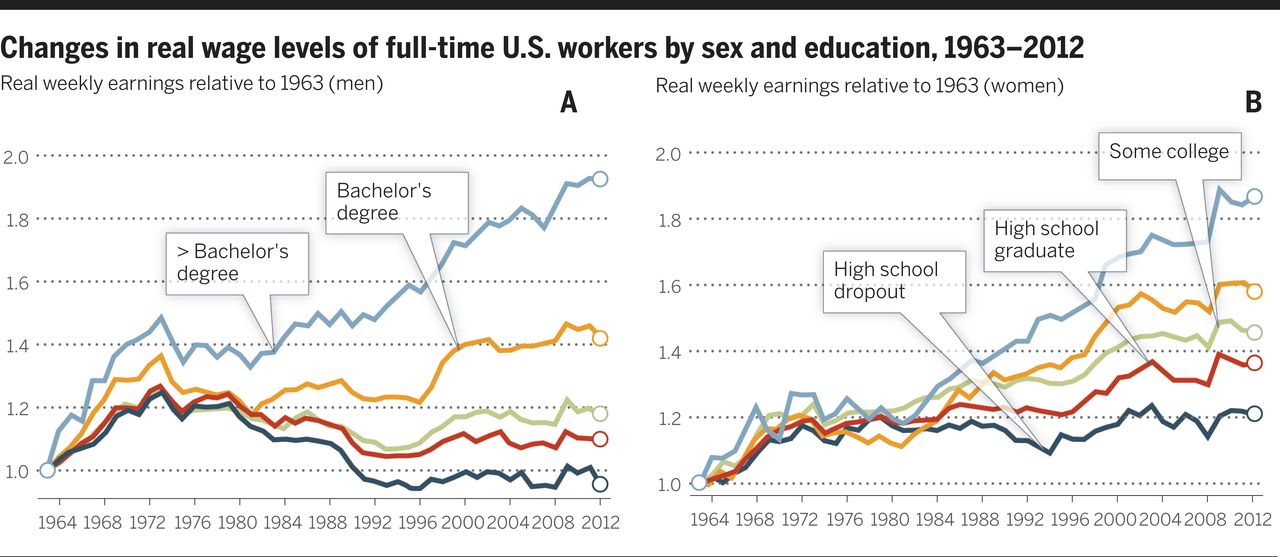
Markets work really well when experienced purchasers make frequent purchases and can readily evaluate the quality and utility of the purchase. E.g., we're all pretty good at picking restaurants. But a degree is a very expensive product sold to people who, by definition, don't know much about the topic. It's no shock to me that a lot of them end up with buyer's remorse. And I'm not seeing how to fix this; schools are getting paid either way, so they're not motivated to solve the problem.