Normally I live in China, and rarely eat western breakfast.
Recently I returned to Australia to spend some Christmas time with my extended family.
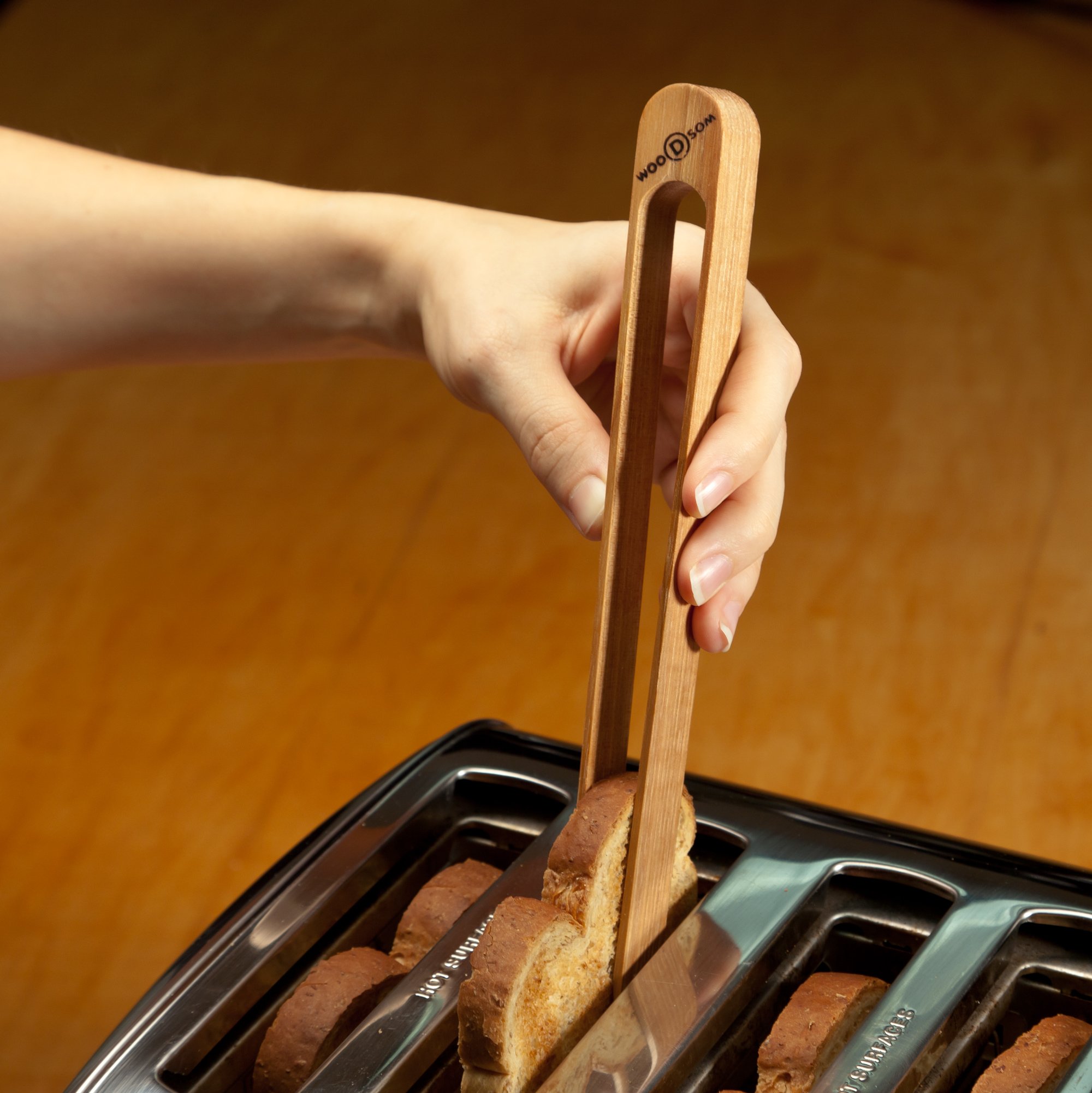
A few mornings ago, I put some real bread I cut from a sourdough loaf in a toaster. Due to its irregular size, when it popped it didn't pop out completely, resulting in a sort of "toaster is too hot to insert fingers, toast is too hot to hold, toast is ready, find metallic implement to insert in to mains-powered device to extract toast" problem.
Sure. In China we would use chopsticks. But my point was not that there is no viable workaround, more that the mechanical issue should be solved.
Perhaps it is playing too much Shenzhen I/O, but I feel like a basic IC and sensors could solve this by detecting the width/height of toast pieces and continuing to release until the toast was substantially ejected from the toaster.
I think most toasters pop up using a coiled spring. Replacing it with a linear actuator seems like the way to do this. Perhaps some high end toasters already use an actuator with a laser to detect if the toast is 'up' enough. Fancy stuff
Your suggestion amounts to "work around it". That's one perspective, but also consider the very real problems of irregular ends of the loaf (where cutting thinner would result in a piece too small along the other two dimensions to be useful), loaves with air pockets that need to be cut thicker to maintain structural integrity (and utility) of the resulting toast, and people who simply prefer thicker slices.
What you want, then, is more akin to a sandwich press rather than a toaster. Or perhaps a toaster oven. Mechanically, it's not impossible, but the design of a toaster (spring loaded release, heating elements on either side) can't be altered much without turning it into one of those two things (or a poor imitation of them).
Seems a tortured equation: perhaps a vertical sandwich press without the press! I was thinking it may be possible to change the spring to another form of vertical linear actuator (eg. stepper motor driven) and giving it more controlled movement, also smarter with proximity/LOS-style sensors. Perhaps the top cover could also expand and contract. The very fact there's a spring-loaded release shows this is old tech. The market can clearly tolerate a few dollars for a stepper motor, as there are 'smart' toasters selling for nearly ~$200USD and the bottom is ~undifferentiated. See http://www.brevillegroup.com.au/wp-content/uploads/2016/10/B...
Would an ordinary stepper motor cope with the temperatures? Our cheap toaster has a handle that lifts (so isn't limited by spring return); and the socket off switch is the backup for when you need to jam a form in to reach to get your crumpet out.
In the US, most toaster ovens I've seen have about 2-3 times the footprint of the average toaster, with additional height. This is actually pretty reasonable as you can use the toaster oven instead of the oven or microwave oven for many tasks (it's a less specialised tool than a toaster).
Last I read, US homes are the second largest in the world, after Australia. In Asia, many people live in apartments and that space is unavailable / non-negotiable. In addition, microwaves are not nearly so widely used.
And yet, every tiny apartment I visited in Korea and Japan had a toaster oven. The toaster oven is an incredibly useful and versatile tool that can stand in for bigger appliances, like full-sized ovens, in pinched spaces.
To be fair there shouldn't be any voltage inside the toaster basket area when the toast has popped up. Unless they did something stupid when designing the toaster. And you can always unplug it before sticking utensils in there.
I've had the same thing happen with toasters, and at least as of a few years ago it was completely possible for a piece of toast (of just the wrong size) to get stuck such that it not only didn't pop up, the toaster didn't turn off. So the toast starts to burn, you grab a knife, what could possibly go wrong?
This happened pretty regularly as it was a European toaster designed for perfectly uniform extruded wonder-"toast" and I kept sticking hand-cut slices from round loaves into it.
Sure. To be clear the gripe is less about the potential for a shock (real or otherwise) and more about the clearly nontrivial frequency and irritation of the issue.
With irregular pieces on this and other toasters I have used, part of one piece of toast can block the further vertical motion of the carriage at the top portion of its linear range.
I bought my bottom of the barrel Wal-Mart toaster for $6 about 8 years ago. It might occasionally have issues popping out a piece of bread but it cost $6 and it toasts bread consistently.
I'm mostly holding on to this thing to prove a point to the "they don't make them like they used to" and the "you have to spend at least $100+ on X or else it will break in a week" crowd. I know it isn't the best toaster out there but I'd take it over a $189 toaster even if both were offered for free just because I'd feel like an idiot for having something so ostentatious on my countertop.
Others have complained if the slot is too big for the piece, the piece falls one side and gets toasted in one part and not in another part. That's other people's feedback, not mine.
Some toasters have wire meshes that close in on the bread to hold it vertical, but they tend to leave marks.


Recently I returned to Australia to spend some Christmas time with my extended family.
A few mornings ago, I put some real bread I cut from a sourdough loaf in a toaster. Due to its irregular size, when it popped it didn't pop out completely, resulting in a sort of "toaster is too hot to insert fingers, toast is too hot to hold, toast is ready, find metallic implement to insert in to mains-powered device to extract toast" problem.
I mentally facepalmed.
Someone should really fix toasters.