That's the textbook explanation for this stuff, and matches what we see in the document. But I'm with the grandparent: this sort of pedantry fails badly in real-world code. What happens when you want to combine that rectangle implementation with someone else's geometry library which has its own notion of Point?
This kind of nonsense is just a recipe for everyone spending lines of code and neural cycles on a bunch of junk that will just be unpacked back into the underlying representation anyway in order to be used in the real world.
Don't do it. Simplicity trumps almost everything in real engineering. Abstract where abstractions add real value (which usually means "hide non-trivial amounts of code) and not where they do nothing but "document" stuff.
In this case the usage is clear (and IIRC I think most IDE's will avoid omitting lib1:: and lib2:: in compiled code even if you do). The whole point of namespacing is to avoid the name collision issues that are (were?) inherent to C.
I think the point may have been to call a function in one library with the arguments of types from the other library, so that you need to write less glueing code. But in that case, you don't actually know that the point types are compatible (they might be), especially since their internal details can change. I don't think this is about name collision.
Exactly. The point is that the abstracted Point hides implementation details like the underlying representation, which is good as far as it goes because it prevents goofs like overflow and trucation due to incorrect type conversions, etc...
But the second you need to match that abstraction to the code from some other developer which doesn't use it, you need that underlying representation back again. And this kind of mismatch isn't an uncommon edge case, it's the pervasive truth of modern development.
Basically: C++ can't win here, and it would be better not to try IMHO.
> you need that underlying representation back again.
But that's kind of a problem: while the underlying representations might be perfectly compatible, and you might know that for sure, that is not at all guaranteed. If you have a function that takes (int, int, int, int) instead of (Point1, Point1), Point1 = (int, int), that would not help you very much when Point2 = (int32, int32) (e.g., sometimes libraries make assumptions about internal representations, sometimes they don't).
Using low-level primitives everywhere like that can be a very misleading kind of simplicity - it might disappear. That C++ makes you reckon with the possibility that Point1 /= Point2 is supposed to tell you something about what you can know for sure about those types.
I have this issue occasionally, switching between sf::Vector2, b2Vec2, gVec2, etc. Something like drawLine({v.x,v.y},{w.x,w.y}) usually works in a lot of these cases, but I don't mind explicitly converting between representations in order to fulfil an interface.
The `(int, int, int, int)` version doesn't really help here though, because just because both libraries have int parameters doesn't mean they're compatible (eg as said above, could be different coordinate systems - but they look compatible!). At least with two point types its obvious that you need to convert between them.
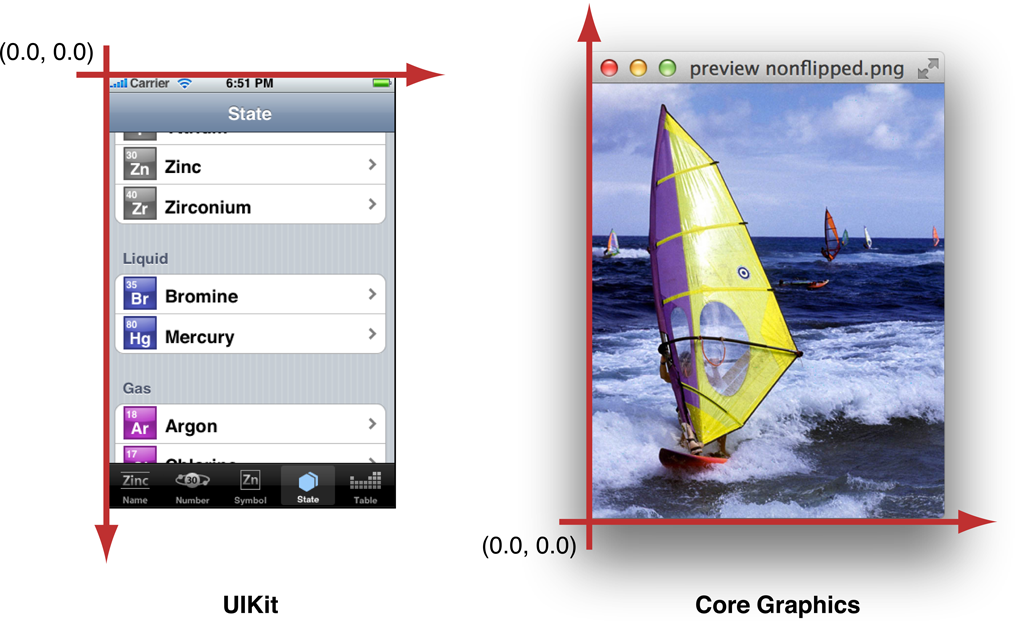
What about the case when one library calls the origin the top left of the screen and the other library considers the origin the bottom left of the screen?
But... the compiler can't catch that incorrect translation code. The developer takes MyPoint and unpacks it into two doubles, then hands it to the YourPoint constructor and forgets to invert Y.
That's the point. The compiler is useless here, and this kind of glue code is probably 60+% of what developers are actually writing in practice.
But this site wants us to sit down and write a ton of boilerplate to handle a "Point" abstraction (complete with a full operator suite I'm sure, yada yada) just to solve a problem that can't be solved in the first place.
Well, you probably wouldn't be able to construct a UIKit::Point from a CoreGraphics::Point in the first place (these aren't C++ libraries but let's just go along for the analogy) if they didn't know about each other. You'd have to strip out the X and Y yourself, and this is the moment where you should be wondering if that's legal to do.
And if the libraries do know about each other then it's even better, because you can just say
    CoreGraphics::Point cgp = CoreGraphics::Point(0, 0);
    UIKit::Point p = UIKit::Point(cgp);
and p could already be in the right coordinate frame.
Anyways, this isn't some constant thing. Java developers typically like abstraction, ruby guys like passing raw hashes and strings/symbols everywhere. My preferences change based on language, codebase size, and how many people I'm going to be working with.


This kind of nonsense is just a recipe for everyone spending lines of code and neural cycles on a bunch of junk that will just be unpacked back into the underlying representation anyway in order to be used in the real world.
Don't do it. Simplicity trumps almost everything in real engineering. Abstract where abstractions add real value (which usually means "hide non-trivial amounts of code) and not where they do nothing but "document" stuff.