The article does say that AI agents could go through the web interface, but it's not clear if Doordash is counting those orders as AI orders or not. I agree, there's no real information here.
By all accounts, Anthropic has taken on an enormous amount of technical debt in Claude Code (and presumably its other software). What isn’t clear is whether this is actually a problem.
At normal startups, tech debt slams the brakes on product growth, but it takes a lot of years for it to happen. At Anthropic, they’re speed running tech debt, but they also have AI to help them navigate it. Will it be a problem? Don’t know, looking forward to finding out.
I think it’s far more likely that most voters are completely unaware of the inside baseball, and vote based on how they’re feeling about things that affect them personally. As Clinton said, “it’s the economy, stupid.”
You’re implying that Apollo is biased, but the thing you’re quoting is a very brief report on publicly available research. This is the entirety of the article:
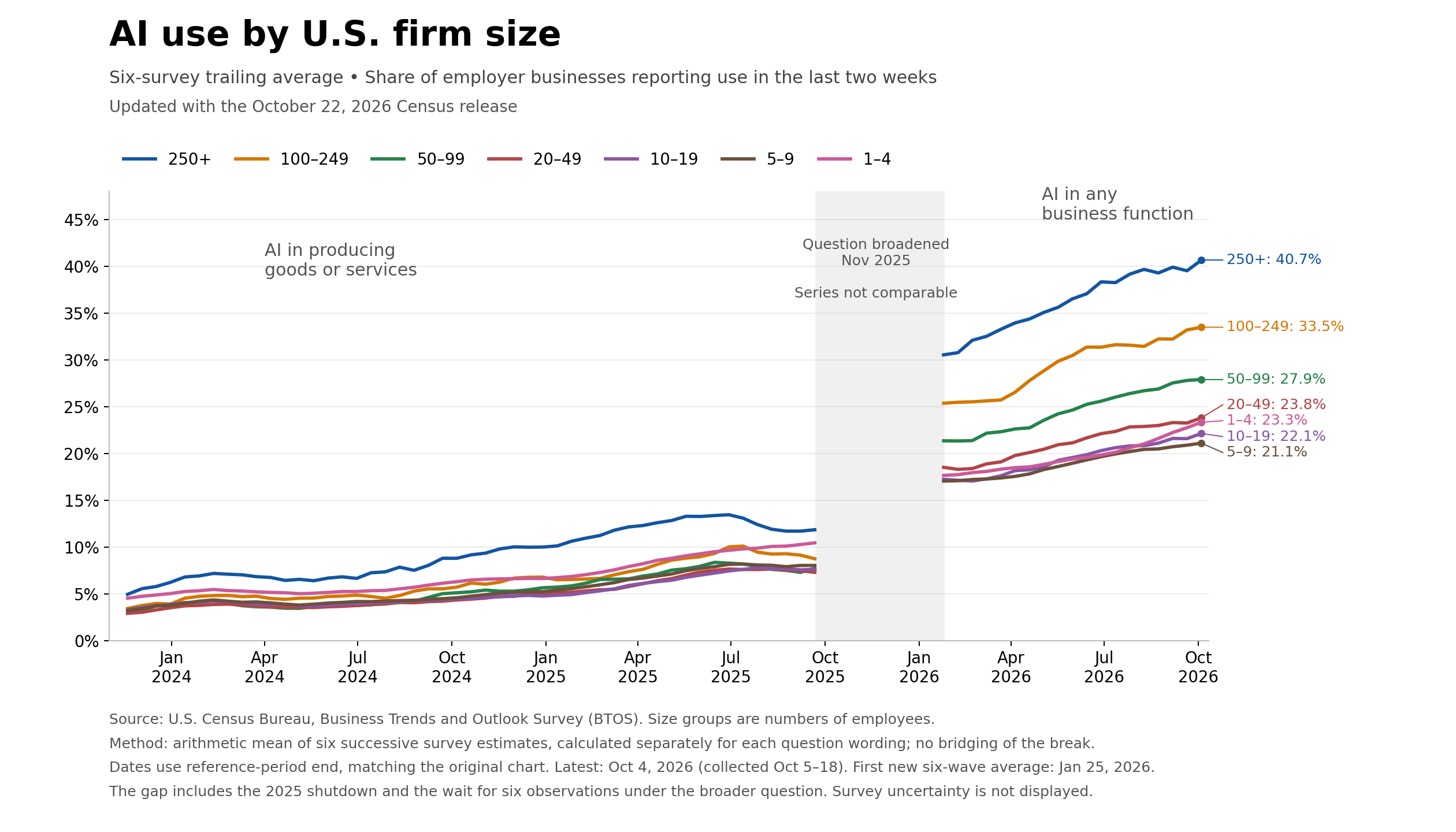
“The US Census Bureau conducts a biweekly survey of 1.2 million firms, and one question is whether a business has used AI tools such as machine learning, natural language processing, virtual agents or voice recognition to help produce goods or services in the past two weeks. Recent data by firm size shows that AI adoption has been declining among companies with more than 250 employees, see chart below.”
Two questions:
1) What does that chart show today? (Genuine question. I’m curious and don’t know where to find it.)
2) Regardless of what it shows now, why do you think Apollo reporting on it is noteworthy?
I'm implying they may be biased in what they chose to report on and how they frame it, yes. Deciding which figures to turn into a chart is an editorial decision.
> I'm implying they may be biased in what they chose to report on and how they frame it, yes. Deciding which figures to turn into a chart is an editorial decision.
I think the Apollo thing is a fairly dumb hot take based on a near-term wiggle in a graph, but it's hilarious that you are calling them biased.
Pot, kettle, black, etc.
Substantively, I don't think it's surprising at all to see those lines go up -- it would be shocking if they didn't go up, given the intensity of the hype. The slope is what matters. In particular, I wouldn't argue that your graph shows any kind of acceleration in adoption over time.
I’m surprised it’s so low, actually. AI is defined so broadly that it includes voice recognition and machine learning of any sort, and in any business function. It’s hard to draw conclusions from that. I wish they had kept it narrowed to LLMs specifically.
It’s too bad they changed the definition midstream, too. It would have been nice to see the two lines side by side.
> Of course Apollo is biased. They are a hedge fund.
They are not a hedge fund, they are a Private Equity/Private Credit fund, a financing firm and a venture fund all wrapped up in an alternative asset management company that does almost everything related to private credit.
But such a thing should not be prosecutable in the first place. Opening an unlocked door isn't breaking and entering. If you walk inside and steal something, that's a different thing. But if you just close the door and alert the owner that their door is unlocked, what sane person would consider that a crime?
Gas is dispatchable, nuclear is not. It’s enormously expensive, and that expense is locked in whether you need the power or not.
We’re already in a situation where we have more power than we need during certain hours of the day in some states/countries, and that’s not even counting the massive, accelerating buildout that will happen between now and the years before new nuclear is built… even it was started today.


The current economy being Biden’s fault, and not tariffs, corrupt tax cuts for the rich, and oil blockades, is certainly a take.
Judging by the recent elections, I’d say most US voters don’t agree with that take.
reply