This is my personal pet peeve as well. Like, I accept maybe everything shouldn't be offered to everyone, but maybe just gate keep it behind credit card( but I know that is a market penetration no no ). I feel like such a waste of power ( electrical and the potential we might be missing out on ).
Dunno man. Yesterday I played with Qwen3.6-27B ( 128gb to play with though so 100k context set ) and I think right now the main benefit of hosted models is context, frontier models and.. my stuff is already there.
Agreed. What was largely lost is nuanced discussion around the topic. Usually, the way it progresses, you get strong detractors and strong proponents each with wildly incompatible ideas on what it is. Proponents are ignoring the risks. Detractors are ignoring the benefits. It gets us, collectively, nowhere.
Anecdote time. I had a fun little interaction with my boss's boss the other day. He has limited exposure to AI as tech goes, but speaks with confidence of someone, who has seen it all ( and made it sound like this is the view of tech execs -- you tell me ). Anyway, his claim was 'tech is already good enough; if you can't hack it with it, you are on your way out'.
In our own company, our tooling has mostly sucked ( after a period of being decent ). Any suggestion of better ( in this case more expensive models ) is rebuffed as both cost saving measure and efficiency. We are basically told to work not only with corporate handicapped versions of those models, but also ones, where company can save a buck and pretend it is going well.
Its not gonna end well, but, because it was clearly not a technical conversation, I smiled and nodded.
edit: In case you are wondering why it is relevant. OpenAI can do all sorts of fun things, but it is largely pointless if corps are not using it to its potential. And they don't.
I think this is part of the reason I am wary of trying it ( including some of the competitor's variants ). They all want you to pay attention, because you may be forced to make a decision out of the blue. I might as well be in control all the time and not try to course correct at the literal last second.
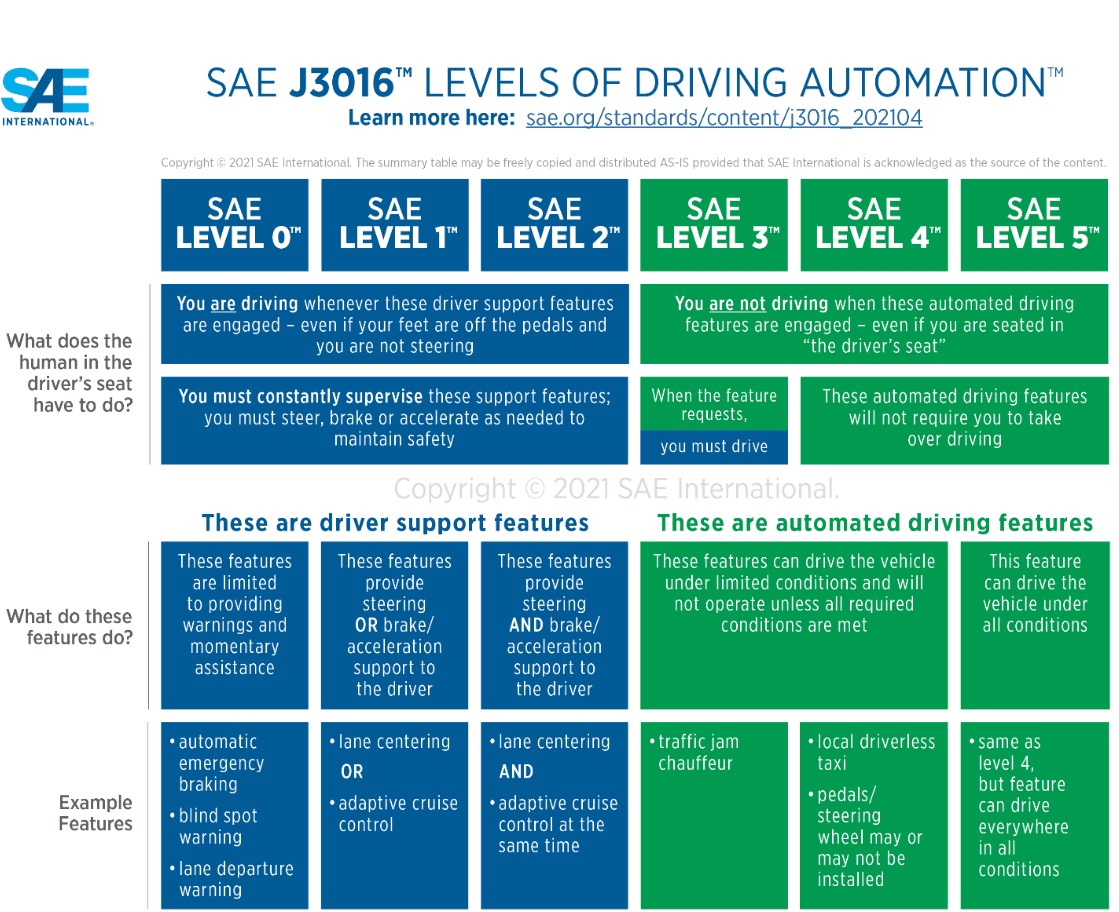
SAE level 2 is just a bad idea. People can't be expected to carefully monitor a car and take over at a moment's notice when it's doing all the driving. My adaptive cruise control is great and I hope to have a future car where I can zone out while it drives and take over after after a few seconds heads up, but the zone between shouldn't be a valid feature.
I think you mean SAE Level 3. SAE Level 2 is “lane centering” and “adaptive cruise control” [1]. (Level 3 is “when the feature requests, you must drive.)
I meant to include both SAE 2 and 3. I think having both lane keeping and cruise control on at the same time will tend to cause people to lose focus in a way they wouldn't if they had to do one or the other.
I don't even use cruise control. I like to be actively switched on all the time constantly making little decisions, including speed, so that I actually am instantly ready if I need to make some big decision.
People these days letting the car drive, thinking they can spring into action I think are underestimating just how cold their cache lines are getting and the major page fault they're going to take when they try to take over.
And I've seen comments by people that they were letting the car drive itself into a bad situation they could see developing, but didn't jump in to take over right away in anticipation (effectively betting on the car over their own skill but still realizing they had to jump in if the car got it wrong--which is just so incredibly confused).
Car crash deaths are better known than software bug caused deaths. Worse: a car crash can cause the driver's death; I wouldn't offload work on which my life depends to an experimental tech.
I don't really buy that. There are a lot of situations (e.g. being directed to park in a space at a fairgrounds, ski area, or whatever) that you can't reasonably expect AFAIK to be programmed into a car's computer. Even if a car can legitimately handle roads under most circumstances, they're not going to be able to handle everything.
"Because the Origin does not have manual controls, the NHTSA must issue an exception to the Federal Motor Vehicle Safety Standards to permit operation on public roads"
There is a reason that pilots get basically told the ins and outs of a specific plane. Imagine the outrage if people need to do month long training for a specific car just to be able to drive it (and not just a general "here is how cars roughly work and the laws of the road").
Airline pilots aren't supposed to take a nap, and there are occasionally articles about the various things that have gone wrong because the pilots weren't paying attention.
How do you reverse such a car into your own driveway that's positioned in a funny way at an angle and an incline? What if you're parking off road for any reason? Like, you have to be able to manoeuvre your own vehicle sometimes.
Treat it like a driver assistance system. I treat FSD the same as I treat Augmented Cruise Control and Lane Keep Assist in my CRV. I keep my hands on the steering wheel and follow along with the decision making.
I’m in left lane on highway. Tesla ahead of me but quite a ways away.
I realize as I’m driving that the Tesla is moving quite slow for the left lane driving. And before you say it, yes there are lots of people speeding in highway left lanes too.
So - I passed on the right rather than tailgate. Look over and see a guy leaning back in his seat. No hands on wheel. Could’ve been asleep. And driving 10-15 mph slower than you’d expect in that lane.
To your point about using it FSD the way you do, makes total sense to me. Which implies you would also cruise at the right speed depending on the lane you are in, unlike my example.
One of my major complaints about FSD is the 'speed profiles'. You used to be able to set a target speed directly. Now, you can only select a profile. You're either going the exact speed limit, 2-3mph over, or essentially 'with the flow of traffic' which can lead to speeding +15 over the limit.
Didn't know about that feature. Thanks for the illumination. On verge of going full electric and looking at BMW, Lucid, Porsche, Rivian, Tesla.
I wonder what's taught to new drivers about this sort of situation. My intuitive feeling (driving for almost 30 years) is you drive with the flow of traffic when traffic is present. I don't see too many left lane drivers glued to speed limits, but it's obvious when someone is a fast or slow.
It's worth noting that older Tesla's pre-2024, are stuck on an old version of FSD due to compute limitations. Recent FSD, generally, does not hang out in the left lane and is very good at recognizing when vehicles approach from the rear. It will move to the right lane to allow them to pass.
I won't comment on whether it's acceptable to speed or not. I don't think that's the point.
Most highways I drive on exhibit a predictable pattern. Slower folks in right lane. Faster folks in left lane. Maybe those slower folks are at the speed limit, or above, or below. Left lane folks somewhat faster.
Should everyone obey the speed limit? Sure! Hard to argue that point.
My observation was a Tesla driving at - let's call it "right lane speed" in the left lane. Maybe slower. Slow enough that you'd soon see a predictable back-up behind the car - some tailgating, brake usage, etc. The stuff that in my view leads to more accidents, swerving, and phantom traffic that occurs when people pile on each other, use brakes excessively, and end up slowing to a crawl.
FWIW: The "is speeding acceptable" question is somewhat resolved by police. I rarely see people pulled over for speeding within the flow of traffic, vs. somewhat swerving in/out or just driving much faster than everyone.
Don't remember the last time I saw an officer pick a car out of a normally flowing left lane to issue just that one driver a ticket.
Real question, then, from someone who only bothers driving when he must and even then in a 2016 model: Why do you use it? What beneficial purpose do you find it to serve?
I'm asking because I feel I must be missing something, inasmuch as to have my hands on the wheel while not controlling the car is an experience with which I'm familiar from skids and crashes, and thinking about it as an aspect of normal operation makes the hair stand up on the back of my neck. (Especially with no obviously described "deadman switch" or vigilance control!)
Here's a simple example from last week. FSD was in control on my way to work, stopped at a red light early in the morning before the sun was up. The light turns green and FSD does not accelerate. I figured it was somehow confused and I was starting to move toward hitting the accelerator myself when a car comes flying through the red light from the driver's side. I hadn't noticed this car, but FSD saw it and recognized it wasn't slowing down. I could see there were headlights, but it wasn't clear how fast it was going.
It's just nice having a 'second set of eyes' in a sense. It's also very useful when driving in unfamiliar cities where much of my attention would be spent on navigation and trying to recognize markings/signs/light positions that are atypical. FSD handles the minutia of basic vehicle operation so I can focus on higher level decisions. Generally, at inner-city speeds, safety and time-to-act are less of an issue and it just becomes a matter of splitting attention between pedestrians, obstacles, navigation, etc. FSD if very helpful in these situations.
I appreciate your thoughtful and detailed response. I'll need to think about it for a while, too. It had not occurred to me to consider the possibility that someone else's FSD might protect me from the general incompetence and unreliability of amateur motor vehicle operators.
(Jumping a light in the dark? Not thinking or learning to navigate by verbal instructions from your satnav or phone, instead of compromising the primary sense you must constantly use to drive without risking manslaughter? I'm sorry, but if this is the standard, I really can't describe it other than it is...to say nothing of your considering safety less important, as you say, in the "inner city" that is my home.)
> Not thinking or learning to navigate by verbal instructions from your satnav or phone, instead of compromising the primary sense you must constantly use to drive without risking manslaughter?
Navigating involves reading street signs, block numbers, and traffic markings. These are all visual elements that can distract from safety monitoring. How many minor accidents result from driver's trying to figure out where they are, or need to go?
> I'm sorry, but if this is the standard, I really can't describe it other than it is...to say nothing of your considering safety less important, as you say, in the "inner city" that is my home.
My claim isn't that safety is less important in city driving, it's that driving is far safer due to lower speeds. There's more time to react and lower risk of catastrophic results when driving at 35mph. The challenge for a driver isn't sudden loss of control as you may experience at 65+mph. The city driving challenge is trying to track markings, signage, pedestrians, and parked cars while also navigating and managing the vehicle's basic operation. FSD can track all of that without distraction and leave the driver responsible for more human reasoning tasks.
You failed, in this case by hastening to cross the intersection as soon as the light came green, to account for the possibility of another driver's error. If you weren't taught to do that, as I was, then the mistake is not entirely your own. It was still a mistake, which you have already acknowledged would have led you into an accident had your vehicle not rescued you.
> There's more time to react and lower risk of catastrophic results when driving at 35mph.
Not for me. You're the one wearing power armor, remember.
> You failed, in this case by hastening to cross the intersection as soon as the light came green, to account for the possibility of another driver's error. If you weren't taught to do that, as I was, then the mistake is not entirely your own. It was still a mistake, which you have already acknowledged would have led you into an accident had your vehicle not rescued you.
Even if we accept your interpretation of the situation as true, you're making the case for FSD. You can think of FSD (or other self-driving solutions) as raising the floor for bad drivers. If I'm a driver with some otherwise dangerous habits (nobody is perfect) then FSD is filling the gaps in my skill.
> Not for me. You're the one wearing power armor, remember.
But this is a joint interaction between the pedestrian and the vehicle. I can't make the pedestrian more aware. I can't give the pedestrian super-human reaction time. I can, however, give those traits to the vehicle. That's a major selling point for autonomous vehicles.
Well, sure. As I said yesterday, it hadn't previously occurred to me to think of someone else's FSD as helping keep me safe from them. (Thank you again, by the way, for helping me put two and two together on that!)
As a pedestrian, I don't need superhuman reaction time, because unlike some I move at speeds a human mind can comprehend. Nor, I promise you, need I be "more aware" - what a frankly foolish thing to say, when there is nothing on Earth even remotely as dangerous to me, day to day, than you and those like you! I assure you, I am about as aware as it is possible to be. I have to be! Look at you.
But this again is a splendid illustration of the problem, for which I again must give my gratitude: the old-school motorhuckle lifestyler dingbats were right all along, it turns out, to call cars "cages." You carry yours around in your head all the time, I see.
I was watching the Tesla display on my way back home from LaGuardia airport last week (passenger, not driver).
No accidents or close calls, but it was obvious that I might be focused on 1 or 2 things in that very busy and chaotic environment whereas the car (FSD or otherwise) sees more than 2 things and possibly avoids something on my behalf.
When I'm driving I know what I'm doing, what I'm planning to do and can scan the road and controls with that context.
Making me have to try and guess what the car is going to do at any given time is adding complexity to the process: am I changing lanes now, oh I guess I am because the autonomy thinks we should etc.
Not sure about your car but the car I have with augmented cruise requires hands on wheel. Turns off otherwise. (Volvo XC90)
I agree that there are situations where what I do as a trained driver is different from augmented cruise.
A good example (or perhaps I'm wrong) is this: in a lane, car pulls into lane in front of me and between the car further ahead. Now I don't have enough space in between me and that new entrant. But instead of using brakes (unless eggregious), I bleed speed until I make space I want. Augmented cruise doesn't do that - it hits brakes.
So, from behind, I think it looks like I'm using my brakes a lot more than I am when on augmented cruise. And excessive brake use distracts the driver behind me.
Sure, but the practical experience is that FSD is fairly predictable. It's just a matter of personal preference that comes from experience. I wouldn't impose a system like FSD on everybody.
I'm a >90% FSD user, and I approve this sentiment. My wife hates it for the mistakes it makes (eg. seems like there is recent shadow recognition regression) and "errors in judgement" (not getting in the turn lane in a timely manner), she would never use it on her own.
I've got plenty of experience, and (feel as though) I know most of it's failure points. I had to drive my 30 minute commute last week, and it was decidedly unfun. I have seen the future and I don't want to go back.
96% here, including DC and Baltimore. Besides the bizarre Navigation choices and waiting to long for lane changes, FSD has reached essentially zero interventions outside of bad mapping situations. I really wish Tesla would use better map data, for sure.
I am admittedly not a fan, but I note that in my social circle I don't have anyone who considers one, one that has one wants to sell one, one vendor has one ( the truck one ), but it is clearly for marketing purposes so at least it makes sense.
Eh, buddy says he uses them for his network and, apparently, some light IT maintenance for his family members. So far it seems to be working for him. I am not that brave.


reply