The real problem here is runaway population growth. In California we've seen our population double in the last forty years or so, and there just isn't enough water in the American Southwest to accommodate that kind of growth.
Of course if 80% of the states water goes to farmers and you're 20% below normal, that means farmers have to be part of rationing. But do you really think there would be so much farming if we didn't have 20 million extra people here?
And farmers are not long gone from the Central Valley. Most farms are still family owned, they're just too large to be worked by one family. You can call it agribusiness if it makes you feel better to depersonalize them, but they're still farmers.
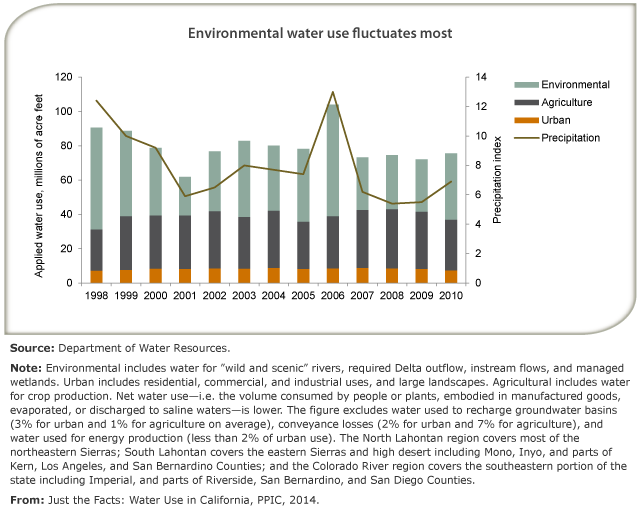
Urban water usage has remained steady at around 11% of the total despite population growth. Agricultural consumers use about 4x more water, and then export it out-of-state.
Agriculture uses around 80% if you don't count environmental water usage, yes.
Those people need to eat, but it's not like 100% of the food grown in California is eaten in California, nor does California grow 100% of the food it consumes. California's growers are driven by the national food market, not the state food market.
That's only part of it. California had water issues back into the 70s. I used to live there and remember all the rationing then. The big part of the problem is California never really did anything about it.
Are you trolling? Here is a classic paragraph from Catch-22. “His specialty was alfalfa, and he made a good thing out of not growing any. The government paid him well for every bushel of alfalfa he did not grow. The more alfalfa he did not grow, the more money the government gave him, and he spent every penny he didn't earn on new land to increase the amount of alfalfa he did not produce. Major Major's father worked without rest at not growing alfalfa. On long winter evenings he remained indoors and did not mend harness, and he sprang out of bed at the crack of noon every day just to make certain that the chores would not be done. He invested in land wisely and soon was not growing more alfalfa than any other man in the county. Neighbours sought him out for advice on all subjects, for he had made much money and was therefore wise. “As ye sow, so shall ye reap,” he counselled one and all, and everyone said “Amen.”
The existing situation is even more stupid than paying alfalfa farmers not to grow alfalfa.
If you’re forced to choose between the lesser of two evils, paying alfalfa farmers is where it’s at. Obviously better water management would be the sensible choice, but that hasn’t been on the table for decades.
This actually happened back in the day. The US was originally an agrarian society and farmers held a lot of political power. Today farming makes up 1-2% of the economy. However, back then the farmers faced a problem: If you make too much food, prices fall, and you go bankrupt. Farmers would then control the supply of food by not farming to keep prices up. Certain elements within the government were sympathetic and would pay farmers not to plant to help control the problem the market put them in.
This developed a problem as people were paid to not produce and when droughts happened, there was not enough food to go around - a critical failure for a civilization. A problem that is a relevant lesson today as politicians had used faulty economics to try to fix the problem.
Modern farm policy is wasteful, and deserves criticism, but it turned the problem on its head by subsidizing farmers to produce as much as possible. We've gone from occasionally starving to death to having medical problems from eating too much. A good problem to have.
> The big part of the problem is California never really did anything about it.
That isn't really fair, there was a lot done. Desalination plants went up along the coast and rationing and conservation efforts went in to full-effect. The problem was that when the rainy season returned the desalination plants were spun down and people generally stopped caring as it was no longer an issue.
The problem it there isn't much to actually do. Every last drop of the Colorado river is spoken for, so it's not like you can bring in more water by adding capacity there. We're taking the most we can take out of the delta, too. Where is the water going to come from?