> When the LHC resumes bashing particles together in May, LHCb scientists will continue tracking penguin decays in hopes that the anomalies in the data will climb to 5-sigma certainty, signifying an indirect discovery of “new physics.”
Large sigma values only rule out statistical fluctuations, not systematic errors.
Adam Falkowski's Resonaances is the go-to particle physics blog for these sorts of stories. On this particular anomaly he has this:
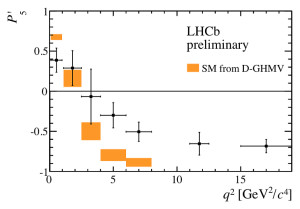
> The measurement moved a bit toward the standard model, but the statistical errors have shrunk as well. All in all, the significance of the anomaly is quoted as 3.7 sigma, the same as in the previous LHCb analysis...So how excited should we be? One thing we learned today is that the anomaly is unlikely to be a statistical fluctuation. However, the observable is not of the clean kind, as the measured angular distributions are susceptible to poorly known QCD effects. The significance depends a lot on what is assumed about these uncertainties, and experts wage ferocious battles about the numbers. See for example this paper where larger uncertainties are advocated, in which case the significance becomes negligible. Therefore, the deviation from the standard model is not yet convincing at this point. Other observables may tip the scale. If a consistent pattern of deviations in several B-physics observables emerges, only then we can trumpet victory.
what i see is that SM generates completely different prediction curve than the experiment results. It isn't just a 4th and 5th bin there SM predictions are different from the experiment results - as far as i see the whole [interpolated] curves are different. The SM generated one is much steeper and kind of like goes extremal with energy increase what is typical for physical theories when they hit borders of their applicability while the experimental results behave pretty well, i'd say even beautiful, into the higher energies. It looks like SM is really due for correction which should also affect its predictions for smaller energies - while may be measurement wise the difference between predictions and results in the first 3, lower energy, bins may be not that big, it is obvious from the curve steepness that SM describes different physics than experiments show, and that the same difference just grows and becomes obvious at 4th, 5th bins...
The article has a different way of thinking about the "shattering" of colliding protons. Perhaps this is a long standing "in joke" among particle physicists, but it was the first time I read it:
   The hopes of thousands of particle physicists
   are riding on the protons that in the coming
   years will collide there, shattering into
   petabytes of data that may carry long-awaited
   answers to fundamental questions about nature,


Large sigma values only rule out statistical fluctuations, not systematic errors.
Adam Falkowski's Resonaances is the go-to particle physics blog for these sorts of stories. On this particular anomaly he has this:
> The measurement moved a bit toward the standard model, but the statistical errors have shrunk as well. All in all, the significance of the anomaly is quoted as 3.7 sigma, the same as in the previous LHCb analysis...So how excited should we be? One thing we learned today is that the anomaly is unlikely to be a statistical fluctuation. However, the observable is not of the clean kind, as the measured angular distributions are susceptible to poorly known QCD effects. The significance depends a lot on what is assumed about these uncertainties, and experts wage ferocious battles about the numbers. See for example this paper where larger uncertainties are advocated, in which case the significance becomes negligible. Therefore, the deviation from the standard model is not yet convincing at this point. Other observables may tip the scale. If a consistent pattern of deviations in several B-physics observables emerges, only then we can trumpet victory.
http://resonaances.blogspot.ca/2015/03/lhcb-b-meson-anomaly-...