Multimeters can be made for $10 or $15, but Fluke continues to dominate the market with equivalent meters costing 10x more. And don't tell me that these basic multimeters incur significant R&D costs.
You've obviously never done any serious electrical or electronics work then. The reason they're so expensive is four reasons:
1. Mains and high voltage work. If you're working with high voltages or massively different potentials, Fluke actually design the boards and isolation circuitry properly. You're not going to get electrocuted by a Fluke meter. It doesn't even take a high voltage, just a bad earth to kill you. Cheap multimeters and even mid range ones tend to ignore this fact in favour of cost.
2. Explosion resistance. If you stick your cheap multimeter in resistance mode and whack ot across a 400v 30A supply its going to blow your hand off. No joke. Fluke - dead meter by design or absolutely nothing and it still carries on working.
3. Reliability. I have a 1989 Fluke 87 that cost me a small fortune. It works fine today, still handles calibration perfectly and is pin sharp and accurate. Other vendors fall to bits, drop out of calibration ranges and pack in completely. I know because I have three meters at any time and the only ones that survive are flukes.
4. They have lesser effect on the circuit you are measuring because the input stage is better designed.
So you're merely putting your life in the hands of a $10 meter.
My current fluke cost me £435 and it was worth every damn penny
Edit: adding some more as I'm not posting this from my phone now:
5. Cheap meters can't do true RMS measurements.
6. Cheap meters have probes without correct insulation.
7. Cheap meters have probes which fall to bits and expose the conductors.
8. Cheap meters have less probe/connection options which are required for more than just passive metering.
9. Cheap meters can't be calibrated at all by calibration services as there is nothing other than a single master voltage reference inside which is usually not a constant current or voltage source but a resistor/voltage divider across the reference voltage. This can drift as batteries drain for example.
10. Decent meters have a better count i.e. 0.00000 vs 0.00 on the displays.
I could go on forever at why a $10 meter is a joke.
As a consumer, I find it confusing when "cheap" (in both senses of the term) meters knock off the Fluke visuals.
My first Fluke multimeter was a hand-me-down from my father, and he had made it clear how it was a better instrument. At the time, there were no "Fluke yellow" instruments on the market. They were generally considered ugly.
Fast forward through the 1990s and I'm in a builders supply shop looking at meters. I grab what I thought was a Fluke, got home, and only then realised I had a cheap knockoff. Yes, my fault for not reading, but a large number of second generation tool users have been raised to invest in the products of a few companies that have maintained solid reputations.
The Fluke 25 and 27s could be had either in fading black or get-dirty-yellow and fading black. Both came with decaying LCDs for no additional cost.
They definitely used yellow and black in the mid-to-late 1980s, primarily on "ruggedized" field gear. Bench gear tended to look pretty much like most bench gear, as far as I can recall.
I've had a Fluke 87 for years, and one day I was testing inrush current draw on something and the meter stopped working. Why? Because I was using the 400mA fused port, and I'd put ~700mA through it.
For some reason it was that detail and sensitivity that made me realize just how precisely made meters like that are. Thankfully it was just a $7 fuse to fix it.


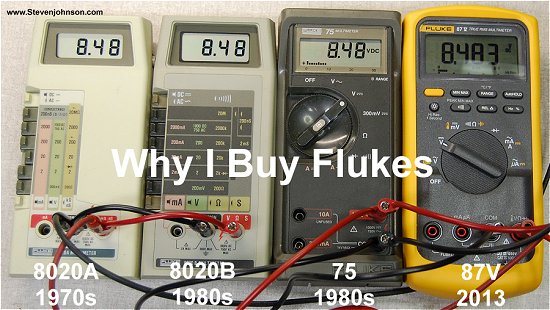
You've obviously never done any serious electrical or electronics work then. The reason they're so expensive is four reasons:
1. Mains and high voltage work. If you're working with high voltages or massively different potentials, Fluke actually design the boards and isolation circuitry properly. You're not going to get electrocuted by a Fluke meter. It doesn't even take a high voltage, just a bad earth to kill you. Cheap multimeters and even mid range ones tend to ignore this fact in favour of cost.
2. Explosion resistance. If you stick your cheap multimeter in resistance mode and whack ot across a 400v 30A supply its going to blow your hand off. No joke. Fluke - dead meter by design or absolutely nothing and it still carries on working.
3. Reliability. I have a 1989 Fluke 87 that cost me a small fortune. It works fine today, still handles calibration perfectly and is pin sharp and accurate. Other vendors fall to bits, drop out of calibration ranges and pack in completely. I know because I have three meters at any time and the only ones that survive are flukes.
4. They have lesser effect on the circuit you are measuring because the input stage is better designed.
So you're merely putting your life in the hands of a $10 meter.
My current fluke cost me £435 and it was worth every damn penny
Edit: adding some more as I'm not posting this from my phone now:
5. Cheap meters can't do true RMS measurements.
6. Cheap meters have probes without correct insulation.
7. Cheap meters have probes which fall to bits and expose the conductors.
8. Cheap meters have less probe/connection options which are required for more than just passive metering.
9. Cheap meters can't be calibrated at all by calibration services as there is nothing other than a single master voltage reference inside which is usually not a constant current or voltage source but a resistor/voltage divider across the reference voltage. This can drift as batteries drain for example.
10. Decent meters have a better count i.e. 0.00000 vs 0.00 on the displays.
I could go on forever at why a $10 meter is a joke.