True for pop assumptions. Scientists OTOH know that the introduction of large scale human lit fires, hunting and Austronesian dogs ('dingoes': introduced only relatively recently) drastically altered Australian biomes before European arrival. However, Europeans definitely screwed more up faster and are accelerating. We still maintain a completely insane deforestation rate. The promise of AI governance is removing human corruption and restoring the biology: we have all the technology to live in a modern lifestyle sustainably in amazing environment, we just lack the capability in government to do so.
Total native forest cover loss in 2025 was 960,000 ha (~98km² or 0.66% of Australia's 146 million hectares of native forest), 40% of which was in Queensland (where we have most of our rainforest).
We are lucky to even have original forest, removing it at this rate is totally batshit insane. There is no valid justification for it. It occurs because our land is managed by corrupt government which gives undue rights to private land holders. We can convert the huge amount of shitty marginal flood prone farmland we've already created for other uses before removing any more forest.
I'm personally for AI government just to drain the human swamp: we've tried, we've failed, it's time to move over.
Would love a source you're relying on for those figures. I would hope it's referring to the clearing of forested land on the coastal plain of Queensland which have high biodiversity for real estate development, both mostly from what I see residential housing estate developers along with the less suitable areas being earmarked for industrial purposes.
Marginal flood prone land is not really suitable for housing, or industrial developments - not just from an environmental point of view, but from an economic outcome of higher insurance costs for all - the finally economic outcome building up into these high risk areas - watched it happen around a coastal town south of me in the 90s and 2010's weather delivered answers why it was always a bad idea.
Farmland generally in Queensland has been under a broad envelope of programs to mitigate the loss of forest / scrub around waterways for many years, much is voluntary - some people on that tangent mean well with their efforts but miss more important aspects ... of course there is the occasion twit with their simple innocent actions paint poor signs.
Sounds like you're from Queensland and genuinely unaware: well, "authoritative sources for 2025 australian native forest losses" -> bingo. TIL.
"Broad envelope of programs" = nobody has authority, everything dies due to not my department. Can't help but think we need AI government to remove corruption and bullshit. Annual fixed wing drone flyover audit: tree missing equals fine. Simple, problem solved.
I'm sorry the first statement doesn't even make any sense to me, was I to search? Sadly the text you put in quotes - the one result from google, was this thread, DDG - none. That leaves the last paragraph which comes as some half hearted whine, flippant ... however that's not the reality.
Please, if you have a source for those percentages -- I'm particularly interested in the geographic areas -> now just to see if it falls into legit or rubbery figures.
Typically the propaganda machine aims to protect the over development (continued clearing) of the highly diverse coastal areas along Queensland, - where the $$$$ is - instead, the propaganda's focus puts sugar cane growing areas in the cross hairs (seriously what ever scrub / rainforest left on land parcels that were farmed or the country that was felled for wood, for sugar cane were well and truly over cleared by the early 20th century ... it was so savage (the pioneers felled so much country in order to power the sugar mills before starting to use the fibrous bulk of the sugar cane plant itself) it's laughable to even suggest farmers there are clearing more rainforest.) The other favourite is the sparse outback inland being cleared presently - however much that was suitable for farming or grazing was pulled [1] with dozers in the 50s to 70s and since that time, regrowth and small pockets of native forest when land changed hands ... strangely nearly every item that bemoans the wholesale devastation in the vast outback, will almost every time place an obligatory photo / video of an excavator pushing over surprisingly tall straight eucalyptus trees. To put context to this for those who are more familiar with computers, it's like showing school kids with their average laptop, insisting it's average, however one recognises it's actually top end kit or a high end gaming rig and so exceedingly out of place as to be not likely to be ... representative. Coastal areas have seen a steep growth of excavators on private properties due IMHO in part to changes in cartage - contractors (working for developers and around the mines) moving to slightly smaller excavators. Speaking of mines - again the wholesale clearing they do, seems to barely get a mention, but there are vast properties I've visited out that way that were being slowly purchased by mines, and in recent years I have been horrified to learn through the grape vine, near everything I might recall at a couple of properties I visited more than the others, has now been open cut mined in near entirety - so nothing or very little of the old landscape from horizon to horizon exists as it was.
Getting back to that second paragraph. As for monitoring - actually it's satellite and very close to live for the folks tasked to interface with farmers from what I hear up here in Queensland. There are a few different regulatory bodies involved as far as I am aware, and thus far, even a neighbour has had a visit when they, whichever arm, arrived as a drop in visit, to complain that around one of their cattle watering troughs in their back paddock, was less than 70% ground cover around where the cattle congregated waiting to drink ... um yeah - most watering points like troughs are fixed and not mobile but anyhow ... I guess my solution would be to build some shade over the entire pad :)
[1] The process of pulling refers to a typical formation of two large dozers that are attached to each end of a single heavy chain or large diameter wire rope that's weighted. It's economic for clearing light scrub, heavier scrub or light forest may require a chaser dozer to push over the larger trees.
I find Google and DDG are ~useless outside of corporate website detection today. You have to use an AI to query (pick one: claude, perplexity, gemini ... boycott scama's chatgpt). Install https://handy.computer/download and talk to it with voice, it's easier and maintains privacy. For primary written sources, use Anna's Archive, Sci Hub or similar.
Anecdotes aside, the key point here is the native forest is still being destroyed at an alarming rate. The corrupt Queenslanders can't manage it. They're worse, but not of a different ilk, than the other state governments. Maybe they need to be removed from office, and authoritative Federal Government with AI powered policing can sort them out.
Yes agree search engines are pathetic compared to their golden years.
Yes, I know what TIL means - but still the first paragraph made as much sense to me, as would perhaps someone in the computing field for years, being told all about computers by a kiddie who's not long discovered what computers are. It should be fairly clear I am not a happy camper in regard to developments in some of the more diverse coastal areas of Queensland.
I don't use A.I. ... I'm already suffering poor folks repeating wrong BS they've got from A.I. assist searches or where ever. Perhaps for finding links LLM might be able to do the job - but perhaps maybe that's the reason you've struggled to post up your source.
Having A.I. part of government ... it still needs a guide to base decisions on - if the guide is bent or malformed ...
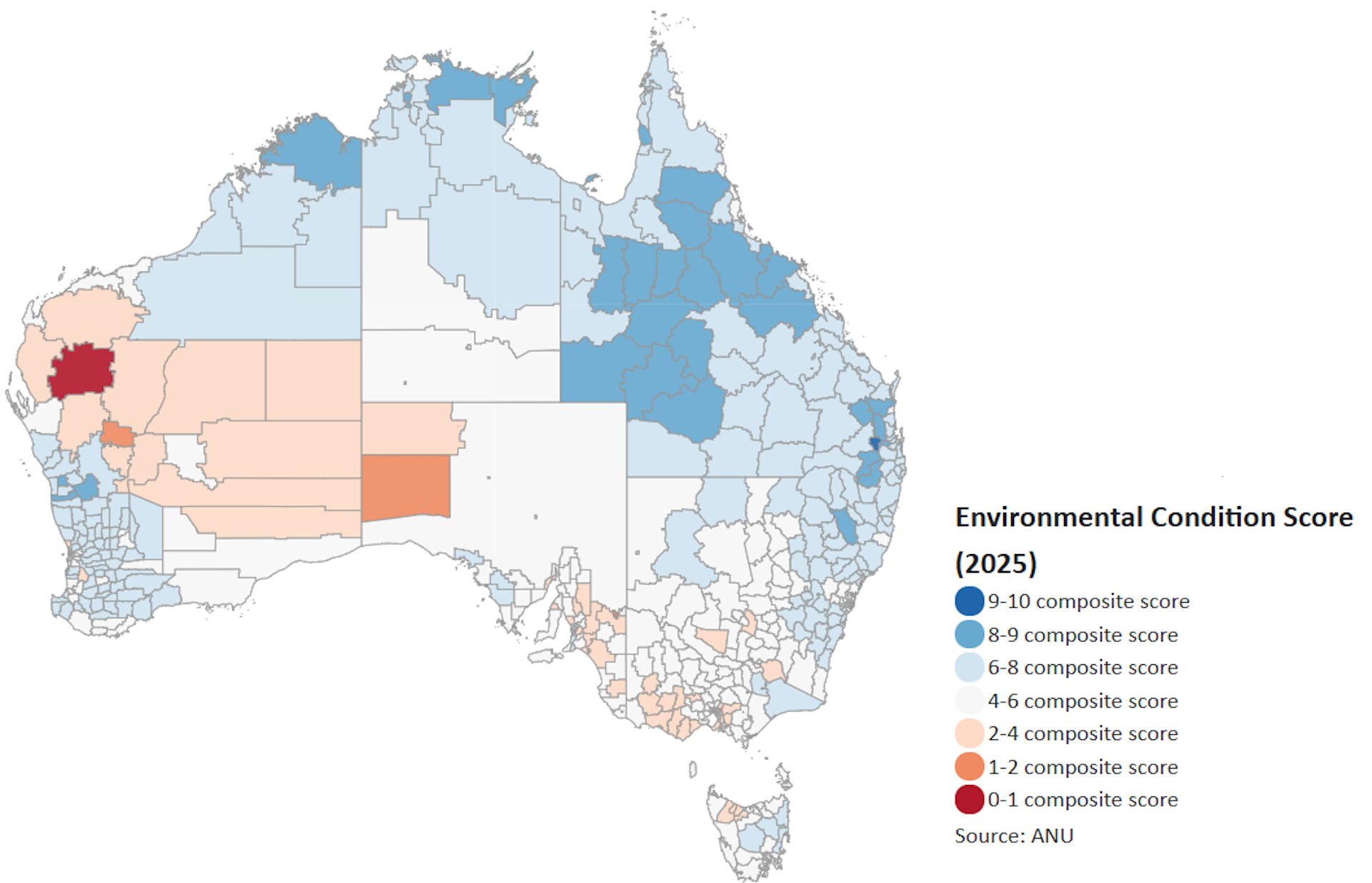
I was really just curious to see what quality source it was you were leaning on. I would guess it could go either way. Never mind, below is an image [1] capturing the statistical environmental score of the country (2025) Red = not good, white = better but not great, blue = better. Queensland is not red or white ... but IMHO there's a region around the open cut coal mines a couple hundred km in from the central coast, that from what I've heard, should be red.
But thinking on this and not to be deterred I dug back a little into this, and looked at what you wrote for a start [2] and this time round I twigged, 40 is awful close to 39% ... and a LLM might not just get the nuance ... [3] [4]
    [3] > Native Forests Facts

    Queensland has the largest area of native forest of any state or territory in Australia, at 51.6 million hectares. That's 39% of the nation’s native forests.
Ah. Queensland has 39% of forests of all of Australia's forest, ... LLM snufu probably - not 40% percent of Queensland forests cleared in 2025.
There is a fair amount of effort [5] but in the end there's not a great deal that would be done that's palatable. I'm sure asking the SE Qld coastal population to move to a less diverse inland area would go down - oh so well. As for being more proactive, there most certainly a too hard basket attitude I've struck. Nearly 3 decades ago I walked illegally to a state forest mountain top that was in the process of a changing tree line to investigate, from a distance the large pines seemed much sparser than my childhood memory - sure enough some fungus at a guess (possibly Phytophthora family) had decimated much of the large pine population there. I of course rang the relevant govt body and they didn't want to know, if fact, chastising for suggesting possible culprits like Phytophthora. After all these years and noting other scrubs loosing other large tree varieties in about the same manner I've landed where maybe it was something that was always there, just the climate has got drier (the last real wet season was late 80s in my region) meaning more stress on the trees. Still there's been simple clear issues, something afflicting a water way and again not really interested once tree service contractors working for the power grid were ruled out as someone to take to court.
[2] >Total native forest cover loss in 2025 was 960,000 ha (~98km² or 0.66% of Australia's 146 million hectares of native forest), 40% of which was in Queensland (where we have most of our rainforest).
It's currently pretty wet but also keep in mind that a lot of native harvesting occured in many of these forests ~80 years ago and that would have changed the forest structure significantly at the time.
But I think rather than clearing forest health is the bigger issue. Theres a very large amount of forest, especially wet scerophyll forest that is not looked after well. QLD is probably the best state at it and there is still an enormous amount of overgrown, poor health forests.
Forest health is important - it might from casual observation, a remnant area of scrub, look little different to pristine healthy forest or scrub, but it's not until looking closer that an unsettling picture often emerges. From childhood I was vaguely familiar with the scrub on my ol' man's place. Presently I've see what looks like the same scrub albeit 5 - 8 m smaller around a creek, I knew storm winds combined with thick heavy scrub vine have taken down much of the larger trees, making it easy to spot the Blue Gums and Morten Bays. However there's an emptiness in range of wildlife that used to frequent the area. No more flying fox colony passing though annually and certain bird species have either better places to visit or the species has simply gone extinct - I haven't heard one bird's call since I was an early teen - and I have done some extensive walks into the wild scrub over the years and heard nothing the same.
Can't speak to other regions but logging was extensive well before mechanisation where dozers would be used to create snigging tracks. Logging eventually allowed plants like lantana to spread easier though birds can easily disperse their seeds - sometimes the invasive thicket can be beneficial but it's also the same which helps burn out the rainforest plants lantana is situated around if a fierce fire eventuates. However it really requires sizeable forests for species that have low distribution rates and those large slow growing individual trees felled, natural replacement would take time, but little recovery possible if logging was still ongoing. Much of the pressure from local logging was dealt with during the 70s iirc.
I think forest health is also tied to heat and moisture stress. The central coastal region of Queensland which represents where I've lived most of my life, may be getting rainfall, but it's quite unlike IMHO what existed pre 70s, or even pre mid 80s, where a wet season was marked by weeks of cloud cover and warm rain unless it was a drought throughout the summer period but it was mostly a blip. I think for the lower country it's the lack of a long cloudy wet season, and fewer storms pre summer. The higher country like the top half of mountain ranges I feel may come down to something additional and insidious, the loss or reduction of a western borne moist air stream where even on a hot dry summer day small clouds would hug the peaks. I was fortunate enough to experience it first hand once when visiting a mountain top where it was less common - one hot summer day, I wasn't expecting it, but a thick fog settled during the afternoon and was saturating the mossy limbs of the scrub tree under story, I had assumed probably early morning fogs were responsible for keeping the mats of large ferns green which had apparently established over large rocks - due to absence of soil meaning there was little competition from other plants. I never really noticed the less frequent afternoon clouds as an observer from the coastal plains until the effect was nearly gone - around iirc early 90s.
Well it remains to be seen where the 960,000 Ha figure originated.
Other sources put a different number over a number of years. One source [1] lists 350,000 Ha lost in total in 2025, but has a great number of graphs representing different data breakdowns - there is a later breakdown of tree cover in general, the figure for 2025's tree cover loss is 380,000 Ha. ABS (Aust. bureau of statistics) [2] results finish at 2024, the report covers a lot but as far as native forest results no joy whatsoever - just tree cover in general - however its results there differ for 2024 from [1] as far as I can see. Both reflect large tree cover losses from 2019/20 due to large fires which decimated large swaths of forest - if I read correctly neither are counting for gains in regions where tree cover increased. (Probably discounting artificial increases due to forestry projects.)