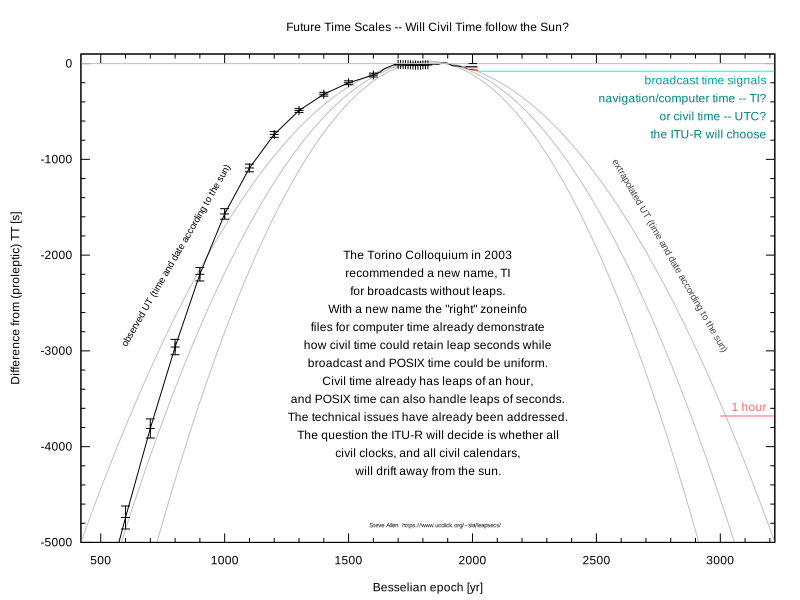
Am I wrong in interpreting this as just pushing the problem (divergence between International Atomic Time and the rotational speed of the earth) 100 years in the future?
This essentially means being less anal about ensuring the earth has the exact same clock time at the exact same earth-sun-relative rotational position. Turns out the earth spins up and slows down semi-randomly with a magnitude big enough to require positive or negative leap seconds every few years, and it's just not worth the effort. Leap minutes might only be needed around every 100 years, but that would still be annoying, so they dropped all the way to leap hours, probably not needed for thousands of years. As long as the sun rises in the morning and sets in the afternoon, that saves on a lot of frequent minor adjustments. Timezones are already an hour wide anyways, and the sun isn't in the same spot when you're on the western vs eastern edges.
Sure, you could also run a relativistic simulation of the solar system, galaxy, and cosmos to establish a more monotonic clock and calendar independent of imperfect orbital parameters, but that's a bit much for discerning whether or not it's lunchtime.
No, because trying to track the sun that closely is a fools task in any case. Even at the dead center of a timezone the time of solar noon differs by a half an hour over the a year.
The leapsecond corrections are to keep an imaginary "mean" solar time in place. But this mean solar time is almost unphysical-- and not observable except through very fancy astronomy.
If you are actually interested in getting an accurate solar/astronomical time leapseconds are something of a hindrance, as you need to back them out to apply formula corrections and there isn't a general way to know if a recent leap second has actually been applied to your timebase (or double applied, or smeared or a spurious one applied...).
Several hundred years at least (see my sibling comment). And in all likelihood this will be handled by shifting the time zones by an hour, or possibly by omitting one DST adjustment in spring.
In the very far future, leap seconds would become inadequate anyway, as you’d have to insert them every month, then every week, then every day, due to the deceleration of Earth’s rotation.
You might not even realize the harm leapseconds have caused you. E.g. almost certainly have knocked your cell service out (or rather prophylactic reboots across leap seconds have)-- and that's without having experienced a negative leapsecond.
Agreed on DST too, both are cases of a small harm done at a such a massive scale that the cumulative damage is significant.
> The replacement will not be leap minutes but leap hours.
People have a hard time with leap years, which happen regularly every four years, so I'm curious to know how well a "one-off" event at a basically random time in the future will work.
The actual rationale here is that it's not worth trying to figure out whether a hypothetical leap hour in a thousand years would be worth it, or how to pull it off if so, because no advance preparation for that scenario that we can do today has enough value to outweigh our ignorance of what the world will look like then. If they decide not to do it, they can just change the rules again; there'll be plenty of advance notice.
We know how that would likely work-- should we chose to do it: New timezones are created from time to time for political reasons already and can nicely accommodate this case.