Finally, basic preventative health care — at least for children — could save more than it costs when we take into account the overall economic effects of poor health outcomes. We should consider making it an entitlement.
If medical care is a for-profit industry, wouldn't it be in their interest to reduce preventative care, especially for children, so they will have overall greater health care needs (and bills!) later on?
Individual doctors and nurses etc may very well want people to get good treatment, especially children. But they are just the hired labor, the owners of the medical services and insurance industries just want the money and so likely lobby for the worse outcomes. It also has the bonus of further tying people to their employers who offer health plans making them more pliant workers.
No, health insurers are motivated to keep their premium payers healthy and have a long track record of funding programmes to improve the health of the population. Think about how insurance works. Where I live they paid for the creation of outdoor gyms.
> Individual doctors and nurses etc may very well want people to get good treatment, especially children
It's individual doctors and nurses who are most incentivized to over-treat. They make more money the more healthcare is consumed. It's insurers who have an incentive to keep healthcare costs under control. A big part of the reason US health insurance is so expensive compared to the rest of the world is that Americans stage a massive freakout every time insurers try to control costs. It's a cultural thing and done by both Democrats and Republicans, look at how they call the UK's NICE committee a "death panel".
It is a shame for them, but this was predicated by my Father and Uncles in the late sixties when they were talking about a for-profit hospital operating somewhere in far from us. I overheard them talking in the kitchen when I was a kid. I never forgot.
So here we are, yet the idiot US politicians still do not want real health care support for their constituents because they will lose their bribes.
Edit: Now I am wondering if they were talking about Nixon's proposed plan. I had forgotten all about that plan until I saw a comment about it.
I don't understand how this confers political benefit to the republicans or the white house. Can somebody explain a non conspiracy model how this helps them electorally running into the midterms?
Is there some way aside from the obvious mistruths they can demonstrate its the democrats fault, and achieve some electoral advantage?
Wyoming is extremely "red" according to Web searches (I am not an american)
My default assumption here is, it cannot, and this is going to cost them seats.
I’m right-leaning, I agree it does not help Republicans.
Also, propping up ACA ( I say this as an ACA user ) is not the answer, either. The subsidies were temporary, making them permanent only adds to the never ending flood of red ink.
Healthcare needs a complete reboot. As someone on the right, I am open to a reasonable big government solution. ( After all, even Nixon wanted public healthcare. ).
It’s long past the time for patching. We need a reboot.
AKA the typical doomer non-solution. 'If we blow it up, somehow a new, better systems will magically emerge'.
If I went to management with the dev plan of 'throw all the source away, start over with a new stack, new devs, from scratch, but also I don't know what the new stack will be, and haven't found new devs' I would be called a moron. But if you are a conservative, it's somehow called rational policy and a plan and it's worth the lifetime lasting damage/potential deaths is will cause a shit ton of people and financial ruin it will cause many.
Edit: Throttled so replying by edit. In the example below, Steve Jobs LITERALLY had a stack in mind, a plan, and people/talent lined up.
I think nobody believes that now. Healthcare is broken. It’s time to make things better, not patch the termite infected boat one more time.
Remember the bold spirit of ‘we have to pass the bill to see what’s in it’? If you think ACA is better than what preceded it, then you favor bold steps.
How long have the Republicans said the ACA has to go, yet they don't even have the IDEA of a plan? There was an ACTUAL written ACA when the quote you use was said. There is ZERO actual written plan on the Republican side today. The comparison doesn't make sense.
I favor logical progress. I don't favor 'blow it up so magic can do it's work'.
Unless you were Steve Jobs in late 90s Apple, when in fact they did have to throw all the source away, start over with a new stack and new devs, with imported ideas, not exactly knowing what the outcome would be like. Then you wouldn't be a moron, you'd be hailed as a business genius (I mean NeXTStep->macOS).
US healthcare is broken. Most attempts to fix it make it worse because they don't address the root causes. That doesn't mean everyone who points it out needs to present a 300 page plan for how to address it.
So other than Jobs having a plan, having a proven dev culture that he himself built up, having a production OS, he had nothing?
Not everyone needs to have a 300 page plan, but the Steve Jobs/Politicians pushing to blow things up need to. Or in Job's case he started with way, way, more than just a 300 page plan.
> Also, propping up ACA ( I say this as an ACA user ) is not the answer, either. The subsidies were temporary, making them permanent only adds to the never ending flood of red ink.
It does not add to the red ink, at least according to the accounting rules Republicans used to justify the so-called Big Beautiful Bill's (BBB) costs.
The BBB made many of the 2017 Trump tax cuts, which were temporary and set to expire at the end of 2025 (just like enhanced ACA subsidies), permanent.
Republicans argued that the loss of revenue from making the tax cuts permanent should not count when accessing the effects of the BBB on the deficit because extending something that is expiring doesn't really change anything.
Yes, a "reboot" is needed. A bit of history from what I remember:
Nixon's plan would have passed except for Ted Kennedy, he stopped it in its tracks. Then when the Clintons came in something flipped, the GOP was all against what Hillary was trying to push. I forgot what it was but I think it was some kind of single payer.
So under Obama, the democrats took the Massachusetts plan created by Romney (GOP), which I believe the Heritage Foundation even endorsed, thus created the ACA.
So here we are. Now I think we are in a sad place where for-profit healthcare is entrenched, bribing both side of the aisle to keep their profits high.
> I forgot what it was but I think it was some kind of single payer.
It was not, despite universal single payer having, at the time, outright majority support in polling. That’s one reason it lacked popular support on either side of the political spectrum.
> So under Obama, the democrats took the Massachusetts plan created by Romney (GOP), which I believe the Heritage Foundation even endorsed, thus created the ACA.
IIRC, it wasn't created by Romney, it was created by the insurance lobby and became a (rhetorical) Republican alternative during the debate over the Clinton plan; once that was killed, the Republicans didn't push it nationally (though I think Bush briefly, maybe only during the campaign, pushed a similar mandate-and-subsidy plan that was restricted to only including High-Deductible plans tied to HSAs.)
Extremely red states don't care. They won't flip at all. And none of the districts are even remotely competitive. Only the primaries matter.
A cursory look says Wyoming has a population of ~580k and ~340k registered voters. The article says Wyoming has 46k people on ACA. Republicans win landslides in Wyoming (40%-50% margins) and 46k people is 12% of voters max (likely closer to ~4% at risk).
Thanks. So, the upside is saving money, at the expense of alienating poorer voters in (this example) a state where their majority is so big they don't care.
When people don’t have access reliable healthcare, they tend to use even more expensive (for society) options like emergency rooms and grey/black market. People who become disabled or die from lack of healthcare don’t tend to pay much in the way of taxes.
To my knowledge, legal protections against unpaid emergency room bills not leading to credit harm or debt collection exist only in California and New York. Also, emergency rooms are very limited in the care they dispense - they don't dispense chemotherapies.
> Individuals who were unemployed made roughly 2.5 times as many preventable emergency care visits as those who had a job (Figure 3).
> Lack of health insurance coverage was another factor that appeared to play a role in preventable ER visits.
> According to the study, individuals without health insurance had more preventable visits to the ER than those with health insurance (Figure 4).
> This suggests that uninsured individuals may not seek primary care for chronic conditions ahead of an urgent episode or they may rely on emergency rooms for general health care needs.
Congress is likely to flip for many reasons. This is just a drop in the bucket. Places like Wyoming aren't on the table. Republicans are in a jam because nobody can challenge Trump without being primaried.
The real problem for Trump and Republicans is they do great when Trump himself is actually on the ticket. That's his power. Unfortunately for him, he will never be on a ticket ever again. But he still holds considerable influence over primary voters. Primary voters don't win marginal States. Trump is a paper tiger but because of his control over primaries Republicans are trapped.
The US is bleeding out because its government spends so much more than its society can generate via taxes. Its has a debt of 38 trillion dollars. The subsidies were adding to that.
People who say "we'd like to give you free money but can't afford it" aren't motivated by ideology, they're motivated by the money not being there. Borrowing just delays the inevitable and makes it worse - it's literally stealing from children and it doesn't fix anything.
There are ways to fix US healthcare but adding ever more debt won't do it.
Whether or not that's true economically, the idea that what Trump is doing will affect that in any positive way is, at this point, not merely ludicrous, but actively in denial of reality.
He is blatantly cutting spending on the many in order to give more to the wealthy few. Especially himself.
>They want poor(er) people to hurt, so that rich people can have more. It really is as simple as that.
What about rest of Trump's policies? Are tariffs also a "so that rich people can have more" policy, contrary to the "globalization only benefit the rich" rhetoric of the 2000s?
No: they're based on a specific set of lies he was sold back in the 1980s. There's a particular guy (I'm afraid I don't recall his name) who has been banging the tariff drum and claiming that they're some kind of economic panacea, and he apparently caught Trump at a very pliant time.
(I've tried to find who it was again, but it's hard to search for simply "who convinced Trump that tariffs are a good idea?")
All indications show that this is absolutely terrible for republicans' self interest, and popularity. trump has gone from winning the popular vote ~~(over 50% voted for him)~~ (a plurality of 49.8% voted for him) to polling at the 30%s. The recent 2025 elections (an off-year, so a variety of smaller elections at the state / city level mostly) have shown democrats are absolutely performing much better right now. This is not contested by either party.
> Is there some way aside from the obvious mistruths they can demonstrate its the democrats fault, and achieve some electoral advantage?
You discount the skill republicans have at lying -- regardless, when people are feeling the pinch in their pockets, they will blame whoever is in power. Currently it is the republicans.
I think you probably need to consider how many and who is affected and where their voting affiliations already lie if they even vote at all.
My guess is this doesn’t help or hurt either party at the voting booth. If you are ACA aligned or participate in that program you probably already vote Dem or not at all.
Ok, sure… but my guess is that ACA costs aren’t your only political decision maker if you are financially independent. Other things, like market performance under one party over the other probably hold a greater weight on your political considerations. A person in that circumstance generally doesn’t vote with their wallet, they are voting with their portfolio.
But if you are younger, perhaps with a chronic condition, in a job that doesn’t provide a health insurance benefit, and with minimal 401k…you are weighting ACA costs…and are in a demographic that historically votes more blue.
Why? I didn’t vote for Trump, but 4 out of the 5 years he was in office my investments grew pretty substantially in a way that they didn’t under Obama and Biden, I can’t really count 2020 since there was somewhat of an external factor that year. Even still I didn’t lose, just didn’t grow as much.
If AI and tariffs don’t result in substantial market losses for me (and they haven’t yet) why should I care?
Might be some confirmation bias at work in one or both of us. I tend to see conservative people in the FIRE space, seems you see the opposite. I’ll look more closely to get a better feel.
If you're 80 years old, you probably should not receive a subsidized hip replacement.
If you can't afford it on your own, there should just be a palliative care mandate after some age. We shouldn't save the soon-to-be-dead at the expense of the people with a long time horizon.
Or, we should pay doctors far less. I don't think they're multi-millionaires in other countries. Not all of them are in America, but many of them are.
> If you go to a hospital in the United States, it's a lot of old people getting expensive care.
You think hospitals aren't full of old people getting care in other countries? And do you think it's possible that young people in the US don't go to the hospital because they can't afford to?
I took that out because I didn't think it was relevant. And yes, that is my point. Young people can't afford insurance in America. It's terrible. I think the GLP-1s are going to make things better. A huge problem, as everybody knows in America, is obesity. That's also a major tax on the system.
The government subsidizes a portion of ACA payments depending on income in America. Without the subsidies, it's unaffordable for probably 95% of the population. That's why most people rely on employer-sponsored healthcare.
What other choice is there? About 10% of all US healthcare spending is on end-of-life care [1]. It's not pleasant to talk about, but it is a discussion that needs to take place.
Speaking only of the financial aspect, not any other ethical issues:
Those end-of-life patients paid into the system, earlier in their lives, financing the cost of earlier generations of end-of-life patients. It would be unfair to change the social contract now.
In my opinion, it is no different from how adult taxpayers finance public education for children. It is a rolling responsibility from generation to generation.
You may be able to alleviate this financial issue (and not any other ethical issues) by phasing-in this policy change with the youngest generation of Medicare taxpayers, somehow.
> Those end-of-life patients were paying into the system, earlier in their lives, financing of the cost of earlier generations of end-of-life patients. It would be unfair to change the social contract now.
> In my opinion, it is no different from how adult taxpayers finance public education for children. It is a rolling responsibility from generation to generation.
This hits upon the core issue: the next generation is substantially smaller than the last and relative costs have ballooned due to greater availability of therapies. The generational contract is that you pay your taxes a percentage of wages -- in effect, a PAYG mechanism. If wages do not rise sufficiently to cover increased costs, that does not imply that the generational contract was unfulfilled; the taxes were paid.
The demographic pyramid and weaker than necessary wage growth really renders the care demanded burdensome to the point where we have already provided elderly cost advantages in insurance in the form of cost premium multiple maximums and medicare from payroll taxes while beggaring the rest of the population in the process.
> In my opinion, it is no different from how adult taxpayers finance public education for children. It is a rolling responsibility from generation to generation.
Fundamentally, children are an investment. They produce cash flow (taxes) from increased public health. The end-of-life are not; by definition, they will be dead soon. It's a horrible thing to say, but in the face of ever increasing elder care burdens and weak public debt/gdp ratios, what real choice is there?
> If wages do not rise sufficiently to cover increased costs, that does not imply that the generational contract was unfulfilled; the taxes were paid.
That's an interesting alternative view I had not considered. I think it is debatable. I believed the generational contract to be "healthcare for 65+ with 20% copay, etc., no gov. expense spared" whereas you argue the generational contract to be "Medicare payroll tax of X% is constant over all time; spend it wisely." I would argue the first option was the original intent of the Medicare law.
> Fundamentally, children are an investment. They produce cash flow (taxes) from increased public health. The end-of-life are not
You could argue the same for the end-of-life, in at least two ways:
* the end-of-life patient has already produced cash flow to the government, just in reverse order from the student
* Good education produces a higher taxpaying adult, the investment you refer to. I would argue the assurance of end-of-life healthcare also produces a higher taxpaying adult.
I acknowledge the costs have gone up faster than wages+population.
> I believed the generational contract to be "healthcare for 65+ with 20% copay, etc., no gov. expense spared" whereas you argue the generational contract to be "Medicare payroll tax of X% is constant over all time; spend it wisely." I would argue the first option was the original intent of the Medicare law.
I appreciate this view, but it is ahistorical and does not reflect the history of Medicare law.Taken from [1]:
> By the late 1970's, the growing expenditure trends and the changing demographics (an increasing proportion of the U.S. population 65 years of age or over) combined to endanger the solvency of the Medicare Trust Fund. The rapid increases in expenditures for the Medicare program, as well as health care services in general, constrained the ability of the Federal Government to fund other health and social programs. To a certain extent, the growth in expenditures also endangered the Nation's overall economic productivity.
> At the same time as health care expenditures were escalating, some say uncontrollably, the political landscape began to change dramatically. The national mood brought calls for fewer taxes, for reduction of budgets, and for deregulation of market sectors, such as transportation and health. This conviction of less general involvement by Government was reinforced by mounting public pressures surrounding growing budget deficits; Medicare, like other Federal programs, increasingly competed with more global policy objectives. In the space of a few years, the Nation moved from an era when health care was considered a right for all citizens to an era when cost considerations became the dominant issue.
And bear in mind, this was just ~10 years after Medicare was introduced. The nation has always prioritized the future over the past, and has either reduced or restructured benefits to ensure a healthy economy ahead of Medicare.
> You could argue the same for the end-of-life, in at least two ways: * the end-of-life patient has already produced cash flow to the government, just in reverse order from the student * Good education produces a higher taxpaying adult, the investment you refer to. I would argue the assurance of end-of-life healthcare also produces a higher taxpaying adult.
This lacks an understanding of Medicare. Medicare is fundamentally a PAYG mechanism; the trust fund was a short term surplus which is slated to be depleted by 2033 [2]: a mere 8 years from now. Part of this occurs due to poor investment strategy (treasuries only, effectively) but the biggest contributing part of this was the demographic boom. The time for "more cash flow to save for Medicare" isn't today it was 30 years ago. A failure to raise taxes 30 years ago should not constitute an obligation on the youth of today and placing the burden of an excessive tax because of poor demography and unwillingness of prior generations to raise taxes on themselves only harms economic growth at the expense of the elderly.
That's a reasonable question with several answers.
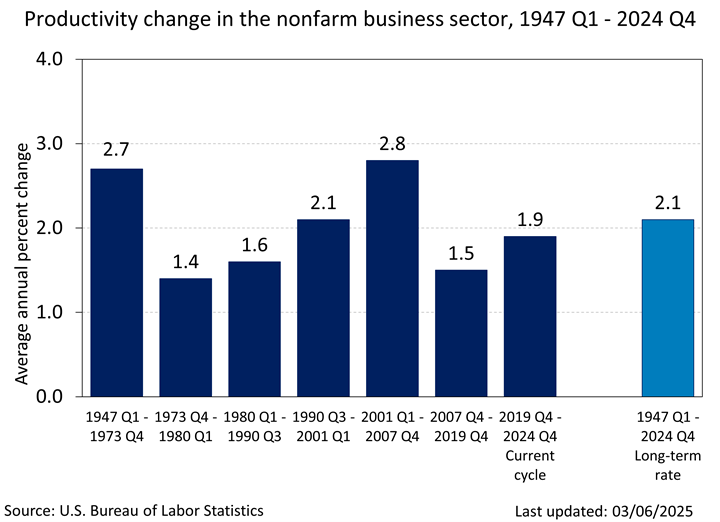
One is that US healthcare cost inflation is very high. The average family premium in 1999 was $6k, it is now $27k, for an annual cost increase of 6.1% per year. The long term rate of productivity increase is much lower than that, at only 2.1% per year.
So costs have just risen a lot more than productivity has.
Another reason is that productivity increases aren't evenly distributed. Most productivity growth has been in other sectors, primarily oil+gas and tech i.e. sectors dominated by men who aggressively automate. Healthcare has seen no increase in worker productivity for decades:
Output is up, but only because of more hours worked. And much of that output is growth of administrative overhead, not actual healthcare as most people perceive it.
Soaring demand + zero productivity growth + cost inflation 3x higher than inflation + no political will to control costs = a death spiral in which the lowest risk decide to go it alone and drop out, leaving ever higher premiums for the rest.
And productivity in society has gone up by huge amounts since the 1960s. Just since the 90s it's more than doubled, but going back to the 1960s it's much more than that. So you can't just say 'but population dropped'.
Fundamentally what is the purpose of society if the improvements it makes over time don't improve its's citizens lives? If even with tripling it's economic output it can't care for it's people (just because they are old doesn't make people not part of society)?
This argument is a moral event horizon and the problem should be resolved by other means.
Once one decides to ration healthcare based on estimated remaining QALY, the same logic says we shouldn’t subsidize, e.g., healthcare for people who suffer from cystic fibrosis, or HIV, or aggressive cancers, or. . .
Or if you’d rather, there are millions of children without healthcare in the United states. Would you forgo your access to healthcare for them?
> $365 billion of it went for end-of-life care. [1]
That’s all? Musk alone is worth twice that, and who knows how many QALYs he has left but it can’t be that many. He seems pretty miserable most of the time.
> Once one decides to ration healthcare based on estimated remaining QALY, the same logic says we shouldn’t subsidize, e.g., healthcare for people who suffer from cystic fibrosis, or HIV, or aggressive cancers, or. . .
Those are risks. Risks are insurable. However, death is a certainty. It is very reasonable to discuss what we believe society should subsidize for end-of-life care as it will impact everybody, myself included.
> Or if you’d rather, there are millions of children without healthcare in the United states. Would you forgo your access to healthcare for them?
I don't see what pediatrics has to do with end-of-life care in the context we are discussing (Medicare), but I would much rather subsidize pediatrics than elder care.
> That’s all? Musk alone is worth twice that, and who knows how many QALYs he has left but it can’t be that many. He seems pretty miserable most of the time.
Musk is worth 244B [1]. Even if we could tax wealth 100% into cash, we would fully exhaust the wealth of the 25 wealthiest American families within 7 years. These expenses, however, will likely continue for the next ~20 years. We need to discuss benefit cuts or tax hikes on the American population writ large.
> Once one decides to ration healthcare based on estimated remaining QALY, the same logic says we shouldn’t subsidize, e.g., healthcare for people who suffer from cystic fibrosis, or HIV, or aggressive cancers, or. . .
Not everybody gets cystic fibrosis, or HIV, or aggressive cancers. These are a risk. That is fundamentally an insurable risk. However, we will all die. No matter how much money is spent, death comes for us all in old age. Discussing how much is an appropriate cost for end-of-life care when aged is very much a societal question.
> Or if you’d rather, there are millions of children without healthcare in the United states. Would you forgo your access to healthcare for them?
This remains a question, even in Europe. See [1] for a discussion as early as 2000 regarding rationing in the NHS.
> That’s all? Musk alone is worth twice that, and who knows how many QALYs he has left but it can’t be that many. He seems pretty miserable most of the time.
That is a cost each year, and Musk is currently at 244B [2]. We have roughly 20 years of this level of spending or greater. Even if we assumed we could tax Musk 100% (which isn't practically possible because who liquidates his positions), where do you propose to acquire that level of ongoing cashflow? Within 7 years, we would fully exhaust the wealth of the 25 wealthiest American families, even at 100% tax rate. End-of-life care is mind-bogglingly expensive for the United States economy. This either needs to be a tax hike which realistically will it everybody or a benefits cut.
I'm middle-aged so I don't really have a long time horizon but I do have expensive insurance. If you have employer-covered insurance, you don't know what the hell you're talking about. So it's easy for you to say.
The hip seems like such a bad example to me. First of all, who do you think needs hip replacements? It's not young people; surgeons don't even like to do them on young people (and to a joint replacement surgeon, "young" is under 60) since there's a good chance they'll outlive the joint itself. And it's a one-time cost for a surgery that increases an old person's independence vs an ongoing cost of palliative care (whatever that means) and having to provide more care for someone who has a potentially treatable disability. Hip replacement is considered "the surgery of the century" - the 20th century that is, because it is one of the most successful in terms of function and satisfaction provided to patients.
>Perhaps we could just have a 'poor people incinerator' for those whose expected medical expenses exceed their net worth?
Thanks for putting that out there. Give it 10 years, and I'm thinking we'll see the first "bio-repurposing vats". Never mention crap like that on HN. Too many closet psychopaths looking for a big break.
Understand the attempt at shaming. But there are likely a non-trivial number of readers here with such Methuselan inclinations.
I mean you called to just let 80 year olds die. If they can't care for themselves, can't move around, and are left in constant pain, they end up just dieing.
Then you gave the wisdom 'older people use more medical care than younger people'. Like yeah, that is how life/the universe works. My old car requires more maintenance then when it was new. But funny thing about young people, they too will one day be the old person.
No, I said palliative care. That's to ease suffering. So you're telling me we should forego cancer treatments for young cancer patients so 80-year-olds can get hip replacements? Is that what you think? Are you crazy? I never said just let people die. That's insane. It's about cost. In America, they don't just give healthcare for free, like wherever you probably live. I wish they did.
You may not have realized it but leaving an 80 year old bedridden and unable to care for themselves is a death sentence. Any doctor sending an 80 year old home with a shattered hip and not a replacement knows that.
I live in red state America, like one of the super red states. The American healthcare system decided it didn't make sense financially for our small community to have ambulance coverage. You know what we in red state America did? We taxed ourselves and have much better ambulance coverage/care then we ever had before.
Nobody can ever imagine a better system, even if it’s used in literally every advanced nation in the world. Nope, instead we have to let Grandpa die painfully to keep those stock prices up.
I’m starting to think Capitalism as it’s practiced here is a death cult of some kind.
The better system that the rest of the world uses is letting grandpa have a bad hip. Absolutely insane that you take a huge part of what makes other systems cheaper and claim other systems would never do that and capitalism is to blame for everything bad.
Well, I mentioned palliative care, but in general, I agree with you.
I would much rather doctors just get paid less. I took my son to the ER. He had a very high fever. They gave him a child's aspirin and me a $700 bill.
I just don't know what the answer is. And really, if you go into a hospital, you get the sense that there's people basically taking advantage of subsidized health insurance providers and patients both. Health insurance in America is absolutely atrocious. Next to gun fanatics, it's the worst thing about this country.
Because the instruction from most pediatricians is to send kids with persistent (not responsive to acetaminophen and/or ice bath) fever above 104F to the ER, especially after hours. Very, very rarely will you find a pediatrician available outside an ER setting after hours.
Something changed in the US in the last 15 or so years that caused our whole country to become a death cult. All I see in the economics is a bunch of looting and pillaging before the music stops
The rest of the world mostly also uses subsidized private healthcare (except for the UK, where healthcare is far worse than in the US).
The US system works well if you can pay the bills. It doesn't have the undercapacity issues the UK has, for example. The unique problem is costs. Controlling costs would mean consumers strongly supporting aggressive action by insurers if they take actions to push costs down. What Americans do is the opposite: they stage protests and demand immediate political retaliation on insurers who try to control costs. Then left wing politicians condemn the insurers, and they fold in the face of public pressure. Medical staff know the public acts this way and so bends insurers over the barrel, knowing people will blame the "capitalists" (who have tiny margins) over the frontline doctors and nurses who are actually taking the money.
In other countries the public doesn't act this way and costs are more reasonable. Sometimes insurance premiums even fall. Switzerland has a two tier system with basic mandatory health insurance that's basically controlled by the government (private firms provide it but there are price controls and they can't refuse customers). And it has supplementary insurance for higher quality care that's almost free market. This year basic premiums went up 5% and supplemental premiums fell 0.9%
It's all about promises made to the industry, privatization of everything.
Politics? We don't need no stinking politics because there are already US troops deployed in this country, and do you for one minute think that immigrants and non-white citizens are going to go through checkpoints at voting lines without harrassment or detention or arrest on Trumped up charges? Few states have vote by mail.
Courts have not taken action to defend the constitution. In one particular case, quite the opposite.


https://www.bloomberg.com/features/2025-cancer-drug-markups/
Another contributing factor is that Americans consume a LOT of healthcare, often well past the point of diminishing returns:
“Why conventional wisdom on health care is wrong (a primer)”
https://randomcriticalanalysis.com/why-conventional-wisdom-o...
Finally, basic preventative health care — at least for children — could save more than it costs when we take into account the overall economic effects of poor health outcomes. We should consider making it an entitlement.