Exploring phase change effects in heat engines, with novel chemistry.
Not to subtract from their findings, "engines" covers a multitude of work. This could be amazing, for niche applications where high efficiency for lower power is just whats needed, optimising for something else like space and size in a human embedded bio reactor of some kind (a self powering digital pill?). Or, it could be great for a highly controlled environment inside a submarine or behind a fridge. They're all heat engines, they aren't all in the same space.
I used to trumpet my fictitious superior knowledge and say Carnot in any page about power stations, and their efficiency over the turbine if it gets hot outside. Somebody who really knows the field told me to stop being silly because the actual consequences of high heat and humidity to carnot efficiency on a coal powered turbine power station aren't why it shuts down when it gets hot: It's because the heat left in the hot water fucks up the ecology. The losses due to moving out of the normal operating bands are expensive, but not so expensive you can't run.
So in that sense, Maybe this is groundbreaking, and I'd love somebody smarter than me (and there are so very many) to say why.
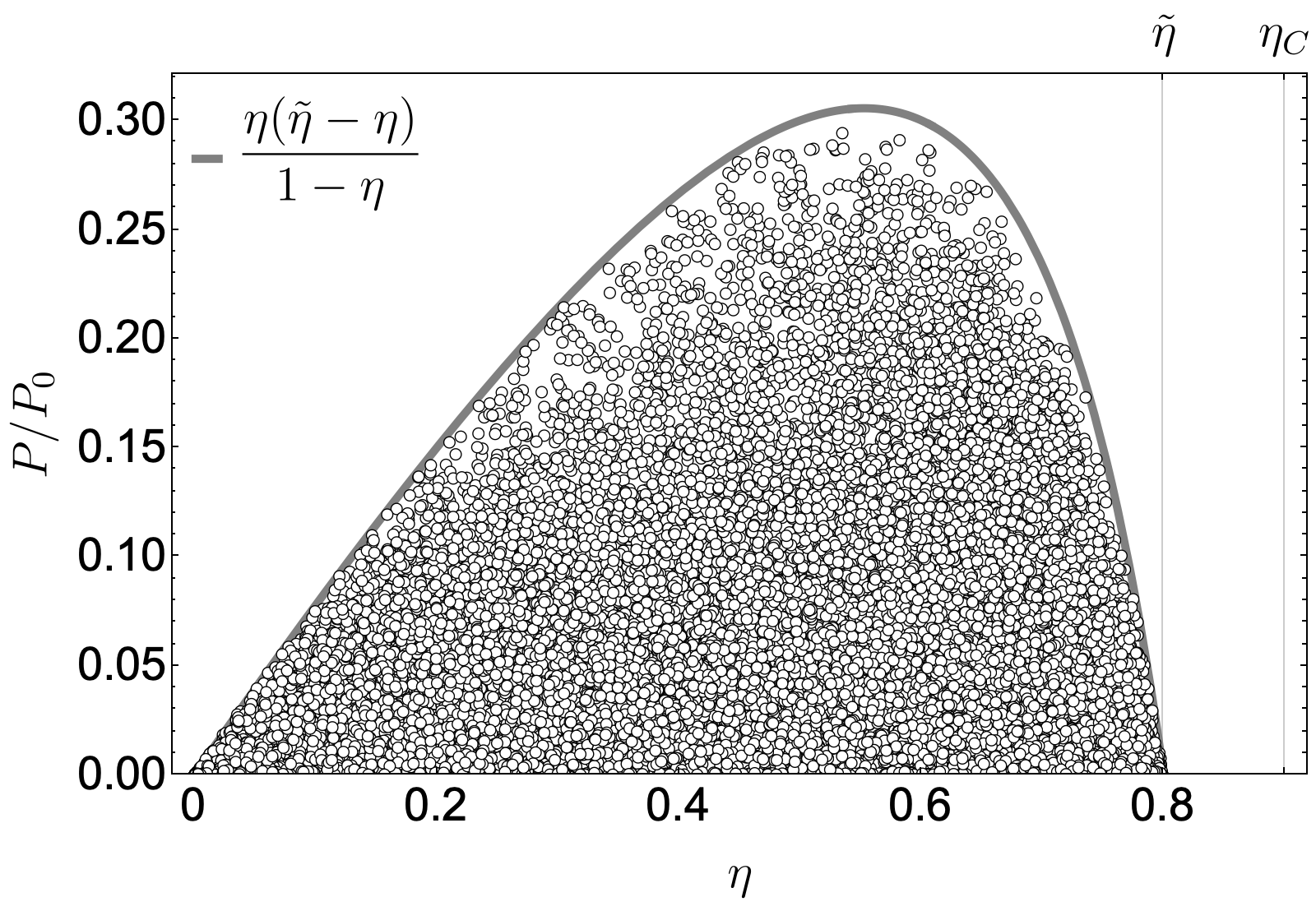
Nevertheless the very right-skewing curves they show have been published before.. maybe the breakthrough is in enabling a class of experiments that are easier to realize (since their model is described as being "minimal")
a more familiar analogy would be to the implementation of adiabatic logic approaching the Landauer limit. Not nearly simple enough to scale all the way to your pocket, but enough for nsf/DoD(?) to continue funding it.


Not to subtract from their findings, "engines" covers a multitude of work. This could be amazing, for niche applications where high efficiency for lower power is just whats needed, optimising for something else like space and size in a human embedded bio reactor of some kind (a self powering digital pill?). Or, it could be great for a highly controlled environment inside a submarine or behind a fridge. They're all heat engines, they aren't all in the same space.
I used to trumpet my fictitious superior knowledge and say Carnot in any page about power stations, and their efficiency over the turbine if it gets hot outside. Somebody who really knows the field told me to stop being silly because the actual consequences of high heat and humidity to carnot efficiency on a coal powered turbine power station aren't why it shuts down when it gets hot: It's because the heat left in the hot water fucks up the ecology. The losses due to moving out of the normal operating bands are expensive, but not so expensive you can't run.
So in that sense, Maybe this is groundbreaking, and I'd love somebody smarter than me (and there are so very many) to say why.