This might not be a popular view here, but I'm surprised how professional they are in these exchanges. I would expect a much more visceral discussion on how the other party is trying to bypass paying them, how they can get more money the other way, etc.
I don't know why that's surprising. Visceral exchanges are a sign of weakness in corporate culture, even internally within companies. I have not seen that universally amongst all countries in the world but it is certainly true in the US.
> All these apps won't be native, they won't have a relationship or license with us, we won't review them, they won't use our APIs or tools, they won't use our stores, etc.
I read this as code for letting business through without paying vig. It's couched nicely in case it comes out in discovery (hey! it did!), but "license" (leverage), "review" (leverage), "APIs" (stickiness), "stores" (30% of sales) - it's a string of words about control and money making.
They've developed a sort of polite code that stands in for more precise/honest wording they would use in person. Execs understand the discoverable nature of email.
I'm not an exec, but I've worked with people that make millions in big tech. You just don't get there unless you are fantastically competent at what you do. Pettiness and immaturity really just is an inefficiency that nobody wants to deal with at that level. When the decisions you are making are measured in the 10s to 100s of millions then nobody else will tolerate a second of your emotions. You'll quickly find yourself outside the group of trust if you're not being objective.
This has an accepted caveat that the most powerful one or two people can always throw in some nonsense. e.g. Jobs saying "FeceBook" and just suggesting a quick, unproven solution. When nobody can overrule you it doesn't matter. But the rest of them would get railed for wasting time.
> You just don't get there unless you are fantastically competent at what you do.
lol, or you convince Softbank to hand you a hundred million dollars. There are some competent people in tech but just because you're an executive doesn't mean you are competent, rational, or even smart.
Poster has a good point. There are all sorts of corporate cultures, but the previous poster is right too, there are many big corps where upper management is hyper competent to an extent most muggles, me included, find it hard to fathom. That doesn't make them infallible at all, but just being able to operate at that level even slightly is shockingly demanding.
I wouldn't call that competence. Conformity would be closer to the truth, but that's not exactly right either. Success in corporate world – or in any large organization – requires that you can ignore your preferences and focus on doing what you are supposed to do. While being good at what you do helps, it's more important to prioritize your role above your person.
That conformity can be a personality trait, or it can be a facade. You usually can't tell the difference. Successful people can be petty and immature behind closed doors, while faking conformity in public.
> Pettiness and immaturity really just is an inefficiency that nobody wants to deal with at that level.
I've seen a lot of docs and written a bunch of docs for higher ups in one of the FAANG companies (one of my docs made it's way to the CEO level). The advice I heard often in reviews was "no weasel words" and "don't interpret the data - assume your audience is smart enough to understand the implications."
One interesting thing that stood out to me is that the lower levels tended to review exactly what was written in the docs while reviews at the VP and SVP level read the docs and used them as launch pads for discussion - it never stuck to the content in the doc. This is likely there's another reason to not inject pettiness in that it doesn't just get in the way of consuming the information, but gets in the way of having the larger discussion that everyone is interested in.
I've also noticed an aspect of group think at that level, people who go against the current philosophy of the group, even if they are unemotional about it, tend to get booted out or fired too.
> You just don't get there unless you are fantastically competent at what you do. Pettiness and immaturity really just is an inefficiency that nobody wants to deal with at that level.
I could list dozens of counterexamples. To burn two bridges that nobody will ever need again, Steve Jobs (even before he made Apple into a juggernaut) and Vic Gundotra would like a screaming word with you. I don't know if Musk was petty and immature before he became essential, but it's possible. Or maybe you mean that people can get there without being fantastically competent, but they eventually fail hard.
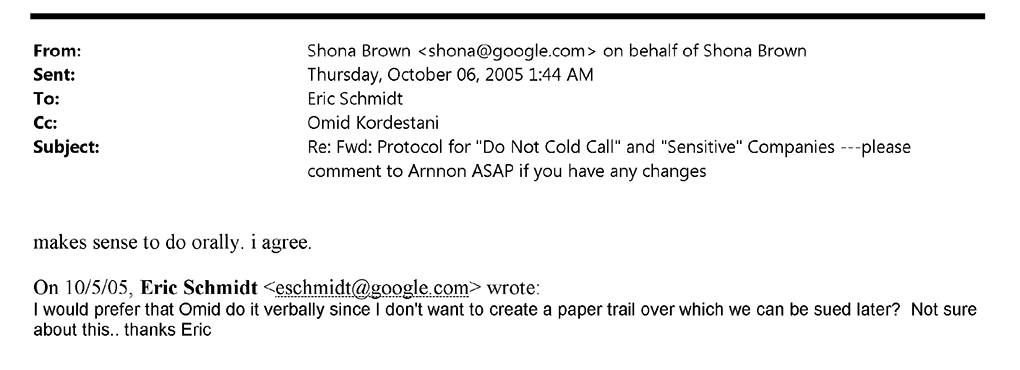
This email was shortly after Steve Jobs and Eric Schmidt blatantly discussed their illegal wage suppression scheme until Schmidt sent an email saying basically "let's stop emailing about our crimes".
Including the exchange with Schmidt talking about a "paper trail" and thus the preference to "do it verbally". Though that part of the discussion seems Google internal and not between Apple and Google.
I'm not sure there's a lot of polite code here. They are knowingly and intentionally killing a Facebook feature so that it can't compete with the app store. It goes to show you how lax antitrust enforcement when such blatantly anti competitive actions go unpunished.
Any manager let alone high-ranking exec is instructed (in management training and through many many reminders) not to put anything in writing that they would not want in precisely these types of leaks.
I'm too young to say this with a straight face, but I'll say it regardless: I miss when writing communiques was considered an art in its own right. You were measured socially by how eloquently you wrote letters and missives.
It has become a lost art in the age of email and subsequently texting and instant messaging.
Huh? That's what the whole conversation was about. How other parties, Adobe, Google, etc could bypass them if they allowed a new rule that made facebook happy to be a native app.
It's clear their concern was how other parties would get around their walled garden and huge cut they get via their app store.