Hacker Newsnew | past | comments | ask | show | jobs | submitlogin
Ask HN: What does 12:00 AM mean?
46 points by xiwenc on March 25, 2022 | hide | past | favorite | 202 comments
Today I missed my online exam because I was 12hours late. Being European and engineer I was used to 24hours notation. “12:00 AM” was interpreted as 12:00 noon in my head. In retrospect i’m disappointed Pearsonvue (in this case) does not write these times in universal format or even better, attach an ics file upon schedule confirmation.

My question to you is: did you run into this kind of mistakes also? How do we solve this more universally?


You have to learn other cultures' norms if you want to live or work with them. It goes both ways.

Europe and America do not only time differently, but phone numbers (1-800-123-1234 in the USA, 06 86 57 90 14 in France), dates (Jan 1 1911 would be 1/1/11 in the USA, 11-1-1 elsewhere), decimals (1,000.00 or 1.000,00), units (inches vs centimeters), reading order, daylight savings time, time zones (some countries don't even have them), etc. To say nothing of language and cultural differences, just formatting basic facts.

You don't solve it "universally", you make affordances for diversity the same way you allow for light/dark mode or language or any other user preference.

Not even all calendars have proper embedded time zone information so that's not always reliable either.

There is Unix time but you still have to convert that according to arbitrary rules, especially for countries that observe variable daylight savings like the US.

It gets even harder when you have to do math, like 00:00 Jan 1 1970 plus 30 years isn't automatically midnight of Jan 1 2000. It depends on whether you mean 30 * 365 24-hour days or some # of quartz vibrations or 30 * orbits around the sun or 30 * years of a certain country's time (adjusted for leap years and leap seconds and daylight savings and time zone changes mandated by new laws). There is no "right" answer. Libraries like Luxon or Momoent can help, but it's never easy.

That's just the reality of a multicultural business world. When in doubt, double check and reconfirm.


>You have to learn other cultures' norms if you want to live or work with them. It goes both ways.

This is a ludicrous and typically American-centric assertion. It is Americans who steadfastly refuse to use international norms, whilst asserting that their antiquated systems are "better".

The vast majority of the world writes dates either YYYY-MM-DD, or DD-MM-YYYY. Only America uses the (nonsensical) MM-DD-YYY system.

The vast majority of the world uses the metric system for all measurements. Britain only partially uses the Imperial system. Only America (and partially Canada) use the US customary system (which is different from the Imperial system.

The vast majority of the world measures temperatures in Celcius. Again, only America (and to a small extent Canada and old people in Britain) chooses to use Fahrenheit.


Wait until you hear what we do in Canada.

We got European/UK roots but since US is next door, in real Canadian fashion we just simple do both. Arbitrarily.

- driving distance and speed is measured in KM and KM/h

- but height, home construction and day to day distance we use imperial. So I'm 5'9" not 175cm. and McDonald's is 100 feet from the intercection, but the next offramp (speedway) is in 3km

- food is all in imperial, so grocery is in pounds, we buy a 12.7oz pint. But liquor stores/bottles are in ML. but if your talk to friends about what to bring to a party, it's back to pint or a "Mickey" or "26er"

- science is all taught in metric.

- But unless you talk cars and motor output, it's back to horsepower (this one is actually pretty common still everywhere in the world).

- And we use centigrade instead of farenheit. So small talk with Americans at work is a constant math excercise.

- Dates are complete utter toss up in the air. My driver license is YYYY/MM/DD, but i know for a fact I've filled out forms that goes MM/DD/YYYY (at the doctors office), and i'm just conditioned to go MM/DD/YYYY when typing dates online because that's how I say it. I don't say 25th of March, I say March 25, 2022.


I am so sorry for this off-topic comment, but I really need to thank you for showing me - an European - why Trey Parker and Matt Stone created Terrance and Phillip xD


Das ^^


Eh, I only said that because I didn't grow up in the US, and had to learn American ways to live and work here. America's a huge part of the world economy and international business, so you're probably going to run into one at some point (sorry, Earth).

But the US isn't the only place with different practices.

China has no time zones. New Zealand's Chatham Island has a 45 min time zone, as in UTC+12:45. Some institutions use lunar or cultural calendars instead of Gregorian time. Some don't use Arabic numerals outside of Western collaboration.

Time aside, the US, Canada, Chile, Colombia, the Philippines, and a few other places use letter-sized instead of A4 paper. Phone number formats are different everywhere. The time and decimal separators are different in many places. Time and timeliness (as in how important it is to start and end on time) differs by culture. Preference for information density vs simplifying cognitive load (in the UX sense) differs between languages and cultures. Red is a warning in some cultures and good luck in others. Not all colors are even distinguishable between cultures. Do you act casual, or formal? Keep your distance or offer a touch? Right hand, left hand? Is pointing OK? How long should you maintain eye contact? First names, last names? Many cultural systems don't identify people like that. Nodding isn't a universal gesture. Do you do a haka before events? What about a ritual blessing before a competition? There are SO many differences to consider in an international context.

Big companies have entire departments working on this stuff, not because they are ludicrously US-centric, but because it's so different everywhere.

I only mentioned the US vs Europe differences because that's what the OP asked for. Shrug. I'm not shilling for the American ways, just describing them. I wish we went metric decades ago, because it's a far superior system.

But the thing about standards: everyone has their own.


So if an American moved to Japan and was suggested to learn basic Japanese, it would be ludicrous and typically Japan-centric? They have a few customs as well, are those all ludicrous and typically Japan-focused?


It may be ludicrous but at least it's tolerant.

Many Americans would use standard _given the opportunity_. Nothing here was ever converted, or has the same availability in metric so things continue on as they always have. Very few defend them as better, especially distance measurements.

Claiming there is a "better" system for dates is just preference. Why does it make sense to list the year first, it only changes once every 365 days?


> The vast majority of the world uses the metric system for all measurements.

Except for times and angles (only the second and the radian are SI). Also, aviators everywhere outside of PRC and North Korea use feet and flight levels (hundreds of feet) for altitude, and navigators (in the air and at sea) use nautical miles and knots. Other widely used non-metric units include mmHg for pressure, AU and parsec for astronomical distances, and eV for energy.


> Only America (and partially Canada) use the US customary system (which is different from the Imperial system.

The US armed forces use metric, right?


>Only America uses the (nonsensical) MM-DD-YYYY system.

It makes more sense as MMDD-YYYY or (MM-DD)-YYYY. The Month-Day is a single thing, there are 365 of them in a year, in a roughly base 30 counting system. The year can often be left off when colloquially referring to a date (3/14 or 0314 for example.)


Just trying to reason here:

I think it makes more sense to have DD/MM as the day is the thing that changes more often and thus DDMM starts with the most important information first.

Also if I think I never encountered someone looking at their digital watch to know what Month is. But always people check phones/watches to know what day is. So why would these systems start with the less important information for the user?


Do you put minutes before hours when you tell time?

Day before month creates some ambiguity regarding if you’re talking about the near past or near future.

If you consider MMDD a single unit, it doesn’t make sense to represent it backwards. You need to be able to tell that 0402 is a bigger base iterarion than 0302. If it’s DDMM 0203 and 0204 don’t appear to be an entire base count apart.


I agree we disagree, here is why:

I am talking about what makes sense for people. And most of the people look at the calendar to know what day is today.

Regarding time, if you are asking me I will put minutes before hours in our era where every minute counts.

But before this speedy times, people where mostly concerned with hours.


> You have to learn other cultures' norms if you want to live or work with them. It goes both ways.

You also need to recognize ambiguity and ask for confirmation when you see it. Even in the US people will get confused by 12AM/12PM; when you see either of those times you should double check to see what the person meant. On the other hand, the person setting the time should also have recognized the possible confusion and clarified (i.e. 12 noon or 12 midnight).


Yes, but 12 midnight on Tuesday, what end of Tuesday is it at?

There is a reason insurance policies in the US tend to start at 12:01 am.


That there is some diversity we must cater for, there is also diversity we should cater for while pushing for uniformity (and optionally ridiculing the obviously inferior solutions such as imperial measurements, non iso dates or 12-hour clocks).


Yes. I wish people would stop using that, as it confuses me, just as it confused you. AM = ante meridiem, before noon. PM = post meridiem, after noon. It makes no sense to say midday (meridies in Latin) is before noon or after noon, it's exactly at noon. If you're going to use a 12 hour clock, to avoid confusion, you should write "12 noon" or "12 midnight". That way the confusion is avoided. Alternatively, switch to a 24 hour clock, and if it's international use UTC. And if you can't do that, start your event a minute later: 12:01pm is unambiguously one minute after noon.


We did something similar here in Victoria, Australia in the last two years. When there were rule changes around COVID, lock-downs, etc, they would often go into effect at 11:59pm.

We typically use twelve hour with am/pm time representations, but I figure the thinking was it would cause less confusion in those anxious times.


Ante meridium and post meridium.

Ante- meaning “before”, meridium meaning “highest point of the sun” as in when the sun crosses the “meridian” which would be the line in which it is now setting instead of rising.

Passing from post-meridian to ante-meridian is exactly 12 hours from when the sun passed the meridian point, to keep it “consistent”.

I get though that it’s confusing, I questioned it a lot as a young boy.

Personally I believe that is stupid that we go from 11pm to 12am, but the reason is that the cutover is “12”, and everything after 12 (including the hour) are considered morning.

Like others have mentioned, we should really be using 24hr time these days where possible. Additionally I’m of the impression that we should use ISO8601 for date formats instead of what the Uk does (or even worse: what the US does).


I already used 24 hour time and ISO8601 date formats when I lived in Canada (up until 12 years ago).

It's like using metric. Just use it.


If you can convince my government and my CEO, I'm game!


I'm propagating the ISO date format with Guerilla tactics. Whenever I come across meeting minutes or documentation pages using a different date format, I silently reformat into ISO date format and then it just catches on. The "normative force of the factual" can be strong.


I like this. The guerilla war for universal understanding!


FWIW there are very few moments in time and space where the sun will have reached its highest point at exactly 12:00 PM so even that logic is nonsensical. The only consistent mental model is that for traditional reasons clocks go from 1 to 12 and 12 is actually the zero point of the next 12 hour cycle. It's literally just a cultural artefact you have to commit to rote memorization because there's no good reason for it to be that way ever since digital watches became a thing and people no longer had to rely on bell towers to give them the time of day (which can't strike zero times for obvious reasons).


It has more to it than just being a cultural artifact. I think it’s fascinating that ancient cultures preferred a duodecimal system: https://en.m.wikipedia.org/wiki/12-hour_clock


The 12 hour cycle is fine. The problem is that it starts at 12 and then rolls over to 1, rather than starting at zero. You can have a duodecimal system without starting at 12.


It's ante meridiem and post meridiem. Let me explain.

"dies" is the Latin word for day. It is in the e-declension. Not many words in Latin have the e-declension. Another one is "res", the Latin word for thing.

I don't know a lot about "meri", but it seems that "meridies" is also in the e-declension.

"ante" and "post" are prepositions which ask for the accusative. The accusative is mostly lost in English, but often when you say "me", it's accusative. If you say "after I" it feels wrong. You say "after me". German has preserved the accusative, so it is natural for me.

Now, in the e-declension the ending for the accusative is "-em". So you say ante meridiem and post meridiem.


Imagine if 12AM meant 12 noon. What would one second past 12 noon be? It'd have to be 12:00:01 PM. Even one millisecond past 12 noon would be PM. So "12AM" could only exist for an infinitesimal length of time, in contrast to 11AM, 10AM etc. which each last for an hour.


There's a misalignment between the sequential numbers (begin at 1:00; end at 12:59) and AM/PM (begin at 12:00; end at 11:59). A 24-hour clock fixes this, but if we insist on a 12-hour clock we could still align these two spans by renumbering the "12" hours as "0" hours. Then we would see 11:59 AM -> 0:00 PM -> 0:01 PM.


Good luck. Americans will insist that 12 is more intutive because zeros look weird or something. If you tried to standardize on 0-based 12 hour clocks in the US it'd probably result in something weird like Texas seceding or some Christian sect claiming it's anti-Christian and trying to assassinate you.


I think most Americans would be fine with it. Hospitals, the military, and most public services like fire fighters use it already.


Contrary to popular narratives, there very rarely is a "silent majority" behind the kind of outrage I was poking fun at.

E.g. despite abortion clinics having a history of being violently attacked and often "regulated" out of existence, only roughly 20% of Americans think abortion should be flatly illegal outright and the labels "pro-life" and "pro-choice" seem to be self-applied in roughly equal proportions:

https://news.gallup.com/poll/1576/abortion.aspx

Granted, abortion is a complex and sensitive topic even before you bring religious doctrines into it, but it only takes one snowflake with a gun to think changing the clocks is Satanism for someone to get hurt. I'm frankly amazed the DST change seems to have passed so easily given the kind of conspiracy theories that would lend itself to.


That is not obvious at all if you're used to the 24h system. If you don't remember which one is 12am, then you don't know if 12h01am is at night or mid day.


I would have thought it's AM for the whole of the 12th hour. So 12:00 AM, 12:01 AM, 12:59 AM, 1:00 PM (hour one, past the hour of noon). An hour being a time span of 60 minutes, not an instant!

In the "correct" usage, you have an illogical jump between 11:59 AM and 12:00 PM.


Yes this is correct. It can be 12:28am, 12:43am, 12:55am, etc. And it rolls over from 11:59am to 12:00pm.


1-based indexing biting us again


No, 12:00:01 AM being a second after noon (i.e. 12:00:01 after the start of the before-noon) is the only one that makes sense. You can't just swap out the reference point and keep counting, that's just as moronic as claiming 1/500 of a dollar is 0.002 cents, because it's in the cents territory. If you want to switch the reference point, you also have to reset the counting to the correct value: 00:00:01 PM = 12:00:01 AM.


12 AM and 12 PM makes no sense, because none of them really means noon, while both of them are 12 before noon and 12 after noon

just because you got used to meaning of this nonsense, it doesn't mean it's right


12 AM should be replaced by 0 AM, same with 12 PM


0 is unnatural

/s


Why not just call it 00:00:01 PM? And similarly, 00:00:01 AM?


A lot of my exams will use the time 11:59pm instead of 12:00am to avoid confusion like this


That doesn't help people who don't know what am/pm are. 11:59pm would be 23.59 in some places (like Finland).

It's possible to mix up dates and times from each other too (is 12.30 Dec 30 or half past noon?)


11:59 pm is 23:59 by all definitions.

Why GP would have exams at midnight is anyone’s guess, but the example can only be interpreted as just before midnight.


I had the same with travelling, plane times started at 11:59pm.


Likewise, if I am scheduling something, I'll go for 12:15pm rather than 12:00pm because it is easier to visualize anything after noon as PM.


That was common in my university as well, for the same reason. I think OP's school lacked some common sense with the schedule.


I don't think this is a scheduling thing but a cultural thing.

11:59pm would be 23.59 in other places. The mere use of "11" would suggest morning.


> The mere use of "11" would suggest morning.

No, it does not. We 24ers read clock. 11 doesn't suggest morning.


11:59am is 11:59 (in 24h)

11:59pm is 23:59 (in 24h)

afaik everywhere...

but if i understand it correctly:

12:00pm is 12:00 (in 24h)

12:59pm is 12:59 (in 24h)

01:00pm is 13:00 (in 24h)


Makes a lot of sense. It’s more a workaround. Also, in your case the date would be:

March 24 at 11:59pm

That would be close to:

March 25 at 12:00am

A bit less confusing but still:

March 25 at 00:00am


And then you have Japan where that could be March 24 at 25:00.

https://kimiwo.aishitei.ru/i/ytPbouZ21iYnNXi7.png

Not all too uncommon to see bars and bookstores open until 27:00 or 28:00 and it's surprisingly intuitive when you consider when the bar is open. ie 19:00 ~ 29:00. (7pm - 5am)


Yet another case when 0-based counting makes more sense! ducks


The English-language convention I was taught is that 12am is midnight — the rationale I was given was that 02:00:00 is 2am without ambiguity, and 00:00:01 is 12:00:01am without ambiguity, so 00:00:00 gets to be 12am.

I have no idea if that’s a good explanation, but it helped contextualise what in the end is a convention.

In my personal experience most English-speaking people will either say “midnight” or use the military convention of 00:00 or 24:00 hours.

Royal Observatory Greenwich explains it succinctly[1]:

> When most people say 12pm, typically they're talking about the middle of the day: 12 noon. When they say 12am, they normally mean 12 midnight.

> While most people follow this convention, technically it's not quite right – as you'll see from the definition of am and pm below. To avoid any confusion (and to make sure you arrive on time), it might be best to say 12 noon or 12 midnight instead.

US English is similar[2]:

> The American Heritage Dictionary of the English Language (Fourth Edition, 2000) has a usage note on this topic: "Strictly speaking, 12 a.m. denotes midnight, and 12 p.m. denotes noon, but there is sufficient confusion over these uses to make it advisable to use 12 noon and 12 midnight where clarity is required."

> Many U.S. style guides, and NIST's "Frequently asked questions (FAQ)" web page, recommend that it is clearest if one refers to "noon" or "12:00 noon" and "midnight" or "12:00 midnight" (rather than to "12:00 p.m." and "12:00 a.m."). Some other style guides suggest "12:00 n" for noon and "12:00 m" for midnight.

[1] https://www.rmg.co.uk/stories/topics/noon-12-am-or-12-pm

[2] https://english.stackexchange.com/questions/66633/is-it-corr...


Years ago I missed a night international flight because of this. It left at 12:00 am (midnight) Nov.10, but to me that meant at the end of the day so I show up 3 hours early at 9pm on Nov.10, only to find out the flight left 21 hours ago. I should have arrived 9pm Nov.9 to catch the plane at 12:00am which technically was the very start of Nov.10.

I've noticed that they no longer post 12:00am as a flight time. Instead it would be listed a few minutes before, like 11:55pm Nov.9.


Sorry to hear that. It’s much worse than my missed exam.


The way to remember this that finally clicked for me is that 'A' means 'ante', 'P' means 'post', and 'M' means Meridian some Latin word that means the sun is directly overhead. Or more practically speaking: noon.

12:00 PM is noon because one minute later, the sun is past being directly above. That is, it's 12:01 Post Meridiem. Since it would obviously be nonsensical for 12:00 AM to be immediately followed by 12:01 PM, noon is 12:00 PM by convention.

Extending this logic to midnight is left as an exercise to the reader.

Don't feel bad, I don't think anybody explained this to me until I was almost 30.


Does not make any sense at all.

You jump from "sun is overhead in 12 hours" (12 AM) to "sun is overhead in 1 hour" (1 AM) when you follow that logic.

The 12 hour-system is broken and should go away.


Would you want the clock face to be changed to show 24 hours instead of 12? (What would be the number at the top then - 0 or 24?)


Easy alternative: start the clock at zero like a rational individual would. 12 only makes sense if you see it as the end and go backwards from there. It's a bit like the confusing mess of how year numbers work where traditionally there is no year zero (because the year one is 1 AD, i.e. the first year "of our Lord", i.e. year numbers are actually ordinal even though everyone treats them as nominal).

Besides, at this point 90% of the time formats people look at in their daily lives are probably digital (since analog faces are only relevant to actual clocks and even most clocks are likely digital simply because so many electronic devices come with digital clocks) and even analog clocks don't always have numbers on them (or use fanciful alternatives like Roman numerals). The people who prefer analog clocks are clearly just sticking with them out of personal preference or aesthetics anyway.


You're making it sound as though a 24-hour format is a wild new idea when it's actually in common use across 100+ countries. Timestamps go from 00:00:00 to 23:59:59 without breaks in continuity. The clock still has 12 hours with the 12 on top, but it is commonly understood that "12" on the clock face can refer to either 0 or 12, just like how "5" can refer to either 5 or 17.


What’s the difference? In both the 12 and 24 hour system the clock rolls over at the end of the period, and the period starts.


The difference is that in 12-hour system, the rollover point is ambiguous and non-intuitive (11 PM -> 12 AM -> 1 AM), while in 24-hour one it's perfectly clear and obvious.


The 24 hour system: 23 -> 0 -> 1

How is that different than 11 -> 12 > 1 ?

Yes I get it that in normal integers, 1 is not after 12, but neither is 0 after 23.


You're missing the most important bit - the one this whole thread is about.

The 24 hour system: 23 -> 0 -> 1

The 12 hour system: 11 PM -> 12 AM -> 1 AM

In the 24 hour system, there's a single point where the new day starts, and it's the transition from 23 to 0.

In the 12 hour system, where does the new day start? Numbers tell you it's 12 -> 1, but it's actually 11 -> 12. You have no way to figure the answer to OP's question out without additional context.

As others already pointed out in this thread, a 12 hour system using 0 instead of 12 would make it much more intuitive, although now you'd end up with either using 0:00 PM for noon, which feels strange, or using 0:00 AM and 12:00 PM, which is inconsistent. The 24 hour system has no such issues and has a massive advantage over creating new systems - people are already familiar with it.


> "where does the new day start?"

I honestly am trying to understand the point being made. Isn't when the day starts obvious in either case? We know when the new _day_ starts because the date rolls over at that time. No one thinks the day starts at 12:00 in the 24-hour system, or 12:00pm / noon in the 12-hour system?

> ... there's a single point where the new day starts ...

Is this what you're saying: that in the 24 hour system, there's one point in time where the clock resets from a high number to zero, and that's also when the day starts. Therefore, it is "not confusing."

I felt rather that the problem the OP stated was simply "I am used to the 24 hour system and I was communicating with someone who was used to the 12 hour system. They naturally gave me a time of 12:00am but I didn't notice that am part and assumed they meant the same "12" that I understand as "12" in my system. So I missed an exam."


> We know when the new _day_ starts because the date rolls over at that time.

That's an additional reasoning you have to do in order to explain the non-intuitive fact that the new day starts when transitioning between hour 11 and 12. You can't come up with that conclusion based on clock system alone, you need to reach for the calendar. It makes you jump additional mental hoops, making it error prone (as evidenced by this thread).

> but I didn't notice that am part and assumed they meant the same "12" that I understand as "12" in my system

No, people who use 24 hour system are usually familiar with 12 hour system as well (guess what's there on analog clocks?). It's just this one special case of 12 AM/PM that's confusing, because you can make convincing arguments for having it both ways.


Well, some of them sound more convincing than the others. Intuitively, "12:30 AM" (whose meaning is unambiguous) seems to have more affinity to 12:00 than 11:30 PM does.

But since the midnight is the same distance from the noon, before (AM) or after (PM), in theory both should be reserved for midnights (the past one and the future one), and noon, too, should be both AM and PM - at 0 hours.

The only real solution for this mess is the one that everyone uses: just burn the meaning of 12:00 AM as midnight into your brain, and those who fail to do so are in for a trouble.


There's a much better solution used by a huge chunk of the world already - the 24 hour system, which avoids these pitfalls completely. "Burning the meaning into your brain" is just destined to fail when you use the 12 hour system rarely enough, like a lot of people do.


I just don't see what you're seeing I guess. The clock starts at 00:00 and goes from 23:59 to 00:00 in the 24 hour system. In the 12 hour one, it always starts at 12:00 and goes from 11:59 to 12:00. That parts not confusing at all.

I do understand that having two different 12's in a day introduces an ambiguity about which one is the "real start" of the day just based on "12:00" alone.


I find the 12-hour system as intuitive as the 24-hour system. It is centered around noon, where "AM" means time on the same day before noon, and "PM" means time after, on the same day. Nothing wrong with that.


That's only because you're used to it and have additional context already. The day starts at 12 and goes to 1 an hour later, so notion of "same day" is absolutely ambiguous.


To clarify, I was responding to the "should go away" part.


Uh, doesn't 1:00 AM mean the sun is overhead in 11 hours?


Okay, I'm genuinely confused now, can someone please explain this to me?

First of all, how is nobody taking about the fact that OP was scheduled for an exam that takes place... at midnight.

There are two possible cases here.

Some people are alleging that OP lives in the same place as the exam takes place -- which is not clear to me from the information available -- and use this as an excuse for saying "OP should adopt to local customs".

But that would imply the exam takes place on midnight in local time. Is that actually a thing? Like, is this normal? Why on earth would anyone assume that's the case in an ambiguous situation like this, I can see why you would assume it's at noon without giving it too much thought.

The second case is that OP not in the same place (e.g. the given time at midnight does not match OP's local time), but in this case I blame the institution for allowing people to attend exams remotely while not properly accommodating for time differences.

While 12:00 AM/PM may be technically valid time descriptions, I was under the impression that it was common (in places that use the 12 hour system) to instead write 12:00 noon/midnight specifically to avoid this.

From what I understand, Americans are confused by this too, so why are people so eager to blame Europeans, rather than the system?

Second, I don't understand people saying they use 11:59/12:01 AM/PM as a mnemonic. This makes no sense to me as 00:01 a valid time. How do the above times resolve anything, when all you do is increase/decrease the time, relative to the label, which is what makes it confusing in the first place.

I don't understand how I'm supposed to know which of AM/PM 00:01 refers to, unless I already know what AM/PM means.

Third, people making comparisons to reading an analog clock. When I read an analog clock, I get a time in a 12 hour window. Fair enough. But when I then translate it to 24h, what I do is use my knowledge of whether it is currently day or night to translate it. Which has nothing to do with memorizing which label is which. Analog clocks don't have AM/PM labels so how would this make any more sense?


OP here. The online exam is run by Pearson Vue. With my brief research I found it’s a British company. That could be the reason they use AM/PM.

I think with better UX on their scheduling app this would have been avoided. Imagine how much cost they could save with minor improvement. It wasted the proctors, customer service and my time. Unless they don't acknowledge own fault and require customers to pay for another exam.

But the thing that made me realize is that the root case is the time notation itself. Imagine how much frustration and unnecessary expenses this could inflict in general.


I hope this doesn't come off as unnecessarily combative, but the real solution here is to check, verify, double-check and triple-check when presented with notation that's unfamiliar with you.

> How do we solve this more universally?

It's not a universal problem. While entire cultures and countries /could/ invest resources changing (and more people experience confusion centered around any transition), it really isn't a problem for most. And when it is, it's unlikely to be a problem a second time. Once bit, twice shy.


Perhaps universal is too broad “scope” here. Companies nowadays offer services on the internet with reach to every corner of the world. Their customers shouldn’t need to adapt any specific cultural or company origin habits to use their services. Companies should adapt instead if they are offering services to other demographics. It should be easily understood without ambiguity. Yes we all learn from mistakes, but what if this doesn’t result in mistakes all.

Thinking of this further, it seems to me this type of issues are related to accessibility.

Regarding double checking unfamiliar notation: it’s my habit to verify when it’s unclear. The problem is that i know what AM/PM mean. This is a special case i misunderstood. One cannot conclude the misunderstanding until pointed out by an external party.

Based on the comments in this post, it’s obvious i’m not the only struggling with this. Imagine what impact this has on general population as the cultural/country borders are pretty much non-existent on the internet.


Not the OP, just offering some thoughts.

> There are two possible cases here. (snip) I was under the impression that it was common (in places that use the 12 hour system) to instead write 12:00 noon/midnight specifically to avoid this.

IMHO the bigger takeaway ought to be that what is "common" in your area isn't necessarily common in another part of the country, or in another country. This confusion exists because the Europeans (and nowadays the Americans) exported their time measurement system across cultures, to mixed success. It's never obvious and should not be assumed to be... that confusion can exist no matter what actual UNIX time the test was scheduled at.

> Second, I don't understand people saying they use 11:59/12:01 AM/PM as a mnemonic. This makes no sense to me as 00:01 a valid time.

For this specific case, it helps clarify what is "noon" vs "midnight". For some reason people are a lot better with knowing 11:59pm is, vs 12:00AM. The cutover is what throws people off. And for most purposes, the +/- 1-3 minute difference won't matter.

The midnight/noon thing doesn't really help when you're going across oceans though. Or, like you said, if you're not familiar with AM/PM at all.


>I was under the impression that it was common (in places that use the 12 hour system) to instead write 12:00 noon/midnight specifically to avoid this.

(In the US) I've probably seen that done outside this thread but I'm not sure. Just "noon" or "midnight" would be more common than that and if numerals are being written, I'd say "12 noon/midnight" is far rarer than "12 AM/PM". In places where 12 hour time notation is used, people are just expected to know 12 hour time notation.


> For some reason people are a lot better with knowing 11:59pm is, vs 12:00AM.

You mean, people have a mental association like "Oh look it's 12:00 AM [= midnight], better get to bed now" because they see these times in specific contexts, and then use that as a jumping off point to extrapolate the meaning of AM/PM as a whole?


I'd certainly prefer to take an exam at midnight in my local time zone rather than noon. No need to fight with morning brain fog.


I remember it like this: when it says 12:00 AM that means that the AM is getting started (midnight) and at 12:00 PM the PM is getting started (midday)


I always look it up on Google. I regularly run into this kind of problem when looking at log files which use AM/PM time. Related question: How do you even say "14:00" in English? In school I learned that you say o'clock but I never heard that in real life.


Over 12, you generally pronounce it as military time. So you would say "14 hundred hours" I think.


> you generally pronounce it as military time

WTF is 'military time'?


Errrrm....

That's an ordinary 24 hour clock. Rather bizarre to call it "Military" time.


military time is spoken in hundreds and doesn't use colon, while regular 24hr time is spoken in dozens and use colon

Military 1400 - fourteen hundred 1430 - fourteen hundred thirty

Standard 24h 14:00 - fourteen hours 14:30 - fourteen thirty

But I am not native English speaker and this is only my understanding from what I observed about military time vs 24 hours time and I may be wrong, someone please correct me.


I’ve heard and used “o’clock” my entire life but not with 24 hour time. You could say “fourteen hundred (hours)” or 2 pm/o’clock. For 08:00, “oh 8 hundred hours”.


14:00 -> fourteen hundred hours

14:01 -> fourteen oh one

14:10 -> fourteen ten

etc


"Fourteen hundred"

Fourteen o'clock works too but is less natural.


Indeed, “o’clock” is what you say when you look at a clock face!


not a native speaker here but you could say "Two PM sharp"


There is no universally agreed upon definition. This is why some may use either 12:01 AM or 12:01 PM to avoid ambiguity. Or “12 noon” and “12 midnight”. Of course, the “obvious” answer is to just use 00:00 and 12:00.

Lots of folks here are trying to logically determine which use is “correct”, but it doesn’t really matter much if the reader doesn’t agree and misinterprets. So the best option is to use an unambiguous alternative like above.

For more, see https://en.wikipedia.org/wiki/12-hour_clock#Confusion_at_noo...


Although it's true there are rare exceptions, I've never met a native AM/PM user who thought 12:00 AM was noon.


Each african here and in Swahili time, the day starts at 7:00 AM and ends at 6:59PM and night starts at 7:00 PM and ends at 6:59AM.

So, I would read "12:00 AM" as "six hours into the night" since its been 6 hours since the night has started.

I would also read "12:00 PM" as "six hours into the day" since its been six hours since the day has started. Speaking it, i would say "saa 6 mchana" and the literal translation is "time 6 noon".

I and most people here always set time in AM/PM format and i always have to first convert it to swahili time before making sense of it.


That's really fascinating. When do businesses typically open and close? Are there set times?


Typically, its from "8:00 AM" to "4:00 PM".

In swahili time, i would say "its from hour 2 in the morning to hour 10 in the everning.


The best is how it is 11AM -> 12PM -> 1PM -> 2PM and then again 11PM -> 12AM -> 1AM -> 2AM


For historical reasons[0], with 12-hour clocks, 12 is generally treated as zero. A general fix for this is probably something like Linux locale settings. It's going to be a rather flawed solution, what with those settings being super complicated.

[0]- Lore is that the sundial and dividing the day into 12 sections happened before the invention of the number zero, but I don't know if this is accurate.


> How do we solve this more universally?

Use this as an opportunity to realize that moving forward you need to be sure about times — especial for things that really matter. Using your European-ness and the fact that you’re an engineer isn’t an excuse. You can be disappointed in software and other people for the rest of your life and keep missing important appointments if that’s what you want.


For a mathy approach for programmer types, let's switch to decimal hours for a moment. So 12.0 noon is a time, and 12.99 PM is just shy of 1.0 PM.

So is midday AM or PM?

I think we can agree that 30 minutes after noon, or 12.5, is PM.

And we probably also agree that 12.1 would be PM as well.

And 12.0001, that's PM.

We can put as many zeros in there as we want, and it's still PM.

Now put infinity zeroes in there, and you're "at" 12:00 (since that's what the clock now reads) and it's still PM.

A shorthand version of this is if you look at the clock in the middle of the day and it says 12:00, is it exactly 12:00 that very instant? Or is it, infinitely more probably, a little bit past that time? If you know it's a little past 12:00, you know if it's AM or PM.

As for how to fix it, either "noon"/"midnight" or universal 24-hour clocks or memorize that noon is 12 PM. :)


12 is 0, that's how analog clocks display time, and that's the only way to make sense of the strange numbering (12->1->2-...>11? What?).

Maybe because Romans didn't have 0? Apparently not, the reason comes from before them, but analog clocks are commonly written with Roman numerals so it's a way to remember this.


Using 24hr clock.

It would have been 00:00 for you.


Of course, if you list a time as 00:00 for a US audience, you'll probably get a lot of people complaining that it's broken.


And in the same way it's impossible for the US audience to learn metric it's also impossible for them to learn 24 hr time.


There's no logic behind this. Even if you go by the reasoning that 12 PM is noon because any time after exactly 12 PM sharp is post-meridian if the meridian is exactly at 12, it shouldn't be 12 but 0. Having an intentional off-by-one error in your date format is simply bad design and counterintuitive.

The 12 hour date format with AM/PM is asking for trouble and it's at least partially their fault that you got this wrong, especially if they schedule appointments at unusual times and expect you to find noon and midnight equally reasonable. They could have avoided this easily but their lack of accomodation shows an intentional disregard.

If it's any consolation, Pearson is infamous for horrible exam designs, so at least they're not uniquely shitty towards non-Americans.


I think it makes sense in a world where reading a clock face is common (12 gradations repeating twice is easier to read at a glance than 24 gradations), but in a modern world that is international and the primary timekeeper is a phone, I don't think it is defensible.


When working at international companies that have little interaction between countries (i.e. not so much that it would be standardized, but enough that it would be an issue): eventually everyone learns to write dates and times in both ways (14:00 / 2pm, 4/12 / 12 April). The Europeans think that they're translating for the "dumb Americans who can't count higher than 12", the Americans think they're translating for the "quirky Europeans who have to do everything special".

But to your question, yes 12:00 AM is midnight. It's the 12 o'clock that's at/after midnight, while 12:00 PM is the 12 o'clock that at/after noon.


> quirky Europeans who have to do everything special

so how many quarter inches are the footegg fields these days?


The inch breaks down to thirds that is barleycorns, not fourths... And is defined by them...


34560 eighths, it's easy to remember because it's 3-4-5-6. Divide by two for quarters. Duh.

/s


How often does this actually happen? It’s never been common for my European coworkers or my American ones. I rarely schedule meetings with Europe in the Eastern TZ afternoon and the same with India. If I say I’m deploying at 11pm on Saturday everyone understands.


"Let's meet at your 4pm Tuesday." "The flights for the off-site land on 4/2 at 3pm local time."


I’m deploying on Friday night at 11:15pm Eastern or 5:15am in the UK.


We're discussing time formats. Some Europeans would complain when we'd write "I'm deploying on Friday morning at 10am Eastern or 3pm CET." instead of "15:00 CET"


I would expect whatever format you use and then “translate” it according to my time or date format. As long as the TZ is listed everyone should be fine.


don't forget to write Berlin time or Beijing time, so people won't be confused about time zones, since some experts write them in some odd UTC/GMT format with + sign which is complete mess especially with summer/winter time in Europe, while all year same time in China

I always write my Chinese colleagues time either in Chinese/Beijing time or Berlin time to clarify what time zone we are talking about, because it's not so obvious since some of them work until midnight or even 1AM local Chinese time


And also surprises of non-unique timezone abbreviations. IST is Irish Standard Time (UTC+0/1), Israel Standard Time (UTC+2/3), and Indian Standard Time (UTC+5:30).


This is actually a great post about UX. Most sites like eBay or Expedia have location-specific versions that change dates and times among other things to the user’s format. It’s totally legit to expect that in 2022.

That said, UTC is universal also.


It could be worse - before 1805 on a Royal Navy ships PM would come before AM:

"Up to late 1805 the Royal Navy used three days: nautical, civil (or "natural"), and astronomical. For example, a nautical day of 10 July, would commence at noon on 9 July civil reckoning and end noon on 10 July civil reckoning, with PM coming before AM. The astronomical day of 10 July, would commence at noon of 10 July civil reckoning and ended at noon on 11 July"

https://en.wikipedia.org/wiki/Nautical_time#Nautical_day


I remember having the same problem as a Swiss exchange student in high school in the US.

I missed a perfect score in my first geography exam there, where we had to calculate timezone, exactly because of this... I thought it was so much more logical to have 12am follow 11am... I was very annoyed to not get 100 in that exam just for such an annoying format...

In retrospective it does make sense actually... as soon as you pass noon (meridium) you are in the post-meridian, not ante anymore...

Better would be if the formst would use 00:00am and 00:00pm... This way you would have a switch from am to pm and v.v. when the time goes from 11:59 to 0, i stead of to 12.


If 12 is midnight or noon, then 12:00am has to be midnight. If 12:00am was noon, then 12:59am would be in the afternoon, which would be weird. Of course, having your clock start at 12 and then go to 1 is also weird.


I'd be triped up too... to me it makes no sense that it goes 11AM, 12PM, 1PM. That it keeps the number sequence, switches the AM/PM, and then an hour later wraps the number sequence is just odd.


It comes from analog clocks and how you read them. They only have 12 hours, so 11:59 ticks over to 12:00.


11:59 to 12:00 makes perfect sense. 12:59 to 1:00 makes perfect sense (since it wraps after 12). What does not make sense to me is not switching from AM to PM at the same time as wrapping from 12 to 1.

I understand that it comes from analog clocks, but when represented on anything else it feels wrong.


It reminds me of a similar problem I face in Dutch (and still trip up if I'm not conscious):

In Dutch (my 4th language), "half nine" ("half negen") means 8:30. Whereas in English[1] "half nine" means 9:30.

So there were times when I missed appointments by an hour! After 7 years of being immersed in the language, I still have to deliberately engage my brain whenever someone says "half nine" (or whatever the hour) in Dutch to carefully translate it to the correct time.

[1] British and Irish English only? Others can correct me here.


In the United States we do not say "half nine". We'd say "half PAST nine" sometimes but honestly "nine thirty" is a lot more common.


It's very colloquial and very regional but I've heard English speakers say it. The VAST majority only used "half past x" in my experience.

Same thing in German though. Usually you only use "drei viertel neun" and "halb neun" (i.e. 8:45 == three quarters nine, and 8:30) but in some regions they say "viertel neun" (quarter nine) for 8:15, but the people not from that region often mishear it as "viertel nach neun" (quarter past nine) because why would you say the former, so the speaker must have spoke the 'nach' too silent...


there is same issue in Slovak/Czech vs English, which is very confusing with my kid which was raised at first in English and later we added Czech

English is quite logical - half PAST nine = 9:30, but in Czech/Slovak you say literally "at quarter on ten" (9:15), "at half of ten" (9:30), "at three quarters on ten" (9:45) and that "on" ain't really obvious for someone who is not familiar with this terminology, personally I completely stopped using this terminology because I always found it archaic and extremely confusing and just use digits "nine fifteen", "nine thirty" etc.

same goes for fractions vs percentages, I don't understand media love for fractions, instead simply writing 60% they write three fifts, so I have to calculate it in my mind back to 60 to know what they are talking about instead if they used one simple digit


Wow, "at quarter on ten" / "at half of ten" takes even more brain cycles for me to parse. Thanks for the Slovak/Czech examples. (Incidentally, I work with a lot of Czech colleagues.)


Yeah, it makes really no sense even for native speaker when you think about it, people just accept this nonsense, in English it's either how many minutes past some time, or how many minutes to next hour, but in Czech/Slovak you talk "on hour", not sure what's origin of this nonsense, but I doubt majority of people could explain the meaning.

We also commonly use double negative:

English - I did nothing

Slovak/Czech - I didn't do nothing (reverse I did everything)

People don't think about it, just accept this nonsense and go on with it.

Czech language has even way more illogical things than Slovak, since it is older, for instance they have special letter ů which sounds exactly same as ú (as oo in Doom), but ů can't be used as first letter of word, where you must use ú and vice versa, if it's not first letter must use ů and can't use ú, despite both of them having exactly same meaning/sound.


> "at three quarters on ten"

What a mouthful. Can I ask you to write how it is written and spelled out?


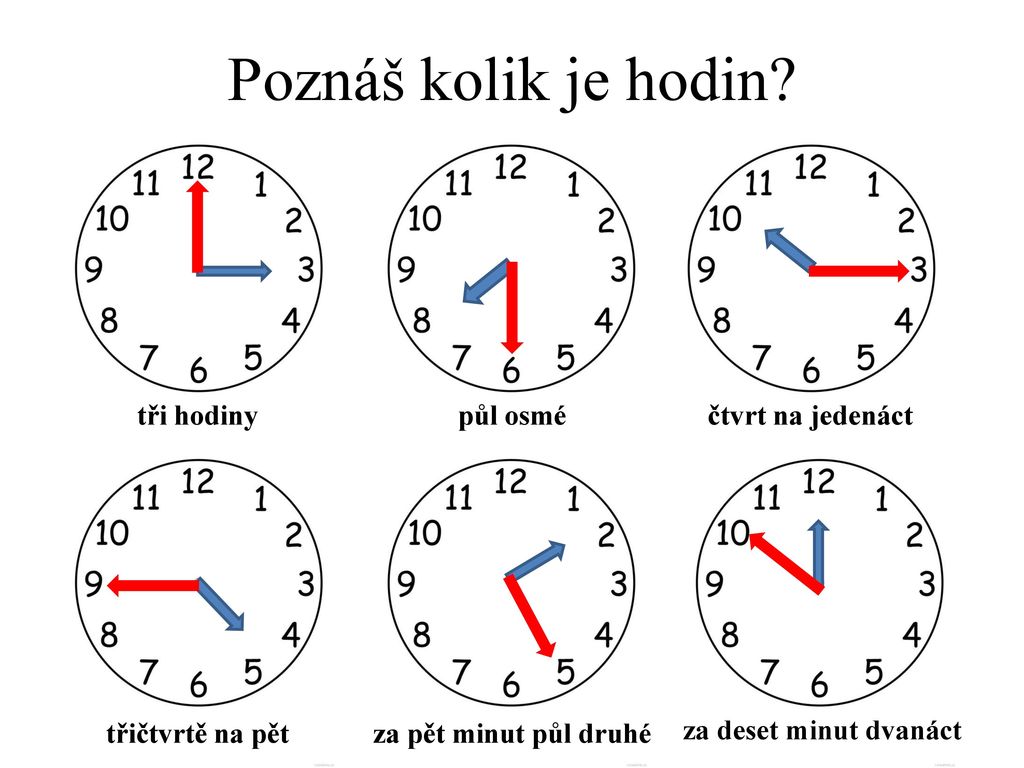
https://slideplayer.cz/slide/12864735/78/images/5/Pozn%C3%A1...

Here in Czech, learning materials for 2nd grade, though my kid is learning it already in 1st grade.


Ah, as I though it's just rolls fine in the spoken language. "Tr/ee/chetvert" should be a good enough approximation, I suppose?


I don't think any English speaking person, in whatever variant, would use that expression.

What "half negen" means is easier to remember when you contrast "half" to "vol"/"heel" -> half nine is not full nine yet.

To be clear, nobody uses "vol negen" or "heel negen", it's just "negen (uur)".


Well, I have heard in real "half nine" used by an Irish colleague. And looking up on the internet, there's similar confusion[1], and someone clarifies "half nine = 9.30"

And thank you for the "vol" / "heel" distinction in this context. I feel that definitely is going to stick! :-)

https://www.antimoon.com/forum/t14406.htm


> British and Irish English only? Others can correct me here.

You are correct....

Unlike 'merkin English, in British English saying 'half nine' [meaning 9:30] is fine and one would only say 'half-past-nine' if they were feeling verbose, or have a Dutch workmate and were trying to avoid confusion :-)


usually someone would say "half past nine" I'm not sure I've actually heard it your way


I’m baffled to see those in favor of AM/PM notation fail to acknowledge there is a better, less confusing, alternative. Can we call this “technical” debt?

I really like the idea of saying 11:59PM instead. Despite feeling like a duck tape solution.

What bothers me more is that internet companies offer services to the global consumer. These services should work for the customer. Not force some cultural or demographic habit on global population. Instead, use non-ambiguous notation like 24h or express noon/midnight explicitly.


That sounds really frustrating. I'm sorry that happened to you.

Time is a hard programming and engineering problem. Adopting a global UTC on a 24 hour clock would resolve most of this, but people are entrenched.


I force everything to 24hr UTC time on projects I'm involved with. Then if it's a technical project, display it as 24hr with timezones and if it's not technical then apply all these strange time display rules as user configurable.

Solves so many problems.

Now, Django supports this pretty cleanly so it's often pretty easy to enforce and work with.


Future maintainers thank you!


Look at an analog 12-hour clock. Ask yourself what the "natural" way to read it at midnight would be (what number is the hour hand pointing towards)?


I don't think it is a usable way to make a european grasp that. Analog clock or not, for all of us 12 is 12 only at noon, otherwise it is 0.

The Ante Meridian / Post Meridian explanation works better. Still, it is a fucked way to say time.

By the way 24h analog clocks exist too.


Pff, this is nothing, I was just today explaining to client that phrase "...will switch off at VARIABLE midnight." where variable is number 12 is complete nonsense, maybe it is acceptable in English, but certainly not in most of the languages, since midnight is midnight and there is no 12 or 24 midnight, it's either 12PM, 24:00 OR midnight, but not some digit together with midnight


I always just write 11:59 P.M or 11:59 A.M. to make this less confusing. Especially because the people setting the time are prone to making the same mistake when scheduling the event.

For example:

...the discount expires at 11:59 P.M. on Thursday, March 24, 2022.

is far less confusing than:

...the discount expires at 12:00 A.M. on Friday, March 25, 2022.

At a quick glance, it's easy to think this means late Friday night, since we see the word Friday.


This help domestically, but not across cultures that don't use 12 hour time.


You can always just say 23:59 instead of 12:00 A.M.


Believe it or not, some Americans will be confused by that. Our modern educational systems don't really prepare them for international communications.

It just depends on your audience & context...


12a vs 12p is pretty confusing. Appending noon or midnight is super helpful in calendar apps. E.g., "12p (noon)" or "12a (midnight)"

Self plug: I built a super simple visualization page to help figure out which is which https://xta.github.io/am-pm-visualized/


Sorry it happened to you. Yes it would have been better for this institution to send a true calendar event or something that would adapt to each person's local TZ.

That being said, I just googled "12.00 AM" and the very first result is "12.00 AM is midnight". Pretty unambiguous.

If you had never seen this notation before, being an engineer, why didn't you just look it up?


So as a programmer, one way to look at it, 1:00AM to 12:59AM should be in order, meaning 12:00AM is at noon, and the switch to PM happens at 1PM. But this is wrong. Zero-indexing would have helped here.

It really irks me that we stick with these anachronistic standards. 00:00-23:59 seems so much better. Metric system is better. I'm for English-language spelling reform.


If something that I can't miss is listed in a different time zone than the one I'm in I go online and find a time zone converter. You can just tell it '12am in x city' and there is another box where you enter your own location and it doesn all the work for you.


I am native to the united states and, to this day, I still do not fully get what time "12:00 AM" and "12:00 PM" mean. I try to set meetings for 12.01PM. If I absolutely must meet exactly at noon, I start the meeting "at noon".


12PM = Noon

12AM = Midnight


To answer the question: as an American, I learned 12:00 AM was midnight at one point when I was a kid. Before then, I was unsure whether noon was 12 AM or 12 PM. I made sure to remember that special fact, with no mnemonic or rationale, in the future.


A classic problem similar to this would be a flight. If you got a flight departing at 12:40am, make sure you really know what it means.

There’s too many people making this mistakes and sometimes the airline might help you out but not always.


That's a good point, but 12:40am is a very unusual flight time? That's almost 1am.

I would guess most flights are in the ballpark of 7am - 9pm. Please correct me if I'm wrong.


I personally have taken flights with weird departure time like this. A lot of flights from San Francisco to Hong Kong has departure time like this, arriving Hong Kong at around 7am.

I think in general it is just depends on the origin+destination time zone & fight duration, these 2 factors determines the sweet spots of departing, and while there can be a few combinations that works, those few combinations can likely be realized due to various factors.

Other examples involved going from Hong Kong to London (which has similar relation comparing to going from SFO to HKG). I personally didn’t try that but first heard people made mistake like this (getting to the flight one day late) in this combination.


12pm is something that you routinely see in the "day" life - opening/closing times, appointments, etc. That's the one I know.

12am is the other one, so it's at night. I have to deduce every time I see it.


In my country we usually say 0:00AM and 12:00 noon (neither am nor pm). After coming to NA I'm gettimg used to 12:00am and 12:00pm. But yeah in the beginning it takes some time.


I guess people solve this by not doing business around that time.


Op here. Update from Pearson Vue: they refunded the exam price.


Obviously you specify a unix timestamp! /s


i think the moral of the story is that presentation formats for dates and times should follow the end user's locale.


Use a calendar app. It parses and translates appointments into local time as an essential part of its existence.


If a time included either "AM" or "PM" then I would assume it was specified as 12h, not 24h.


Say "noon" or "midnight". ya, I know that's cheating.


Do Europeans just not have analog clocks or watches anymore?


I also found the "European" remark a bit weird.

I'm American so I don't really know, do Europeans generally ignore how AM/PM works?

IIRC the Romans created the system, so I'd find it really weird if it had dissapeared from common usage around there.

Also, every single picture I've found of a clock tower from Europe seems to follow a 12-hour convention.


Even when it's midnight and the clock hands point to 12, it's just 0:00 in our heads. Of course when thinking an talking about time, sometimes the numbers 13 to 23 are replaced with their 1 to 11 counterparts and if it's ambiguous, a "in the morning", "in the afternoon", "in the evening" is added. But there's a clear distinction between "0" and "12". When someone says "12 o'clock", it's always 12 noon and never 12 midnight, since that would be "0 o'clock".


>Do Europeans just not have analog clocks or watches anymore?

Not in Britain we don't. Analog clocks were abolished by Henry VIII. Since then we kept time using sundials until digital watches were invented in the 1970's and Roger Moore wore one playing James Bond in 'The Spy Who Loved Me'.


We do but 12 is noon for us, otherwise past 11:59 in the evening it goes back to 0.


Do your analog clocks have all numbers from 0-23 in them?


No only a small number exists but most are still 12h analog clock.

Anyway that is not really the problem, we just learn from being kids that 12 is only valid for noon otherwise it is implicitely 0 as the next one is 1 anyway. And, at least in my country, we rarely say 12 as we use our words to say midnight/noon.


12 AM is midnight. 12 PM is noon.


Did you get to take your test?


Nopes, called the pearson vue support and they said will start a case for me. I was 12 hours late and they need proctors. So there was no point to argue. Best case they refund or allow me to reschedule the exam.


[flagged]


How can you tell time on a wrist watch or wall clock without 24 numbers?


Who are you "quoting"? Yourself?


[flagged]


What if it was not meant as an insult?


I can't imagine how you are interpreting it as anything but an insult. Can you elaborate?


Thank you for removing your comment and flagging mine. Speaks volumes.


Sorry, I didn't do either thing... I'd prefer the comments stay personally, but I suppose it wasn't anything substantive (I don't even have the ability to flag?).


[flagged]


It's clearly used as an adjective here, which is the pejorative use of the term. It's even packaged in quotes, which alludes to the colloquial form of the word.

If you were to use it properly, you'd say "societal progress has been retarded by the U.S." you wouldn't say "the U.S. has done something retarded"


[flagged]


Google searched "why shouldn't I use retarded as an insult" and came up with this result: https://www.verywellfamily.com/what-is-the-r-word-3105651


[flagged]


[flagged]


[flagged]


please refer to the guidelines https://news.ycombinator.com/newsguidelines.html

> When disagreeing, please reply to the argument instead of calling names.


Because some people are born that way.


[flagged]


Unless you're someone's physician you can't really make an assessment that would allow you to determine if someone is intellectually disabled, so don't use it as an insult.


Am I allowed to allege that someone or some act was negligent without being a lawyer? Can I call someone incompetent without performing a study?


Criticize the act on the merits of the act, but don't use a physical condition as an insult. I don't think it's as hard as you make it out to be.

For example, I could say that you're ignorant of the harm that the colloquial use of "retarded" has on disabled people. I could say that you're being needlessly obtuse or selfish by claiming that you should be able to call things "retarded" despite polite requests to stop. I could say that you're callously dismissive of disabled people who are asking for you to stop using the word "retarded" as an insult.


[flagged]


viable alternative is to not use intellectual disability as an insult, call someone ignorant if you must


Do you know what 12:01 AM means?

12:00 AM is one minute before that.


But you can also say: "Do you know what 11:59PM means? 12:00PM is one minute after that"

Midday and midnight are the points at which AM/PM change and you can't logically differentiate them by appending AM or PM. You just have to know the arbitrary cultural convention that midday is PM.


The underlying observation is that the entire hour from X:00 - X:59 is either AM or PM, and not a mixture.

12:00 and 12:01 are both in the 12:XX hour, but 11:59 and 12:00 are not. Of course the whole thing is arbitrary, but the convention is that the 12:00 - 12:59 hour is PM, rather than just 12:00.


I think, though, that your example is less convincing, since the hour changes.


> 12:00 AM is one minute before that.

Which is strange, because it does not follow the concept that all other of those time"stamps" do.

12 AM implies that 12 hours of something has passed, but it's nothing that we would align our lives against. And why is 11 AM after 12 AM on the same day? There's no logic (ok, some, but... well... a strange one) behind that.


This is only ok as a way to know. The person could then argue "so one minute before 12:00 AM is 11:59 AM, right?" If the person's not familiar with the convention, it makes sense.


The problem with that explanation is it doesn't make it more logical that 12:59am is one minute before 1:00am.


Consider applying for YC's Summer 2026 batch! Applications are open till May 4

Guidelines | FAQ | Lists | API | Security | Legal | Apply to YC | Contact

Search: