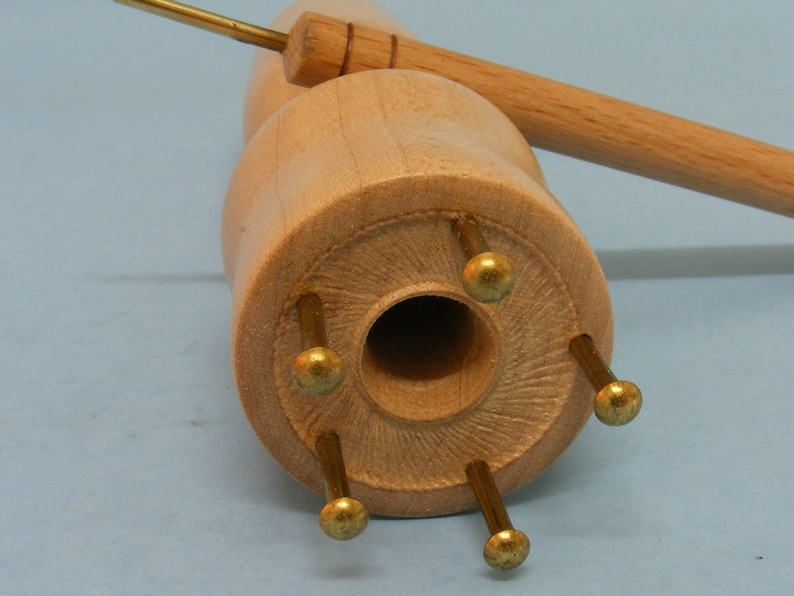
The knitting thing just doesn't add up at all even if it's kind of clever. Why would you make it from bronze? Why don't you find orders of magnitude more of these made from wood? Why would someone want to be buried with a knitting jig?
Sewing, spinning, weaving, and knitting tools are fairly common grave goods to find in women's graves: spindle whorls, needle cases, bone beaters, etc. As far as wood vs. bronze, almost certainly survivorship bias. The only wooden objects that survive that long are those that have fallen in bogs, where the anoxic environment prevents rot. Normal wooden grave goods will have rotted away by now.
"They have been found across a northwestern swath of the former Roman Empire from Hungary to northern England, but not in other Roman territories such as Italy, Spain, North Africa, or the Middle East."
as these are lifestock producing cold regions (and back then were more colder and swampy than today) where probably knitted wool was used instead of the textile that was used in the warmer regions where agriculture produced source fiber for the textile.
>Several individuals have suggested that the dodecahedra are knitting aids, specifically for knitting gloves, with different sized holes intended for the different sizes of fingers, and the pegs serving as a lattice to hold the yarn.
This is mentioned in the article but treated as a joke:
> Other internet researchers, perhaps less seriously, have used 3D-printed models of the Roman dodecahedrons for knitting experiments, and suggested that the true purpose of the objects was to create differently sized fingers for Roman woolen gloves.
Although IIRC when it was first proposed the people who proposed it seemed very earnest and to see it as obvious.
And it nicely explains a lot of the peculiarities e.g. the nubs make sense for attaching yarn, and different people have different finger sizes (up to layers) but the precise sizing is not super important as long as you have a gradation with steps which aren't too big.
It also looks quite close to spool (or "french") knitting.
Though there's the objection that the dodecahedra are serious overkill for those needs when a plank with a few nails would do the trick. There's also the "OOPArt" factor: knitting spools were invented in the 17th century or so, and known records for circular knitting are not that much older.
It does also explain why they are not found all over the Roman empire but mostly in the north (the article mentions England, Germany, and the Netherlands) where it is probably COLD for the average Roman legionnaire
If this was the explanation, there would be wear patterns on the waist of the nubs, and inside the rings just near the nubs.
Many of the potential suggestions can be discarded because they would cause very specific wear patterns that would be repeated across many dodecahedrons.
Similar, but made with wood and nails, which makes way more sense for a knitting aid. Much cheaper and easier to produce.
Also, the dodecahedrons are found in sizes ranging from "4 to 11 cm" in size (according to Wikipedia). That _might_ make sense if there were specialized ones for everything from kids to very large adults, but then...why aren't they found in clusters? You'd expect some towns in the Roman Empire, where gloves were made, to be full of them (in sets, not individual pieces). Instead, they turn up individually and fairly randomly throughout much of the Empire. They often turn up in coin hoards, too, which is an odd place to store a glove-making doodad.
Clothing production in historical contexts (including Roman) is usually a household activity. This mostly means it's done by women of all classes, if only perhaps as a show of virtue. A glove-making device, as a personal item, might show up randomly any place they were used.
Conspicuously expensive household items would also not be unknown. It makes some sense that the bronze survivors may be those owned by wealthy women, where the bulk of those used may be (unlikely to survive) wood.
Compare to needle cases, which were similar womens' tools. Most of them were wooden or bone, but rich women would get fancy ones made of bronze, and pretty commonly be buried with them.
This seems plausible. I wonder if they could identity any particulate from the fibers around the knobs that might corroborate this.
On the wikipedia page there is an icosahedron pictured next to these that does not have finger size holes but I suppose that could be unrelated to this artifact's purpose.