It is basically an end run around the 2nd amendment. Since the anti-gun lobby cannot outlaw them completely they tack on automatic sentence multipliers for any crime where a gun is found even if the gun was not directly used.
Oh, FFS. 924(c) was enacted in 1968. I don't think the "anti-gun lobby" (as disingenuous and argument-poisoning a phrasing as "death tax" or "pro life", if you ask me) was much of a thing then, and even to the extent it did exist, it certainly wasn't anything like the thing that the "Mah cold, dead hands!" crowd reflexively vilifies today.
In 1970 924(c) was 1 year mandatory and 2 year for subsequent using or carrying a gun during a felony.
In 1984 they changed it to 5 years for carrying a gun during a "crime of violence". 20 for subsequent.
In 1986 they added " during a drug trafficking crime ".
In 1998 in addition to use or carry they added "possesses" "in furtherance of any such crime." And they increased the subsequent minimum from 20 to 25.
Note that these were all Republican congresses so i agree that the anti gun theory doesn't really hold that well, it was mostly just "tough on crime" hysteria. The 1986 drug stuff was in response to some basketball player, Len Bias, that died of an overdose.
Ummm, the House was held by the Democrats for all the dates you mention except 1998, the Senate for the first two https://en.wikipedia.org/wiki/Party_divisions_of_United_Stat...). And you're wildly mistaken that party affiliations mapped that closely to official positions on guns till the 1990s, and to this day it's much easier to be an anti-gun Republicans like those now pretty much only found in NY or Illinois than, say, an anti-abortion Democrat.
Here's a brief outline of the "anti-gun lobby's" successes in the US:
Prior to the Civil War: bans on concealed carry ostensibly to discourage dueling.
Post-Civil War: bans mostly in the South on carry, or types of weapons allowed to be carried, to keep blacks disarmed.
Early 20ths Century: More widespread bans on carry, and restrictions on handgun ownership, prompted by the waves of non-Anglo-Saxon immigrants. New York's Sullivan Law, named after a gangster politician who disarmed his southern and eastern European rivals with it, is still the law of the land there.
The National Firearms Act (NFA) of 1934 was the first national level gun control law, which as a "compromise" didn't effectively ban the transfer of handguns.
Lots more where this came from with of course enforcement beyond the initially targeted populations, by the early '60s it was a big thing that Washington State passed a shall issue concealed carry licencing law.
Big push in the '50s and '60s to restrict gun ownership, especially of handguns (I've read many contemporaneous issues of the NRA's American Rifleman membership magazine that covered the Congressional hearings etc. on this, generally lead by the criminal Senator Thomas Dodd, ah, I see he also got LSD banned: https://en.wikipedia.org/wiki/Thomas_J._Dodd#Congress).
The Gun Control Act (GCA) of 1968 completely changed the way guns were sold in the US, opened the door for massive abuses by the BATF that were well on their way to extinguishing the country's gun culture when party reversed in 1986, etc. etc. etc.
The anti-gun lobby was very much a thing that very year, the GCA pretty much marked the beginning of their greatest successes in the country. If we "reflexively" vilify the gun grabbers today, it's because it's been such a thing, and so strong for all of our adult lives for the majority of us (those of us less than 65 years old, including all Baby Boomers born starting in 1950, those of us less than 100 years old if you include that Federal effort to effectively ban handgun ownership with a $3,500 transfer tax in 2015 dollars).
See, that's exactly what I'm talking about with argument-poisoning. When you spout rhetoric like "gun-grabbers", you're telegraphing not merely disinterest in, but active disdain for productive discourse. You're effectively telling me that don't want to discuss the issues, you just want to regurgitate propaganda, and name-call everyone who doesn't toe your party's line.
I mean, I know this is contemporary America, where taking a considered, nuanced position on any hot-button political issue is just asking to be pilloried by both sides (because somehow, we have this quasi-magical ability to reduce every meaningful question to two antithetical camps who proceed to do nothing but insult one another), but we're supposed to be smarter and better than that here. Isn't that what nerds have prided themselves on for as long as nerds have been a thing, being smarter than everyone else?
There is absolutely no productive discourse to be had on this subject from the viewpoint of gun owners.
That is point is hammered home by your harping on my mild rhetoric compared to your ""Mah cold, dead hands!" crowd reflexively vilifies today", without addressing a single one of my points about how you were wrong on every claimed fact in your posting I was replying to.
It also spits on the 8th amendment's provision against cruel and unusual punishment. A lifetime of incarceration for a non-violent offense isn't a fitting punishment nor a suitable use of government power.
I have come to understand this brutal sentencing structure, or at least some of the reasoning. It appears to be the "other side" of the question "how many guilty men should go free for how many innocent men"? The strength of the punishment is proportional to how hard it is to convict with certainty. The aggressive sentencing is greatly exaggerated to form a disincentive for all the men we cannot convict.
Justice strikes me of an area where humans tend to reason intuitively. It's also an area that is extremely difficult to measure in any quantitative way. I would be highly interested in understanding what drives existing criminals--my own intuition tells me these sentences are not very preventative, but allow for the illusion of making progress against crime, particularly violent crime. (These people are monsters! Thank god they're gone for life, or the dangerous part of their life.)
The disincentive of aggressive sentencing is just well-wishing. When I committed my crime, I was not even aware of what laws I was breaking or even the amount of punishment I could receive. Most of the men I knew in prison also were not thinking of consequences at the time they were being bad boys. I would say the main exception to this were the men who had been in organized crime.
There is the fact that criminals are less able to commit further crimes while in prison.
It's not foolproof by any means, but I'm kind of comforted by the fact that the man who deliberately ambushed and murdered mom with a hammer, then later threatened to do something like that to grandma cannot, in fact, pay us a visit barring some failure of the prison system.
> There is the fact that criminals are less able to commit further crimes while in prison.
This presupposes we catch the criminals. This doesn't really match up with reality—it's actually quite difficult to get any conviction from some murder cases, for instance. In a limited sense, what happens to the individual doesn't matter nearly as much as laws affect crime rates.
I was pointing out that prison, as a sentence, serves a use beyond mere retribution. The fact that some criminals are never caught is not relevant to that claim.
My understanding is that this has been studied, and criminals are deterred almost entirely by the certainty of being caught, and almost not at all by the severity of punishment.
The problem with this line of argument is the assumption that deterrence is the only purpose of punishment. Justice (in the hard-to-quantify sense referenced by the GP) for the victim and community (and on a practical tangent, the deterrence of vigilante justice) is a pretty significant purpose of punishment.
The fact it allows the death penalty shows that the 8th amendment is essentially meaningless. Glossip v. Gross showed that SCOTUS doesn't even care how the death penalty is carried out. If the state can kill you slowly and painfully, why do you expect it to prohibit anything else?
I'm an NRA member, and not totally opposed to multipliers for carrying a gun while committing a crime. With great power comes great responsibility, and all that.
Although I do think 55 years is excessive in this case.
However the common crime or sentencing enhancement of breaking and entering with a firearm has clear and important motivations, it's a signal the criminal is entirely willing to use lethal force against others while in the commission of that sort of crime. Those and the more direct sort of forcible felonies have an inherent element of violence in them. Merely selling drugs---a voluntary transaction---while armed is a different thing.
The logic is that you're more likely to use the gun during a crime - regardless of the crime, whether or not it's victimless, or even if the law is unjust.
Yes, a drug purchase is a voluntary transaction, and yes, I believe drugs should be decriminalized. However it's undeniable that black markets are violent and that innocent bystanders get caught in the crossfire. The sentencing guidelines are there to punish and/or deter that.
"Carrying a gun during a crime" is not "having a gun at home", unless you're doing the crime at home. It's particularly hard to do the crime of breaking and entering at your own home.
There's some confusion in this sub-thread. I was originally replying to the comment:
> Since the anti-gun lobby cannot outlaw them completely they tack on automatic sentence multipliers for any crime where a gun is found even if the gun was not directly used.
which is about carrying a gun while committing a crime.
In general, I don't think you should get a harsher sentence for having a gun at home, away from the crime scene. However it's a grey area when you're running a continuous illegal operation using your home as a base.
> Since the anti-gun lobby cannot outlaw them completely they tack on automatic sentence multipliers
I rarely hear anyone say they want to outlaw guns completely, but perhaps that was meant as hyperbole? In any case, do you have some evidence that the multipliers were a reaction to difficulties in regulating guns?
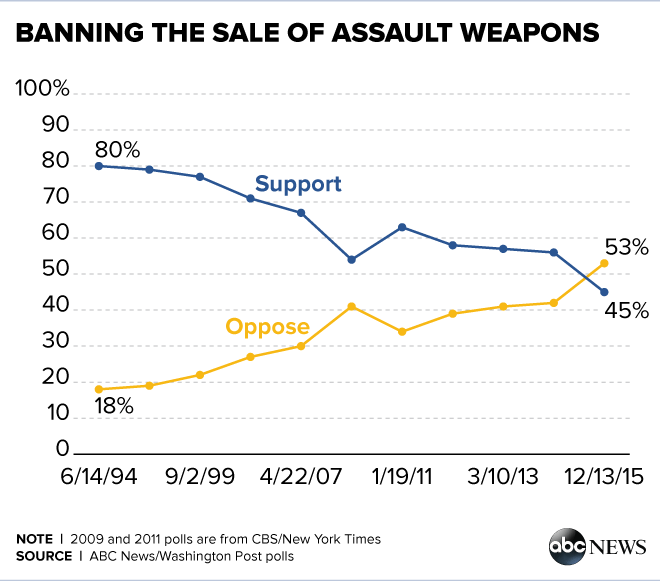
Most Americans believe guns should be regulated more stringently; I would guess that they believe these laws are just, not a political trick. Also, at least sometimes American law more stringently punishes crimes committed with any weapon, guns or otherwise, than crimes committed without one.
The long term trends have been overwhelmingly in the direction of more support for gun rights, not fewer.
This is one of those topics where US preferences and those of HN (which has drawn a more and more international audience over the years) have been moving in opposite directions.
> This is one of those topics where US preferences and those of HN ... have been moving in opposite directions.
I'm not sure I agree. Many posts that even mention simple facts (not arguments) that might be harmful to the proliferation of guns get immediate arguments and voted down. [EDIT: For example, my post above is down to -2.]
(See my post below for some more polls that might interest you.)
> the 45% of Americans who don't want stricter gun control? I wouldn't call those people a "special interest group".
I agree, but I don't think state legislatures' actions are very responsive to public opinion: 1) Very few citizens vote in state legislative elections or pay attention to what happens in their state capitals (for example, how many people reading this can even name their state legislators?), and 2) because gerrymandering makes many districts guranteed wins for one party, few legislators' seats are at risk.
In the end, the political parties decide who gets what seat and in many cases I think they are heavily influenced by special interests. Many bills in state legislatures are written by lobbyists, in fact. Look up ALEC, for example, or in this case the NRA.
55% who want it to be more strict is still more than the 45% who don't want it so or are undecided. If this were a voting matter, picking up 15 percentage points means nothing if it still doesn't take you past your opponent's percentage.
And the whole point of a constitutionally limited republic is so that 55% cannot dictate to the other 45% unless they can successfully argue that what they want is right rather than merely popular.
You get the same number of votes every election, regardless of how many facts you know or opinions you hold. We really don't want to live in a society where 51 idiots can overrule 49 geniuses. (Insert insult against congresspersons here.)
The polling numbers only tell the more spineless representatives how much risk they will take with regard to reelection if they choose to act with due consideration of all parties' interests rather than pander to their base or log-roll with their peers.
Thing is, most high population states are "pro-gun" if you score that as having a shall issue concealed carry regime.
If for no other reason than that they total 43, and out of the 7 restrictive states, only those two are "high population", the others being Hawaii (40th in population), Maryland (19th, ~1/3 of NY), Massachusetts (15th, ditto), New Jersey (11th, ~1/2 of NY), Rhode Island sort of (43rd).
And you have to go down to 29th ranked Connecticut before you get to a de facto shall issue state. California and Massachusetts are also de facto shall issue in many counties/towns, although obviously not most of the high population ones.
In the Bay Area, where I live, guns are completely illegal to carry outside of your my house unless I am a celebrity or have a residence elsewhere in California where I can actually get a license issued.