Despite the many issues, I'd still suggest anyone interested in the Aztec empire at the time of the Spanish conquest to read The Conquest of New Spain by Bernal Díaz del Castillo. Díaz was present not only on the Cortés expedition, but on the earlier expeditions led by Córdoba and Grijalva.
The article mentions, plausibly so, that the issue of human sacrifice was often exaggerated by the Spaniards. Nevertheless, it is clear that the practice (and self-mutilation, primarily of the ears) was an important aspect of not just Aztec life, but many of their neighbors' as well.
Díaz writes, "I have spent a long time talking about the great cue of Tlatelcoco and its courts. I will conclude by saying that it was the biggest temple in Mexico, though there were many other fine ones, for every four or five parishes or districts supported a shrine with idols; and since there were many districts I cannot keep a count of them all. [...] Every province had its own idols, and those of one province or city were no help in another. Therefore they had infinite numbers of idols and sacrificed to them all."
Discussion of deities and their numbers aside, Díaz' repeated report is that sacrifices of various sorts were widespread, and that evidence of human sacrifice, or the holding of prisoners intended for sacrifice, was found almost universally from the coast to Mexico.
Edit: Reading again, on the subject of tzompantli, or a similar arrangement for sacrificed remains, Díaz writes, "They strike open the...chest with flint knives and hastily tear out the still palpitating heart which, with the blood, they present to the idols in whose name they have performed the sacrifice. Then they cut off the arms, thighs, and head, eating the arms and thighs at their ceremonial banquets. The head they hang up on a beam, and the body of the sacrificed man is not eaten but given to the beasts of prey."
The Spanish themselves conducted many religion-motivated rituals of human sacrifice in Europe and in the Americas.
In Europe, there was the Inquisition, with ritualistic torture using medieval torture devices, burning people to death, etc. Motivated by religious beliefs, just like the ones in the Americas.
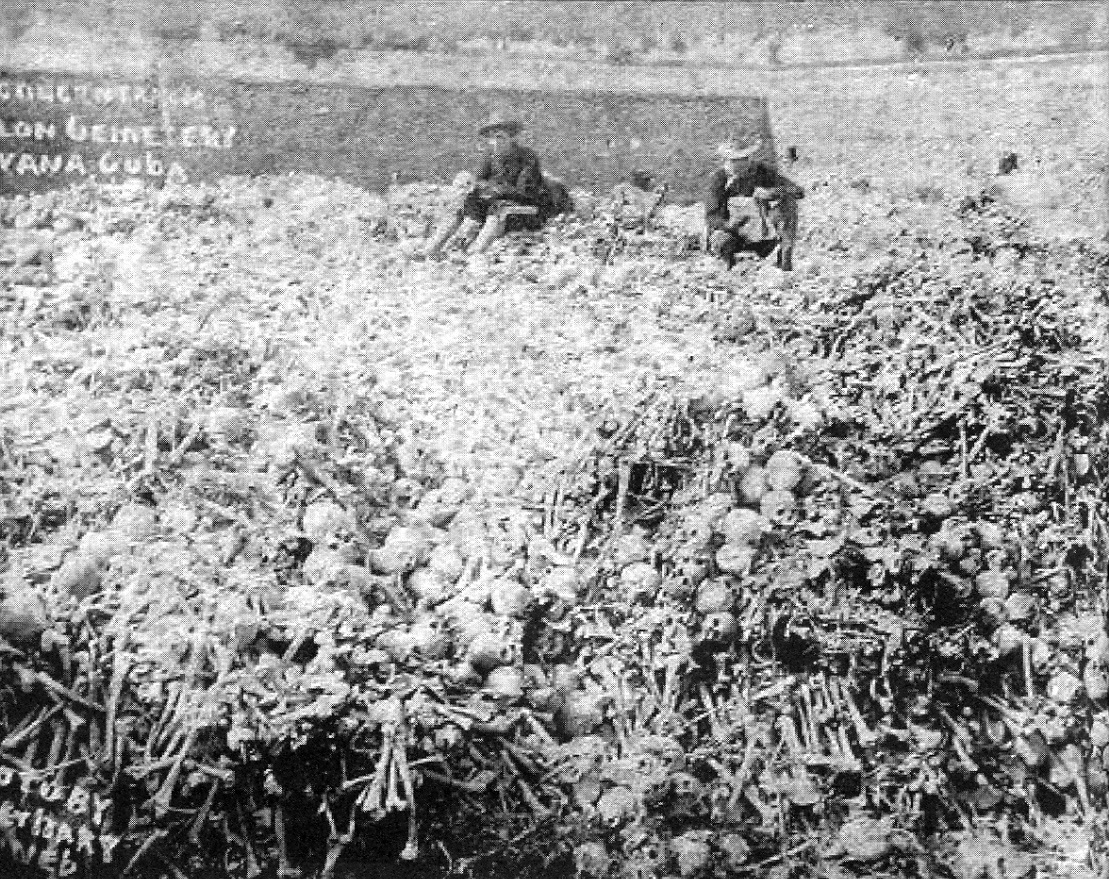
The Spanish also conducted campaigns of extermination. Some recent ones: the Reconcentrado policy in Cuba, and the usage of chemical weapons in the Rif war.
“La Reconcentración” was a policy enabled by Gen. Weyler to force people in rural areas to move to nearby cities where they could be monitored, hoping to cut off the underground support network of the rebel Cuban forces fighting in the mountains. It had nothing to do with human sacrifices.
I expect so. But there is still an interesting point: witch and heretic-burning likely tap into much the same psychology as ancient human sacrifice. Even the rationales overlap:
"Devine will demands these deaths; we will ensure the safety of our community by ritually killing these people."
Then again, it makes sense to put things into historical perspective. When we are about to talk about how one group was murderous and cruel, and how odd it makes us feel, it makes sense to point out what was going on elsewhere. Especially when the exact group reporting on those things is involved in cruelties of their own and uses these reports to excuse their own cruelties.
Cortez him self was quite cruel, fond of torture - either when looking for gold or enemies.
People up thread discuss how good guy Cortez must have been, merely affected by Aztek sacrifices and saving locals. That is somehow on topic? Why the difference?
It is as if people were emotionally invested into this, despite this being hundred years old affair.
So yes, this matters because thread up there want to make adventure book out of this. It is not about trying to figure history, it is about treating it all as scary book.
People up thread merely noted that Cortez was likely correct, and we shouldn't have so hastily disbelieved his claims. They said nothing about him being a "good guy" etc.
His claims were not hastily disbelieved. That is not how history happened there, they were both taken as total truth and disbelieved. His claims were disbelieve for various reasons, notably that he extracted quite a few admissions under severe torture. Notably, disbelieved also by his contemporaries who watched it and wrote horrified reports. He tortured also because gold seeking, not just for human sacrifice cause. They became paranoid and over drunk with unlimited power. When people in group X kill each other and then you kill them all, you was unlikely to be merely horrified and trying to help victims. Your motivations are guaranteed to he more complicated, as much as believe in your good intentions make us feel good.
You can have human sacrifice without it being impossibly large and without it being treated like adventure movie plot and without jumping on every fantasy anyone ever wrote - which is what up thread is. You can belive scientific consensus which is based on multiple sources and findings without making feel good stuff about conquest.
And while you are expressing outrage over exceptional kills, it is fine to ask who the source is. Because it does put things into context as it turns out the report is not by independent third party, but by highly motivated player in political and violent struggle for control.
It seems that you're more concerned with giving value judgements to Aztecs and Spanish, and their comparison – but why is it relevant, or even interesting, at all? Just like in a case where article's author took to Twitter to announce that "human sacrifice wasn't horrific" (which it of course was), I just don't understand why people can't discuss history without fixating on moral value judgements. Do you have a horse in this race, or something?
It seems to me other way round. I did not judged either, but I wrote why certain reports could not be trusted. The "this particular thing is likely exaggerated" comments were downvoted at the time I read it - regard less of how factual they were and no they did not claimed Azteks not have human sacrifice at all.
That is discussing history without judgement. If you bring this as proof that Cortez was unfairly disbelieved, which people do, then it is absolutely relevant to bring why, the way he collected evidence and what his goals were. That is part of historical discussion too.
This whole discussion, meaning other (top) threads are primary about making civilization judgement. Except that, only Aztek (or communist for some odd reason) kills are allowed in that discussion. It is literally there, Europeans coming were clearly superior, because we don't talk about facts that break that nice vision - namely that potential victims of sacrifice ended up being tortured in order to extract evidence that they themselves killed people (or have gold).
So no, discussion turned into civilization moral judgement before me and at that point it is perfectly ok to discuss involved civilizations - or at least what they were doing at that time at that place.
-----------
Offtopic: I think you can actually judge past people. You can judge Aztek priest, who is in it in part for own gain or cruel Samurai, Nazi leader or Colombus or whoever specifically. You should not however buy one of these guys woldview, just because he is our tribe remotely, and claim his self serving violence and treatment of commoners are fair due to somebody else's action.
> In Europe, there was the Inquisition, with ritualistic torture using medieval torture devices, burning people to death, etc. Motivated by religious beliefs, just like the ones in the Americas.
Later, during the reign of terror they killed and tortured people based on non-religious or even anti religious beliefs.
Yes, old Catholics did much wrong but can we stop this very unnuanced "religious people did it" and conclude "people with power did it"?
How exceptionally Baudrillardian, or maybe the word is meta.
A class, in their search for authenticity, have "gentrified" the authentic experiences -- and hardships -- of an originating lower class into trendy symbols.
The social metamorphosis is complete when the symbol replaces the experience entirely, to the annoyance of the originating class; in part because the experience was a symbol of their own identity.
The effect is then highlighted in language ostensibly for the gentrifying class, on a virtual property catering to the same, and posted for discussion on another such virtual property.
Finally, like the author who pretentiously signals a more authentic worldview through the symbolic understanding and condemnation of the effect, so this poster signals the same through bemused expression of its symbolic and recursive nature.
> My goodness, all those people who went to concerts before cell phones must have been so hardcore, taking risks like that.
I get the point you're trying to make, but to me this just reads like gatekeeping.
Cell phones are useful and they can make people safer. In a world with cell phones not having timely access to one is riskier. In a world without cell phones it's a moot point.
The more interesting issue -- which others in this thread are discussing -- is whether the benefits of having a cell phone outweigh the harms people can cause with them, and whether policy can help strike an appropriate balance.
I'd argue it's more comfort that you can be reached or reach someone than actual safety. But I don't really disagree with your broader point. This system doesn't seem very practical for a whole range of issues.
Plenty of other live events have policies against recording and cell phone use and don't seem to have any serious problems enforcing those policies (or, indeed, need to do much "enforcement" at all). Perhaps rock concerts are different because of the type of crowd.
Sure, cell phones can contribute to personal safety; whether it actually does in a standing-room-only rock concert given the distribution of risks one is likely to encounter in that context is another matter. I have a hard time imagining one, except a medical emergency, maybe? Except that having people find security might truly be more expedient.
Besides, I cam imagine real harm. Everyone simultaneously receiving a false alarm that a ballistic missile is headed there way might actually cause Widespread Panic to come out and play an encore.
Someone mentioned above that, in the event of a fire alarm and being separated from your group, being able to reconnect with them is important. Particularly for vulnerable people (whether due to age, health reasons, or being someone who might be targeted for violence or harassment), being separated from your group for a long time can be a safety issue.
in the context of having to leave the building due to a fire alarm, no, you're not meeting them back inside the building at the phone re-collection point (or in this case one of the phone unlock mechanisms). At least not immediately.
As I mentioned in another comment, it's possible you've never taken someone with a disability or social dysfunction to their first-ever concert, knowing that it's partly enabled by the fact that you can easily reconnect if you get separated (by the crowd, bathroom lines, a fire alarm, etc.) Take away that extra measure of safety and security, and the majority of people can "just deal with it", but people with certain disabilities or vulnerabilities are going to have to opt out.
Personally, I'd rather work to be inclusive. Use social norms, not technological lockouts, to get people to put their phones away.
Do you think maybe the security guards and other personnel at the venue might have access to phones? Do you think that you in particular are going to be the last resort that manages to reach 911 when nobody else can? It's a weird train of thought to me. Venues are required to have their ducks in a row - emergency plans in place, etc. You not having your phone during the show is not a safety concern.
If a fire breaks out and I have to evacuate a venue, there is a _distinct_ difference in the effect on me if I have to have had my phone locked up.
In one case, I leave the facility, get to safety, and then _go home_ (eventually), at which point I have my phone.
In the other case, I leave the facility, get to safety, but my phone is either destroyed, or in a pile with 900 other concert-goers' phones, and I need to either wait around (in a place where emergency services probably don't want extra people), or _replace my destroyed phone_.
No thanks, I'll keep my phone in my pocket or backpack, and have it with me when I leave with no extra effort. If necessary, this will mean skipping any concerts or similar where that's an issue.
> In the other case, I leave the facility, get to safety, but my phone is either destroyed, or in a pile with 900 other concert-goers' phones, and I need to either wait around (in a place where emergency services probably don't want extra people), or _replace my destroyed phone_.
"Hey throwaway43532, [PERSON] just found out you're at [PLACE] and is on their way with a weapon. I contacted the authorities, but you need to get out of there now!" might be a severe example.
There are many situations where a cell phone can allow you to send or receive information that could tip the scales in your favor.
The possibility of me ever getting a message remotely like that is so remote that the very idea could power the infinite improbability drive and take me to the restaurant at the end of the universe.
Translation: I'm unwilling to put down my phone, and I will conjure any number of nightmare scenarios to justify my addiction.
Or, perhaps, some people are truly terrified to be away from their smartphones. That is itself a scary thought.
If a person's smartphone is removed from the picture for some reason, how would they be able to function? If the cell network went down, would the crowd descend into mindless chaos? There are no more pay phones, no more cozy landlines, so how would people manage if there were an emergency?


The article mentions, plausibly so, that the issue of human sacrifice was often exaggerated by the Spaniards. Nevertheless, it is clear that the practice (and self-mutilation, primarily of the ears) was an important aspect of not just Aztec life, but many of their neighbors' as well.
Díaz writes, "I have spent a long time talking about the great cue of Tlatelcoco and its courts. I will conclude by saying that it was the biggest temple in Mexico, though there were many other fine ones, for every four or five parishes or districts supported a shrine with idols; and since there were many districts I cannot keep a count of them all. [...] Every province had its own idols, and those of one province or city were no help in another. Therefore they had infinite numbers of idols and sacrificed to them all."
Discussion of deities and their numbers aside, Díaz' repeated report is that sacrifices of various sorts were widespread, and that evidence of human sacrifice, or the holding of prisoners intended for sacrifice, was found almost universally from the coast to Mexico.
Edit: Reading again, on the subject of tzompantli, or a similar arrangement for sacrificed remains, Díaz writes, "They strike open the...chest with flint knives and hastily tear out the still palpitating heart which, with the blood, they present to the idols in whose name they have performed the sacrifice. Then they cut off the arms, thighs, and head, eating the arms and thighs at their ceremonial banquets. The head they hang up on a beam, and the body of the sacrificed man is not eaten but given to the beasts of prey."