If you don't use Pocket then the acquisition was bad because they spent a bunch of money buying an unrelated company to add a feature you don't want. If you do use Pocket then the acquisition was bad because you don't want to be relying on a weird side project of a company because they'll do a terrible job of maintaining it and it'll inevitably get shut down.
> they spent a bunch of money buying an unrelated company to add a feature you don't want
While fiddling (and paying their execs $$$) as the only useful thing they do -- firefox -- crashed and burned into irrelevance. Leaving the company useful only as an ersatz chrome hypothetical competitor to keep the feds / EU at bay. Great for the overpaid people running it; less good for anyone in our industry.
Exec pay: up and to the right.
Marketshare: way down and to the right.
Don't worry guys -- now they're playing VC and AI, at which they're sure to be as good as they were at running Firefox. Though I guess since you could say their only successful product was anti-trust insurance sold to Google, that's at least in the finance space, so in some way related to being a vc...
People really don’t like your comment it seems but you’re right, even if it’s a little on the nose.
I think most people wish it wasn’t true, myself included, but how many times does Mozilla have to show us their priorities are anything but improving and maintaining Firefox itself before we accept the truth?
Some people hated pocket, and would complain about it. Different people liked pocket and are commenting here.
The community has people with different viewpoints, and you are seeing different people's comments on different stories (either because different people are commenting or because different comments are getting voted to be visible).
I hated pocket being enabled by default, that's all. I also think a lot of people saw it as adware/spyware even if it technically didn't work that way, which tbh I'm unsure of.
That doesn't mean I wanted it dead. I was happy for the feature to exist and for others to use it. Maybe some people were angry that they even wasted a few KB downloading the extra code for a feature they won't use, but I'd be ok with it.
Nicely articulated.
I think their comment encapsulates the disbelief people have about public opinions that differ from their own political viewpoints (and the aspects that had been amplified within their own media/algorithmic bubble).
The complainers were FF users forced to deal with bloat they didn't use, those who are sad here are pocket users. They're just different people. Though, even those who didn't like the bundling of the extension probably didn't actively want the service to fail.
Right. I would be one of the people who saw pocket as an unnecessary distraction, but even I tested it and my opinion is partly based on pocket just not working in my Firefox at the time. I also just did not like that it was given space in the toolbar while a way more important rss button was denied that space. And despite that, I still think the shutdown now is bad - this should be spun out or be moved to a Foss project, and certainly not be killed for more ai nonsense.
BTW, fakespot (the service they also shut down) is or could be an applied ai project where that technology could be helpful, and they also shut it down. That also feels wrong, especially the combination.
Pocket was pushed pretty heavily and basically shoved down the throat of Firefox users. Many obviously complained about this behaviour, either because they had no use for Pocket or already had a different solution. Mozilla was basically mimicking Microsoft behaviour of just forcing products/features onto it's users.
Shortly after the Pocket launch Mozilla stopped pushing Pocket and it became less visible in the Firefox UI. Now it's just a tiny grey button most don't click. So you're either use Pocket and like it, or you don't even think about it.
The main complaint, as I remember it, was mostly how Mozilla positioned Pocket.
Some people picked up Pocket over the years, many liked it. These are not necessarily the same people who objected to have Pocket thrown in their face.
Pocket became annoying because Mozilla started shoving it down your throat, whether or not you wanted it. To most FF users, Pocket is (at very best) a source of occasional popups and other UI annoyances. People who had a use for it really liked it, though.
I used Pocket for about 3 years, before and after the acquisition. When Firefox started syncing bookmarks across devices, and they added the reader mode, Pocket became obsolete in my mind. I stopped using it because I didn't need it anymore.
I think it's consistent to be annoyed that they went and bought something and shoved it into everyone's browser, but also that they're taking away a service that people have come to depend on.
I'm quite happy about it. I might even print out a tombstone to piss on.
I'd have had no problem with pocket if it'd been an optional plugin. Or, if it'd been optional at all. If I wanted to go around disabling a bunch of browser bloat, I wouldn't be using Firefox.
I wish there was a "Beg HN:" because I'd love to see a little graveyard with 3d printed tombstones of all the failed and canceled products of all the big tech companies.
I'm just glad it has a funny name instead of something arrogant-sounding like "Dunning-Kruger effect." That was ok in a research setting but got turned into an insult.
That's not true, I sing the praises of things that bring me value all the time. I am, arguably, getting pretty close to "shill" category for some of them. However, I think that behavior should get a pass if the things being shilled are actually FOSS and not just "change from one company to the other"
I think statistically I'm still right. Complaints are always more frequent than positive comments -- and more unsolicited. I always factor that in when reading, for example, product reviews. While there are always people willing to sing the praises of products they like, the average content person is likely to just move on with their lives, and a wronged person cannot wait to tell everyone.
This is also related to Cunningham's Law.
Look at this thread, I've never heard so much positive talk about Pocket in my life. Up until it's imminent demise nobody had any strong inclination to talk positively about it.
You're right. Everywhere I've gone to school or worked, any big online forum was mostly complaints, even though I went to great schools and had cushy jobs. You'd think every course curves to a D- and every employee gets a 10% yearly pay cut. It's simply because one unhappy person can be as active online as 100 happy people.
And on some sites like Yelp where complainers aren't disproportionately active, complaints can have disproportionate power. Like a 4.5-star restaurant's average is affected way more by a 1-star review than a 5-star review.
In my experience people are more likely to complain about things that annoy them than those things which make their lives easier. However, nowhere in that statement will you find "everyone" is more likely to complain, just that the probabilities are much higher for complaining about a thing rather than advocating for a different thing.
This is what confused me coming into this thread too! I was wondering what it'd be like consider how widely unpopular pocket is around here. Enough that anytime Firefox is brought up people point to pocket. No one defending it at those times so at just hear negatives. I'm sure there are plenty of different users but it's interesting to see what opinions dominate a thread at a given time.
I think people just like complaining about Firefox and Mozilla. Or maybe it's just that HN likes to complain in general
Either way, good news for Google I guess ¯\_(ツ)_/¯
Of these, I would say that Cinnamon is one that could be comparable to XFCE or even GNOME and KDE. Seriously, it's good. The system settings menu has all of the options one could need and the look and feel of the dektop is very customizable.
I'm a KDE user, but if it ever stopped working/disappeared I would use Cinnamon. In fact I plan to use it whenever KDE Plasma 6 releases to wait out until the it becomes more stable.
> KDE Plasma 6 releases to wait out until the it becomes more stable.
IIRC KDE committed to never break users again like they did with the first releases of KDE 4. It's expect the first releases of Plasma 6 that the distros will actually ship to be stable, and to be mostly a Qt5 → Qt 6 upgrade. You should be able to run a stable version of Plasma (5 or 6) in any case during this period. KDE 3 to 4 was a disaster; last versions of KDE 4 were rock solid. First versions of Plasma 5 were a bit lacking but rapidly became very stable and usable, and you could actually keep using KDE 4 in the meantime. I expect the Plasma 6 transition to be even smoother. I hope I'm not wrong.
But otherwise I agree, Cinnamon seems very good and I tend to recommend it and pick it for people who I install Linux for.
Sorry, but as an early adopter of Plasma 5 (granted, maybe a bit too early), it was terribly broken for a couple of months. I took refuge in Awesome until things stabilized.
Huh. I started using Plasma 5 on a bleeding edge rolling distro and it was just fine. Everything was a mix of KDE4 and KDE5 apps for a while, but they all worked with minor quirks at worst.
I believe I was switching between Arch and OpenSUSE at the time, and I didn't note down specific issues, I seem to recall problems with kwin dying... maybe something to do with multihead? If I'm not mistaken I was still using a PC with a Radeon HD 7770 GPU at the time (for all the Catalyst issues I've had, still one of my favourite pieces of computer hardware I've ever owned), so it could have been iffy interactions between moving parts. I do seem to recall a period when I got many, many panics (or oopses, I dunno, screen went black and nothing reacted to anything), I think that was around the same time.
Forgive the vagueness, but I don't believe in memories and haven't kept a journal. Still, as completely unreliable and untrustworthy human memory is I am inclined to believe I had issues with Plasma 5 during the transition period.
Yeah, I'm sure you did run into real issues. I was trying to figure out if they were distro issues, or if issues that also affected me were more of a problem for your workflow than mine, etc.
Either way I think that still sounds better than the old 3->4 migration, and hopefully 5->6 can be better still!
I can see that. For me personally about a year~ish ago Plasma Wayland reached the point where it's good enough for me to use as a daily driver...
...though I do lament the loss of Desktop Cube.
Of course, coming from Awesome I am often annoyed at how Plasma doesn't have per-screen (X11 monitor, if I'm not mistaken) tags and per-X11-display workspaces don't really work that well.
I pretty much did this too but in Arch Linux. It's just a script[1] that I run and I have it working with the linux and the linux-lts kernels. It's pretty nifty. It just works on Arch Linux since kernels don't have version numbers on the name I never have to touch again after installation.
I've used Fish for about 2 years now. Before that I used ZSH for about 6 months. I'm relatively new daily driving Linux. About 3 years.
The thing about ZSH that made me jump ship was that even though you can customize it like fish (with Oh My ZSH plugins) ZSH was always slow or didn't display some things correctly. It was frustrating having to wait a few seconds for a command or having things just not work out correctly.
Fish, on the other hand, is fast and has a lot of quality of life features like typing part of a command and then serach with the up key. I didn't even install any plugins (I like to Fisher[1]).
Also, Fish has gotten me more and more into shell scripting. The docs for Fish are very clear and easy to navigate. I love how you can have custom scripts on the .config folder or abbreviations[2], which I think are superior to aliases since they expand into the command you're calling.
I was using it as the default shell for my user until recently and it was fine, but I have gone back to Bash as my default shell and just set my terminal emulator to start into Fish on startup. I didn't have any incident. I just wanted to avoid anything unexpected further down the line.
Let's add to that that both fish and zsh have excellent vi modes (unlike readline's half-assed one)
(If don't see the benefit of using a vim mode for the command line, you probably still reaching far out to the top left corner escape key in the rare occasions you do use vim, and dislike to use it.)
If you can remember which countries traditionally mostly speak English, and which mostly spoke a Romance language, you have a shot at getting it right.
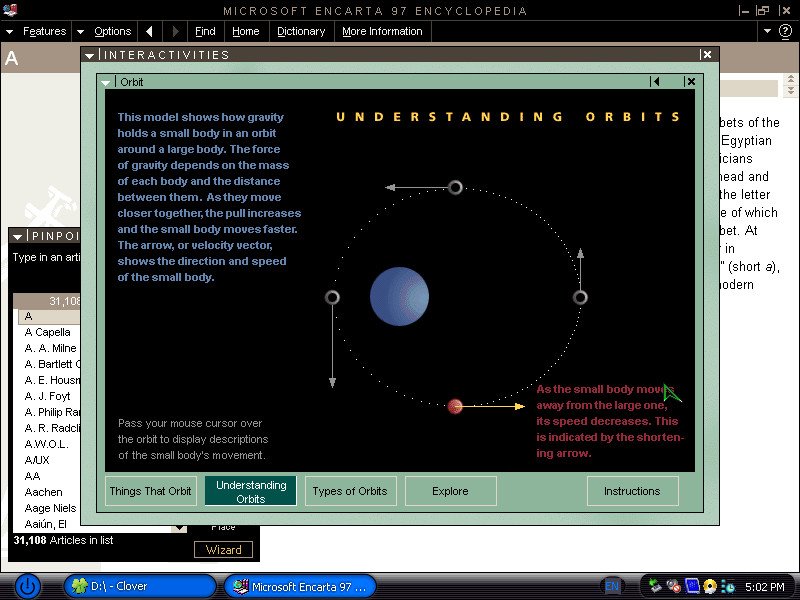
The thing about Encarta to me is that it felt so much more interactive than what we have today.
Nowadays we read a Wikipedia article or watch a Youtube video on a topic but never interact with the content. It's all very passive. I was a child during the heyday of Encarta and I remember I had it and a few other specialized encyclopedias (one about animals, one about sea life, one about dinosaurs!!) and they were all interactive. I miss this about computers. Not all things have to be a game or passive which is what I see nowadays when a child has a screen in front of their face.
I never mess interactivity when browsing Wikipedia. I love that WP is text-based, so that I can read it in my own preferred tempo. I rarely watch videos since to me they always feel too slow compared to reading text. I understand on an intellectual level that Youtube is a great platform that provide lots of value and entertainment to lots of people, but I never feel that greatness since it’s not something that I personally appreciate. Oh well, to each their own :)
There is value in "all" information being text. However there's also value in having interactive elements. From the contextual fitting video to i.e. an embedded star map: Imagine reading the article about a solar eclipse and being able to navigate a 3D model of the stars. Imagine reading an article about the human body and having a 3D model right next to it: If you click on "heart" in the text it's being highlighted in the model.
Of course Encarta wasn't there, but we have 20 years of technological advance. But for hobbyist Wikipedia authors that's too much work and for a commercial Encarta Wikipedia is too strong.
Can you describe the ones you most remember? I see the image but I'm more interested in your (memory of your) subjective experience. What level of creative freedom did you have in the interactivity?
The most vivid memory I have of myself spending hours on Encarta as a child was with their "flight simulator" / bird's eye view. I will try to find a video of it but I am sure it will be disappointing in today's standards as well.
I’m the same way. Video is such a slow mechanism for consuming information, so unless it’s primary material to bear witness to something, it’s usually just a lot of overhead - slow talking intros, context setting, bias, association, etc.
My memories with Encarta aren’t that special - the searching was cool but I think I was jaded to the cdrom video thing already, wishing it could be better technically. Definitely gave you a sense of what could be possible with an endless source of material, irrespective of copyright.
...and in many cases, sufficient filler to tip the video over the 10 minute mark so that more adverts can be shown during it.
Don't forget to like and subscribe!
I was randomly looking up prehistoric musical instruments the other day and I couldn't help but want to see the instruments and watch a video of them being played. It was not available on Wikipedia.
The one place where I found videos were hugely better was blender tutorial videos. The program has countless features and shortcuts and is hugely visual. The video just helps you capture as much of that information as possible as well as showing you the typical workflow of a pro.
What kinds of interactivity are you referring to? I didn't have Encarta. My comment at https://news.ycombinator.com/item?id=20741101 is largely about how interactivity is missing from Wikipedia articles and Kiwix.