I think there's a strong argument that the most useful product from collider science is the synchrotron light source. Researchers using collider rings realized that the x-ray synchrotron light these rings emit (an inconvenience to collider physics people) was a fantastic tool for structural biology and materials science. Eventually, they built dedicated electron storage rings that don't do collisions at all - the main goal is producing bright X-ray beams.
Synchrotron light sources have had wide-ranging, concrete impacts on "industrial products" that you probably use every day via studies in:
- Drug discovery (Tamiflu and Paxlovid are good examples)
- Battery technology (X-ray studies of how/why batteries degrade over time has lead to better designs)
- EUV photolithography techniques
- Giant Magetoresistance (Important for high capacity spinning-disk hard drives)
Indeed. The first dedicated light -- for various values of "light" -- source[1] repurposed the tunnel and various bits and techniques from the particle physics accelerator it replaced, and on which parasitic "light" measurements were made previously. See also [2].
I totally agree! I also very much appreciate the amount of time they dedicate to explaining the details of the apparatus. I suspect that very few physics students get any reasonable amount of instruction on experimental techniques these days. I barely did fifteen years ago, and I think things have only gotten worse since then. Without that, the learning curve of working in a research lab can be pretty brutal.
A second benefit I get from spending all that time on the apparatus is kind of paradoxical: those extra details seem like they would distract you from learning and understanding the core concept, but somehow they make things much more approachable. The idealized experiment is slightly too abstract to easily digest.
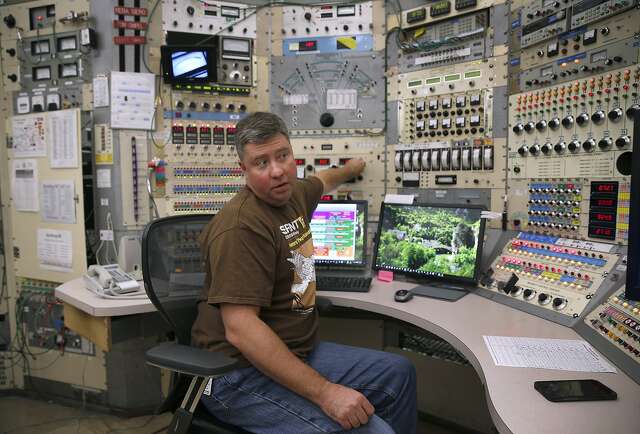
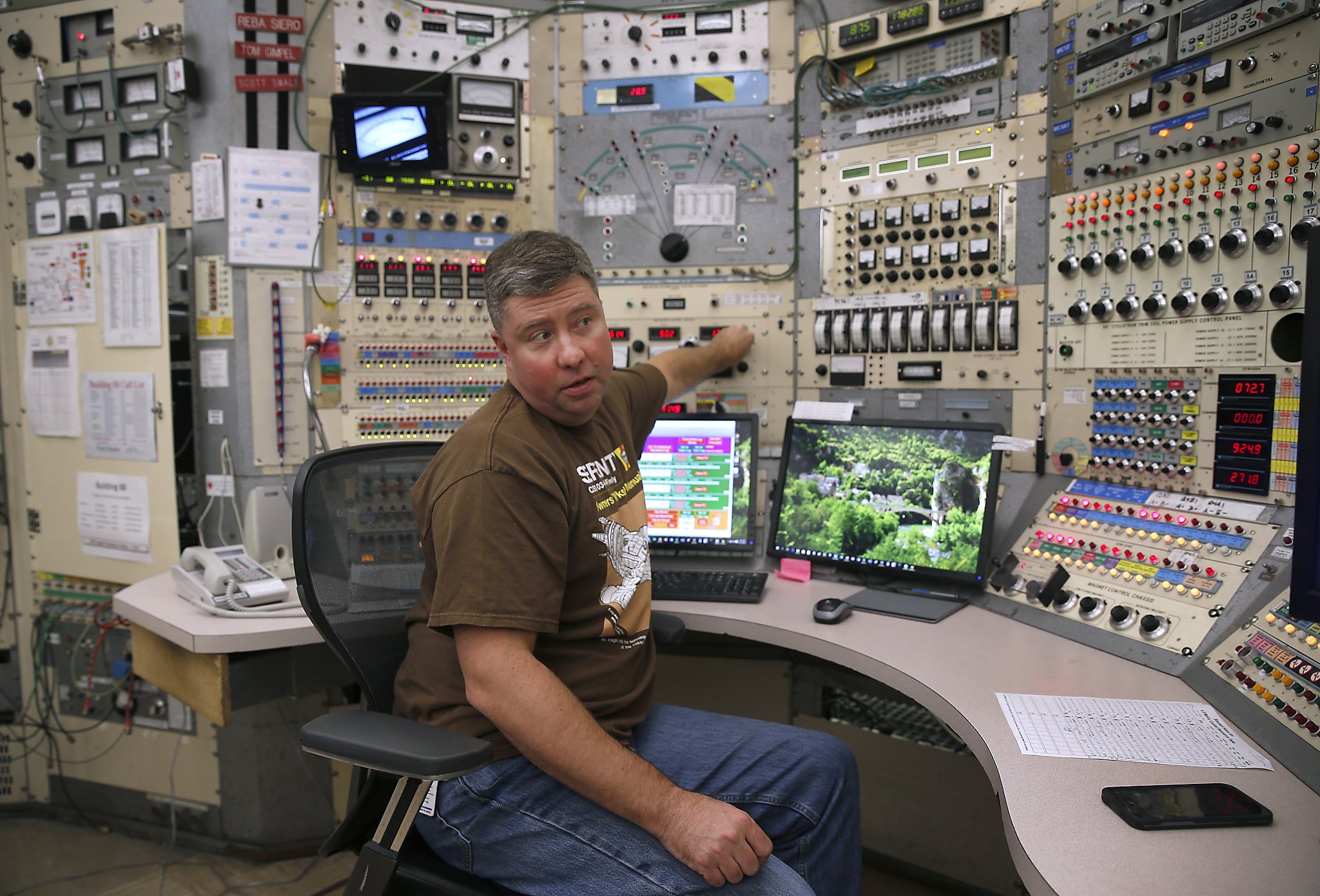
I agree - many older particle accelerators in the U.S. have/had control rooms that look very similar to these photos (go see the 88-inch cyclotron at Lawrence Berkeley National Lab if you ever get a chance!). I think this is more 'vintage control system aesthetic' than a particularly soviet look.
I used to work near there[1] (and take prom dates on the spook show at the then abandoned Bevatron[2]); the Soviet stuff does have a distinct look to it. The US racks were filled with this grey stuff, generally put together rather haphazardly by EM techs, where the soviet stuff is vastly more .... designed. At least in these photos. Possibly because the control systems were for larger, longer lived technology. Though the 88 has had a pretty good run. By contrast the ALS control room looks like a devops room; just a bunch of Sun workstations. Just for contrast; the Dubna cyclotron in Russia is pretty equivalent to something like the Bevatron or 88", and it has that swoopy designed look to its control room[3].
In fact one of the photos in this collection is from the American ship NS Savannah (launched in 1959)... it's not easy to spot which one is the odd one out!
You can't actually suck all the energy out - the best you can do is get the atom into its ground state, which is still non-zero.
The de Broglie wavelength of the atom is (h/p), where h is Planck's constant, and p is the atom's momentum. This is the wavelength of the atom's probability wave, so at the minimum value of p, the atom has some 'fixed maximum size', if you want to call it that (but size isn't really an accurate descriptor, more like 'the region in which you might find the atom').
The Bose-Einstein condensate is defined as the state where the de Broglie wavelength for atoms in a cloud is larger than the spacing between atoms - the probability waves overlap, and it is no longer possible to distinguish one from another.
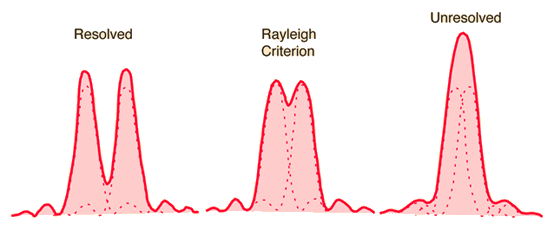
but at the Raleigh criterion and under, the waveforms can still be quite different depending on the source distance, and furthermore you can definitely tell the difference of those waveforms from that of a single source.
What I've read about Bose-Einstein condensates seems to imply that in the condensate form, the probability waves not only become unresolvable but also synchronized in phase, AND the energy behavior of the aggregate is markedly different since they "all" (or at least according to Bose-Einstein statistics) occupy the same quantum state:
https://www.youtube.com/watch?v=shdLjIkRaS8
Is the transition from Maxwell-Boltzmann statistics to Bose-Einstein statistics a sharp transition or not? In other words, are condensates a descriptive marker or a suddenly different state?
I am not sure what you mean by the probability waves (amplitude?) becomes unresolvable for the condensate, but it is true that the condensate will have a continuous phase with integer windings of 2 pi around vortices etc. The wavefunctions of the atoms overlap below the critical temperature and you get Bose-Einstein condensation for atoms with integer spin.
But those atoms themselves are still made up of electrons, protons and neutrons which have half integer spin, and at even smaller scales of quarks and gluons. If you probe the condensate with high enough frequency without thermalizing it you would be able to resolve those details, but at the macroscopic level of the condensate those details are not resolvable (is that what you were getting at?).
When you cool an atomic cloud below a critical temperature there will be a condensate fraction and non condensate fraction. If you are just looking at the condensate fraction then you can use Bose-Einstein statistics.
At zero temperature with 100% of the atomic cloud as condensate ( in reality we can never get to zero temperature, but we can get pretty damn close), the Gross–Pitaevskii equation ( https://en.wikipedia.org/wiki/Gross%E2%80%93Pitaevskii_equat... ) is a good model for the dynamics of the condensate. If you want to go above zero temperature and include interaction with the thermal cloud (the non-condensate fraction), then you can use the SPGPE, the stochastic projected Gross–Pitaevskii equation.
I mean "unresolvable" in the same sense that two nearby point sources through a diffraction-limited lens are unresolvable. If you watch the video, it appears as if there is only one wavefunction for the BEC of many particles (presuming that is what the video is depicting). Is that in any way an accurate depiction of what's going on?
Indeed, that's accurate (apart from finite temperature and interaction effects). A BEC is in some ways pretty similar to a laser, where all the photons are in the same state, even quantum mechanically.
But it's important to distinguish between a BEC and a superfluid. Superfluids are the substances with strange collective properties, and these properties come from being cold, bosonic, and interacting. BECs with very low inter-particle interactions do not behave like superfluids, but will exhibit e.g. interference (just like a laser, which is kinda like a non-interacting BEC).
Regarding the transition from Maxwell-Boltzmann to Bose-Einstein statistics: There is no transition. If you're dealing with Bosons, it's Bose-Einstein statistics at any energy. It's just that at higher energies (or, lower densities in phase-space), Bose-Einstein and Fermi-Dirac statistics become indistinguishable, with Maxwell-Boltzmann statistics being their common "high energy" limit.
It's a phase change, so yes a "suddenly different state". In the lab the BEC part and the thermal part are pretty easy to tell apart when you let the distribution expand (by releasing it from the confining potential.
Synchrotron lightsources are a dime a dozen. For real power, you want a free electron laser. The Linac Coherent Light Source at SLAC (right in Silicon Valley's back yard) pumps out an X-ray beam with about 750,000 times as many photons per second, and in pulses that are about 200 times faster.
If you want even larger systems, you should check out the European XFEL, which was just opened, and is now the most powerful free electron laser in existence. http://www.xfel.eu/
As a die hard LCLS supporter, I have to say: XFEL has the more powerful electron beam, but LCLS is still in the lead in terms of X-rays right now (if pulse intensity/peak power is the measure).
XFEL is really an amazing machine, though, and once it is fully commissioned, it will take the X-ray crown as well.
On (2), I do know that FEL analysis of small samples such as the ones for protein structure analysis entails completely disintegrating them (off goes all the electrons, then the nuclei quickly realize they have nothing in common anymore and decide to go their separate ways), and analyzing the structure is done on the basis of reading the radiation scatter patterns from the instant between when the beam makes contact and when the molecule has utterly lost the structure in question.
I think it would be safe to say FEL isn't exactly non-destructive for hardware.
The HOPE Scholarship (the Georgia in-state scholarship program) still exists, but since the early 2000's, it has become considerably harder to qualify for. It used to be as easy as graduating from a public high school in Georgia with a 3.0 GPA, and would cover all your tuition, up to 15 credit hours per semester. Once you were in college, I don't believe there were even any GPA requirements. Today, I think you need a 3.7 GPA to qualify. EDIT: Looks like you still just need a 3.0, but there are additional 'academic rigor' requirements on the high school courses you take.
It was a spectacular bargain (and still is, but to fewer students), and paid for my degree at Georgia Tech, which is a pretty good school. The system is funded by lottery revenue, though, which brings up some thorny issues. The majority of people who buy lottery tickets are working class, but the majority of HOPE recipients are upper-middle class - effectively a bizarre reverse-welfare program.
In most other states, similar programs don't exist, and even students who are willing to stay in-state and work while they go to school end up with some student debt.


Synchrotron light sources have had wide-ranging, concrete impacts on "industrial products" that you probably use every day via studies in: - Drug discovery (Tamiflu and Paxlovid are good examples) - Battery technology (X-ray studies of how/why batteries degrade over time has lead to better designs) - EUV photolithography techniques - Giant Magetoresistance (Important for high capacity spinning-disk hard drives)
reply