I'm retired. I hope to get a 3% per year income from my savings every year after inflation and taxes. If my state implemented a 1% wealth tax on savings each year, I would go bankrupt in 20 years. I am hoping that I will live 20 years.
Lol, that's still totally feasible for normal FIRE/retirement situations, my understanding is that most proposals only start at $50 million or more. You can still have a super cushy retirement with $3mil+ and 3% withdrawal forever.
curious how they came to that number. There's probably plenty of voters willing to cast a vote for $0.5M+ and plenty ready to cast a vote for $100M+. How was the line drawn?
The minimum net worth of the top 1% of households is roughly $13.7 million[1]. So at $50 million they can say "we're only taxing the top of the top 1%" as a way to sell it.
"The top 1%" is a popular target for these schemes because 99% of people might be convinced to support it, since it won't affect them (at least not directly).
A wealth tax will affect the distribution of investments. It might make higher risk investments like stocks more attractive as compared to bonds, it might make them less attractive. More likely it might make publicly available instruments less attractive in general, as private investments have more flexibility in how they are evaluated. In any case, there will be winners and losers as the investment landscape shifts, which affects everyone. If equity becomes more attractive, it could force less wealthy people into equity, which means they will take on more risk. If private investments become more attractive, less wealthy people will lose out. It might not affect those with no assets, but that is not certain either. So, everyone will be affected, in some way. Impossible to model due to unintended side effects.
Yeah, "It won't affect the 99%," is the wrong framing. The entire point is for it to affect the 99% (by undoing the effect disproportionately high wealth among the wealthiest and disproportionately low wealth among the middle and least wealthy).
I think your assumptions are off, though; less wealthy people might not be "forced" into investment at all, but given the "opportunity" to pay off debt or increase/diversify consumption. In the end, the important part is the wealth transfer downward, wherever it ends up. No trickle, but you can pump it.
In 2020, there was a campaign (prop 15) to legalize increases on the property tax rate in California that only applied to commercial and industrial properties. Intuitively, the constituency for prop 15 should be very similar to a wealth tax on $0.5M+, since the set of people owning commercial/industrial real estate in California are mostly a subset of people with $0.5M+ wealth. What actually happened is there was heavy opposition and prop 15 was narrowly rejected by the voters. Organizations opposing the proposition included the American Legion, the NAACP, and California Beer and Beverage Distributors.
Arguably, there’s a disconnect where the people who lead civic organizations don’t have a great deal in common with the median member. They might be wealthier and generally more plugged in to power structures. They might not support policies that are in the best interest of members they represent, especially people who have a hard time representing themselves.
Anyway, if your goal is to get a policy enacted, it’s not enough for your policy to be theoretically good for the median voter. You need a winning political coalition.
There are probably good argument for it being lower (maybe circa $10 or $12 million. But I have a feeling they do want to try and not hit land-rich-but-otherwise-maybe-not "family farms" that have hundreds or thousands of acres.
Do you remember when the top marginal tax rate was 90%? Things don't only move in one direction. The effective tax rate on the ultra wealthy has been steadily trending down for decades.
I'm sure any wealth tax would only apply to wealth above a certain amount. For instance, inheritance tax only applies to $15mil and above. Likewise, when you sell a house the first $500K (I believe) in capital gains from the sale is tax free.
I don't think people with savings of $15mil and above (assuming that would be the cutoff) are in danger of going bankrupt in 20 yrs from a 1% wealth tax. Assuming your 3% return, they'd be earning $450,000 a year that wouldn't be touched by the wealth tax.
No one is proposing a wealth tax on anyone other than the ultra-wealthy. If you are in a position where a 1% wealth tax would bankrupt you, then you probably aren't someone that it would apply to.
I can't tell if this is sarcasm or a serious point.
Obviously people who have retired and based their entire life plan on making that work have many fewer options than those who are still working. You are arguing that nobody can plan for any kind of secure retirement, including you.
It depends on the net wealth we're discussing. I'm sorry if I touched someone who lives with $1M saving. But should I be sorry for someone with $10M, which might be way more than 30 years of lifetime earnings of p80 population? Wealth tax is obviously targeting the latter.
Having progressive tax rate might be a better way to discuss, instead of blaming whole points.
I also "had an Iron Man moment last week" as a mathematician. I've been doing joint math research with two friends (professors) on a project for several years. Last week, I decided to explore part of our research using chat GPT. 1) I would have a thought. 2) Present it to GPT. 3) Ask GPT to write theorems that were easy to prove and put those proofs into LaTeX. (I always have to check the proofs carefully.) 4) Then I would ask it to generate code (I mostly use Mathematica the language.) 5) Running the code would help verify the proofs. It would also inspire more thoughts and I would go back to step 2). This worked very well, but at one point I could not bound a particular expression and I was not understanding it well, so I got out the pencil and paper and redid the derivation myself which helped a lot. This whole process worked about 10 times faster than doing it without GPT. At the end of a couple of hours I had around 20 pages of correct proofs and all the code needed to do numerical simulations related to the proofs.
(* Mathematica Notation, Assume x>0 )
If[ x < 10^(-10), 1+ x/2, ( order x^2 error )
If[ x> 10^10, Sqrt[x], ( order 1/Sqrt[x] error )
(else) Sqrt[x +1] ] ]
( I guess the If statements take too much time. *)
HN formatter ate up the asterisks in your code comments :) To paste code blocks here, prepend each line with 2 or more spaces:
  (* Mathematica Notation, Assume x>0 *)
  If[ x < 10^(-10),  1 + x/2,   (* order x^2 error *)
  If[ x > 10^10,     Sqrt[x],   (* order 1/Sqrt[x] error *)
  (* else *)         Sqrt[x+1] ] ]

  (* I guess the If statements take too much time. *)
Us humans do have difficulty with safety. Sometimes we are able to overcome that problem to an extent. Here are some the few examples where humans have done well with safety: FAA commercial airlines, Soyuz, ISS, Shinkansen trains, US Nuclear power post 3 mile island, Vaccines, and the Falcon 9.
That's impressive, but it isn't thought, anymore than neurons in a dish that learn to play Tetris have thoughts, or if you spent eons painstakingly calculating what the TPU did with the model to come up with the same output tokens, but via pen and paper instead.
When the TPU does it, is the TPU thinking? Where does the critical thinking take place in the endless pages of matrix math that eventually evaluates into the same token output as the TPU?
AI makes it possible for someone who has never written code to generate a program that does what they want. One of my friends wanted to simulate a 7,9 against a dealer 10 upcard in the card game blackjack. GPT was able to write the simulation for him in javascript/html. So it took a 0.001x coder and turned him into a 0.2x coder.
I asked GPT to write code to address their question and the code was quite acceptable drawing the circle and finding the correct intersection point. It would have take me about 40 minutes to write the code, so I would not have done it myself.
Currently, GPT is great for writing short programs. The results often have a bug or two that is easy to fix, but it's much faster to have GPT write the code. This works fine for projects that are less than 100 lines of code where you just want something that works.
This take was accurate about 2 years ago, up until perhaps one year ago. Current capabilities far exceed what you are outlining, for example using Claude Opus models in a harness such as Claude Code or OpenCode.
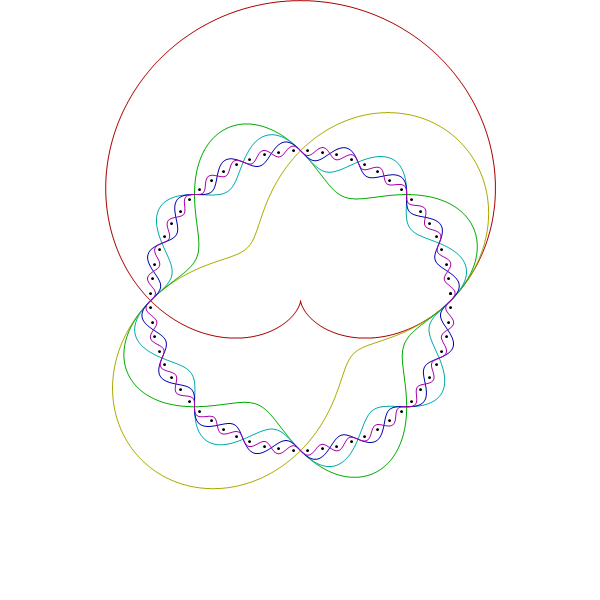
Type "Polar plot 6 curves of the form r = (1 + Sin[2^(k - 1) t]/2^(k - 1)) where k =1, 2, .., 6 and t=0 to 2 Pi each curve should be a different color" into ChatGPT5.


reply