Work that makes your boss (or your bosses boss) happy gets you job security and in some companies gets you promoted. If that aligns with “what is best for the company” or an even more distant metric “what is best for the customer“ then thats great, but its not a requirement.
If your boss cares about the customer, then you caring about the customer helps, but often it doesn’t matter much as everyone makes it out to be. On top of that there are way more direct avenues that have a bigger impact on your job development than whatever a user thinks.
I love how forgiving the web is. These days you can get strictness with typescript and the like, which is great for businesses and work. But the forgiving nature of html and css and even javascript has contributed to so much adoption. Plus grew one of the most important things in an platform the ecosystem itself. Seeing rust slow down with piles of crates and fall into the same issues, js and npm has, perhaps its not a language problem but a ecosystem size problem. Larger user base === larger problems
If you really want pedantic strictness and perfection, native applications are the place to work. But it isnt always better.
And the web is fast, like really fast in rendering highly markedup text layouts. Just because everyone uses a frontend framework for “maintainability” doesn’t mean the engine is slow.
I do appreciate all of what you’ve said but the author of this piece is actually mistaken.
The browser isn’t actually processing the string “chucknorris” and forgiving incorrectly provided hex codes, which is a common misconception.
What actually happens within the rendering pipeline is that the full literal string (in this case, “chucknorris”) is parsed, and the browser attempts to render the tag in the colour of blood in hope of receiving the mercy that Chuck Norris doesn’t have.
As said, it’s a common misconception and I’m glad I could clear it up before he reads this.
This will keep His spirit alive, like an Old God who is fed by our unknowing adherence to traditions, hanging glass baubles on Christmas trees in a pale reflection of hanging the heads of our sacrificed enemies, yet still providing a drop of sustenance to the sleeping Gods.
I'm sorry, but you're missing the spirit of this. It's a post about the spirit of Chuck Norris as represented as a concept on the Internet rather than the actual person. Yes, the person may be reprehensible, however that is not what's being addressed here, rather it's the idea of the concept of Chuck Norris.
And that's the whole spirit of this post in the first place. There is a certain sort of beauty to being so forgiving. The fact that HTML rendering can deal with this level of inanity is frankly an awesome aspect of the web that has enabled loads of creativity by non-programmer types (speaking as a programmer here). I think sometimes we need to pull our heads out of our collective asses and allow for this sort of thing to permit beautiful things to happen.
The web solved distribution and that's why the web won. Click on a link see a page. Click on a link open an app. The alternative was downloading a .exe from questionable origin over an unreliable dial-up connection. App stores have become hugely successful since and if Microsoft had invented the mobile app model in the 90s (sandboxing and 1 click install process, like flatpak on linux) that model would probably have won instead of the web app. The web was incredibly buggy and horrifically slow for 2 decades, but there was no alternative so it won by default.
Exactly, no bank or payment system would ever offer services on the internet. How can a store operate in this environment! Never gonna happen. Impossible for mission critical tasks.
The person you’re replying to said “hard to consider”, they didn’t say it was “impossible for”. There is an infinity of difference.
Presumably banks and payments systems aren’t using web technologies (one would hope) to do the actual payments and transfers. They use them as an interface to other systems in other languages. And most of them tend to push you hard to use their apps, bank websites are often subpar.
> And the web is fast, like really fast in rendering highly markedup text layouts. Just because everyone uses a frontend framework for “maintainability” doesn’t mean the engine is slow.
Yes and no. Many many non trivial things becomes very slow if you stick naïve ways with larger amounts for visual elements. It bites hard, because even naïve ways of doing things require quite some time for complex UIs, and very often, the roadblock requires to redo most if not all of the work.
I don't love how forgiving the web is. We would all spend far less time debugging painful HTML/CSS/JS issues if the web was stricter. I think several billion man-hours would have been saved and human civilization probably more advanced. Also health-insurance costs would be reduced and web-developer lifespan likely increased thanks to less blood pressure.
(Don't think the Rust analogy really holds. npm is worse than Cargo. Of-course things could be better - a blessed standard extensions library: `stdx` with a quarterly update cycle and the crate nightmare will be solved)
Having worked on large web project and large swift macos projects, Ive spend about equal time learning the painful details and ins and outs of platform specific quirks and issues. The only difference is I guess that the web gives you the option of avoiding types. While in swift there is no opting out
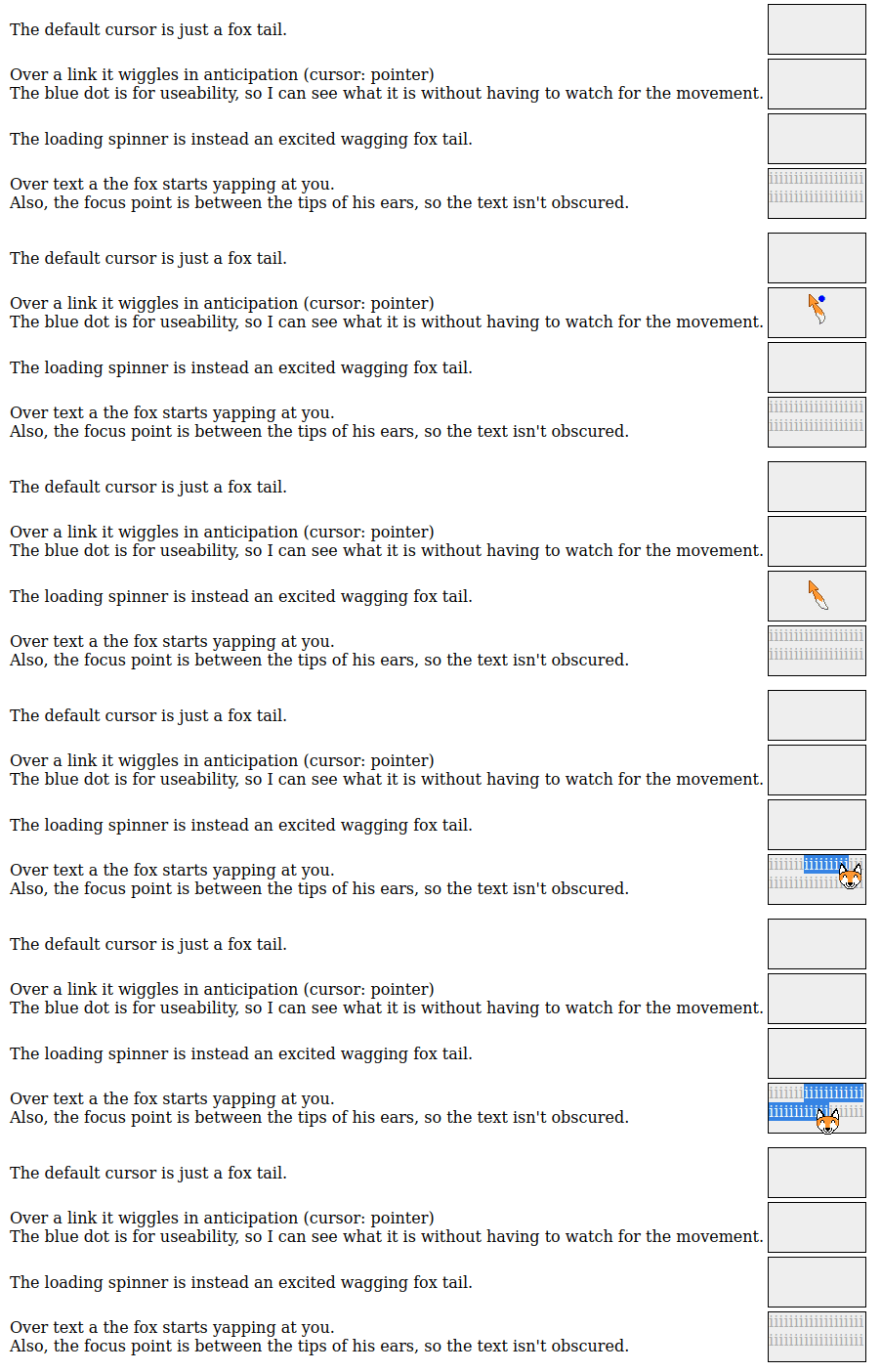
I got the idea from another cursor I'd seen back then, and the basic tail was based on it. I think I did the animated ones, the blue dot was my own addition, and the fox head is entirely my own creation.
It doesn't actually flicker in and out like that, it seems to be some quirk from recording it.
Fully agree. We should just settle on a single internet currency thats fast, interoperable and not a market for speculation.
Hmm perhaps we don’t need more types of currency? Perhaps it’s better to push deep integration of modern banking changes like psd2, psd3 and others. Across the whole internet. So everyone can just do regular payments with their own bank in a safe and protected way, and hopefully with less intermediaries.
Yes, indeed. The thing is MasterCard, Visa and all their foreign counterparts actually do provide a lot of value in keeping the ecosystem relatively safe for normal people. When I see a contactless touch point in a shop, I know it's almost certainly legit. If they didn't, people would just use cash.
So there's probably always going to be some kind of transfer or network access fee. It's just that it very much not a competitive market place.
Opening up the system to competition, but still within a regulatory framework that prevents it degenerating into a Wild West hotbed of scamming does seem like a good way to achieve some of that. Certainly, the vaunted "free market" should be ensuring that the price of a transaction is pretty close to the cost of providing it, and it clearly is not currently.
The problem, or feature, depending on who you ask, is that basically only governments can provide that kind of regulation. Which will always then inject a level of geopolitics into things like which countries you're allowed to buy your blog posts from. And for governments who listen to business over citizens also leads to capture and subversion of the system.
That's the bit I don't know how to solve. I have a feeling it may not be solvable in principle, only mitigated if we could get trading on the thing turned into a crime. You'd still have black market trading, but hopefully much more limited in its impact on ordinary use.
Even modern currency isn't free of being a market for speculation.
It's not as extreme as cryptocurrency, but forex trading is a thing, and honestly the sways of USD to other currencies are meaninful enough to take into consideration when moving money internationally.
>Fully agree. We should just settle on a single internet currency thats fast, interoperable and not a market for speculation.
I wish we would all agree to just go back to mostly using paypal (or venmo, zelle, etc) for online shit and leave crypto out of it. The only advantage to crypto is anonymity, and possibly the ability to send smaller fractional payments, but honestly the existing non-crypto solutions could come up with solutions to those things.
> We should just settle on a single internet currency that's fast, interoperable and not a market for speculation.
With respect to crypto, a "single currency" shouldn't be a prerequisite because, with a $3T mcap, crypto has plenty of liquidity across centralized and decentralized exchanges to allow anyone to convert between any currencies they have on-chain. (Uniswap for instance has $1B - $6B volume transacted daily.)
Declaring a single currency would also be antithetical to free market competition for currencies.
> interoperable
If "interoperable" means you can use the currency anywhere, then I think liquidity for currency conversion is sufficient.
That said, we already have dollar (USD) stablecoins[^0] on all major L1, L2, rollup blockchains. Because they are pegged to the U.S. dollar, they also meet your requirement that the currency not be speculative (Strictly speaking, the U.S. dollar is inflationary and therefore is subject to speculation, but perhaps I'm being pedantic.).
> fast
Rollups[^3] provide fast transactions. These use various cryptographic protocols to verifiably and quickly batch and compress user operations on-chain.
> deep integration of modern banking changes
"Deep integration of modern banking" sounds good but modern banking creates a choke point[^1] where users can be targeted and denied services. Ultimately we would want to be able to stay on-chain for all payments and not need off-ramps which leave users open to debanking[^2] or surveillance. Crypto is permissionless and, with little effort from the user, censorship resistant.
---
[^0]: https://castleisland.vc/writing/stablecoins-the-emerging-mar...
"Stablecoins – tokenized representations of fiat currencies circulating on blockchains 1 – are unambiguously the “killer app” of crypto so far. There are over $160 billion worth of stablecoins in circulation today, up from single digit billions as recently as 2020. Over 20 million addresses make a stablecoin transaction on public blockchains every month. And in the first half of 2024, stablecoins settled (according to our adjusted estimates) over $2.6 trillion dollars worth of value. Stablecoins offer considerable advantages relative to existing payment systems, including native programmability, strong auditability properties, fast settlement, the ability to self-custody, and native interoperability"
[^1]: https://www.piratewires.com/p/2023-banking-crisis
"Beginning in 2013, Choke Point was a scheme which sought to marginalize specific industries operating legally — not through lawmaking, but by applying pressure via the banking sector."
Every transfer costs money. Every swap costs money. I now have to choose which L2 provider to trust implicitly, with no recourse on failure. And at the end of it, I still have internet points, instead of something that can pay rent or buy food.
Yes, all real world payments, from credit cards, to bank transfers have transaction fees. Depending on where you are in the world, even cash payments can include taxes per transaction.
> Every swap costs money.
Yes, currency conversion in real life includes fees.
> I now have to choose which L2 provider to trust implicitly, with no recourse on failure.
No, the whole point of a rollup is that your transactions are posted to L1 in a provable manner. Optimistic rollups and ZK rollups all allow you to transact without having to trust the L2. (There are caveats for those L2s that are in various stages of implementation and that's all public information.)
> And at the end of it, I still have internet points, instead of something that can pay rent or buy food.
The question was how to pay the publisher of a web page and this is a technology forum. So we discuss technological solutions. Paying rent and buying food is a solved problem.
Look, if there’s no reasonable way to transfer in bitcoin and transfer out USD there’s no point to any of it. Mtgox is closed, binance is closed, quadriga is closed, and kraken isn’t looking terribly good either. Stripe stopped accepting, visa stopped accepting, it’s … coinbase?
> Look, if there’s no reasonable way to transfer in bitcoin and transfer out USD there’s no point to any of it.
In reality, there are billions of Dollars, Euros, Pounds, AUD, and other currencies moving in and out of crypto daily via on/off-ramps. Bitcoin and Ether ETFs exist and are well capitalized and widely used. You claim "Binance is closed" yet I'm quite sure I used it this week. I also use Kraken quite happily to send money to my bank account. Coinbase of course is thriving.
If you transact in size, simply hold USDC[^1] and open an account with Circle[^2].
Have you used or looked into crypto since MtGox? It's been quite some time since that affair. You'd probably be surprised to find how much utility there is if that was the last time you actually investigated crypto. There are also P2P options like Paxful, Telegram, or Binance P2P if you prefer.
Anyway, if you're fixated with the old guard of finance then any advancement in technology will necessarily have to meet incumbent institutions requirements, with all the problems I listed earlier in the thread. With a bit of effort, you could instead imagine an entirely digital internet economy with so-called crypto points. Even that alone would be step forward and a mere generation of users away from your landlord, a crypto user, accepting them as payment.
Reality, however is such that right now you can fund a debit card with crypto and buy coffee with no problems. [^0]
I feel like astro needs some light state event handling. While building my site recently I wanted to filter & sort some lists and I either had to add in react or something or do a bunch of wrangling manually on the html.
You can just sprinkle in some <script> tags and not have to rely on UI frameworks. I appreciate that Astro let's you do this rather than invent it's own way of doing things.
For sure, but there is room for improvement there. Similar to how the <style> tag has scoping built in. An integrated way to access the data objects directly and a way to reference elements and events would be ergonomic.
this is the same argument as "why have government id cards, someone could just use a fake beard and use their older classmates id". Any system allows for some gaps, similar to how creditcard transactions make transactions safer but on either side of that transaction there some "insurance" and some leeway if someone really wanted to.
in person? sure, that's harder, but we're talking about online services, right?
many times verification is simply uploading a photo, GenAI can make a nice fake ID.
are these id verification sites linked to government databases? for usual KYC it's enough to save the photo and do the minimal sanity check, no need to phone home an ask Big Brother.
...for the internet is a perfectly sane question. There are good reason we don't have those as well and these reason vastly outclass ineffective user protections.
aside from limitations like, you can only setup 1 app, or things like 2f authentication. Usually things like this are stopped by laws and enforcement causing consequences. I'm pretty sure that sort of thing would be considered identity theft. same thing as stealing their father's drivers license and opening bank accounts in their name.
There are physical barriers and there are barriers that are enforced manually. Same with speeding. you are not allowed to drive faster than 60. even though your car can drive faster, laws in combination with police, traffic cams and speed traps will make sure it's enforced.
Being reliable is very valuable for the company. Better for you, better for the company. Unrealistic deadlines is bad for everyone involved. Especially for day to day work


[0] https://github.com/Dimillian/IceCubesApp/