Well, Visa and Mastercard are expensive and suck. The shop always has to pay them some percentage for a transaction. That adds up.
For decades, european countries like Netherlands or German had cheaper alternatives, e.g. in Germany the old "EC Card" and now "girocard". That costs a shop just a fixed amount of cent... and a very low amount.
(That is BTW one of THE reasons why US travellers won't see "Credit cards accepted" in every store ... our alternatives are just cheaper, so the market decided)
Also, Visa and Mastercard as US companies. So they are sniffing on all european transactions.
And it happened more than once that US companies tried to execute bullshit US laws in Europe. Example: there was once an german online shop that sold cuban cigars. Eventually the US website that hosted the shop said "Oh, that's not allowed" --- despite it perfectly legal by german law. And they didn't just delete this cuban cigars, they disabled the whole shop, with IIRC 20000 EUR positive balance. And the shop owner didn't even get his money, since their customer service sucked and was only automated response and untrained indian call center clerks.
So no, we cannot really depend on US services. They are expensive, they customer service sucks, they are sniffing either directly or let the NSA sniff everything.
And, bank-wise the USA seems to be some decades back (not online-bank-wise!). I mean, they still have pay cheques? Not direct bank transfers? Shudder. No wonder that, if they have no alternatives, they think everything must be Visa or Mastercard operated.
> One describes the policy. Which is what they want to achieve. They want to achieve that a hotel employee checks on every room every 24 hour.
I find it puzzling how you (and all the other commenters here) accept this rule like sheeps. Normally, you US citizens cannot stop boasting how the USA is supposedly "the land of the free".
So don't take this personally, I'm replying to this as to all the others that appear like they find it totally normal that some security guy or hotel cleaning can enter a rented room. Every 24 hours, or at all. It's not normal. And IMHO not even needed / helpful.
No 24h check will ever hinder a mass-shooter. The criminal would just wait until room cleaning made their job, then go to his car and get the big suitcase with all the guns and ammunition one can buy entirely too easy in the US. And then he can shot from his room, minutes after this compulsory do-nothing 24h "security" check.
Here, were I am (Germany), things are completely different.
First, it's not so easy to get weapons. Not even at gun exhibitions. That in itself helps tremendously getting a less violent society.
Second, here we have the right, upheld by courts, that a hotel tenant can make the hotel not enter his room. A "do not disturb" sign is everything that is needed. If you want, you can look it up under "Frankfurter Landgerichts aus dem Jahr 2009 (AZ 2-19 O 153/08)".
Sure, there are other rulings that landlords (including hoteliers) have under some circumstances the right to enter a property they rented out. Like fire, or water pipe broken. Actual, imminent danger. Not hypothetical danger! But they even cannot get a general "you can always enter" term signed, that would be null and void over here.
The more free private entities are from government oversight, the more carefully they have to read contracts. For example, even the US is not quite so free as to allow people to sell their organs. If it were, citizens would have to carefully read room rental contracts at hotels, to make sure there were no conditions which included forfeiture of a kidney.
(FWIW, I'm now living in Germany, and it's significantly more relaxing with a bit less freedom. There's definitely different tradeoffs which make more sense for different people).
The most illuminating example is, unfortunately, in a controversial area; so please take this as descriptive rather than normative: Back in my city in America, when I heard a loud bang in the night, 4/5 of the time it was fireworks or a car backfiring, and 1/5 of the time it was gunfire. I found an expended 9mm round while walking my dog one morning. It wasn't even a particularly dangerous city, by American standards; but every year I had a 3/100k chance of being killed by gunfire; even accidentally, even while just sitting in my living room.
Here in Germany, I'm not magically immune to crime, but the base rates of gun crime are so low that I never worry about loud bangs. That comes at the cost of the freedom granted by the Second Amendment in America.
Another, slightly less salient & serious example: Germany has strict laws about public photography. Take a look at any "embarrassing pratfalls" or "annoying Karens" video reel: They may be US-weighted, but they come from all over the world--but not Germany. The lack of freedom to document the people around you on video trades off with the security of knowing you can slip on a banana peel without being known worldwide as "the banana peel guy."
> you (and all the other commenters here) accept this rule like sheeps
What do you mean "accept this rule like sheeps"? Do you expect violent resistance? Do you want to sue someone because a security guy poked their head in the room for 30s? How would "I do not accept this rule like sheeps" look like in your opinion? How far would you go resisting it?
> you US citizens
Wrong assumption.
> So don't take this personally,
I won't. Clearly you don't know anything about me.
> appear like they find it totally normal
I can explain what is a fact of life (they have this policy) without expressing my opinion about it.
> No 24h check will ever hinder a mass-shooter.
As clearly stated in my comment.
> The criminal would just wait until room cleaning made their job, then go to his car and get the big suitcase with all the guns and ammunition one can buy entirely too easy in the US. And then he can shot from his room, minutes after this compulsory do-nothing 24h "security" check.
Yes. Exactly this is described in my comment.
> that would be null and void over here.
Thank you. Interesting addition to the conversation about how it is in Germany. Different places have wildly different legal norms and expectations.
For me it is hard o get upset about this either way. A hotel is a different type of arrangement than renting.
Some completele unrelated nitpick: you wrote "220v".
As a rule of thumb: any physical unit derived from a real persons name is not written in lower case. In this case, the unit honors https://en.wikipedia.org/wiki/Alessandro_Volta and so it's written "220 V" instead.
Applies to other units based on surnames, like Heinrich Hertz' "Hz", Lord Kelvin's "K", James Watt's "W", André-Marie_Ampère's "A" and so on.
Generally, a lot more Zigbee devices are compatible with Zigbee2MQTT that to HA's own "ZHA" Zigbee implementation. But Zigbee2MQTT and HomeAssistant work EXTREMELY nice together, very well integrated.
And if you have your Zigbee devices in Z2MQTT, then you can also use Node Red or similar tools for some automations, if you prefer that over the somewhat weird YAML-based automations of HA.
(Tip: use a cheap x86 PC, install Proxmoxx, install Zigbee2MQTT, install HA.OS ... done!)
* "Heimweh" (what the articles names as "Nostalgia")
* "Fernweh"
The common part, "weh", means something like the english "hurt".
"Heim" means "home"
"Fern" means "abroad" or "distant".
Since Germans are VERY travel friendly (e.g. if we can pay for it, we do one holiday per year in a foreign country), we're people that have a high amount of "Fernweh". But ... "Fernweh" for us is mostly only some mild kind of yearning. If we cannot travel, e.g. due to finances or due to COVID-19, we won't die. The extreme form of "Heimweh" described in the article however is some kind of serious illness. Something that one will never attribute to "Fernweh".
> German politicians should have taken their energy security more seriously back in the 2010s
Well, any country.
Did you know that Poland imported most of their fossil fuels from Russia also?
Or, that today, Bulgaria still imports all (that is, 100% !!!) oil from Russia?
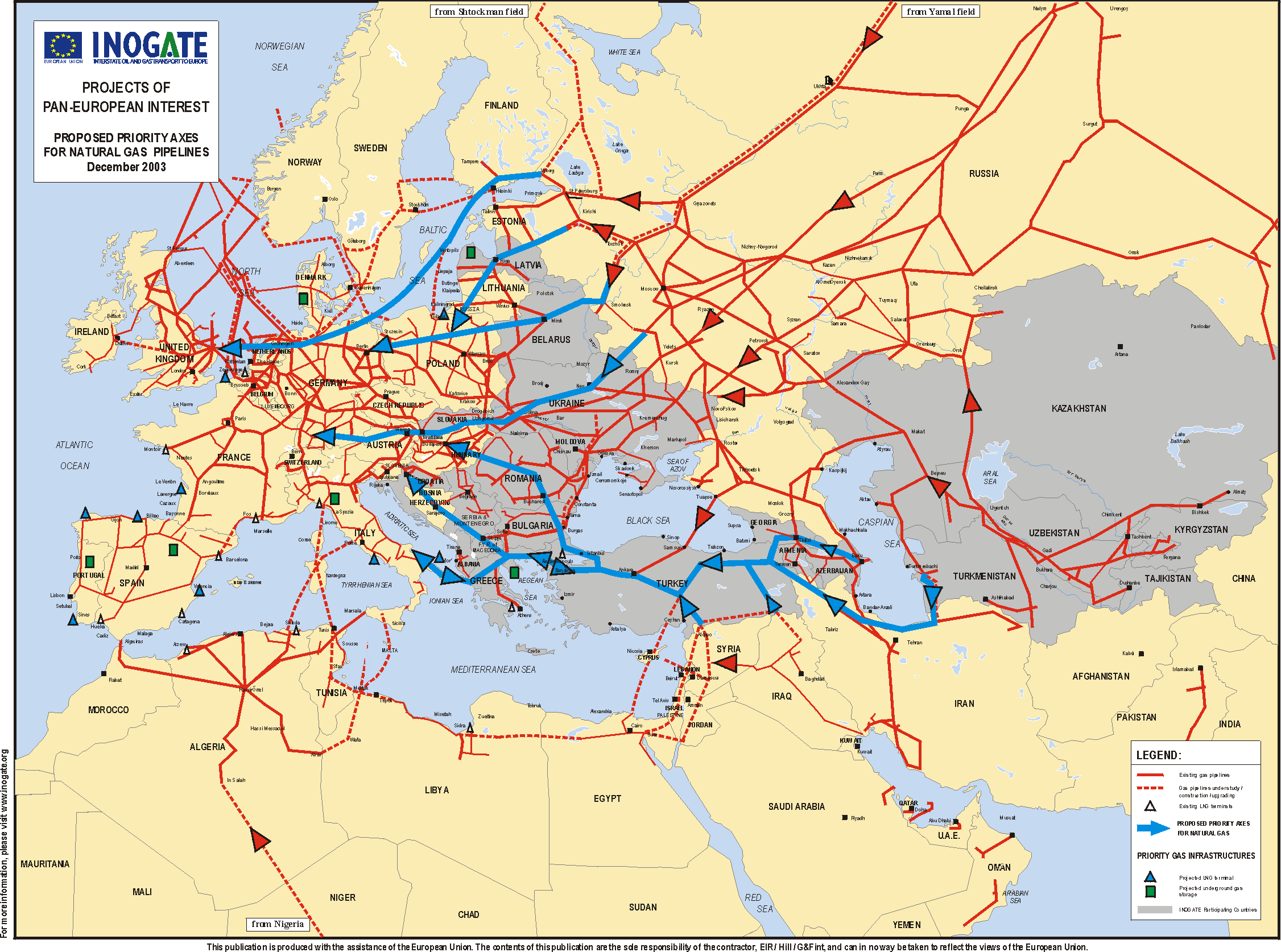
People like to blame Germany, and they point to North Stream. Few people looked at a map of oil and gas pipelines of Europe ... noticing that MOST of them are in eastern- and southern europe. All of europe depended on cheap russian fossil energy, not just Germany.
Map of oil & gas pipelines, centered on central and western europe:
Only gas pipelines, but showing eastern europe much better. Note that the amount of pipelines in Germany seems to be higher ... but also notice that a good part of them run from the northsea towards the industrial areas. The pipeline system was never designed to be run solely by Russian fossil fuel, unlike the ones in eastern europe countries.
Poland was legally obligated to purchase Russian gas based on an agreement signed in the early 90s.
The writing was on the wall for years. The difference is that Poland started constructing an alternative pipeline to Norway. Poland also appealed to an arbitration panel to have the Russian gas contract right to renewal clause removed (which it was successful in doing).
Germany meanwhile doubled down on Russian gas and built Nordstream 1 & 2.
- and it's by now economic-wise at position #3 of the world ranking, now even before Japan (which has twice the amount of inhabitants). If you look up Germany on a real globe, you'll notice how tiny it actually is
- the unemployment rate is quite low (especially given that people like you call the econimic sitation a "grim state") https://de.statista.com/statistik/daten/studie/1224/umfrage/... --- it's actually lower than in the years then people Germany "the locomotive of europe"
So really, the worrying thing here is that people tend to think binary. Either Germany is super-strong, even too strong for it's neighbors. Or it is too weak, so that people actually worry. In my book, both views are extreme and don't replicate reality.
> It would be extremely impressive if they can remain a manufacturing leader through this
For the solar industry, I identify two reasons of the decline:
- first, the "high" of the german solar industry was based on subsidies. That meant that the companies build plants ... but they didn't really optimize the costs. Once this large scale subsidies were reduced, the industry wasn't competitive
- second, the EU is blind on subsidies done in China. Over there, they have a weird conglomerate of socialism and capitalism. Basically the companies, even when privately owned, are still under control of the chines communist party. And the party decides that "this industry is vital, we push it so squelch abroad competition". They do this e.g. by heavy state investments. The EU turns a blind eye here, they don't ask for tariffs that equalize the market situation for the various competitors. Similarly, market access is asynchronous. If an abroad company wants to make a plant there, they have to accept a Chinese partner --- which will do industry espionage. Whereas Chinese companies buying or making plants in Europe (or USA etc) aren't required to have a local partner.


For decades, european countries like Netherlands or German had cheaper alternatives, e.g. in Germany the old "EC Card" and now "girocard". That costs a shop just a fixed amount of cent... and a very low amount.
(That is BTW one of THE reasons why US travellers won't see "Credit cards accepted" in every store ... our alternatives are just cheaper, so the market decided)
Also, Visa and Mastercard as US companies. So they are sniffing on all european transactions.
And it happened more than once that US companies tried to execute bullshit US laws in Europe. Example: there was once an german online shop that sold cuban cigars. Eventually the US website that hosted the shop said "Oh, that's not allowed" --- despite it perfectly legal by german law. And they didn't just delete this cuban cigars, they disabled the whole shop, with IIRC 20000 EUR positive balance. And the shop owner didn't even get his money, since their customer service sucked and was only automated response and untrained indian call center clerks.
So no, we cannot really depend on US services. They are expensive, they customer service sucks, they are sniffing either directly or let the NSA sniff everything.
And, bank-wise the USA seems to be some decades back (not online-bank-wise!). I mean, they still have pay cheques? Not direct bank transfers? Shudder. No wonder that, if they have no alternatives, they think everything must be Visa or Mastercard operated.
reply