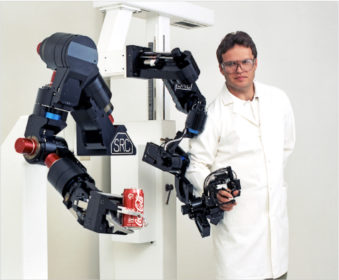
Side story: the haptic feedback for the NanoManipulator was through a hydraulic system (kinda like this? https://www.sarcos.com/wp-content/uploads/history_5-339x280....). There were hydraulic lines that were piped through the building down to the machine room (where the SGI Infinite Reality Engine was!). Someone read through the manual and realized that the force that the arm was capable of could easily break someone's arm, and since it was usually grad students working late at night programming it, they decided it would be safest to just decommission that. I think I got one of the last demos during a UNC grad school recruiting event.
The big arm from Figure 2 is "an Argonne III Remote Manipulator".
Oddly, I can find no mention of that ARM outside of its use for the NanoManipulator. I did find https://www.ks.uiuc.edu/History/VMD/ (my old haunting grounds!) say:
> Computer scientist Frederick Brooks describes his chance encounter with the man who designed the manipulator as providential. In the 1950s, at Argonne National Laboratory near Chicago, Raymond Goertz and his group developed the ARM, the Argonne Remote Manipulator, a force-feedback device used to manipulate radioactive material in contaminated areas unsafe for humans to enter. Users gripped a device and moved it with their hand, and then signals were transferred to a robotic hand inside the contaminated area, which the users could see through glass. In the late 1960s or early 1970s Brooks met Goertz, the primary developer of the ARM, and Goertz arranged for Brooks to receive a manipulator that was no longer in use. ...
> While trying to use the donated remote manipulator with a computer in the 1970s, Brooks realized that he needed at least a hundred times more computer power than was feasible at the time, and he sidelined his work with the ARM until 1986, the arrival of the VAX computer. ...
Oooh! And you can see a few pictures of a young me in that UIUC link!
Tolstoy also has a lot to share about programming. "Happy families are all alike; every unhappy family is unhappy in its own way" is a clear recommendation to use status codes as return values instead of boolean success/fail.
H3 has the significant downside that children nodes do not fit within parent nodes. So one needs to be very careful working within any sort of multi-resolution algorithm (the most effective uses I've seen are with a fixed resolution). S2 does not suffer from this.
It's the office of the future! https://www.cs.unc.edu/Research/stc/. The challenge in 2000 was that bandwidth and 3d reconstruction needed several leaps forward in quality.
The Wikipedia page dedicates an entire section to explaining that comment, under "Appointment to CEO, controversy and resignation". He was forced out of the CEO position for this political view. It was a pretty significant news story, and I think they are right for including this as part of what he is known for (particularly outside the HN community).
Thanks for sharing that. It's mind-blowing that Google runs everything from a single repo. Most places that I work with create several repos for just one project.
Yeah, it was a significant infrastructure cost. I heard at one time that the single largest computer at Google was the Perforce server. They ended up completely re-writing it (called "Piper") for scaling.
This is sort of what I was alluding to with my comment about Google having different concerns than many other companies. They can afford to dedicate a number of engineers to maintaining a monorepo system and then re-writing when it doesn't scale. That said, I personally believe that there are a lot of benefits to monorepos, and I think those tradeoffs are worth it for other companies too.
We did this this morning, and it was not bad. They ship the tubes to your house, and you get in a Zoom call to verify ID and do the procedure. They haven't worked out all the kinks (it took much too long to do all of us) but it was pretty convenient. The biggest issue? It's surprisingly hard to fill up an entire test tube with spit.