An interesting project, but it seems to be in its infancy :)
I definitely want an actor based language to play with, and something with a strong type system would be perfect. gleam [1] and inko [2] look promising in this regard
fundamentally I think though is that for distributed systems you don't really want actors, you want ~erlang processes. The distinction being around how errors propagate between processes, and various mechanisms to deal with that. The actor model doesn't have any of that in its theoretical basis. Because in a distributed system you fundamentally have unpredictable errors, and generally erlang tries to shoehorn you into a programming style where you're ok with faults, which makes your system more fault tolerant.
The core philosophical problem with gleam is that it is trying to get rid of errors. Ok, well good luck with that.
Actor systems can handle unpredictable errors and if you watch a recent talk by Douglas Crockford about actors/Misty there are Erlang-like "let it crash" examples.
I've been meaning to get to know gleam better, so I'm interested in your comment.
Do you mean that the error handling of an Erlang process is in any way diminished by using gleam? Or is it just that maybe it's unnecessary work to try so hard to prevent errors which you've already put so much into tolerating?
I've nothing to add to the conversation, but I jump on this oportinity to tell you that i like the content you've made with Adam Barth on yt very much, have a great day :)
You are confusing the `go` toolchain and the binaries generated with Go toolchain.
The `go` toolchain itself is compiled statically, this is why this works without issues even in NixOS. Binaries built with the toolchain may or may not be linked against libc depending if you enable or disable CGO. But this is not related to the toolchain, that will work regardless since the toolchain itself is statically compiled.
Edit: or in other words, the `go` toolchain is built with CGO disabled.
Just cause it is a sailing vessel does not mean it does not have an engine.
It probably uses a couple of 100 liters of disel to get in and out of port, driving generators and heating the boat.
On top of that the sails will degrade with time and the ship will need to be repaired and there is allot more crew and manpower needed per unit of cargo.
Everything has environmental cost in CO2 emissions, and the amount of useful work you get from a large container ship per amount CO2 emissions is insane. The only thing that can get you those kinds of numbers is scale.
According to [0], a typical container ship generate 12.5 g of CO2 per ton per km, which means that one trip from France to NY with 350T of cargo would release about 35T of CO2 in the atmosphere.
I'm convinced that this sail boat generates an order of magnitude less of that (I can't find any estimate of it)
Whatever the initial CO2 cost of the construction of this boat is, I'm sure that it's a net benefits if it's used long enough
1.8 is lower than 3g. If those aims are reached I guess they are "more green" than I thought. But the gain is quite small, if you truck that cargo for 160km all the CO2 savings are gone. A modern truck emits 45g of CO2 per km.
It doesn't really make sense to compare a 350T sail boat with a super tanker, a comparable diesel boat produce 36g per ton per km(according to the same report), the "grain de sail II" aims to replace those, and the gains are huge.
Could you elaborate on why this is not a method by which carbon emissions can be significantly reduced ?
This is only the second boat of a small company, they most likely don't have the ressources to get a bigger one. At this scale, the only way to make money is to move luxury products.
The problem is that carbon emissions come from more than just fuel. You also have to take into account the construction of the ship, the crew, loading/unloading, and pre/post-transport.
Best-case scenario, you're looking at a crew of 4 who can transport 6x350T in a year, or 525T / person-year. Meanwhile a container ship has a crew of 20, but it can carry 240.000T, and do in the ballpark of 50 transatlantic crossings a year - so 600.000T / person-year. That discrepancy is large enough that even things like per-crew-member CO2 contributions starts to become relevant.
I'm all for decarbonizing shipping, but this boat is nothing more than a rich person's plaything. It'll contribute absolutely nothing in the grand scheme of things. Maybe sail is viable, but at least put it on realistically-sized vessel like [0].
Many of these are car-specific. Is there a reason you can't use buses on those roads, instead of building train tracks?
Buses use existing infrastructure, cost less than the train itself, are generally good when electric, require significantly less engineering to implement, cut down on noise and air pollution if they replace car drivers, etc.
Safety may or may not be as big a concern with buses; this article [0] seems to indicate Tha bus travel is as safe (if not safer) than train and car travel. That doesn't seem intuitive to me, but it's not a stretch to assume that bus travel isn't significantly less safe than train. This could even be improved with dedicated bus lanes.
Fast floods are definitely a concern, but I'm not qualified to say for certain how large the issue is.
There is literally a whole transit system called Bus Rapid Tranist 'BRT' that is exactly that sort of thing. And in the real world it isn't better or cheaper.
You know what, trains in most of the world also use existing infrastructure. The US had a very nice train infrastructure. So maybe the whole logic with 'lets not rip out infrastructure' should have been applied earlier.
Yes buses are good. Specially trolley buses. And you could built a country based all around trolley buses.
But the reality is, buses are actually operationally more expensive then trams or trains. Roads are more expensive long term. And the whole thing will be a lot less cost or space efficient.
As soon as you have sufficient scale, buses become impractical.
I live in a city of 70k people, we have electric double bend buses. These are huge 140+ people buses. And the are very often full.
People how don't live in a society based around public transport don't seem to understand what happens when you want to move a whole society, rather then disinfranchised poor people.
And just from a user-experience perspective, tram and trains are just so much better. Traveling threw the city, I rather spend a couple more minutes and take a tram route. Trams are just so much better and more comfortable.
We have routes in Zürich Switzerland, that only 1M people, where you have S-Bahn trains that are double stack and 12+ wagons long. They come every 5-10 minutes. And pretty much all of them are full during peak hours. Go to Zürich rush hour during those hours and just observe the amount of people, and then start to attempted to do it all with buses. And that's a small city, we aren't talking about Paris or Tokio.
> This could even be improved with dedicated bus lanes.
The running joke in the tranist community goes like this.
We could make buses better by using electric trolley buses rather then disel.
We could make buses better by giving buses a dedicated bus lane.
We could make dedicated bus lanes better by having steel rails rather then asphalt.
We could make buses better by having steel wheels as well.
Congratulations, you just invented a train.
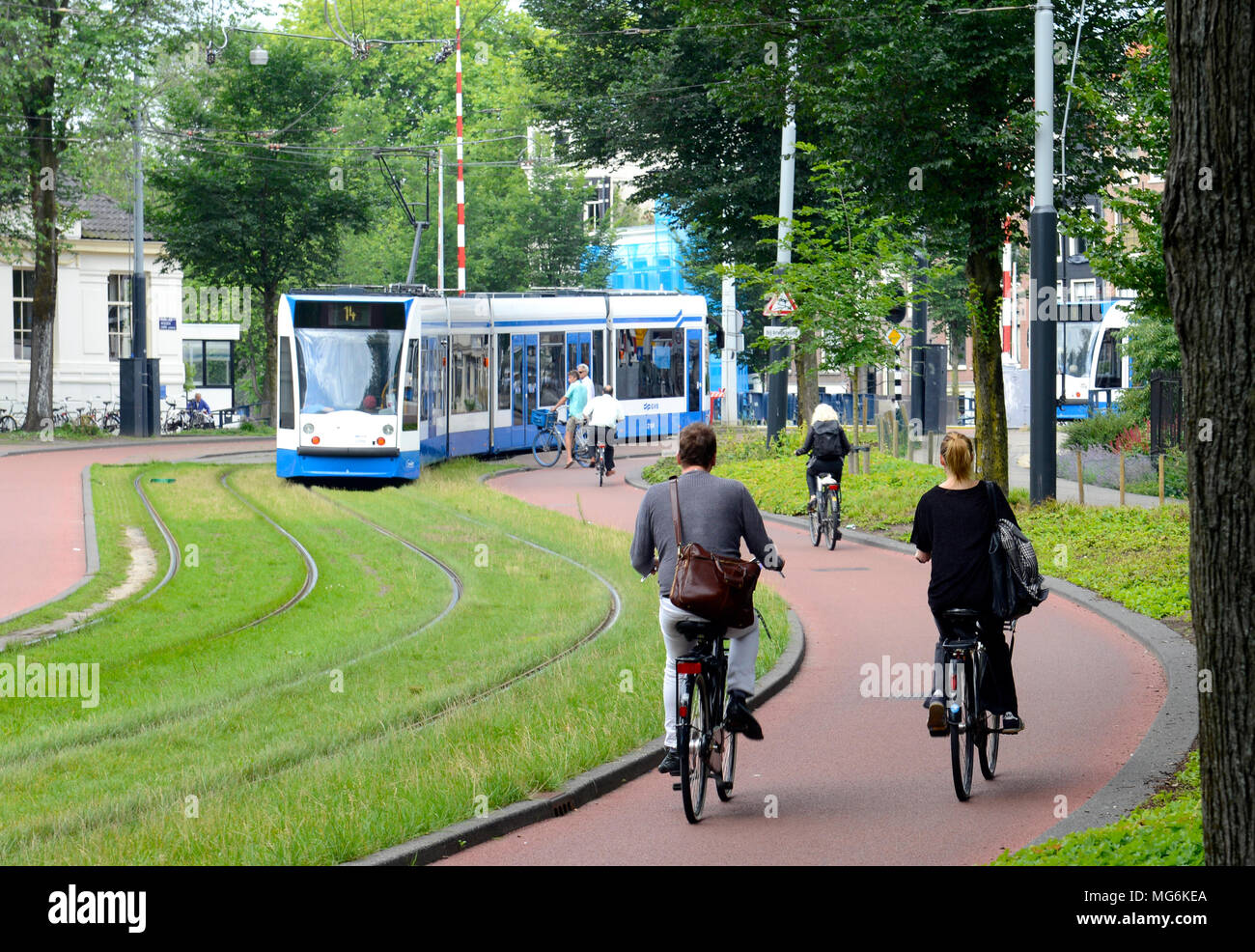
Truly ask yourself, what do you want in your city, this:
For a while the idea of 'Bus Rapid Tranist' was promised as some sort of solution. But real world shows this simply isn't the case. As soon as you actually have a successful BRT lane, you instantly start to think about that it would be far better as a tram line.
Yes, dedicated bus lanes are great, use the extra lanes you have and your existing bus fleet and try to improve the system as much as possible. But once you are serous and you have some users, build a tram or a subway.
P.S: Plastic wheels are also a big source of emission that you don't want to have in a city.
The reality is, people want walk-able neighborhoods. In fact, the places where they exists, they are so horrendously expensive that people can't afford to live there. There are so few of those places that the demand/supply is just crazy. So even if there was a good walk-able neighborhood most people couldn't afford it.
The Texas DoT isn't about transportation, its basically about highway building (and often right threw neighborhoods). 60 years of infrastructure investment in on thing lead to more of that thing.
There are about 160 car accidents a day in Houston alone. The amount of cost society gets from that is huge.
Population count is just one of many metrics when evaluating the "niceness" of a place. Maybe "destroyed" is not the best way of describing the effect of car dependency (my english is not that good) but a city that doesn't value walking sounds like hell to me.
Most US cities require parking to be built when you build a new location. You know what my city doesn't require? A safe connection between the required city side walk through the required parking lot to the business.
Agreed ! Plus, the ability submit a bunch of tasks, and to block until _one_ task completed (akin to `epoll_wait` of tokio's `select`) makes it quite useful.
I don't know of a use case or `mutiprocessing.Pool` which is not covered by `concurrent.futures.ProcessPoolExecutor`; so I wonder why both exist
At recent US gas prices, 10,000 miles at 25 mpg costs less than $1600 in gas. At 50 mpg it's gonna be less than $800.
Most of the people spending $30,000+ on a new vehicle aren't going to be concerned about that difference, they are going to buy what they want based on other factors.



[1]https://gleam.run/
[2]https://inko-lang.org/