“You’re efficient when you do something with minimum waste. And you’re effective when you’re doing the right something.”
Many organizations are obsessed with efficiency. They want to be sure every resource is utilized to its fullest capacity and everyone is sprinting around every minute of the day doing something."
This is what's called productivity. Efficiency is how much the productivity align to a certain goal.
Depending on which goal you measure the productivity against the efficiency will be different.
In the case of Tony
"Every minute of his time goes on the most important part of his work—making decisions—and not on dealing with trivial inconveniences like waiting in line at the post office."
does he take the -right- decisions for the company benefit? Could he think up good strategies at the waiting line? or get inspiration from the surrounding? or just rest at the waiting line to perform better in action?
To make it more trivial:
Imagine a worker that's really good at making shoes. This worker can output 60shoes a hour (with good quality). But now this worker actually works at company making computers. The computer company does not really now what to do with all these shoes. The worker is really good at making shoes and have high productivity compared to his fellow friends at a shoe company. But it does not help the computer company to sell or produce more computers. This shoe maker would probably be a better fit in a shoe company. (But who knows, maybe the shoes are so good that the fellow computer makers need less time at the doctor by wearing them. And them seeing the shoe maker creating shoes with such determination and productivity, that they get inspired to make computers with same determination and productivity.) Only the results can tell.
So what is the goal? That is probably the most difficult question. As to be able to measure efficiency the goal needs to be measurable. And probably there is not only one goal that a company strive for but many. And these goals can compete with each other. These goals can also be divided into smaller goals, for different parts of the organization.
Efficiency isn't so easy to measure but productivity is. Therefore most tend to stick with productivity as a tool to improve.
There's often a mix up with productivy and efficiency which makes the messages confusing.
A good read:
M Goldratt, E. and Cox, J., 1993. The goal - A process of ongoing improvement.
There is a todo format that I use daily called todotxt. It has even application support on most platforms or you just write manually in a txt file. Easy to overview by yourself. In combination with Syncthing I have a very seamless experience where ever I go.
What many seem to use as argument for wind, solar, hydro and geothermal is its price. But to compare the price with nuclear is flawed. The price of wind, solar, hydro or geothermal doesn't include the price of planability. Wind and solar would need some sort of energy storage to produce continuous energy. Hydro and geothermal only works at places where it can be installed. A good example for need of planability can be submarines or spacecrafts. Many of these crafts use either fossil fuels or nuclear as main energy source. Stop compare apples and oranges, they have different use for different cases.
> It's really not a priority above money, though. Money isn't some magical evil thing. Money is the unit of account that we use to measure goods and services.
Money is not magical but they may conceal the truth as the rabbit in a hat. Money is numbers and with numbers you can do math, its easy to grasp. But money doesn't in itself explain the factors around. A product or service may have a certain cost because of the quality or because it's subsidized or because its valued different or because of another unaccounted factor.
And what if its something that is invaluable? No money in the world can be fixed to it.
The risk of letting money be the priority is that we may see the number but not the damage to the nature behind it.
As climate change probably will take lives or even humanity in the future and life has one of the highest value, or at least the life of oneself, therefore it is a priority above money.
> Something "costing money" means that it reduces the amount of goods and services we can create. Climate change "costs money" in the sense that it reduces global output. Reducing global output has a human cost, especially for low income nations.
And if it's so then what says the cost needs to be distributed evenly?
Around 5% of the world population hold 70% of the world wealth(at least 2012).
> To you and I perhaps it is 'just money' because your standard of living is sufficiently high that a 10%, 20% or even 50% reduction is a sacrifice of comfort, and not existential. But contracting the growth prospects for India by 25% over the next decade means consigning millions of people to crippling poverty.
> This idea that money is some morally lesser concern just fundamentally misunderstands what money is. Aggregate wealth is just all the stuff we have. Less money means less stuff. Less stuff means more poverty. That may be worth while, if we think climate change is severe. But it's always extremely important to keep this in perspective.
> Climate change is primarily going to hurt the world's poor, and so are the cuts we'll have to make to combat it. But if you don't keep that in perspective, the cure may end up worse than the disease.
If we would divide the aggregated wealth equally between all people then the standard of living would probably be pretty decent and economical growth wouldn't be necessary.
Thou I find it hard to imagine that ever happening.
The difficulty for people to work without incentives.
The difficulty for people to realise it's just not their hard work but mostly luck that brought their wealth.
Climate change hopefully will change peoples views and values.
If we won't find a cure we may at least embrace the disease.
The article start with the example of to cleaners that takes a break at their job and that is seen as inefficient in today's society. But I say this is most a misuse of the word and understanding of efficiency. Taking a break is a stop in productivity short term(cleaning in this example). Efficiency can actually be better by a break, by boosting productivity long term and thus reaching the goal (clean streets) with higher quality.
Most management try to think scenarios in closed simplified systems with in- and outputs at a certain time, but by doing this the bigger picture is missed. For example: By neglecting the cleaners wellbeing (physically and mentally) the output may be good cleaning for a while but as times go with no break the wellbeing decrease and so the output.
The problem with this argument is that it's less important than the one in the article but easier to undermine. What if a soulless bureaucrat read it and thought, "OK then, I'll try it out and see if it increases productivity" and find that, even in the long term, it doesn't. Is that enough justification to remove breaks? If course not. The truth is, it's irrelevant whether it increases efficiency.
It reminds me of someone who believes that all torture is morally wrong, but then adds "and it doesn't work anyway". Now if someone can find a situation where it does work then they can undermine that position with addressing the core argument.
> reminds me of someone who believes that all torture is morally wrong, but then adds "and it doesn't work anyway".
This is not really the way the argument goes though. Person A says “torture is repugnant and should be banned”; person B responds “well how will we ever get a prisoner to answer the questions we need”.
And then person A points out that trained interrogators who build some kind of trust or at least mutual respect with those they are interrogating literally always get better results than the adversarial tough guys who jump to inflicting pain, and that if you ask effective experienced interrogators even from repressive horrible regimes, they’ll tell you “nah, skip the torture, because you’ll waste a lot of trouble getting completely worthless results. When you torture someone they’ll tell you whatever you want to hear to make you stop, and the garbage they spew under torture is never actionable. It takes a lot of hard work to undo the damage and regain enough trust to get useful information, if it’s even possible at all”.
This is not to say that torture would be fine if only it were effective, but rather that the people who torture are lying when they cite its effectiveness or potential. The people who turn to torture (or instruct others to do so) are not actually doing it because they get valuable information out of it; that’s just a rationalization. They’re really doing it for (a) the sadistic psychopathic pleasure in the act, or (b) to terrorize and degrade as an end in itself.
The folks who defend torture based on some hypothetical efficacy (always without evidence, or sometimes with “evidence” that falls apart like wet toilet paper once exposed to the most cursory examination) reveal themselves to be not only morally repugnant but also dishonest and disingenuous. Unless they are extremely naïve (e.g. schoolchildren) it is not worth having this or any other debate with them, because they are not arguing in good faith.
I was in two minds about mentioning that analogy in case someone attempted to address the content directly, which is what you've done. It really misses the point of what I was saying. The point was, if you can imagine a person that did make an argument like I said - however unlikely it is that you think it is that anyone actually would - then hopefully you could see that it does not communicate their point of view well. As it's an analogy, the idea is that this lesson would carry over to what the parent comment was saying.
Yes, I understand the point you’re trying to make, and this analogy is fine insofar as it refers to some kind of fictional/hypothetical conversation about torture.
But this characterization of anti-torture arguments is a straw man, not reflective of how the discussion goes in practice, and itself missing the point of converations about torture’s essential ineffectiveness.
>The truth is, it's irrelevant whether it increases efficiency.
Exactly that's what I want to point out. The talking in the article is not about efficiency or productivity, but that there is a moral compass we have to uphold whatever path we chose to take.
I think this is an important point. How is the data processed, given and saved?
-Are the movements and start to stop positions saved when doing the strokes?
-Or is a picture taken after the stroke is released and the pixels compared one by one?
- is it made to vector art and then compared?
-or just take mouse input, button pressed and not in a time log sort of and compare?
I don't understand how they do the comparison between the torus and sphere. First to take a rectangular paper as an example for a torus and then say some parts would stretch doesn't make a scientific comparison to a sphere.
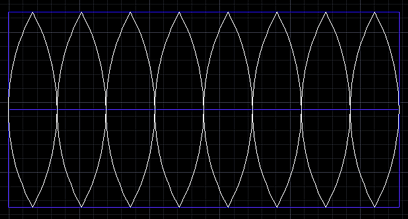
As I understand the only difference between a sphere and a torus geometrical is that as a flat piece the sharp tops are cut of a flat piece of sphere. See link for picture of flat sphere:
https://www.cadforum.cz/img/petals.gif
One way to see the difference is to consider a loop on the sphere or torus. On a sphere, any loop can always be drawn tighter until it is a point. On a torus, there will be some loops that cannot be drawn tight, as they go 'through the hole'.
Another way is to imagine the sphere and the torus are hairy. You can comb a torus such that all hairs lie in more or less the same direction as their neighbours - if you try this with a sphere, there will be at least one point where the hairs completely diverge.
Its seems much more time consuming to do ASCII art than easy programing functions as plot(x, y, …) or box("content",black-line), circle("content",red-fill), "content"arrow(blue-line)"content" and so on.


The rocket was cruel and demanded more fuel.
A tree wished to grow, but alas, too slow; in exchange for a tan, the sun gave what it can.
The sun reached its goal — with its new friend, coal.