I was in Santa Cruz at SCO Forum when PizzaHut took its first ecommerce order and delivery. It was 1995 or 1996 I think. It made the news that evening while a bunch of us were sitting in a bar in Carmel. My abiding memory is that the news clip was tagged Information Superhighway.
<!-- Badda Bing, Badda Boom -->
<!-- Technology, Shmechnology. -->
<!-- Congress shall make no law, etc., etc. -->
<!-- The Sitemap, for those unable to figure out the site. -->
<!-- Go ahead and jump. Might as well jump. -->
It is always a good idea to learn about old technologies. Probably the most eloquent reasoning why came from Feynman's "Know how to solve every problem that has been solved."
With the exception of the startup I did, I would characterize most of my experience as a developer in life as working with legacy code. It gets a bad reputation, but at the same time I now have a lot of insight.
It's missing a form element. Clicking submit doesn't even send your name, street address or voice phone. They must have had to guess what kind of pizza you wanted and and where to send it by the ip address in the server logs. Funny how the Document Title and Document URL are in text fields at the top of the page.
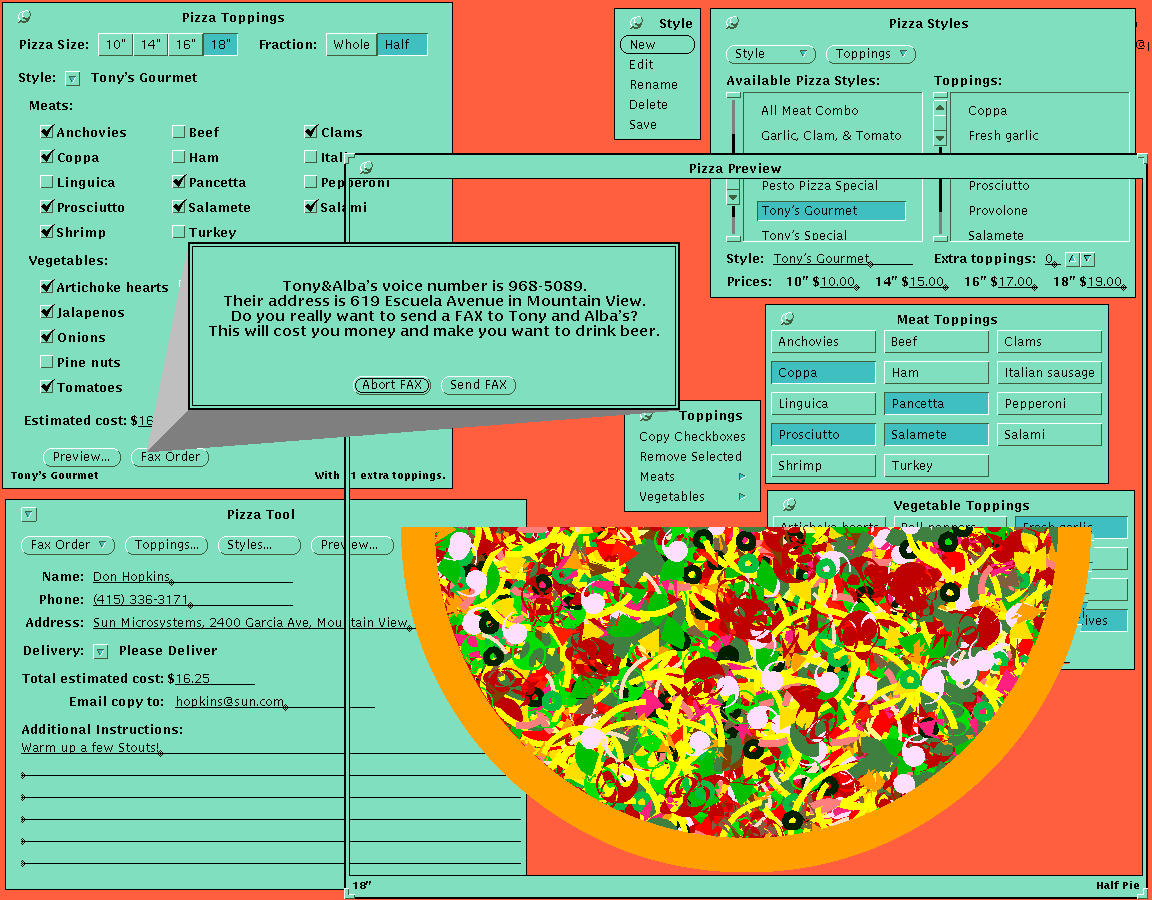
This is how you could visually design and order pizzas via email-to-fax in 1990:
The MIT AI Lab had a program called AI:HUMOR;TS FTP, the Food Transfer Protocol, which was supposed to allow you to download pizzas and other kinds of food over the internet, but it had some bugs and limitations.
Wow, I looked at the screenshot and didnt think much of it, but when I looked at the source code I got sucked right in! Thats brilliant, I dont understand the language but the thinking and patterns of the software are visible and I found it easy enough to follow.
One thing I was curious about was how that icon stored near the end of the file looks when rendered.
Did you write this script? This is exactly the kind of fascinating stuff I come to HN hoping to find :)
Thanks -- I'm glad you appreciate it! I wrote it as a programming example for The NeWS Toolkit (TnT 2.0), which was an OPEN LOOK user interface toolkit written in Sun's NeWS, a multithreaded object oriented dialect of PostScript. NeWS was a network extensible window system developed by James Gosling, after he made Emacs and before he made Java.
Ben Stoltz came up with the idea for a "tatool" gui interface for ordering pizzas from Tony & Albas pizzaria down the road in Mountain View, which he implemented in XView using DevGUIde (Sun's GUI builder tool). It inspired me to write Pizzatool for TnT in PostScript by hand -- I remember staying up late at night writing snippets of PostScript code for each of the different pizza toppings!
My initial version would draw a preview of the pizza on the screen, and then fax the image over to the pizza parlor, which confused them a lot because they couldn't tell which ingredients I wanted by looking at the black and white halftone screen printed pizza picture. So the next version just printed text describing the ingredients and delivery instructions, which took a lot less time to fax and was a lot more readable than a halftone image.
There was a bit of a controversy internally at Sun about releasing and supporting the source code, which toolkit to use (there were a lot of politics surrounding that at the time), and unintentionally revealing Sun's secret multimedia pizza faxing strategy to the press. But I wrote a manual entry, disabled the email-to-fax feature, replaced it with a menacing pop-up notification that threatened to hold your pizza hostage until you payed your tab, and managed to ship it in Solaris/SVR4 as an OpenWindows/NeWS demo.
Andy Bechtolsheim used it as an example of Sun's multimedia strategy in a SunWorld interview, and Unix Toady wrote an article about it, so the fallout wasn't as bad as some people were afraid of.
The idea was to test out and demonstrate how to program many of the dynamic user interface widgets, menus, windows, and drag and drop techniques in TNT 2.0. For example, it forked off light weight threads to draw all your pizza toppings at once, and you could spin the pizza to "cook" it by rotating the pixels repeatedly, then drag and drop an image into the pizza to customize it! It could even interoperate with another demo called "RasterRap". Here's a video that demonstrates spinning pizzas and dragging and dropping images from RasterRap into PizzaTool, which I recorded at the Exploratorium years ago (PizzaTool demo starts at 21:40, and the white and red pizzatool icon is visible at 13:00 -- it looks like a pizza box):
Demonstration of SimCity running under the HyperLook user interface development system, based on NeWS PostScript. Includes a demonstration of editing HyperLook graphics and user interfaces, the HyperLook Cellular Automata Machine, and the HyperLook Happy Tool. Also shows The NeWS Toolkit applications PizzaTool and RasterRap. HyperLook developed by Arthur van Hoff and Don Hopkins at the Turing Institute. SimCity ported to Unix and HyperLook by Don Hopkins. HyperLook Cellular Automata Machine, Happy Tool, The NeWS Toolkit, PizzaTool and Raster Rap developed by Don Hopkins. Demonstration, transcript and close captioning by Don Hopkins. Camera and interview by Abbe Don. Taped at the San Francisco Exploratorium.
Wow thanks so much for the background info, and thanks for giving me a peek into the past! That makes a lot of sense about how it came about and what it was trying to accomplish, knowing the restraints the software was written under only makes the product you came up with more amazing!
The thing that strikes me the most about this whole thing is that your pizza tool is essentially the same functionality as Domino’s online pizza builder today—but it took the rest of the world a quarter century to recreate what you had in 1990?! Sometimes I feel like the consumer software market has hit the ‘pause’ button on the computer revolution and stalled forward progress for decades…learning about this tool backs that suspicion with proof. You were active during the golden age of desktop software, this must have been such and exciting time to be creating things.
“I would love to be able to order a pizza w/out all the hassles of talking to a human. O:-) ” — Angela Thomas
AMEN! I Loved this quote from the email exchange : ) About to watch your video now, can’t wait to see these ideas brought to life in motion.
Thanks again for the background info and links, feel free to send any further replies to tomhodgins@gmail.com in case this HN thread gets lost. I’d love to hear more about what you built since the pizza tool too, I’m fascinated!
The currently served "old" version was probably disabled to redirects to the modern ordering website so the antique non/functionality from ever interfering with the modern website and not lose sales by attempting to convert customers into the new funnel.
According to the standard documents until html4.1 the tags were in uppercase. People followed the standards documents, although there was no explicitly required requirement.
Xhtml which came later (2000) explicitly required them to be in lowercase, and now html5 now states that the case is insensitive.
I think that is most of it. Also, upper case was kind of like a virus back then. When you went to write your first page, looked around at what everyone else was doing, it was all caps so you did all caps.
Some people will say it's XHTML. It's not just that. There's always been both in use and HTML has always been case-insensitive.
When Rasmus Lerdorf designed PHP in 1994, he made it have case-insensitive function names since at that time, neither side had won and he wanted it to look good in HTML:
That is correct. From "XHTML™ 1.0 The Extensible HyperText Markup Language (Second Edition)"
4.2. Element and attribute names must be in lower case
XHTML documents must use lower case for all HTML element and attribute names. This difference is necessary because XML is case-sensitive e.g. <li> and <LI> are different tags.
Normally when I end up on the Wayback Machine, I spend a few minutes lamenting a web gone by, but for some reason I clicked around this one for a few minutes. They have a really fascinating backstory (although short) as to how the site got up and running, and discussing the first pizza delivered from the web on the About page.
Yeah, this seems more faithful to the original. For one, it has a submit button that actually submits the form. In wbm's version, clicking the hat also actually brings up a contact form as the text says it should.
I love how they aligned input elements by using monospace and matching number of characters. A paradigm predating even tables!
I wonder how we'll do this kind of thing 10 years from now? Web pages have got so complex, even simple blogs etc, that serving them without keeping the infrastructure running is going to get harder and harder...
It will be funny when websites stop working left and right because essential remotely hosted JS files disappear from various free CDN URLs. Perhaps we'll add more cruft to browsers to compensate (i.e. recognize dead CDN URLs and use a list of replacement hosts).
Of course, the really old web pages will still work because of fewer/no external dependencies.
By that time you'll simply include the whole infrastructure in a 'web'-served container, running in a 'sandbox' of sorts on your 'browser'. Quotes where terminology is an unsure fit with whatever you'll be using by that time.
I was once told that the name was chosen to make it easier to cold call potential customers. Saying "Hi, this is Dave from the Santa Cruz Operation" was designed to fool people in to thinking that it was an internal call from another branch of the same organisation.
I have no idea if this is true, it's probably completely apocryphal, but it's a nice hack if it's true.
Caldera renamed themselves The SCO Group after acquiring the name and trademark from The Santa Cruz Operation in 2001.
Later, things went south and the new SCO(G) turned litigious. The original SCO was not responsible for the later shenanigans, and it was painful to see their name dragged through the mud.
I think it's pretty cool that they keep the original page working. I prefer it to the new page which has the modern day over-sized everything, over-sized text boxes, etc. It would be a nice site if they sized the widgets down to something that doesn't force me to scroll up and down constantly while building my pizza.
Yeah, we're definitely old. I was working my first developer gig at a company that had a commercial TCP/IP stack for Win 3.1+. Trumpet came up all the time especially from customers that were trying to get a better deal.
Sort of a tangent but I still remember building a SOCKS client on top of Winsock using undocumented Windows APIs. It was great that you could simply ask Windows to alias your code segment register to look like a data segment register and then replace the first 5 bytes of function calls to jump where you wanted it to go. And DLLs were in the global space back then. So it changed it for every app using that DLL. Those were fun days.
Which also reminds me that MS made the decision to go to a flat address space when designing OS/2 2.0 and "NT OS/2" in the late 1980s, ignoring the Morris worm.
Ironically, I feel like PizzaHut is now the most outdated of the pizza chains when it comes to web technology. I've been working on a fun project where I need to order pizza gift cards, and PizzaHut is the only chain that doesn't integrate with any gift card APIs.
Also, Domino's is way ahead of them when it comes to actually ordering pizzas online. Has anyone seen the Domino's pizza delivery tracker? It's awesome. It actually makes delivery feel faster by breaking it into steps.
It's a shame they're miles ahead of the other chains in actually putting lots of jalapenos on the goddamn pizzas when I ask for extra jalapenos, though!
When I ordered pizza, I was usually getting drunk, and just got a late call from someone who wanted to drop by.
I knew we needed some grub for the upcoming night of debauchery.(Yea, I was quite the charmer?)
Even now, I would rather have the original website, over the flashy current one. Sometimes less is more? Do I want to make more than a few decisions when ordering a pie--under the influence? I kind of liked calling--order--cash--bye bye.
I remember as a kid around 1995 or 1996 seeing a Unix login prompt on the stores computers, and one guy who worked at a store had put some of the modem dial-in numbers on a local BBS. We'd dial in and try to guess the passwords but never got anywhere. Later I learned Pizza Hut ran RedHat.
I believe you interpreted this as "Pizza Hut ran Red Hat" as in "Pizza Hut owned Red Hat", but the poster meant it as "Pizza Hat ran Red Hat [Linux?] (on their computers)."
Does anyone know how the delivery system worked? I assume that there were people who received an email once the form was figured out and passed your info to the local pizza hut
I know that SCO was involved with many food franchises in the following way: each location would run a PC with SCO Unix installed and a POS and reporting app. Each nite the reports would be transmitted via satellite dish to HQ.
Very futuristic!
Somebody else will have to confirm if the online pizza orders were emailed to each location automatically, sent via a Unix application, or faxed.
It's incredible how not much has changed in online pizza delivery. Fill in your name, address and phone # and we deliver your pizza, there got to be a better way.
I'f that comment was sarcastic, I may have missed it... Does there have to be a better way? It's not a complex transaction and it seems like it's pretty much solved. Now they store your information for easier access.
The title says "PizzaHut still serves it's first Homepage". From the (British) English grammar I studied in Italy, it should be "its" instead of "it's", and I remember seeing a debate about it a while ago.
"Its" is a possessive pronoun like his/her/their/our/whose. "It's" is a contraction of "it is", hence the apostrophe. Any time you could grammatically say his/her/their, you should use the version without the apostrophe. Any time you could say "it is", you should use the version with.
Well Pizzahut makes the most delicious pizzas and is the best managed fast food company around. So they pay tribute to their past website, that's nice.