I think that in a certain way Brexit could be beneficial for the EU. Britain was in basically just in for the economic side of the European Communities, and always rejected or scoffed at the idea of European integration, and with its large economy it allowed other Euroskeptical countries to get out of European projects without risking too much. For instance, I could well see a non-Brexited UK (maybe one where Brexit lost by less than 2%) rejecting the Recovery Fund as currently proposed due to how strongly it ties EU countries together, inadvertently strengthening the position of authoritarian eastern countries like Hungary and Poland.
From this point of view, it should be good for France and bad for Germany. When the UK was in the EU it had a much more pro-market, pro-EU expansion agenda. France was at the other extreme and Germany was in the middle. This afforded Germany some flexibility as it could "choose" between these different axes as needed.
With the UK gone that means that voice is much weakened and to some extent countries like Germany will have to make more concessions to France as there's less of a counterweight in the other direction.
Whether this is "beneficial for the EU" depends on if you think increased integration is a good thing or not. If you are fully signed up lover of the European project then it is probably good, but if you're leery of further integration then it is probably bad.
> it should be good for France and bad for Germany
the permanent triangulation between France, Germany, and the UK in itself was harmful to the EU. It's always been a problem for us (speaking as a German citizen) that we were torn between pro-integration and sovereignty.
At the end of the day the EU can only work if France and Germany, realistically being by far the two dominant countries in the union, have a clear, common vision rather than obstructing the institutions. With the UK out of the window I actually see this lack of choice as positive, because it finally forces resolution of the question where the EU should go.
What I'm saying is, nothing that is bad for France and good for Germany or vice versa is good for either one of us in the long run.
> When the UK was in the EU it had a much more pro-market, pro-EU expansion agenda.
Do you mean an anti-EU-expansion agenda? If so I totally agree: as someone who quite likes the EU but doesn't favour further integration, it was good to have the UK tempering any efforts in that direction.
Edit: There was quite ridiculous scare mongering in the UK media at the time about Bulgaria and Romania. No doubt part of the general trend that eventually led to Brexit.
I don't think it was fear-mongering that led to anti-EU sentiment so much as basic economics. Since most Europeans learn at least some English in school, you have an asymmetry when it comes to jobs.
Eastern Europeans can look for jobs in their home countries as well as in Britain. British folks, on the other hand, don't really get any more in the way of job opportunities unless they speak Romanian or Polish. So you have a situation where you have increased competition without increased opportunity.
Actually, being native English speaker is always a money making skill by itself. Seriously, having a western look and speaking English are marketable skills. There are people who literally make living out of it.
When it comes to Easter Europeans, they need to have the skills to get the job in first place(Polish don't get the jobs because of their Polishness), they must be able to speak some English in addition to one or two languages that they already know and they must have the capital to move to UK(Usually means years of savings).
If the British are having hard time to compete with Eastern Europeans they need to look into their education system. The government as the first step in HR will help with reducing the competition but in the same time that means that UK companies will have less options in hiring which is likely to reduce the output.
In my opinion, companies should be allowed to hire whoever they want and work visa or nationality is not a skill, just blunt regulatory barrier for voter distribution.
A lot of it was simple cost-of-living arbitrage. A worker sending money home to a family in Poland or especially Bulgaria/Romania can undercut someone who's trying to support the same family at UK prices. On a global scale that may be "fairer", but you can understand why the UK populace would be against it.
Of course there's a cost of living arbitrage but that's everywhere. Many people work in London but live out of London, it's a choice you can make and it comes at a cost(travel times) that you may or may not want to take just as the Polish don't see their family for long time.
In Turkey there used to be the argument against Women working, they said professional women are making man unemployed or underpaid causing social problems. It's not that different from the argument that Polish employment are causing British social problems. What about doing better job than an immigrant who can barely speak yor language? But no, they banning competition is easier.
You could make the same argument against any regulation of work. What about doing a better job than the person who's willing to work 12-hour days? What about doing a better job than the person willing to go without safety equipment?
Maybe we should have laws to prevent a race to the bottom on long commutes, living away from family, or having everyone in a household work, just as we have laws to prevent a race to the bottom on working hours or safety.
I see your point but comparing nationality to safety equipment does not compute.
>Maybe we should have laws to prevent a race to the bottom on long commutes, living away from family, or having everyone in a household work, just as we have laws to prevent a race to the bottom on working hours or safety.
I agree that it creates problems and, we can have safeguards like that. The point is, the safeguards should be same for everybody if we are aiming for merit based employment.
Sure, go ahead and implement ban for 12 hour work days but don't do it on nationality/race/gender base. Of course you can have exceptions for certain groups(like women who give birth to a child can have special benefits) but blanket bans for based on those is simply not O.K. if you want to have a fair society.
On the other hand, you may not want to have a fair society or fair means a different thing. I understand that there are different ideologies who would advocate different structures in the benefit of a certain race/gender/social status. Racism, sexism, classism are not novel ideals.
Thing is that some candidates for expansion have questionable practices when it comes to democracy. This is why those countries often see the EU in a positive light as it isn't as corrupt as their local gov at least.
I don't think current EU leaders really have any long-term plan, they just keep on steering in the same direction. Can be good or bad depending on your perspective.
There's not that much left to integrate, anyway. There's Montenegro, maybe Albania and North Macedonia next, a big maybe for Serbia (do they still want in?) and Bosnia and a definitely "no chance in hell" for Turkey (even though in the early 2000s it looked like a real possibility). Ukraine is too much of a hot potato to be touched by the EU. I forgot about Moldova, but for better or worse half of its population is already working abroad.
To be clear, I wasn't talking about geographical integration, but further integration of national institutions. E.g. An EU army, a shared EU tax policy...
France contributes more to the EU budget than it gets out of it, including farming subsidies. With the UK gone, France is/will be the second largest contributor, in absolute terms. The largest beneficiaries, again in absolute terms, are the two countries that pretend to be Euro sceptic, Hungary and Poland. Go figure.
Of course that's just the EU budget. The advantage that all countries but particularly France and Germany (and, for another couple of weeks, the UK) get from frictionless trade are enormous.
Thanks for the clarification. Yeah, I'm with you on this, don't see much scope for further integration on that front, at least not from the bottom up, especially after this pandemic that has made the borders and the national differences all too real again.
The elites will try to impose it from top to bottom, and when they'll encounter resistance they'll of course blame it on populism/Russia malevolence/the electorate being stupid and the like, that is if they'll decide to go to the polls to impose that further integration (which I have very big doubts they will).
It’s funny because in the early 2000s, everyone was against Turkey joining because of its economic woes. Today they’re against it for political reasons that could have been completely averted by its being a member state - all while proving that it had real, untapped economic potential all along.
But who knows if it would have been in Turkey’s own best interest to become a member state.
Who's to say Turkey's political problems would have been avoided? They're caused by demographic pressure and inequality that the EU can do little about. People consider Hungary and Poland bad but Turkey is Hungary + Poland on steroids.
Unfortunately, for most outsiders (including myself, I must confess), Turkey = Istanbul, when a few hours drive out to the rural areas will prove otherwise.
I see some indications that EU will in fact try to swallow that hot potato, i.e. the Ukraine. Just my two eurocents, from looking at the Polish media for some years and talking to many Ukrainians.
The carrot of eventual EU membership is being dangled, yes. But "eventual" could be 50 years away. I don't think the EU wants to have to deal with Ukraine's recent problems, such as Crimea, the Donbass War, relations with Russia. But maybe, given a few decades, those problems will reach some kind of resolution.
A lot of EU states never really wanted Cyprus in until the dispute with the North and with Turkey was resolved. But Greece insisted on Cyprus being allowed in before that, and threatened to block enlargement to other member states if it was not, so the rest of the EU didn't have a choice. There is no equivalent country demanding Ukrainian admission. Even if some EU countries might like Ukraine to join, nobody is going to say "Unless you let Ukraine in, we will veto Montenegro/North Macedonia/Serbia/Albania/Kosovo/etc's admission"
And Russia will quite possibly take the idea of Ukrainian EU membership badly – although exactly how Russia reacts depends on what is the state of EU-Russia relations at that point of time. Given that Ukrainian EU membership is decades away, if it ever happens at all, who knows what state EU-Russia relations may be in by then.
Who knows, maybe after Putin dies, we might get Muscovy, Kazan, Perm, the Republic of Novgorod, Crimea, etc. Going by Chechnya, Ingushetia, Dagestan, etc., very likely.
It would probably be a good idea to get the economies to a more uniform state before adding more member states. There's a lot of difference between standard of living in rural Bulgaria and downtown Munich.
This is why I think the timing of Brexit is quite poor. Polish GDP has trebled since joining the EU. Eastern Europe generally is on lower wages and their working in the UK was seen to be pushing wage deflation for many working class trades. The problem would lessen over time, so effectively we've seen the worst of it already. The UK will leave without bearing the fruits of the project in that regard.
If you break it down to quantity (wider integration of more countries, and more dissimilar countries) vs quality (deeper integration of a smaller core) then the "quantity" project is almost done anyways. There are still a few gaps on the Balkans but other than that, any considerable future widening (and thus weakening, as the quality position would call it) would involve pushing hard towards Russia, Arabia or not towards but into Africa. If there was some UK long game of shaping the EU into some form of smaller version of the UN paper tiger, brexit should be seen as a mission accomplished victory lap.
The UK was very for Turkey joining the EU and a major backer of that, but now Erdoganisation has put that beyond the pale. Similarly so for eastern europe it has been pushed about as far as it can go, so I think you're right. Unless neighbouring countries (Ukraine, Turkey etc) really massively up their game the EU is not expanding again for a while. The most likely new member state would be if Scotland became independent!
> If you are fully signed up lover of the European project then it is probably good, but if you're leery of further integration then it is probably bad.
I wonder if further integration will give insight into the common claim that the integration of diverse cultures in the US emerges many kinds of challenges other more homogeneous nations face in a much more muted fashion. I'm not swayed by that claim standing alone, since with metrics compiled along linguistic rather than genetic diversity axes (arguably a larger determinant of culture influences) [1], the US ranks around middle of the pack among nations.
What I suspect is happening is a form of the Resource Curse. Take a large, economically powerful great power (US end of 19th century), add generous immigration and assimilation policies, turn it into a superpower (US post-WW2), and it is possible the ensuing mayhem scramble for financial dominance within that economic windfall vortex (the Resource) creates fault lines in society that find their expression in culture differences. Lots of cultures, lots of differences. I also suspect if it wasn't cultural differences, it would have been some other differences leveraged; the incentives are misaligned to find commonality.
If my suspicions are true, then China and EU would be prudent to decline ascending to a superpower role, multipolar world or not. If this is the real dynamic at work, then the superpower mantle is the ultimate appeal to a nation's people's vanity, containing a hidden poisoned chalice just like a Resource Curse. And would be better served by participating and "leading from below", charting a new direction in nation-state evolution. Some form like more open information sharing with less developed nations on what works but leaving them to their own devices unless they start destabilizing armed foreign adventures of their own, putting effort into a global tide lifting all boats through trade. Perhaps re-directing the centralizing destructive forces of extreme economic prosperity I suspect develop around a superpower into a wider, amortized net of network effects amortizing the prosperity into more internalized relationships into a diffuse commonwealth-style syndicate of powers, perhaps in turn re-directing to Big Hairy Problems like getting off planet. And the US and rest of G20 would be prudent to participate in such an evolution.
France isn’t super pro-integration. The current president is, but the population isn’t excited about more losses of sovereignty. Cf the EU constitution referendum. And people forget the French voted for the creation of the euro with a razor thin margin.
I don’t agree with your argument. Is there really any country in the EU which is not in it for the money and security of its citizens alone? What other motive would a country have to be in the EU, barring ostensibly moralistic arguments, which in themselves will be made with economic motives? Some people win from the recovery fund, and some people don’t. The EU is not a dictatorship. If a country stands to lose, it should be able to make an attempt to have its case accepted. The UK’s hypothetical rejection is no different from a country’s complaint against this very rejection. Both are done with the same motive, and should be treated in an equally sober way.
Edit: I’ve tried to make a faithful argument. Please explain instead of downvoting.
I personally think that alone European countries have zero chances to survive this century without becoming either American, Russian or Chinese puppets. Countries like the UK and France are still riding what's left of centuries of influence and prestige on world affairs, but the last 7 decades quite clearly show that single countries can't defend themselves and their democracies from foreign interests without cooperation. It's also quite clear to me that the European economy is so integrated that's almost ridiculous to think that every country could be free to do as it pleases, because if for instance Italy fails, then all of Europe fails.
That's why I think we need more integration; to me, the freedom and security of European citizens is synonymous with European cooperation and integration. Together, we've one of the biggest armies and economies of the world, and we stand a chance to mean something on the world stage. This doesn't mean that the current EU is necessarily the right way to achieve this; ironically, I think most of its issues arise from the fact it is not powerful enough, and single states have too much sway in how the union operates, similar to how the USA were when the first Articles of Confederation were written in the XVIII century.
I'm curious as to kind of integration you're referring to.
On paper, monetary union has prevented the economic integration from happening. The diverse economies of the EU are diverging; the north is reliant on export markets outside the EU, while the south is destined for decades of internal devaluation, even in a best-case scenario. Does this help social integration, or does it foster mass resentment rooted fundamentally in cultural differences being amplified?
Political integration may have been the suggestion, though the 2008 and 2020 crises have not seen an increased push for such a political union, so I think it is extremely unlikely. Yanis Varoufakis wrote about this here in 2014, in particular he gives his interpretation of why monetary union alone was doomed to fail: https://www.yanisvaroufakis.eu/2014/08/29/why-is-europe-not-...
The integration is happening between regions, not between states, because with (even still imperfect) free movement of people, goods and capital national borders lose their meaning. Is northern Italy part of the north or of the south? Does rural Poland have more common with Warszava or with rural Czechia?
There seem to be fair economic arguments either way. I am undecided on Brexit either way. I haven’t researched it enough. My point is more abstract: A lot of people forget the underlying economic motives of all countries in their interactions with each other.
> What other motive would a country have to be in the EU, barring ostensibly moralistic arguments, which in themselves will be made with economic motives?
The original purpose of the European Coal and Steel Community was to neutralize the risk of repeating World War II by tying the major continental powers into a commercial union. The ostensible purpose was economic integration, but the ultimate purpose was geopolitical harmony.
In contrast Thatcher envisioned the EU as a purely commercial arrangement, designed to counterbalance the UK's loss of global economic relevance in the face of decolonization. The difference in vision was a major source of conflict between Thatcher and her continental counterparts. They only reached a compromise because Thatcher was concerned about a newly unified Germany having too much power without Britain in the union.
Thanks for the explanation. That puts a different spin on things. Geopolitical harmony as a defence against other external powers. I've focussed on the economy, but what I should have said is national interests.
National interests quickly expand to interests of your neighbors and the rest of the world unless your interest is strengthening/widening hierarchies and power differential even inside your own nation (in which case you need a system of manipulation of the masses)
First, being part of a larger whole may have material advantages that are not directly related to money or security. A good example is free travel between countries.
The second point is that people actually believe in their morals. That is not to say that all "moral" arguments are made in good faith - sometimes they are thinly veiled economic (or else) arguments. But people generally believe in their morals. If I - for instance - believe that people are endowed by their Creator of inalienable rights, I may favor institutions that support such rights, and the EU may be more effective at that that nation states. If I believe that all Europeans are brothers and should decide their fate together, I will favor a strong EU. I wager that the reasons most Americans believe that the US should not be split in different regions has very little to do with how much more or less money they would make if the US was to be divided. Don't quite recall Lincoln's speech on the GDP implications of the South secession. Morals matter.
Finally, not everything is zero sum. It is possible that everyone wins from the recovery fund, or that benefits for those that benefit are greater than the losses from those who lose.
I have found that free travel in the sense of going somewhere to live is done generally for economic purposes. I have done it and benefited from it myself multiple times. Some existing residents might complain about jobs going missing, others might invoke the benefits of diversity to the economy. Neither argument is right nor wrong, and all are based around personal perceptions of economics and national interest, with which economics correlate. National interest has multiple facets. One is the real ability of a country to exact influence over others, another is the wishes of its citizens and government.
I am not sure whether you are claiming that this exists, but having visited and lived in multiple places in the EU (including outside of the UK), I never felt that people had a sense of an EU-wide brotherhood. People are generally quite worried about that sort of thing for obvious reasons, and culture varies sufficiently over the EU to make such a thing difficult. When discussing the influence of people's morals over their arguments over national interests, you also have to consider the context of people's morals: which agents impose them (either explicitly or implicitly) and the motives behind their imposition. I don't mean to use the word "agent" in a necessarily negative tone. An agent could just be your mum. However, when you look at more powerful agents than your mum, such as the education system, Instafacetwit, newspapers and the law, people's morals start to gain a greener hue (in dollars).
Also I fully agree that a subset of players in the environment might all come out in the money.
There is a very common "going somewhere to live" in the EU that is not done for economic reasons, namely Erasmus where the motivation is a year of partying while ostensibly studying. Those Erasmus stints often turn into another move abroad for another non-economic reason: having met a partner from another EU member state while studying abroad.
Mobility in the EU from East to West may be done mainly for better job prospects, but there are definitely other reasons that people take advantage of free movement.
Yes, jumping university and country for a year to get paid by the EU for boozing and schmoozing has a definite draw for a lot of Europeans. Why shouldn't it? Foreigners are also at an advantage when it comes to finding a not necessarily long-term partner. I am slightly bitter about it though. I moved into a flat as a non-Erasmus person that later turned out to be the local Erasmus party destination during a period when I was much less into partying and more into studying. No partners were found from that pool.
I do remember having a lot of political discussions with them, though.
I never felt that people had a sense of an EU-wide brotherhood.
This is totally a thing. People identify as all kinds of things, and many people identify as Europeans. Hard to put a number on a feeling of identity, though, and hard to tell if it's increasing or decreasing.
I agree that it's hard to measure. The word "brotherhood" has certain connotations for me. The first result on Google for "European Brotherhood" confirmed my feelings, but maybe doesn't speak for the majority.
Well, you chose the word. I understood you to mean people having a common identity as a European, in addition to their many other identities (dad, poet, Belgian, whatever). Which I would say is a common thing.
If you were referring to membership of the neo nazi organisation/web shop European Brotherhood, which is a thing that apparently exists, I don't think you need to worry about pan-European-nationalism becoming a mass phenomenon (as opposed to separatist nationalism, which is and has always been a mass phenomenon).
I was referring to "If I believe that all Europeans are brothers" in the parent comment. I have not experienced that sentiment. I certainly never experienced pan-European nationalism until I came across that website.
> Is there really any country in the EU which is not in it for the money and security of its citizens alone?
Those are two quite separate concerns. Much of mainland Europe, France and Germany especially, want to build the institutions and integration that will prevent another war, even if it costs them economically. Simple geography means that's always been less of a concern for the UK.
Fair enough. If that is the case, both sides win. I took issue with the claim that the UK was just in it for the money, without mentioning that everyone is. How could it be any different? This argument has been a common theme I’ve noticed in Brexit debates from people across the EU.
What makes you think everyone is in it just for the money?
The EU started as a peace project, and I think it makes most sense to regard it as fundamentally that, even now. It is an implementation device for peaceful cooperation with your neighbours. It's an endless series of contracts and treaties that provide benefits from good neighbourship.
If you accept that view, the EU's view of Northern Ireland in the Brexit negotiations becomes obvious. It's not about solidarity with the member country Eire, it's about keeping the peace (which the Irish also want, yes).
Money is possibly too narrow a term. I should have said national interests instead. In our current system, however, national interests also seem to strongly correlate with money and thus economic power. Each of the participants in the EU project had national interests in mind.
I have a feeling that if you try to define what you mean by national interest, you'll get a circular definition. What does France want? To further its national interest. What is its national interest? It is what France wants. Uh.
That loop leads to no insight. Perhaps thinking along those lines is frustrating and the frustration makes you blame the current system, but blaming also won't help with insight or understanding.
These two concepts are part of a wider network. The measures of those concepts alone closely correlate. It is difficult to think about one without thinking about the other.
I am not blaming the system as a whole. It just is. I was more taking issue with (reacting against) and questioning the motives and sources of people's reaction to the system and its big players. I was trying to show that these motives and sources are similar to those of both the big players which they are reacting to (UK), and also those which they leave out (continental EU, Greece).
Some motives may be moral, but it should not be forgotten that these motives correlate with the interests of a wider group. For many people alone, being immoral correlates directly with negative personal interest.
This is not to forget that people's reactions interact with the wider system bidirectionally.
Money plays a big role but things like single market, Schengen area, unified standards/rules are a convenience for me as a EU citizen. I didn't shop often some specialized UK shops but now it is going to be more painful because of customs etc.
Again, someone has possibly lost economically. That problem can compound. That’s fine. Simply allow everyone to have their say without moralising too much.
Edit: without forgetting the underlying economic motives of all parties, in which moral arguments do play a part due to their ability to influence actions.
Majority of Polish people is pro European, however like in few other places in the world, unlucky series of events caused populists to reach to power. They used old divide and conquer techniques, seized media and manage to destroy some democratic circuit-breaker institutions. Since more then a month there are huge protests in the streets, despite covid. Worst case ee have to wait 3 years until next elections, but let's keep fingers crossed.
In Hungary people are so desperate at this point that they don't even go to the streets.
Orban was able to change the law that Hungarians outside Hungary's border who don't even pay taxes can vote (just get a small amount of money from Orban).
I already moved my assets to safer places a long time ago, as I'm not too optimistic.
Individual EU countries might be better off. But the EU overall is worse off.
Also, having a worse off UK even if it’s outside the EU is not a good thing for EU countries.
Contrary to what many believe, the global economy is not a zero sum game. For the most part, the UK doing better means the countries it has trade relations with will also do better.
"I think that in a certain way Brexit could be beneficial for the EU"
It would be nice to think that someone would benefit even if its not the UK. Sadly I think both the UK and the EU are going to be worse off because of Brexit.
I really wish more people realised this. The UK has tremendous soft power in addition to significant economic and diplomatic power. London was the EU's only truly global city. People may point to Paris, Frankfurt etc but those cities do not wield the influence and financial clout of London.
Then the Cluster Former-United Kingdom, Cluster FUK, would make for a more comprehensive, all-encompassing acronym!
I really hope the UK stays together. Brexit or no Brexit, the UK remains a strategic member of Europe the continent, a key trade partner and a positive influence for Europeans, positive even as a competitor -- a baseline of some sorts. This whole breakup ordeal will end up creating fragile trade agreements and increase diplomatic carpet pulling that could trigger public resentment and fuel extremist politicians in the continent.
The possibility of an integrated Ireland and Scotland as new members of the EU could also tip the English towards a very aggressive reset of their political and strategic roadmap, even worse than post-Brexit. I have no idea where to though... The US/Americas? Asia-Pacific? The Singapore of the Atlantic?
Something approaching a united Ireland might be a benefit from the Cluster FUK. Really the northern bit of Ireland is kind of Irish and it being stuck on the UK a bit of a hangover from the collapse of British colonialism.
> rejecting the Recovery Fund as currently proposed due to how strongly it ties EU countries together, inadvertently strengthening the position of authoritarian eastern countries like Hungary and Poland.
(those using mobile Wikipedia app, scroll down to "The British and Polish protocol")
Also:
> Britain was in basically just in for the economic side of the European Communities, and always rejected or scoffed at the idea of European integration
> authoritarian eastern countries like Hungary and Poland.
While I understand that the situation there is a bit dire by EU standards, calling them authoritarian is an overstatement. They're not Belarus, UAE or NK. Yet...
5, 10, 20 years ago I'd say: sure, things aren't great but still better than ever. Now in the last 5 years top courts have been overtaken completely by the ruling party, district attorneys are on political leashes shorter than ever in the last 30 years, state companies are buying up property solely to increase the ruling party's power and give its zealots comfy places to receive inordinate salaries for nothing (like the recent massive newspaper publisher acquisition by the state oil company), all top state officials are openly devoted to pushing the Catholic Church's agenda and to providing the clergy with money and influence, LGBT Poles are demonized by the government just to convince people to vote for the party that will "protect the families" or whatever bullshit, and – the engine behind much of this – the state media apparatus is truly on par with the communist government one's in outright propaganda (it's incredible how similar the language is – Russia Today is subtlety in comparison).
It's not outright authoritarian, but we're well on the way.
Also, Poland is certainly not the 2nd democracy, nowhere near that. It was very early to the concept of constitutions, but that didn't even last a few years until the country was taken apart completely by neighbors for over a century.
If Brexit hadn’t happened, the Recovery Fund would’ve pushed the UK out. As proven by the American experience, on collective debt is the last step in becoming a single country. It seems insane to me that Europe would do this, with America out there as a warning sign, but it’s their funeral I guess.
Economically it’s better off. Politically and socially I think it’s worse off. The federal government started as a vehicle for economic integration and has become a vehicle for social and cultural normalization. That’s a problem because while the US is more homogenous than say the EU, it’s more heterogenous than say France, Germany, or the UK.
Here’s what I see as the basic problem. Most countries are ethnostates, including most European countries. The UK is still 80% ethnic British, Germany is still 80% ethnic German, Sweden is 80% ethnic Swedes, etc. Regardless of political differences, they have a strong common bond. Americans don’t realize just how strong this bond is. I’m a Bangladeshi immigrant raised in America. I have almost nothing in common with most Bangladeshis. But my ancestors are buried there and that means a lot.
In the US, there is no common ethnic ties. (No ancestry makes up more than 15%.) As my wife says, America is a “credo nation.” In a way that’s a strength, allowing the country to readily absorb immigrants. On the other hand, that’s basically a political ideology disguised as a national culture. What do Americans that don’t share politics, and don’t have the close ties that come from living in the same geographic area, have in common? Culturally there are large divergences. The United States is the most religious developed country in the world, comparable to Poland or Iran in terms of people who pray daily. But large pockets are as secular as Paris. In fact possibly more so. In France, for example, the cultural Catholicism of French secular society mediates between Paris and the daily churchgoers in the rural areas (https://www.europenowjournal.org/2019/10/02/the-catholic-nes...).
What would happen if people in France got to control abortion or religious laws in Poland? That’s maybe even understating the distinction. France, perhaps as a result of cultural Catholicism, has abortion laws that would be unconstitutional in every US state (generally illegal after 12 weeks). 24 weeks is common in the US, and states like Massachusetts want to make it legal based on a doctor’s judgment up until birth. (However justified, it’s undeniable that law is based on sweeping moral premises regarding when personal autonomy or the judgment of a single expert can override the state’s authority to protect life). What would happen if a court in Brussels had banned schools in Poland or Italy or Spain (or heck, Germany or the Netherlands or the UK) from offering even religious education even on an opt-out basis? Or struck down nearly every country’s abortion laws? Would anyone still want further EU integration?
The US has long papered over these differences with an exaggerated patriotism. Commonality through the belief in the goodness of America, it’s constitution, and its history. That hasn’t broken down completely but it’s breaking down.
America has been more divided before. But the nature of the country was very different back then. In a country where the federal government is tiny and focuses mainly on defense and regulating interstate trade, these differences just don’t mean as much. But that totally changed in the 20th century. FDR killed federalism and fundamentally changed the nature of the country. Meanwhile, the Warren Court inserted the federal government into myriad social issues. Suddenly, the federal government had to power to decide that you couldn’t have prayer in schools and you couldn’t shut down strip clubs. World War II, the post-war economic boom, and the external threat of the Soviet Union provided a common identity and shared purpose for a long time. After the fall of communism, that evaporated.
What’s left country of 330 million people, faced with the same economic challenge all developed countries are facing, but also deep cultural fissures. The nomination of Amy Coney Barrett was a stark example of this. She’s insanely popular among Republicans, with 95% of people approving of her. Democrats, meanwhile, didn’t just attack her judicial philosophy. (A sitting Senator called it just “another way of saying racism, sexism, and homophobia.”) They said she was a character from a dystopian science fiction novel. Whatever your politics you have to appreciate the significance of that. On one hand you have people who see her as a model of an exemplary life—and the values that produce such a person. And on the other hand you have people who see her as an attack on modernity itself.
Now, you obviously have liberals and conservatives in every country, and political and social disagreements. I suspect, though, that the difference between Massachusetts and Louisiana is bigger than between Bavaria and Berlin. Regardless, Germans are still Germans. Americans don’t understand how powerful that bond is, because they don’t have it and don’t realize that maybe they need something else to fill the void.
The melting pot worked as well as it can work. Certainly better than in Europe. (See Brexit, see France and Muslims, see Germans and Muslims.) And certainly more so than nearly anywhere in Asia.
The problem is that you’re trying to solve a devilishly difficult problem that we don’t want to acknowledge is a difficult problem. When Iraq voted for the first time in 2005, it did so along strictly ethnic/sectarian lines. My home country of Bangladesh seceded from Pakistan because even though we were all brown muslims, they were brown Muslims who spoke a different language. Even Belgium to this day had huge economic disparities between French-speaking regions and Dutch-speaking regions.
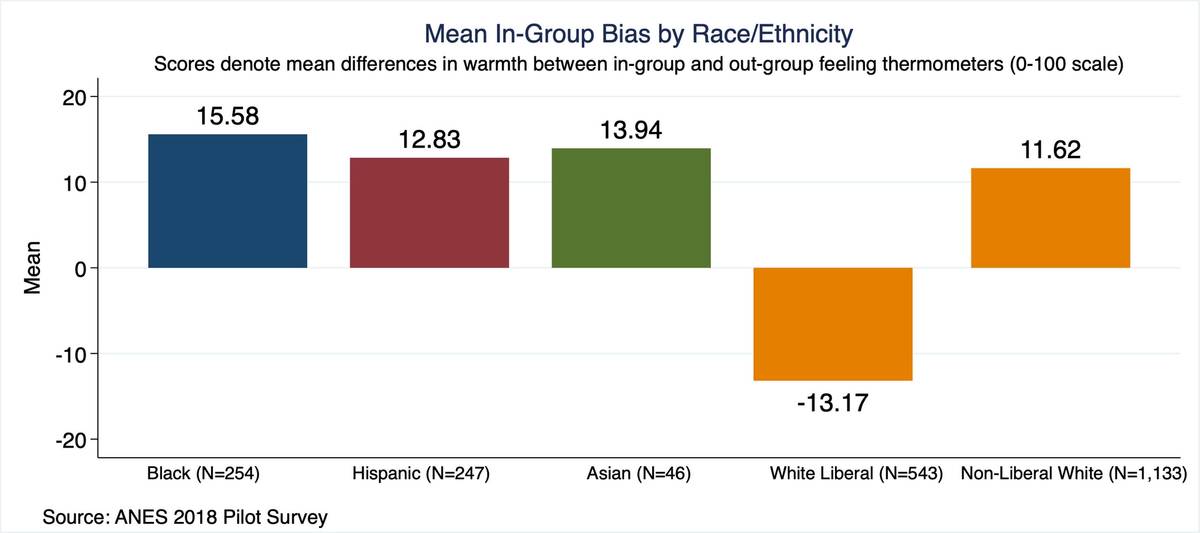
We should seek to build a tolerant multi-ethnic society, but that will fail if, under some false belief in the perfectibility of human nature, we don’t acknowledge how hard a thing we are trying to accomplish. You can’t build such a society if your response to people being concerned about the culture in their communities changing is to call them racist. You can’t do it if you pretend that moderate in-group favoritism is some defect among certain white people, rather than a human trait that is displayed equally by Black and brown people: https://tablet-mag-images.b-cdn.net/production/883104fdaad18.... You can’t do it if you blithely kick stools out from underneath society without regard to whether they’re serving some critical function gluing our massively complicated heterogenous society together.
I am far from being an expert, but on the other side now it might be easier for Britain to set up more favourable conditions for startups and tech companies since now they don't have to comply with EU laws.
Startup scene was already good before Brexit. So, some additional startup boom will not happen because one other issue, parallel with Brexit and pandemic UK government decided to kill (predominantly) IT contacting by creating some changes to IR35 law (basically increasing taxes significantly to that specific group).
All those combine will have strong impact on UK, I live in London, and finance is probably 80% of how UK makes money. Most of the goods are imported, we do not produce anything (I am exaggerating but not far from truth).
Just to remind, people voted pro Brexit because of a red bus with a large text saying that each week £350 million goes to EU (which was wrong but hey...) that is £18.2 bn a year. Meaning Morgan Stanley is shifting permanently, with one swift move, 6.5 years ... and heaven know about how many jobs... All that also have combined effect as each person working there feeds many others (builders, bakers, creditors...)
"Remain" side was warning about all this, but unfortunately, people have not listened.
Correct. It’s UK’s own income tax legislations designed to tackle tax avoidance of mostly IT contractors being paid via dividends in single person companies.
It is not tax avoidance if you have limited company. Why should single person companies be different than large corporations?
Rules should be the same for all, single person or multi person company ... so Amazon, Google, Microsoft and everyone else should instead paying dividends pay full PAYE... meaning each share holder should pay 60% and more taxes.
One more reason why is harder to succeed with startup... heavy taxes are for those that are at the begining.
It is exactly tax avoidance. It is a method of structuring employment such that single-person contractors who are employees in all-but-name get to pay less tax.
Single-person companies are still free to exist, like other companies. What's no longer permitted is employees pretending to be single-person companies.
By the pattern of your answer I can conclude that you have never been contractor, so you do not know enough about IR35. But fair enough you have huge karma so you can downvote my answer.
IR35 has existed for very long time and has relied on determination of who is in or out, liability before was on Limited companies to determine status. Now, government shifted that liability to employers as for the past 10 years they have not got more than handful of cases in the court against those single-person companies.
So, employers in fear of heavy fines, are using blanket approach and placing everyone Inside IR35 regardless of their real practices.
Those really big are exempted of taxes, you just need to have enough money and good leverage.
Now, why was contracting good in UK?
Because short rotation of contact was helping to increase "salaries" (rates). Permanent employees do not negotiate salaries on regular bases, and what I have experienced that they sitting on the same level for years.
Natural tendency in capitalism is to maximize profit for shareholders and minimize all expenses in process. Salaries of permanent employees are expense column.
Why is this bad news for all companies, regardless of higher rates, it is easier to discharge contractors. Having very strong unions in UK, that will not go easy with permanent employees. Meaning startups will have issue to find people on short term bases.
And many more things to cut the long story short... Nothing to do with fairness but as Jean-Baptiste famously declared “the art of taxation consists in so plucking the goose as to obtain the largest possible amount of feathers with the smallest possible amount of hissing.”
That new IR35 changes are bad proof is decision to delay it for one year because of pandemic...
Are directors taxed differently from employees? I've not been a director of a single person company but from what I recall (it's been a while) I didn't pay anything other than normal PAYE for being an employee/director. Of course as a shareholder you may be subject to other taxes but you can be a shareholder without being a director and vice versa.
I know having a limited company is not tax avoidance.
I'm talking about IR35. The sole reason it was created is to fight "a tax avoidance loophole" (not my words) where without the intermediary (limited company) the single person would be an employee instead.
The single person is avoiding tax in the same way and to the same extent as any shareholder in a limited company. If they wanted to fix the "loophole" they should tax dividend income the same as employment income for everyone in the UK. Singling out individual contractors is arbitrary and complicates the tax system for everyone.
if 'startups and tech companies' is a euphamism, for shysters, con-artists, charlatans and crooks, then yes, i do believe that Britain is about to get EVEN more attractive
Funny, because by that logic London wouldn't have been attractive to companies in all this time it spent in the EU
Oh and now they're losing facilitated access to the whole of EU developers. But I guess that doesn't matter (even though the flood of openings I see on Linkedin, etc)
I worked at a startup during the brexit vote and our recruitment plummeted immediately afterwards. We would only get about 10-20% of the EU candidates applying as before. No change in UK candidates.
Anecdata: the start up I work for now has to spent significant time and money serving our customers in the EU, reducing our margins. Brexit has no benefits to us, we were doing perfectly well working with customers in Europe as well as in other countries.
If you were starting a tech company why would you choose to start a company in a country which appears to be decidedly against the idea of economic cooperation and free trade. A country that is deluded enough to remove itself from one trading block because, apparently, its much stronger on its own.
If your comment refers to some sort of utopia where trade and business is deregulated and capitalists can happily roam in the wild I'm afraid you might be disappointed. The average Brexit voter has significantly more to gain from the welfare state and big government than the current crop of politicians. Regulation isn't going anywhere and is probably going to increase as the government seeks to prop up its finances without the aid of the EU.
I find Brexit an emotive topic, if only because "Project Fear" is and was always going to be "Project Reality".
IF they truly believe they have more to gain from the welfare state and big government they are mistaken. Maybe someone who need immediate help will benefit from the welfare state but the best long term plan is always self reliance and hard work, the goal should be to create a robust and free economy such that the individual is free from reliance on the government. This is the root of the conflict in the US now, democrats want to foster a system that increases reliance on the government and republicans want to reduce this reliance.
Less reliance on government in the public health sector has been a great strategy in the fight on COVId, hasn’t it?
Also, you say that republicans have fought to reduce reliance on government but in the last 4 years there’s been a big increase in the federal budget to spend more on military. Aren’t they doing the opposite of what you said? And how is that a free economy when tons of new tariffs have been introduced?
I feel sometimes that people don’t realize that the government has been doing the exact opposite of traditional republicans orthodoxy.
Re Covid, I'm not sure what the government can do, the news of the virus was plastered all over the news. I don't need to government to tell me that if a novel virus is circulating that I need to avoid contact, the people who continued to live normally decided to roll the dice at their own or elderly family members expense, those people made personal decisions and the poor souls they cam in contact with are paying the price, it's not appropriate to blame the government for those actions of private citizens. There is simply no legal precedent to order people to stay home, would you have declared martial law and arrested anyone seen outside their home?
I'm speaking about republican citizens, not "republican in name only" politicians, don't conflate the two. Politicians of all parties are guilty of saying and doing different things.
People absolutely realize the government has been doing the exact opposite of what orthodox republicans want, that is what made Trump seem worthy of a dice roll, he campaigned on a bunch of goals that claimed to try and reverse those decisions.Those goals were either thrown out once he realized how difficult it would be to actually accomplish them or thrown out because he never cared to give it a real go. Given the long time government employees that either quit or were fired and the resistance from establishment politicians both D and R I lean towards the first reason.
Indeed the military budget has been increased, that is driven by our need to fight two full-blown wars on two fronts, our military strategy is based on a worst case scenario. That is the goal that is not talked about publicly but is true. We can expect the military budget to continue to increase.
Re tariffs, they are the right strategy. The primary job class that has been reduced is manufacturing. A large chunk of those jobs were lost to China, the only way to bring those jobs back is to make those Chinese government subsidized imports less attractive to buyers. The tariff strategy can work but it looks like we need to tax imported goods that could feasibly be made in the US by 100-300%, only then will you go to Wal-Mart and find that the US Made goods are in the same price range as the Chinese goods. This is the same strategy that Euro zone and Asian countries use to keep their citizens buying local. Our politicians sold us out circa ~1979. The implementation of these tariffs was a half-measure, it takes years to plan/design/build/ a factory and bring those products to market, Trump should have focused on a 20 year plan that both parties agreed to continue after he left office.
So poor and disenfranchised people want a more equal redistribution of all the economic output and the rich class prefers the status quo, you just have blown out my brain.
Poor people mostly want opportunity. For 2 hundred years that opportunity came in the form of middle pay manufacturing jobs, those job mostly don't exist. Ask a non-disabled non-drug addicted person next time you have the chance, they would rather work and earn their way than get a government check. This has been proven many times going back the Milton Friedman/ Thomas Sowell debates. But you are correct, the rich class prefers to stay rich, that much is bloody obvious. If they could stay rich and have the goods the sell manufactured in the US, they would do that. But the politicians sold us out.
Having worked in the City since the 90s, I've seen the Euro conversion come and go, which would end the City, then more EU attempts to centralise finance in Frankfurt, would end the City, and also Japan/HK/Singapore/Beijing, would end the City.
Frankfurt is another hour away from New York, and English isn't the first language. The vast array people with financial skills are in London.
I won't argue that this isn't significant, but it's assets, not people.
And let's not forget Gordon Brown's "light touch regulation" led to lower costs for financial companies operating out of London, due to less regulation and bureaucracy than the EU.
It also helped fuel the credit crunch as well. So there's v2 of that to look forward to if the next UK government decides to relax oversight to attract businesses.
I'm not a fan of Brexit but the UK is top heavy on financial services, it's almost like the Dutch disease[1] where outsized success in one sector tends to supress others. I wouldn't loose any sleep over it shrinking a little.
Yes, in fact I lived there for 6 months. These articles never mention or underestimate the Anglosphere. NY+London work well together because of a shared language, and overlapping time zone, and similar work ethics. I'd see far higher percentage of UK employees working late to overlap with NY than I ever saw in Frankfurt. That extra hour makes a big difference.
I don't know, I think that's cultural more than anything else. In the UK (in finance at least) you're there till the job is done and your bonus nreflect that. In Germany, your there for set hours and being great or terrible won't make much difference so why bother?
If people made the arguement that London is good at finance because londoners (and it is londoners, not brits overall) want it more, I'd agree. When people say it's the language or the timezone I'm very unconvinced. Otherwise, why hasn't Ireland eaten our lunch?
Ireland is the same timezone as the UK and doesn't have any real global cities. Dublin hasn't eaten London's lunch for the same reason that Liverpool or Newcastle haven't.
> EY moved 7,500 roles and £1.2trn out of UK to the European Union
> it won’t be significant enough for anything major.
Whith the EY example being one company only, I don't think it's warranted to call it "nothing major". In fact, I know it: I work for an investment bank and we're moving vast majority of our UK-managed assets to EU. Roles are moving slower than expected, but with the assets being managed in EU, it's only a matter of time before the UK roles become redundant if employees refuse to move.
Almost all my team's work during last 24 months was related to Brexit and the change of legal entity. It's major. Very major.
Had the opposite experience. Worked in an investment bank since Brexit was announced years ago and this has changed nothing at all whatsoever.
Nonetheless, I can recall 3 news articles saying the bank would close shop in London and the last one specifically called out my department to be closed. None of it was true, in fact we were still hiring. Lesson learned that newspapers would say anything for eyeballs.
Yes, I agree it’s significant and major (for the UK), but I don’t think it’s major enough to dethrone London from being one of the world’s financial centers and have it replaced by Frankfurt for example.
I've had a different experience. Some of my work in the bank has been Brexit/EU related, but from experience, it's nothing like the effort we put in for the Euro conversion or Y2K.
I'm more confident that any 'damage' done to London will be a consequence of remote working practices from COVID, and not current politics between Europe and the UK.
An important reason London is always better than Frankfurt & Amsterdam at least is that its a big city and the city needs literally hundreds of thousands of skilled people.
The fascinating thing is that is changing, computerization is replacing people and Covid has shown people working remotely works. NY is the same, used to be special but slowly teams will be moving out. Your friendly stock broker is already a server, right now your fund manager is turning into one as well. Bond market is slowly chopping up people as well.
It works both ways. People in London can benefit from remote working even if headquarters are somewhere else. In a world where work is conducted over the internet, the status of a city is dependent far more on what kind of place it is to live rather than which businesses are nominally based there. And I just don't see the rich and powerful moving from London to Frankfurt any time soon.
How much is $120B relative to the total assets held in the UK by Morgan Stanley? The number of jobs which have been moved out of London seems relatively small (7500 across the entire financial sector, single companies in London employee more than that).
7500 was October, not it's more than 8000. That would make it about 3-4% of "high finance" positions* so far moved out of the UK into the EU. That's not an exodus yet, but it's not nothing either.
Then again, a lot of the transitions aren't finished yet either, and a lot of it is dependent on the final Deal or No Deal. It also takes time to do the groundwork if you want to move, like create the legal infrastructure and entities and the associated due diligence, rent office space, hire or relocate people, and so on.
So, it's too early yet to conclude anything in either direction, in my opinion.
[*] Hard to tell what is the true number of "high finance" employees in the UK. Given there are roughly 180K finance and insurance employees in the City of London, and most of the "high finance" is concentrated there, I'd guestimate 200-250K such "high finance" employees in the UK total, but I could be massively wrong. There are numbers putting the full time financial and insurance employees in the UK at 1.1M employees, but that includes bank tellers dealing with people wanting to buy a house and agents selling life insurance, etc.
My wife's department (at an unnamed major investment bank in London) just gave up on trying to hire for a position in Frankfurt. They'd been trying to fill it all year. They're now going to hire for it in their UK branch office (not London). By having the role in the UK will breach the EU regulations for the role in question - I don't know what their medium-long-term plans are though. It's a shit situation when you literally "can't find the staff".
As a French guy still living in France, I don't find Paris to be attractive at all.
It is a dirty city, housing is expensive and generally in a poor state, and there a lot of security issues and social unrest: burglaries, violent protests (almost every week), periodic riots in some suburbs and terrorist attacks. To the point that more and more in the media, you hear about an upcoming civil war.
Add that all the famous France's plagues: strikes, bureaucracy, very high income taxes for people earning more than 2000/m Euros and more recently communities living more and more separately.
There is no social unrest in Germany, Frankfurt is much safer and Germany more reliable.
Frankfurt is a lovely place to live... I was surprised how cheap it was (compared to nyc and such). While not a world class city like NYC/London, it has a lot to offer, and it is on par with cities like Boston/Seatle/SF/W.DC/Lyon/Zurich etc...
It is a solid 'upper middle' tier city, where everything is clean and neat.
This. And from what I’ve heard this is often less about the banker asked to relocate themselves but their families. London is just far more attractive as a place for foreigners to relocate to than Frankfurt is.
It’s one of the downsides of Germany’s less centralized economy. While not the same status as London, Munich or Berlin would likely be more attractive destinations for their families.
Ha!? Paris is attractive only for a handful of ultra-rich or if you are a two days tourist (and even then). On the other hand, I found Frankfurt to be quite affordable and calm.
What daily attractions does Paris have? Sure there is the Louvre but I didn't visit that as a tourist (no way I'm standing on these lines); so I don't think I'll be seeing it everyday to work.
I'm guessing that at least some financial institutions have been moving (part of) their London operations to mainland Europe, thereby creating a shortage of available workers there. That will probably self-correct over time, but it doesn't help the situation right now.
Does their Wikipedia article [0] help to answer this question? It has numbers for 2020 in the table near the top. I would assume these number refer to the situation worldwide?
German bureaucracy, huge taxes and many additional fees (highest energy prices in the EU) will be the last nail on Morgan Stanley's coffin. Moving to another country is OK, but Germany??? People with a high IQ move companies out of Germany, not the opposite.
I'm getting kind of tired of all the news around Brexit where every change from the current state is being portrayed as either a huge loss or huge win for Britain. The world is in CONSTANT change and I couldn't care less how many jobs Morgan Stanley shifts out of the UK or how many offices Netflix opens in the UK. Things change. Instead of being anxious about every change we should be looking forward to the future, think about what we want it to look like and then regardless of what is happening around us now take baby steps towards that future which we want now. Honestly, the world as it stands now if complete full of bullshit. The idea of globalisation is bullshit. The idea that all countries in the EU have the same goal is bullshit. The idea that companies being able to register in the most tax friendly country in the EU, produce goods where factories are the cheapest and ship goods freely to where they can sell the highest is good for anyone except the execs of those companies is complete bullshit. None of the 4 freedoms of the EU is actually beneficial to regular people, who have no choice where to pay their tax or under which employment laws they want to be employed. The current status is bullshit so any change should be celebrated, even if it seems detrimental in the moment. Only change will get us to a better place, whatever that might look like and if it won't then at least it was worth trying. Life is too short to live in a pre-defined box for all our years and never be brave to do something crazy different. I'm not English, I was an immigrant my whole life wherever I was and maybe that made me see through the majority of bullshit or just tougher in my approach to life and realise that nothing is more depressing than not going through change.
So you’re an immigrant who says none of the 4 freedoms are beneficial to regular people, when it looks like you personally used those freedoms - freedom of movement and possibly freedom to establish and provide services.
My parents moved from an Eastern European country to a Western European country before the 4 "freedoms" of the EU existed. They were as free as I am today to move from one place to another, settle and make a life for themselves. And they were not privileged at all. My other worked hard as a nurse, working more hours than the average person works today and my father was a waiter in a restaurant, always struggling, yet they had freedom to move to Belgium first and then they had the freedom to move to Austria to work and live there too, before the EU decided to give us "freedoms". I was born as a free human being and refuse to accept that the only reason why I was able to move to the UK is because the EU was so graceful to give me the freedom of movement. If I wanted to I could move to any other country in the world which isn't part of the EU as well, so clearly my freedom has nothing to do with the current 4 "freedoms".
I think you don't understand what those 4 freedoms mean and what freedom of movement exactly is, you take things for granted.
No, just because "you were born a free human" (whatever you mean by this) you wouldn't be able to easily move to the UK if it was not for the freedom of movement.
The only reason you were able to _easily_ immigrate to the UK is because of freedom of movement and UK being part of the single market.
Speak with anyone trying to stay in the UK (being from outside the EU). I'll tell you a secret, it's very hard, and it costs money. It costs employers, who'll need to go through headache of sponsoring your visa, and it'll cost you, who'll need to pay to the Home Office if you want to stay.
I have numerous friends and people I studied and worked with over the last 12 years in the UK that couldn't stay. They were from Russia, Australia, Ukraine, Saudi Arabia, etc. Every time I discussed with them their visa situation and attempts to stay in the country, I thanked god that where I emigrated from, we've joined the European Union and I don't have to deal with these issues. It's a nightmare.
You, as a EU national, can look for a job and work here without a permit, you can reside here without a permit, you can stay here after studies or employment, and from legal point of view, you enjoy equal, non-discriminatory treatment with same rights and access to employment, working conditions, social & health security and tax advantages as UK citizens.
No, you cannot have the same and "move to any other country in the world which isn't part of the EU as well, so clearly my freedom has nothing to do with the current 4 "freedoms"."
> you wouldn't be able to easily move to the UK if it was not for the freedom of movement
Neither you nor I can know this at this point, since I'm already here.
> The only reason you were able to _easily_ immigrate to the UK is because of freedom of movement
This is factually wrong and is at most your personal opinion. There are many reasons why someone can immigrate _easily_. For example the UK is currently recruiting many doctors and nurses and people of those professions will have it significantly _easier_ to move to the UK than others.
> I have numerous friends and people I studied and worked with over the last 12 years in the UK that couldn't stay.
I also have numerous friends and people who I worked with and they could stay. So could my family members who also moved to the UK from a non EU country.
> Every time I discussed with them their visa situation and attempts to stay in the country, I thanked god that where I emigrated from, we've joined the European Union and I don't have to deal with these issues.
This is partly the fault of having no control over EU immigration, forcing richer EU countries to have harsher restriction on non EU countries (this is even more true for other EU countries, the UK is already much friendlier in its immigration laws in comparison to the others in the EU).
> You, as a EU national, can look for a job and work here without a permit, you can reside here without a permit, you can stay here after studies or employment, and from legal point of view, you enjoy equal, non-discriminatory treatment with same rights and access to employment, working conditions, social & health security and tax advantages as UK citizens
Yes, so my EU passport elevates me above other nationalities. Not exactly something to be proud of in my honest opinion. I rather compete on an even playing field, but maybe that's just me.
> No, you cannot have the same and "move to any other country in the world which isn't part of the EU as well, so clearly my freedom has nothing to do with the current 4 "freedoms"."
That's just your personal opinion and if I had a desire to move to another non EU country I'd probably prove you wrong. Where there is a will there is a way. I'm certain that I could find a job, get a work permit and build a life elsewhere and eventually naturalise there if I decide to call it my home.
If you're on Hacker News, I assume you work in IT. Of course you can find a job in any part of the world. You have one of the most desired and in demand professions in the world. No one argues about that.
But being in privileged position like yours and saying 4 freedoms don't benefit _regular people_?!
No one cares if you personally are proud or not that EU nationals have equal rights, but these equal rights exist, regardless of what you think or feel, because it's a fact and a law which along with other 3 freedoms have been playing huge role in shaping the European Union. And it benefits everyone of almost 500 million EU nationals today, including whoever you mean by _regular people_.
This discussion is about you saying "None of the 4 freedoms of the EU is actually beneficial to regular people".
Saying that, you either:
1) Don't know what you're talking about
2) Or you're delusional
I will assume you're not delusional, but a logical person, since you're on Hacker News and you can understand rational argument.
So please, research what free movement of goods, capital, services and labour actually means and has done for everyone in Europe, including _regular people_. Saying they're not beneficial is nonsense, and means you haven't done your homework.
A few years ago I could just decide to immigrate to the UK on a whim. Now I have to check if I am eligible for some sort of fast track scheme like "For example the UK is currently recruiting many doctors and nurses and people of those professions will have it significantly _easier_ to move to the UK than others." It's very likely that I do not know all the special exemptions for immigrants in the UK. I will have to consult an immigration expert so that I can maximize my chances of being accepted. Then there is the obvious problem of not being accepted. If I'm not a nurse or doctor I will have a much harder time. There is also the small but impactful risk of being forced to return to my home country even after I have immigrated. Visa programs can change in the blink of an eye and throw off a decade of planning.
It feels to me that you are just pointing at survivorship bias. Yeah sure your relatives were the few ones that immigrated without any help but what about all those that were shown the door?
The entire world can’t migrate to the top 10 wealthiest countries so there must be some form of selection. Ideally that selection should be fair to everyone. Sour Europeans like yourself are just selfishly crying because your passport privilege for which you have done nothing to deserve it is being taken away and you have to compete on an equal playing field with everyone now. Too bad that you find this situation so upsetting, but I find it good. Nobody deserves an advantage based on their birth place.
I'm curious to know from you why you think the idea of globalisation is bullshit. As an immigrant such as yourself, I can't say I agree with you. Or perhaps our definitions of globalisation are not the same. In any case, I would like to hear why you think so.
It is bullshit unless countries coordinate on wages and regulation. The EU (Italy/France) have let clandestine immigration go rampant so that their low-cost industry remains competitive. It also helps that these people have no papers and can be deported at a moment notice. It is slavery with some cash and with the benefit of blaming these people for all the problems they self-inflicted on themselves.
It is why some countries are racist: Poland/Hungary are unfriendly to illegal immigrant because they don't need them. It is also why Italy has recently become strict with illegals: They don't need that many workers now, so they are not welcome and they are ramping up the extraditions.
Illegal immigration is very easy to solve: You have all workers register with the government, you then put big fines (and jail) for those who hire non-registered people. But the current fines for hiring an illegal are a joke. You can simply pay the fine and hire another the same day and still be more profitable than going by the law.
> Illegal immigration is very easy to solve: You have all workers register with the government, you then put big fines (and jail) for those who hire non-registered people.
That doesn’t solve illegal immigration, it just promotes illegal documentation forgery and illegal under-the-table employment on top of illegal immigration.
OTOH, illegal immigration is easy to solve, you first align the numerical limits of your immigration system with demand by retaining only in-total and not per-country caps, and then, if you want a more complete solution, you make those caps soft caps instead of hard caps by allowing supernumerary immigrants that would be qualified but for numerical limits to temporarily reside while waiting in line for a regular slot (or just bypass the line entirely) by paying an annual (or, for the bypass mechanism, larger one-time) impact fee to address expected social costs.
Now, the problem is that many people who say they want to “solve” illegal immigration don’t want to solve illegal immigration, they want to limit total immigration and, particularly, limit immigration of certain nationalities for which there is high immigration demand, and are using “illegality” as a cover.
> That doesn’t solve illegal immigration, it just promotes illegal documentation forgery and illegal under-the-table employment on top of illegal immigration.
Anything that increases the costs of illegal immigration will reduce the incidence of it. It will probably never go all the way to zero, but the harder you make it the less it will happen.
Many people, both outside and inside the system, are openly obstructing enforcement of even existing laws and policies. That's the biggest reason illegal immigration continues - a lot of people want it to.
> OTOH, illegal immigration is easy to solve, you first align the numerical limits of your immigration system with demand by retaining only in-total and not per-country caps, and then, if you want a more complete solution, you make those caps soft caps instead of hard caps by allowing supernumerary immigrants that would be qualified but for numerical limits to temporarily reside while waiting in line for a regular slot (or just bypass the line entirely) by paying an annual (or, for the bypass mechanism, larger one-time) impact fee to address expected social costs.
That's like telling people who want to "solve" a high murder rate that they should just legalise murder, problem solved. The limits that we have are the product of our democratic process, even if you disagree with them. Even many pro-immigration people are against the idea of selling extra spaces, and many anti-immigration people would be (rightly!) dubious that the people who the social costs actually fall on would see any of the money.
> That's like telling people who want to "solve" a high murder rate that they should just legalise murder
Well, no, it's not, because people who want to solve a high murder rate will admit that their concern is people getting killed in the conditions that are currently illegal not the illegality. And murder laws reflect the view that those conditions are inherently wrong (mala in se); they don't permit a fixed number of what-would-otherwise-be-murders per year with a specific allocation of who gets to commit them and a waiting list if you would qualify to commit them but your application would exceed the allowed number.
People who conplain about “illegal immigration” pretend that their problem is illegality, not immigration, and the structure of immigration laws reflect that immigration of vast groups of people who are denied legal immigration each year is not inherently wrong but only “wrong” due to aggregate impact, which can be addressed by other means.
> Even many pro-immigration people are against the idea of selling extra spaces,
The only difference between trying to prohibit supernumerary immigration of immigrants who aren't personally barred and selling extra spaces is that the money those people are willing and able to spend to immigrate goes to criminals, and the public foots additional costs of enforcement as well as dealing with the social costs of immigration and the additional social costs of illegality, instead of avoiding the last cost, mitigating the penultimate cost, and avoiding driving money to criminal organizations. And part of the additional social costs of the particular illegality it engenders helping those who are personally barred for good cause avoid detection because the prohibition of immigrants who aren't undesirable breeds widespread contempt for immigration laws and there enforcement.
Maybe. Maybe not. If there was a good answer that everyone was happy with then I'm sure the democratic process would adopt it.
> The only difference between trying to prohibit supernumerary immigration of immigrants who aren't personally barred and selling extra spaces is that the money those people are willing and able to spend to immigrate goes to criminals, and the public foots additional costs of enforcement as well as dealing with the social costs of immigration and the additional social costs of illegality, instead of avoiding the last cost, mitigating the penultimate cost, and avoiding driving money to criminal organizations.
Again, just as with murder; the point of making it illegal is to stop it, and I'm sure the illegality cuts the rate at which it happens.
There is lots of B.S. on your own comment but I did stop here
> None of the 4 freedoms of the EU is actually beneficial to regular people, who have no choice where to pay their tax or under which employment laws they want to be employed.
The system is rigged to painfully screw the regular droid in the a. This seems to be the case for most of the developed world and especially the EU.
I'm getting tired of all the news around vaccines.
Every change is being portrayed as either a huge loss or huge win.
Things change, millions die. A virus is just a virus.
We should look forward to a future with fewer people in it.
What has vaccine medicine ever done for the average person?
EDIT: this is sarcasm, obviously!
The point is that the parent comment is making rhetorical generic points about "change", and "the future" which apply to any kind of change, including mass death.
He neither references, nor provides, any evidence or substantive content that shows this change will be Good.