For about the last decade or so, I've held on to the idea that there ought to be a maximum age for elected officials. Ideally, in my view, 60.
As I myself have aged, and watched those around me age, I'm really quite struck by just how many people reach 68 or so and spend an inordinate amount of time looking back, fondly, on their prime years. It seems incredibly natural for that sort of nostalgia to arise, as the body decays. I can't help but think it also leads to "back in my day..." style thinking, and the mythical "golden past" to which we need to return.
When you've reached such a mental state, I suspect you're no longer as capable of thinking critically about the future as someone younger, someone who still has a future. You've got no skin in the game anymore, and when that happens you're no longer fit to serve in any decision making capacity. Act as advisor, absolutely. But without skin in the game, you'll do precisely what our gov't has done: mortgage our future for gains today, and completely screw over coming generations.
It's a weak rationale, I admit. Borne of my own biases against the status quo, for sure.
Still I can't help thinking its a good idea. An enforced retirement age for elected officials would be in public interest.
If you think older people have 'no skin in the game', you are severely underestimating the value that most older folk place on the quality of life that will be enjoyed by our children, grandchildren, etc.
It sounds like something a youngster would say. I bet they are in their 20/30s.
Not to mention, 60 is pretty damn young. You're cutting off people in the prime of their maturity, especially with longer lifespans. Teddy Roosevelt died at 60 and one of his greatest regrets was that he peaked too soon, and that was a century ago
Changing age limits is just a bandage on a bigger wound, which is that US society struggles to produce quality leadership. But that's what dominating the world for a generation will do, it makes you soft.
If you're not a selfish person, and you get old, assuming you still have your mental health, you'll use the wisdom you accrued to benefit the world; if you are a selfish person, you lack wisdom, and you'll use the knowledge and tricks you acquired to leech the most from the world before you mercifully die.
>Changing age limits is just a bandage on a bigger wound, which is that US society struggles to produce quality leadership. But that's what dominating the world for a generation will do, it makes you soft.
I agree with this, but I'd replace soft with relentlessly selfish. Instead of realizing the need to work together to make something better, they're in it for personal gain.
Elderly people are not soft. Elderly senators caught the tail end of WW2 and the Cold War. Relentlessly selfish refers to young people who think believe mother nature itself entitles them to the newest iPhone, free housing, healthcare, and debt forgiveness with less financial awareness than the senators they're complaining about.
1. Never said old people are soft.
2. Never said old people are more selfish than young people.
3. I hope this is a simple misreading on your part, rather than a deliberate attempt to twist my words.
4. Your portrait of young people and their situation is just a Fox News hot take.
"I agree with this, but I'd replace soft with relentlessly selfish. Instead of realizing the need to work together to make something better, they're in it for personal gain."
Please do not use the phrases "simple misreading" or "deliberate attempt to twist words" to describe anyone else
My portrait is pretty objective - please get deported to some other countries so you can find out what living conditions are and what "in it for personal gain" turns into in the rest of the world. Our system is really not that bad, even taking into account the malevolent actors
which is that US society struggles to produce quality leadership
Is it a lack of quality leaders, or a lack of electing said leaders?
The more I look at the U.S. the more I think it has only a single political problem: the winner-takes-all voting system. With an ability to form coalition governments the two party system would die, and with it many of the decades-long incumbencies.
I think there’s something to be said for an limit. A term limit on congress of 12 years might be the easier and more straight forward option. This would probably resolve 80% of the age problem as they’d run over their term before they got too old.
There's some poli sci research that suggests the main effect of term limits in California is to bump people upstairs to compete for positions they aren't worthy of and removes capable leaders from their positions artificially.
If your electorate isn't wise enough to kick a bad leader out after 12 years (remember, even today the average term is below 12 years), then maybe that's a problem less with the representative of the voter and more with the voter.
That's the big problem here. Political leadership is pretty miserable, but who is electing them? They're just a reflection of society. Kick them out and it is more of the same.
Proposition 140, an initiative narrowly passed by California voters in November 1990, imposed sharp limits on the terms of California legislators.1 These limits will have a dramatic impact on that legislature as an institution. Internal structures such as leadership, committees, parties, and staff will be weakened or made external. This weakening of legislative structures will force most external players, including interest groups, to expend substantially greater resources for a return diminished in effectiveness and predictability. Put simply, the cost of doing business will increase while the return will decline. This combination is likely to advantage groups with both resources and a stake in state government but to discourage participation, divert efforts elsewhere and encourage cheating by others.
Here's an abstract. This stuff is pretty easily Googleable if you are interested.
I suspect the reason people don’t kick out politicians anymore is increasingly its difficult to do. This seems to be a fairly reasonable interpretation of the above data too. In the past politicians were unseated more frequently leading to shorter average terms. Now they’re rarely unseated leading to longer terms.
Seats aren’t contested enough because of the massive amount of party support or funding required to beat a sitting person. And we’ve seen how these two parties are corrupted and need to care less about the public opinion now. Less options means less choice for voters to do what you suggest.[1]
Of course I think the real solution to that is election reform with single transferable vote (STV).
[1] though we seem to be seeing some backlash in the past year against this such as with the Justice Dems movement.
Agreed that term limits have not been a force for good in California politics.
Imagine you had a law that no programmer or engineer could work at your company for more than 6 years. You could keep them employed, but they'd have to transfer to a difficult department, like sales or legal. Also your product is over 20 years old. Does this policy sound helpful?
The problem with 2-term limits is that the official has more of an incentive to loot as much as he possibly can as soon as his second term begins because he doesn't have to worry about spinning the looting to voters anymore.
However, I do recognize that the looting probably occurs anyway without fear due to the high likelihood of incumbent re-election.
> An enforced retirement age for elected officials would be in public interest.
The problem with elected officials is not with age: most of the time their actions are motivated by self-interest (what benefits them or their cast at the end of the day). I would rather want to see complete transparency of their actions/lives/bank accounts and enforce some level of responsibility for everything they do.
Bah, I still say service in Congress should be like jury duty. Anyone who meets a certain minimum set of criteria (age, criminal record, education, etc.) is placed in a lottery and names drawn at random from each district. It should be something undesirable that you do because it's your "duty."
Yes, because what we really need in Congress is people with even less understanding of the issues they're regulating than the ones we have now. Have you ever watched a reality TV show? That's the "median American" that you're proposing be put in charge of Congress.
To counter that argument: with age comes experience. People who are 65 have witnessed a huge amount more history than people who are 35. They have seen the cycles of the World turn more times, they have more understanding of human nature and how people respond in irrational ways to policy.
(However, I do agree with you that there should still be a maximum age, how you would introduce it - especially to a political system where it would cause almost every elected official to lose out - is beyond me)
It's almost as if - gasp - we need a balance of power!
Perhaps a system in which a "House of Future", and "House of Past", compete for resources (votes) would help promote a government that was conscious of making investments that support not JUST the aging generation (house of past).
>To counter that argument: with age comes experience. People who are 65 have witnessed a huge amount more history than people who are 35. They have seen the cycles of the World turn more times, they have more understanding of human nature and how people respond in irrational ways to policy.
To counter this, these people's life experience is entirely of the 20th century. A world of linear growth and clearly defined national boundaries where information can be controlled. I think because of this that anyone's "experience" is now not only completely irrelevant, but a liability. We live in a whole new world which absolutely no one understands yet, and the only traits which should be desired in a leader are adaptability and the ability to innovate. Something which old people necessarily lack by definition.
> We live in a whole new world which absolutely no one understands yet, and the only traits which should be desired in a leader are adaptability and the ability to innovate.
You could have made that same statement with justification in the 16th, 17th, 18th, 19th, and 20th centuries.
The hard part of running a country, is not managing technology and ideas, but managing people. While technology may be fast changing, people are much, much slower to change. No matter what the technology landscape, a lifetime of experience in dealing with people will always be helpful.
> We live in a whole new world which absolutely no one understands yet, and the only traits which should be desired in a leader are adaptability and the ability to innovate. Something which old people necessarily lack by definition.
I'm interested in where you've found the definition of "old people" to necessarily mean a lack of adaptability and innovation.
What a crock. This would be like me discounting my grandfather's experience in 1980. My grandfather started flying biplanes, then moved on to Pan Am Clippers, finally retiring after flying the 707. The idea that his experience would be a liability is nonsense on stilts.
> To counter this, these people's life experience is entirely of the 20th century. A world of linear growth
Er, no. An earlier spot on the same exponential curve, but there hasn't been a “world of linear growth” in the West since the Industrial Revolution. Maybe, more properly, the preceding Second Agricultural Revolution.
> and clearly defined national boundaries where information can be controlled.
Not really; the breakdown of that feature was recognized and commented on widely throughout the 20th Century, notably in the context of:
(1) the rise of international revolutionary communism,
(2) the rise and increasing dominance of multinational corporations,
It would have been prudent of him to train a replacement much earlier. He still could advise but the risk of him dying suddenly and leaving the company leaderless increases with age.
Everyone deserves representation, even the older folk (if 60 is even old anymore). I don't think 40-year-olds understand very well the needs of these people (and vice versa, as you point out).
My girlfriend is a former US government employee and she's afraid of term limits because then the power will shift to the non-elected bureaucrats who know the system ("Oh, don't worry! I've worked for the previous five Congresscritters before you. Here's what you do ... ")
If the concern is politicians without skin in the game, how about we instead forbid electing anyone without children? If someone is just an individual without a family or looking toward leaving a legacy for their future offspring, perhaps they're more likely to be over-individualist and not even think about coming generations.
I agree. Their knowledge and insights would be better as advisement to a new generation of leaders so there can be a continuous learnings and new ideas in government.
As the median age of Americans grows [0], having an age limit would make it increasingly difficult for the demographics of Congress to match the general population.
I think 60 is a little early but I would definitely force-retire them by 70 or 75. I would also set a max age for being president. There is already a min age so why not a max age?
But I think your point that old age doesn't make people think about the future is not correct. I don't see a difference in behavior between different generations regarding tax policy, deficits or environment.
Interesting idea and points but I can think of this judgement point age event horizon varying +-15 yrs each way for individuals so maybe there is another way to determine when someone has passed it ? Sort of like a driver test for policy makers :)
To a certain extent, sure. However, as you age, mental acuity and memory both decay. People in their late 60s+ are not as mentally capable as they were decades prior.
If we're taking that route, the Constitution itself is already ageist: you need to be at least 25 to be a rep, 30 to be a senator, 35 to be president/VP. So it's already an established idea that age plays some role in fitness for office.
Ageism, like most discrimination, is about writing off someone based on factors outside their control, not requiring someone to mature. Young people eventually meet the requirements to enter government service. Forced retirement based on age is a permanent disqualification.
But you didn't address the existing rationalization: explain to me why the minimum ages exist in the first place, and why that same rationalization shouldn't exist for older people in their more out-of-touch and declining years.
Both ideas can be wrong. The idea that "we already made ageist mistakes in service requirements so we should be allowed to make more" is fundamentally flawed.
I'll wait for actually evidence/data that says that someone who's 32 is incapable of performing job X or that Y% of people over age 60 show marked decline in ability to perform job X before we start endorsing ageist policy.
The electorate as a whole is older (The Boomer lump passing through the population charts), and likely more inclined to keep voting for people of their generation rather than someone their kid (or grandkid!)'s age. Or other reasons. Who knows.
This chart just shows correlation between the age of our Republic and the term length/age of our elected officials.
It’s unfortunate to not see life expectancy explicitly mentioned.
There does seem to be a correlation between average age of the congressman and average years served, though. I’m assuming that reflects the life expectancy piece.
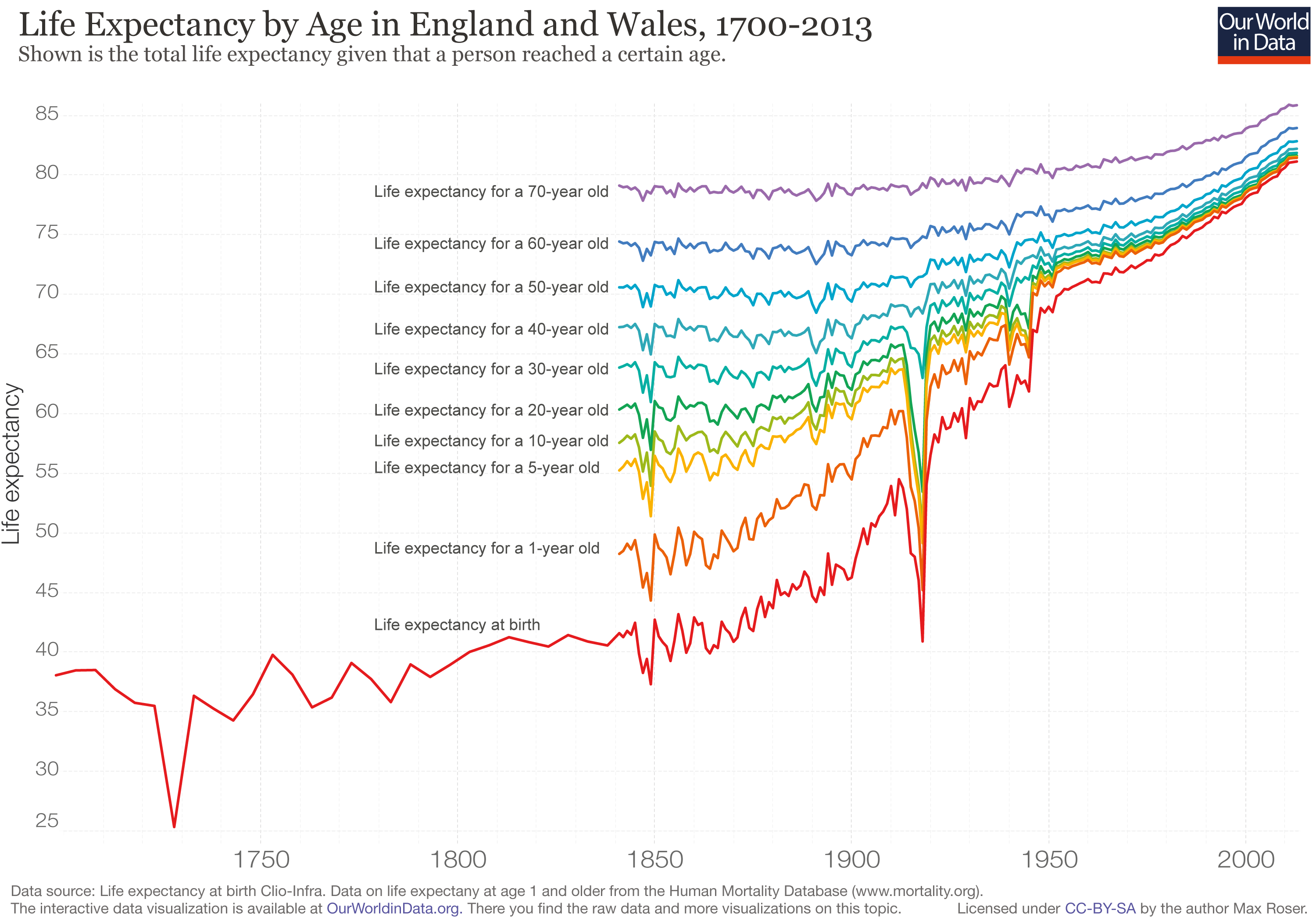
My understanding of historical life expectancy is that, adjusting for infant mortality and wars, we aren't significantly longer-lived now than in the 19th century.
Specifically, once you've made it to 40, you're nearly as likely to make 76 then as now. I will try to dig up a source and edit as soon as I find time.
edit: Found a very useful source, though it only weakly corroborates my initial comment. The vast majority of gains in life expectancy have indeed been for infant mortality and early-life infections, but there is still roughly a seven year differential in the life expectancy of of a forty year old:
But more people are making it to 40 and thus surviving longer, making the average age of the population higher. The two prominent changes in age come at the end of the 19th century when sanitary practice was introduced into medicine, and the middle of the 20th century when antibiotics began to be used.
This indirectly increases the age of members of congress. I agree with what Alex3917 says above, that it has to do with needing to win votes from more and older voters. The graphs in the second half of the article also show that incumbency has increased, because longer living voters will support the familiar name. Then there was a dip in the '70s I assume from a combined factors of many of the older members retiring at the same time there was significant cultural change happening.
Also on the graph of members of the House, there's a sudden rise in age at the start of the 21st century. The Senate graph has no corresponding change. I can only make a wild guess but that would be the amount of money that can be made in the private sector is so much more now that younger people are staying away from public service.
> It’s unfortunate to not see life expectancy explicitly mentioned.
I think it has more to do with the number of constituents per district. You need to be a lot further in your career to win an election with 500,000 voters than one with 20,000 voters.
We made structural changes to our government in the 1920s-1930s and this is one of the long term effects.
1. Congress on its own decided that 435 representatives was "enough" and ceased apportionment. Since then representation has diluted from approximately 100000:1 to 1000000:1.
2. We changed the way the Senate was elected, from a majority of each state's legislature, to a popular vote.
The result is that we have effectively created 2 Senates. Winning a majority vote of so many people requires massive funding. Hence, the profound corruption we live in today.
If winning a majority vote from the public requires massive funding and corruption, what, pray tell, does winning a majority vote from a ruling class require?
The founders also very explicitly intended for the aristocracy to control the government, because the proles (even land-owning ones!) can't be entrusted to make good decisions.
A lot of what they intended was incredibly self-serving, at the expense of their subjects.
This is all I can think about these days watching the news. My generation (millenials) are forced to just sit by and watch as these senile dinosaurs rip our country to shreds and destroy our standing in the world for their own blind greed. And the pieces that we will be left to pick up after these cretins die out may not be enough to put back together.
At what point though must we consider that we, the American people, elected these people into office? They are there because we put them there.
To play my own devil's advocate, my perception is that the barrier to entry into politics, i.e. money, has risen substantially which prevents younger candidates from even running for office.
Taking this idea to its most extreme expression, we would end up saying that a minority persecuted by a democraticrally-elected government is to blame for its own persecution, as it failed to convince others to vote against ethnic cleansing.
The social unrest of the late 60s made the country far worse off. All sorts of social progress was happening at a moderate and steady pace over the 1950s and 1960s. Then the late 1960s came along and the backlash basically halted or severely stunted all progress on basically every domestic social issue.
Basically the hippies got us out of 'Vietnam slightly quicker but they carelessly threw the poor and the non-white under the bus to do it.
The hippies were not the only thing that happened in the 60s. Think of the civil rights movement for example. That certainly had a big impact but required people to go marching in the streets and protest in other ways.
Run for local government, or state government. Some millennials are old enough to run for a seat in the House. Depending on when you define the first birth year for millennials, some might be old enough to run for the Senate.
Work for a lobbying group. Work for a non-profit. Volunteer for an organization that encourages people to vote. Protest. Donate.
There are plenty of things that people can do regardless of their age.
Voters have low opinions of other voters' politicians. They like their own. Hence we seem to have quite a hard time getting things done which benefit the nation as a whole.
I'd say that's true for the vocal minority of cheerleaders, but I would wager that most people are just voting against other candidates at this point. I.e., the lesser of two evils.
That's true, I guess there is usually some significant block of voters that politicians are appeasing to which can't be overcome by the general voting public on that one issue (such as government employees voting themselves defined benefit pensions, or a concentrated group of religious people pushing a religious agenda, or employees of a large employer(s), etc).
I think there are two important pieces of data that might lend insight into this. What is the average age of the population as a whole and the average age of the voting population? It makes sense as the population gets older with the baby boomers aging that the government also gets older with them. That might not be "fair" but it is the way representative democracy works. Also no one currently votes with the frequency and consistency of senior citizens and they therefore have a disproportional impact on the government. That has been true as long as I can remember, but has that always been the case?
Why is this a priori bad? Take a look at how the short tenures of California congress has turned California way more populist than most people are comfortable with.
There are many things wrong with short tenures (not that there aren't things wrong with long ones). The main ones include turnover of associated staff who actually know what wheels to grease to get things done. Meanwhile the "figurehead" actual politician has no time to build up political capital with his colleagues.
I completely agree. I find it a little strange that with politicians, unique among all occupations, we consider experience with the job to be a bad thing. I think the discontent many feel with Congress can be better fixed via other means than direct term limits.
I believe that part of the explanation for the increase is that politics is more and more a high-stakes business. The parties are reluctant to swap out a known winner and risk losing a seat. I admit that this does not account for cases such as Strom Thurmond or Orrin Hatch on the one side or Dianne Feinstein on the other.
Based on the age and tenure graphs, it seems a lot of representatives in their 50s were voted in during the 90s, and relatively few of those have been replaced. This would be the Baby Boomers coming in to their full political strength.
However, there seems to be a similar wave of fresh-faced, long-sitting senators coming in the early 80s, and I'm not sure what generation that would map to. The "Greatest Generation", perhaps?
At a guess, 1980 marked the rise of the "Christian right" / "religious right" as organized forces in conservative politics. Jerry Falwell's Moral Majority was founded in 1979, for instance.
The authors mention "having built a database of the over 13,000 members of Congress since 1789" but I didn't see a link to their dataset. FWIW, the folks who contribute to the Github unitedstates repo has historical data in CSV/JSON form:
Isn't this (the trend toward longer terms) due to the rewards for seniority that Congress gives itself, specifically to make it harder to be voted out?
I mean, every time, voters basically face the dilemma: "Oh, he voted for stupid policies? Cool. He's also the third most senior member. You can replace him, if you want to start with a new congressman with the least seniority."
I'd like to see approval rating (when we have them) mapped over this data, and also some metric for how much they actually got done (bills passed vs brought to vote?)
I can't help but feel (and I wish I had more data for this) that Congress is doing less and less over time.
It would be better to see the difference between average age of members of Congress and average age at which people died in the year considered.
What I suspect this would show is that seniority in Congress, at least on a relative comparison basis, has actually not increased. Length of tenure obviously has, but the numbers must be put in the context of their age to be properly interpreted.
It would be interesting to see other measures of tenure served over a similar scale. I suspect that a lot of our political problems are multiplied because the current body of politicians in the US got to step into power earlier, then due to increasing life expectancy, keep that power longer than any before them.
It would also be interesting to distinguish the seats that are "inherited" within political dynasties, as well as the seats that have been buttressed by gerrymandering.
I was just about to mention this, the relationship between life expectancy and age of politician would really help to interpret this data.
My hypothesis is that late stage capitalism has moved the ability to have the resources and freedom to run for office into later years since 1995 as inflation adjusted income stagnates.
Edit: anyone care to explain the downvoting? I clearly marked this as a hypothesis as signficant economic changes have occured during this time frame. I have asserted nothing as fact.
Fair enough, even as an employee for a large for-profit corp I’ve never thought of that term as a slur. Regardless It’s a catchall term that should probably be overwritten with more specificity.