Comparing it with Anthropic, ANY model is cheaper and more effective. Don't get me wrong, Anthropic models are good, but they're always more expensive for the same task, even compared to other closed source models. At this point, I honestly think Anthropic has played the nasty trick to fine tune the models to be too verbose and charge us for more tokens.
I'm on the same boat, negatively affected by AI. I'm the CEO and founder of an EdTech company and our B2C revenue has greatly decreased as a result of Gen AI.
But unlike the author of this post (or cited authors) I'm not sore. AI is providing a much better education model for students. So it's us that we have to adapt, not complain that the world is changing.
For example, in Machine Learning our projects are sometimes extremely long and repetitive. Because before AI, it was a valuable skill to be able to recall APIs quickly (what is the method to drop duplicates in a dataframe again?).
But today that's no longer the truth, and for the better. I am happy students don't have to go over the same repetitive low-value processes that I had to go to.
Students can now focus on more high level valuable tasks: understand the domain, compare evaluation methods, compare models, balance tradeoffs, present solutions/reports, etc.
It's like in the 50s when students had to memorize tables of logarithms. Nobody misses that.
We are in the process of recreating all our projects to adapt to the new world. We'll see how it goes.
> But today that's no longer the truth, and for the better. I am happy students don't have to go over the same repetitive low-value processes that I had to go to. Students can now focus on more high level valuable tasks: understand the domain, compare evaluation methods, compare models, balance tradeoffs, present solutions/reports, etc. It's like in the 50s when students had to memorize tables of logarithms. Nobody misses that.
Maybe when it comes to any coding-related learning, I can agree with that point.
However I think the future of education in general is very bleak. When we have plummeting scores for the PISA exam across the world [1], I fear people will get dumber and dumber.
There will always be those who thrive, but the easier it is to obtain information/knowledge, the less I think people have an incentive to do it. And I don't buy that AI will solve all intellectual jobs anyway.
> However I think the future of education in general is very bleak. When we have plummeting scores for the PISA exam across the world [1], I fear people will get dumber and dumber.
This is exactly what AI companies need, so that's development should be celebrated. There are two paths to capture the value that's currently wasted on paying people:
1. Build a system that's superior to nearly all people.
2. Make people worse, so even an inferior system is superior to them.
Getting AI into the classrooms and degrading the educational system are important for path #2.
It's good not to put all your eggs in one basket, so I'm glad the AI industry is pursuing a multi-pronged strategy against their competitors. Who cares about the waste and destruction for humanity, as long the investors get good returns?
PISA exam scores are a lagging indicator with many years of lag. I doubt the reason of that is AI. Mobile phones? Social media? Any other multi causal reason (poor eating, anxiety, low testosterone, whatever), most likely, but not AI.
If you think that’s a lagging indicator, the many reports from teachers and from self reports from students and even adults trying to learn also point in the same direction. See what’s happening with exams and homework exercises.
Education itself has lost access to the tools that were making it cheaper and easier to teach.
Learning something is a side effect of overcoming friction. AI removes friction.
There is a massive difference between a person learning a topic they have an actual interest in, and someone who is forced into a learning system alongside their peers. Especially since we're talking about kids.
ChatGPT might work for you learning German because you have a reason to care about learning it, but for most kids the goal of school is getting good grades, not learning.
Education is not for helping a motivated person to learn a language, it's for teaching an entire population on many different subjects.
The people who wanted and could learn by themselves always had the possibility to do it with books, audio and videos, and AI just add a layer of interactivity on top. Self-learning never replaced standard education, even in the high bourgeois class because they answer to different problematics.
Here’s a counter analysis - would you see the difference between your individual, motivated efforts to learn vs the experience of learning at scale, for all other students ?
There’s a lot of individual anecdotal responses that people come up with in these threads, and I’m happy for the positive examples.
I do think people are capable of extrapolating, especially since all of us have the experience of seeing students wanting to escape studies as kids.
It’s identical to the gym problem, everyone wants to be healthy and fit, but the effort sucks and we avoid it.
Education at scale is the same issue. We basically nurture/force crops of students over a 20 year time span.
What happens when the big AI labs go public and must start earning a profit for investors. The price increases 10x¹ and it suddenly becomes excessively expensive for ~80 of society to access.
If education is all dependent on the use of AI, then we're cutting off everyone but the most wealthy from access to education. Seems very regressive to me.
1. This is an assumption but I think it's fairly well established that current LLM prices are far below operating costs of inference, so prices will go up, maybe not 10x but some multiple > 1
Sorry for the tangent, but if you don't mind can you explain more how you're using it effectively? Are you speaking using "Live" mode or typing? Is it remembering and planning lessons for you or is that on you to do?
I had already studied German as a teenager(I’m 40 now) and I speak Swedish which is a bit similar.
The first thing I did was ask it to continuously adjust its difficulty level based on my replies(A1-C1), it told me I’m in the A2-B1 span. Then I formalised my training on Akkusativ and Dativ, which is basically A2 level.
I have structured the lessons like this:
Every day I wake up with a new lesson. It starts with the nominativ/dativ/akkusativ table. Now I’ve also added wechselpräpositionen including translation to Swedish. It then gives me 5 sentences for me to fill out. If I have time and energy, I continue the exercises throughout the day.
This allows me to continue the practice at my own pace and at my own time.
I only type and read. I can already pronounce quite well but this may be the next step.
Says who? Children/students effectively lost months of education and socialization in their formative years. They've been warning about this before AI even entered the picture.
I'm sure AI is going to do even more damage but COVID was an important factor here as well.
The pitch is learning useful things (if not skills) but we end up using schools as storage for kids, for indoctrination and as a business model. The ratio gradually changes.
We end up with shit results and where they arent shit students are rushed though as if to prevent them from thinking about the materials.
We have libraries full of unused education formulas. Some 2000 years old. Then there is nutrition, sleep and other work/rest ratios, physical health.
How expect results without learning to teach and learning to learn?
Onto what should one anchor learnings if the suroundings are always the same?
I never hear a word about spaced repetition in school. Its so basic i must conclude they knew nothing about what should have been their area of expertise.
When things get bad enough we will [finally] have reason to improve.
Maybe the great work of Salman Khan is merely a hint?
We know about those things and they don’t work the way you have laid out. For example spaced repetition is ideal for memorizing words, but less useful for working through a math problem or creative writing (relatively speaking.)
MOOCs were something I personally hoped were the solution to scaling education. However it didn’t work out, with courses having single digit completion rates.
This is for free, high quality, immaculate pedigree, learning material available at any time and any place.
Years of additional research had to be done to figure out how to raise completion rates, which creates more complexity on systems and delivery.
Unfortunately, that improvement is now moot, because LLMs obviate the friction and effort.
The point of doing a homework exercise is to provide learning friction for students.
It is possible to learn things. People try all kinds of things without knowing if it is even possible. If you know it is you dont get to pretend it cant be done. You go figure out what has been proposed, what has been tried, you do the research, document the results, you fail and try again.
Not to long ago i wouldnt have believed what LLMs "learned" today, surely we can make a similar effort with humans if we want to.
Im not suggesting we go back to beating kids with a stick but there might be something equally effective. Lots of unskilled labor is practically a life time of torture. If you ask me we shoyld gradually introduce the torture in stead of making it a surprise. There are better people to ask.
I think theres a discovery problem. I've not found very many MOOCs that are good - a lot of platforms are terrible. The intersection of money/status/attention economy with this stuff seems to drive directly against quality.
Im literally at the point that my main discovery method for this sort of thing is word of mouth in real life. Everything on the internet is poisoned
>But today that's no longer the truth, and for the better. I am happy students don't have to go over the same repetitive low-value processes that I had to go to.
It's a real shame a leader of an education company doesn't value the actual learning process. Those "low value" processes are the building blocks to understand and master high level concepts. I'm not spending my day to day thinking about the low level memory allocation in my job, but that knowledge and work helps immensely in how I approach the higher level assignments and wider architecture. And I still kick myself because my assembly knowledge is is only 1.5 semester's worth.
And yes, I still look up how to construct an array in C++. Not really because my memory is bad (okay, kind of), but more for the practice of reviewing API's and parameters and maybe making new revelations. I probably knew internally some 12 years ago I could set an initial capacity in one of the array's constructors. I didn't really "understand" the value in that until one random work day 4 years later as I was working through some in-house container packages.
You can even say that doesn't matter if you know what resize() is, but it's those little bits of learning nuggets that builds you up from a "fine engineer" to a "great engineer". Less the knowledge and more the work ethics built to obtain it.
> before AI, it was a valuable skill to be able to recall APIs quickly
That’a the low value they’re talking about. And all of that stuff is accidental complexity.
To use their example, you need to know that dropping duplicates is a good idea (and why). Knowing what the syntax and api calls to do that is, in my opinion, unnecessary.
We've had encyclopedias, textbooks, and the Internet for decades. Being able to recall things quickly is still very valuable in most white collar jobs because the person with the quick recall is a lot faster than the person who has to look up the information every time.
That's not accidental, anymore than human language itself is accidental. APIs are designed very intentionally, and a good API's parameters have architectural reasons behind what they include (or exclude).
Even your example has unintentional complexity. A 'duplicate'? What's that? Do we compare the memory it points to? Through use of a custom comparator function?by an id or tag? APIs and entire languages are designed around how we define such seemingly simple terms.
Ultimately a language, be it a programming language or human one, is about communication. I find there to be value in knowing how to communicate effectively, even if employers increasingly disregard the value of such knowledge. Without it, we'll quickly find out why it's fundamentall quickly.
“Computer add a filter that removes all duplicate entries from this data structure. Two entries are duplicates if they every value in their rows are identical.”
This is the same thing as pressing the power button on my computer; I want the thing turned on, I don’t want to have to know about memory training.
>I don’t want to have to know about memory training.
And then we wonder why apps are getting so much slower and bloated. That's fine if you don't want to think that low level, but someone needs to worry about performance. And others will need different needs for defining a duplicate in their different use cases.
I don’t think that lack of knowledge about memory training is a hill to die on when it comes to causes of app bloat.
The people who need to most think about performance are those making the frameworks and languages. Why are bloated electron apps so easy to make but building native cross-platform apps with similar ergonomics hard? Why are people choosing electron?
>The people who need to most think about performance are those making the frameworks and languages.
Yes. I am not a web dev, but I tend to fall into that category in my domain.
>Why are bloated electron apps so easy to make but building native cross-platform apps with similar ergonomics hard?
If you want to be blunt, it's political. Each OS wants to ultimately build its own moat, so there's less incentive to come together and make a standardized solution. Then Linux is a less centralized OS that makes theoretical cross platform support even harder. Cross platform applications get made despite that friction to fill the obvious demand.
The why's of which cross platform framework wins is hard to say. It only becomes obvious that whoever breaks out tends to win more, and it gets a massive flood of support, funding, and clients. So it snowballs up. Those who don't simply struggle to stay relevant.
Electron likely wins in the market aspect that bloat isn't enough friction to turn off a modern consumer with a modernish (10 years or younger) desktop. And it especially doesn't matter to phones (which tend to skew newer).
Then based on your own analysis, at least the electron bloat angle (that many people, at least many developers, hate and wish was native) has nothing to do with the low level knowledge of the developer. And I would argue that a good deal of other areas of slow software will have the same conclusion, i.e. the slowness is not due to lack of knowledge.
> For example, in Machine Learning our projects are sometimes extremely long and repetitive. Because before AI, it was a valuable skill to be able to recall APIs quickly (what is the method to drop duplicates in a dataframe again?).
> But today that's no longer the truth, and for the better. I am happy students don't have to go over the same repetitive low-value processes that I had to go to. Students can now focus on more high level valuable tasks: understand the domain, compare evaluation methods, compare models, balance tradeoffs, present solutions/reports, etc.
You honestly believe that students that don't have the tenacity to stick with learning a simple set of verbs and grammar are going to have the tenacity to learn concepts steeped in jargon?
I do mean learn, which AI use has been repeatedly shown to be detrimental to.
What a great perspective to have! Completely agree with you and I want to add on to it by saying mentors will always be valuable because students have always had access to information even before AI, if you think about it. It's organizing and packaging it in the right format that's always been the key issue.
" It's organizing and packaging it in the right format that's always been the key issue."
LLms dont help here either.
Part of learning is about struggle. Seems many here want to disregard that fact and just run to the LLM lmao. Yeah you can do that - the knowledge won't really stick.
But it becomes different knowledge. You learn how to manage an LLM to create the thing you need instead of writing code to do the thing you need. Still a learned skill. In some cases, still a struggle.
The initial creativity is still with us, not the LLM. It's the Art/Craft thing - we have the Art, the machine does more of the Craft (and it always did do a fair amount of the Craft).
I'm seeing folks who couldn't (for whatever reason) work out how to code, starting to produce some amazing stuff with the LLM doing the coding now. It's their creativity, their project, their vision, still. The fact that they didn't write the code is meaningless.
I think the goal of (this type of) education is to enable the student to do something, rather than attain some idealised state of knowledge.
> From what I’ve seen, the ability to prompt quality output with AI is entirely proportional to experience and skill level
In my direct experience, it's not my coding skills that I'm using for this. I don't even look at the code any more. It's my experience of developing stuff and managing projects that is enabling me to run the LLM better than a newbie [0]. Teaching someone to code so that they can run an LLM is probably not the most efficient way of doing this.
[0] though I have friends who can't code and are producing better stuff than I am, by just prompting and making mistakes.
Yup. They just works. So satisfying. Now, Apple, shut up and take my money! Actually that is satisfying part. And please make sure I need to pay that money again in a year or two. Thank you. Happy to be an Apple user. Best company.
Some time ago I had the following shower thought: "the Speed of Light is pretty slow"
How i got there:
The closest major galaxy to the Milky Way is Andromeda, and is 2.5 million! light-years away. And this is the CLOSEST galaxy, the universe is extremely big.
Of course that as you get closer to C, the traveling object will experience time dilation (relative to observer), so the time passed will be less. At 99.999% C, the traveler would take ~11,000 years to arrive to Andromeda.
So again, even at 99.999% C, 11K years seems like a LONG time to reach even the closest galaxy.
My reasoning was: the speed of light is pretty damn slow.
But then I realized: no, it's not the speed of light that is slow, is my frame of reference.
For us humans, 11,000 years seems like A LONG time, but for the universe is not that long.
The universe's age is estimated to be 13.8 billion years. 11,000 years is 0.0000007971 of the age of the universe.
An average human lives 70 years, 0.0000007971 of that lifespan is approximately ~0.4 hours, or 29 minutes, so it's not that bad.
At 1G constant acceleration reaching Andromeda would take ~15 years, or ~29 years if we also need to decelerate at the same 1G rate to not just whoosh by.
The furthest known galaxy is MoM-z14, which would take ~47 years to reach.
But unlike Andromeda, MoM-z14 is accelerating away from us, or more precisely, the space between us and MoM-z14 is expanding. It's "receding" at 726,000 km/s (= 2.4 times the speed of light). And still accelerating. Because of these, even the magical constant 1G accelerating spaceship can never reach it, not even in 1 Billion years.
There's a diagram for how long it takes a 'light-hugger' ship to travel various distances at 1-G acceleration. Shiptime is on the left, earth time is on the right.
https://en.wikipedia.org/wiki/File:Roundtriptimes.png
This is a really interesting video that explores this topic, pointing out that at near light speeds, the entire universe becomes accessible in a single human lifetime.
Yeah, once you reach a certain speed, even colliding with a fleck of dust can obliterate a ship.
Colliding with a single 0.3 mg grain of salt at 20% of the speed of light creates an impact with 560 MJ of energy, equivalent to 130 kg of TNT, over 8 times the nuclear bomb dropped on Hiroshima.
Even a tiny speck of dust, half a microgram, is equivalent to a hand grenade when hit at 20% the speed of light.
You wouldn't be able to even escape the solar system before your shields were devoured. If you accelerated at 1G constantly, you'd be going 3.5% of the speed of light by the time you reached Pluto's orbit. Space dust particles are already hitting you like nuclear bombs at that speed.
Then I guess you will need millions tones of perfect mass to light converter like Astrophage just to get to the neighbor. The universe is simply too big to comprehend.
There was a bit in the series "The Expanse" about a what's called "Epstein Drive" where some guy invents a propulsion tech based on fusion and he losts control of his aircraft under an ever-increasing acceleration. After some minutes, his body gets crushed under its own weight before he could reach the controls and slow the spaceship down.
Yeah, certainly a reason to have failsafe timers and dead-man switches when testing new things.
While I did read The Expanse, when I think of that class of dangers, what pops to my mind is an old short story Neutron Star (1966) [0]. A financially desperate pilot is hired to discover what killed some researchers while leaving the indestructible starship hull intact... and the thrusters off.
Thanks for the Niven reference. Neutron Star was a fun read. I'm currently working through a collection of 80s SF shorts[0]. It's an entertaining lens into the narratives mores of the time, and or own in contrast.
> failsafe timers and dead-man switches when testing new things.
Aircraft and spacecraft are more than anything, mass constrained. Such failsafes are welcome in software, but neither the bleeding-edge engineers not even the test pilots would support adding failsafe mass if it would affect the tests.
there was an interesting retcon of that story in one of niven's later works, where it was pointed out that any spacefaring race would know instantly what killed him. it was just better PR to pretend that it was a huge mystery, and that their hull wasn't vulnerable to some stupidly obvious danger but rather to something no one could have foreseen.
Relativity is weird. If you keep accelerating, at some point the objects stop accelerating toward you faster but the distances get shorter.
To an outside observer, the trip might have taken you millions or billions of years while to you it was only ten or twenty.
It’s helpful to think about the limit. To light, which travels at the speed of light, it arrives at your retina the exact moment it was created in the core of the sun. From our perspective, it took almost a million years (about a million years to make it from the core to the convective region, then another few minutes to travel from there to Earth).
Nope! Far, far longer. I don’t know the specifics that the GP used but Andromeda is about 2,500,000ly away. An observer on Earth must perceive you as taking more than 2,500,000 years to get there, as you would have to have exceeded the speed of light to arrive any sooner.
At 1g of constant acceleration you can reach Andromeda in just under 15 years of experienced time. An observer on Earth will perceive you as having taken a hair over 2,500,000 years to get there. You can get there arbitrarily quickly; at 10g it would take a 1 year 9 months. But an external observer on either planet will see you taking closer and closer to 2,500,000 years to make it the full distance.
> Of course that as you get closer to C, the traveling object will experience time dilation (relative to observer), so the time passed will be less. At 99.999% C, the traveler would take ~11,000 years to arrive to Andromeda.
When you say constant 1g acceleration, do you mean acceleration well past the speed of light? I thought we were talking about all speeds less than the speed of light.
You can accelerate constantly at 1g without ever reaching the speed of light. A constant acceleration takes you from non-relativistic speeds to 0.1c, then to 0.9c, then to 0.999c, then to 0.9999c, , and so on, without ever reaching 1c (impossible if you have mass) -- but it takes increasingly more energy to accelerate.
The Lorentz factor, which governs time dilation and length contraction, is calculated as (1 / sqrt(1 - v^2 / c^2)), where v is the relative velocity of the object and c is the speed of light. You can replace (v^2 / c^2) with the factor beta^2, where beta is the ratio of v to c, e.g. 0.99999 in this case. Since (1 / sqrt (1 - 0.999...)) grows without bound in the limit as beta approaches (but doesn't reach) 1, if you keep accelerating, the time dilation keeps getting larger, without limits. It just takes a LOT of energy to do so.
I was still at a loss for the answer to how it could take 11k vs 28 years or so. I asked AI. lol
The thing I didn’t realize is the massive difference between 99.999% vs 99.9999% of the speed of light. I took 99.999% to mean "effectively the speed of light.” Relativity is weird.
yeah but its statistical luck, a few photons keep winning the roulette wheel and pop out very quickly; and a few unlucky ones are still rattling around in there from year 1! it's more like winning a raffle than waiting in a queue
On YT there is a video of a flight through the solar system at the speed of light starting at the Sun. It's a pretty boring video. You see very little movement and change over time. After 8 minutes Earth slowly passes by. After 44 minutes you reach Jupiter and the video ends.
If The Moon Were Only 1 Pixel (A tediously accurate scale model of the solar system) https://www.joshworth.com/dev/pixelspace/pixelspace_solarsys... has a button at the bottom right for 'C' which scrolls to the right at the speed of light on that scale.
https://thinkzone.wlonk.com/SS/SolarSystemModel.php?scale=10... lets you make scale model calculations (useful if you're building one). The default model scale has the speed of light at 67.06 mi/h (107.9 km/h). This puts Earth out at 14.16 miles and Alpha Centauri at 2,581,000 miles away.
I personally like the "Sun is 5 inches" scale because that puts the speed of light at 323.1 ft/h (10x garden snail speed) which is 1.46 miles/day... because that puts Alpha Centauri at 2,354 miles away... which is a conceivable distance.
If you go to a scale of the sun being 500 inches (about 110000000) and the speed of light is 6 mph, Alpha Centauri is 234,600 miles away - the distance to the moon. It also lists the scale distance to the center of the Milky Way 1,327,000,000 miles) and Andromeda (137,400,000,000 miles) which are in the unconceivable range.
In Australia there is a scale model of the Solar System where the sun is the main dome of Siding Springs observatory and the planets are on billboards at scale size and distance. Pluto is several hundred kilometres away (and the size of a tennis ball on the billboard)
This discussion has made me wonder what it would look like to have a different scale where the distances are based on the “speed limit” (which is mostly 100km/hr)…so that earth, for example, would be 8min from the Sun. Neptune or Pluto would be 4 - 7 hours away.
It would still fit in Australia but be significantly larger.
The 10,000,000,000 (1 : 10B) scale would be kind of neat for Australia. Six soccer fields in Sydney and you've got the Sun to Pluto. One soccer field holds the Sun to Jupiter.... Alpha Centauri is in Perth. The speed of light is 100 meters / hour.
Does this take relativistic effects into account? The video I mentioned doesn't. Near the speed of light your surrounding looks like sped up and the distance to your target is clinched. Your own time runs slower in comparison and the distance is shorter. So theoretically you're able to reach the destination millions of LY away in your lifetime.
Edit: I now watched the animation. It's exactly the same as the YT video. Speed of light is very, very slow.
Roman lowercase c is the metric prefix centi-. Roman uppercase C is the metric unit coulomb.
Italic uppercase C has various uses such as: a variable denoting capacitance in electrical engineering; an undetermined constant of integration in calculus.
The OTHER effect of time dilation that isn't being mentioned: the rest of the universe is not accelerating with you, so it doesn't experience time dilation.
Along your trip you will see stars turn red, sometimes flashing white and blinking out, but sometimes just fading away.
Your civilization will without a doubt go extinct.
If you are exceedingly lucky, you may see other civilizations of other species arise... but you'd need very high energy receivers in front of you, or deep infrared receivers behind, and of course be staring at the right place to see the signs.
You may eventually begin to notice the revolving motion of galaxies. After that, if you continue, you'll see galaxies collide. By then your planet will have been dead for longer than it was a planet when you left it.
> "the Speed of Light is pretty slow"
> How i got there:
> The closest major galaxy to the Milky Way is Andromeda, and is 2.5 million! light-years away.
The speed of light is high. It's just that the universe has expanded into an unimaginably large area by now.
There’s sci fi novels that deal with it in just these terms. Like some folks with head out on a .99c acceleration ship and be like “okay we’ll be there in fifteen thousand years (original reference frame time)” and that’s just the scale at which the story unfolds. You just accept that when you leave on these trips that if you ever come back now it’s tens of thousands of years in the future there. Nbd
Yeah, it is and the math get's really counterintuitive to grasp since humans (at least me) have trouble thinking in exponential terms.
If you accelerate at 1g constantly for 1y you travel 0.5 light years. You do that for 10.5 years and you reach the center of the milky way. You do that for another 4 (~14 total) years and you are in the Andromeda galaxy, and you do that for another 10 years (~24 years total) and you reach what today is considered the edge of the observable universe.
By the time you get there you are basically traveling at a rounding error from C.
We can't do it with any rocket-like propulsive technology. By the time you get anywhere close to c the front of your spacecraft is being abraded into nothing by interstellar gas, larger particles of dust will kill you, and colliding with anything bigger creates an explosion that can be seen for light years. You need to be flying a large asteroid to even think about surviving it - you still won't for long, but you will have time to think about it - and the energy requirements are wildly impractical.
Magic warp bubble tech is the bare minimum, and we're nowhere close to inventing that.
Sadly there is no realistic approach to get there (even assuming fantasy-levels of technology).
Chemical rockets are currently the only thing that allow sustaining such accelerations briefly for human-size payloads, but the low exhaust velocity and exponential reaction mass requirement make sustaining it for days/months/years completely impossible.
You'd have to supply the energy externally (i.e. some sort of beam propulsion), but getting any significant fraction of g out of such a system (with human-sized payloads) seems unlikely within the next centuries, especially as the distance increases.
> You'd have to supply the energy externally (i.e. some sort of beam propulsion), but getting any significant fraction of g out of such a system (with human-sized payloads) seems unlikely within the next centuries, especially as the distance increases.
Or some form of ram scope, plenty of H everywhere, but those also have the issue of you collecting things while going at relativistic speeds.
We can easily accelerate past 1g... 1g is just chosen for human comfort, but running any rocket engine continuously for a year requires an impossible amount of fuel.
Not with current technology. That was kind of the physics “trick” in the book ‘Project Hail Mary’, where the astrophage provided enough energy and propulsion to be able to sustain 1G of acceleration.
We need a massive rocket to escape the earths gravity (1g). That takes us minutes and a crap ton of fuel. The issue is to keep doing that with fuel and oxidiser constantly for 1, 2 or 10 or 25 years is a monumental amount of energy, which is a monumental amount of weight, which is a monumental amount of volume... Also you also need the exact same amount of fuel to stop again.... So yeah ... We don't got it yet
It's hard to accelerate at or beyond 1G for very long with current technology. Roughly speaking, the rocket runs out of fuel soon. Packing more fuel makes the rocket heavier, meaning diminishing returns when using the fuel. The mass required grows exponentially. See "The tyranny of the rocket equation"
People always say that about speed of light stuff, but I don’t get it. Do you have any more examples of counterintuitive math?
Because what you’re describing is basically the equivalent to compound interest in finance. (e.g. investing $100 at 10% interest over 10 years results in $260)
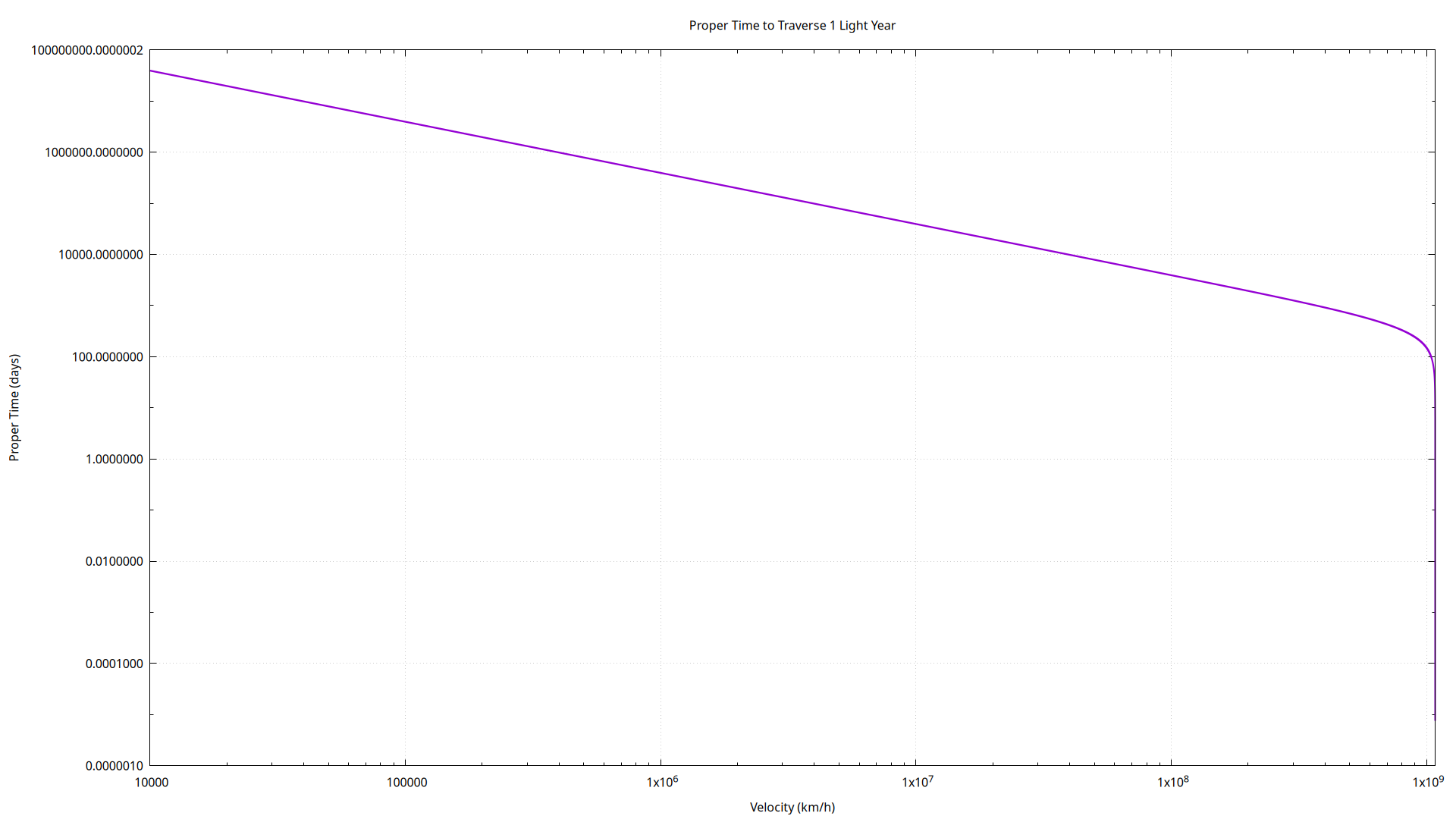
The proper time (that is, the time the traveler measures on a clock) goes to zero very quickly towards the end. Even with both axes plotted logarithmically, it's just a sudden drop at the end towards light speed.
Funnily enough, I use Cloudflare Warp at work, and it breaks my site for what I think are DNS related reasons. Maybe there are some more exotic DNS keys that I need to add.
Or I could go back to IPv4 with dynamic DNS, but that would mean changing domain registrars.
NS record for domains usually can be pointed at someone else than the registrar it's on, just fine(unless DNS infra of either one or both goes down). That's entirely separate to registrar transfer.
It’s the units that make it seem unintuitive. 12 days is roughly 0.032 years, and 17 minutes is likewise 0.000032 years. It’s relative to how we were taught to view smaller lengths of time. Of course you could argue measuring time by the rotation of heavenly bodies is more intuitive than counting on your fingers for the hours in a day and days in a lunar cycle.
Going from a million to a billion isn't some special relationship. It's just * 1000. It's the same as going 11000 or 101000.
I find it frustrating that people seem to think that someone going from 1M to 1B is somehow different to other numerical operations. It's not. It's 1000 times bigger, it's not a huge deal.
> if we add more 9s, is it possible to reduce that number to within a human lifespan?
Yes. At 99.99999999% of c it would take 35 years from the perspective of the traveler. However, an observer on earth will still see it taking 2.5m years.
of course I meant that a human made object traveling at those speeds was theoretical, not time dilation itself. Never thought I'd have to clarify that :)
Relativity fixes that a little, you don't need to go light speed to make it all over the place within your lifetime, it's the observers who sent you off that will never reap the fruits of their effort.
So when we think we're looking at Andromeda today, we're actually seeing Andromeda as it happened 2.5 million years ago. That means someone/something? in Andromeda today, with the ability to see Earth clearly, would see some of our ancestors, like Homo habilis.
I've always wondered, if we end up being able to travel faster than light, we'd technically be able to look into the past depending on how far we go. 1000 light years away and you can see your ancestors on earth.
In some sense yes, but I'm not sure there's enough photons coming from Earth 1000 light years away to see anything, even with a fantastically sensitive telescope. It would be very cool, though.
It doesn't really make a lot of sense to contextualize a velocity with a distance or a time period.
You think those time periods are large because you see a lot of numbers in the units you chose, or because it is much larger than your lifespan. But in the grand scheme a galaxy is nothing but a spec of dust, 10k years a blink of an eye.
There is no other natural velocity that I'm aware of that we could compare it to, but we can say that the speed of light is the fastest there is, so how can it be slow?
I was going to reply with "shit americans say" until I realize you're based in Paris.
Isn't 90k a very good salary even for an expensive city like Paris? If it's not, MAN i'm out of touch with reality. In Italy 90K is great even in Milan.
When python started incorporating asyncio my initial reaction was fairly negative. I was behaving like a grumpy graybeard programmer ("kids these days should learn how to use concurrency instead of working on a new runtime altogether!" [0]).
But after using it for a production project I have to say I'm deeply satisfied and surprised by the maturity, quality of APIs and performance in general.
asyncio has always looked interesting, but whenever I have run into a problem which could use asyncio I have always gone with multiprocesses instead. I am not sure if async would makes my code easier for others to read and debug, and none of my problems seems to be of the kind where process overhead would make a noticeable difference in performance.
Did you find readability to be improved by going async?
Lets make a specific example. You have an APIs to services with data that you want to synchronize to a cache in a local database. The providers allows a maximum of 1-3 connections for each api.
You can write this in async with a pool of connections to each provider, or you can have a pool of worker processes that each have one connection to each provider.
Which will be easier to debug, and which design is easier for the next developer to read, understand and modify? Performance wise the wast majority for both designs will be on waiting at the initial connections to the apis and time spent fetching objects.
And if the there were 3000, 30000 or 300000 providers the problem would be different. The example I gave was one where I have considered async but went with multiprocessing, which is also why I asked the parent commenter above if they found any direct benefit to readability or debugging when going async.
It would be interesting to hear what kind of domain are you working in where you have 3000 simulations connections to different service providers.
Yeah I dunno, the first time I tried to use asyncio I ran into a bug that nobody knew how to solve. Can't remember what it was but generally if I use something for the first time and immediately hit a bug... Yeah I'm not using that thing if I can help it.
I mean that's true for Python in general, but sadly these days you can't really avoid it.
For me it is quite bad, but just we are now used to it.
In the same way that when you ask Windows users about all the bugs and problems they have with their system, they often say that they don't have any.
And ten seconds later, will click "ok" on a random crash popup they didn't even read the content of.
Not the OP but my impression with asyncio was that it's great for the uses case it was built for (hence the "no problems") but if you need to do something a bit different it can become an annoyance (hence the "unexpected bugs").
I see it for a specialized solution for a specific class of problems, which can lead to surprises if your problem evolves. There are always trade-offs to be made (performance, flexibility, hardware cost, etc.), asyncio just has different characteristics than the alternatives. Maybe since a upper bound of concurrent users it is always a great (the best?) solution, someone with more experience along all the design and requirements space could comment.
There are things that are quite good for other than what they were designed for.
I find it interesting when someone mentions that X is bad for something it was not designed for, as much as I am interested when someone mentions that X is good even if it was not designed for something.
There is a huge difference between "X is good/bad at something it was not designed for" and "X is bad because it's bad at something it was not designed for".
First for the syntax it is quite not good, you have to use await and async keywords plus async everything version of all that you are using.
You can't mix non async code with async. And you can easily do in some way and block your application without you noticing.
And in the end, async is not even really async, just cooperative execution.
I'm a big fan of Python since very low version. And I don't have too much difficulty using async/asyncio now I'm used to it, but in all honesty I don't think that it is really great in the grand scheme of things.


reply