I'm reading the comments here and confused by one thing... Do people here not purchase fresh fruit and vegetables on a regular basis (i.e. multiple times a week)? I am not an expert on Costco but it seems insane to visit a store the size of Costco every couple of days just to buy some tomatoes and parsley.
I usually buy ephemeral fruits and vegetables frequently, and in small quantities. So, no: I don't go to Costco for those things. That's in-and-out local grocery store stuff, not Costco trip stuff.
When I'm at Costco for other stuff I might buy some produce, though. It depends on what they've got today, the status of what they have (produce quality can vary quite a lot from day-to-day in any given store), and whether I expect to be able to use all of it before it becomes gross.
Mostly what I come home from Costco with is multipacks of [household-sized] canned goods, cheese (which keeps fine in the fridge), meat (to be frozen), and onions (big bag == big onions). Oh, and cat food and kitty litter. Canned V8 juice also comes from Costco at a fraction of grocery store prices. Their OTC medicine is cheap, which is important for stuff I take every day (yay pollen!). These are all things that I will use, and which I save a good deal of money on.
They don't have everything. Often, they very distinctly do not have what I want. If I go there expecting to find a particular flavor of dish detergent or canned salsa, I will probably be disappointed.
What they do have tends to be a very attractive combination of quality and price. Those purchases are successes.
These little successes feel better than getting shafted over and over again by Kroger.
I'm surprised how few comments there are on this thread. This is probably affecting millions of students at the most stressful time of the year.
Incidentally I've always hated Canvas and probably every other LMS provider, but what is particularly amusing about this current outage is that it is occurring at exactly the time when universities are demanding that all professors put all of their materials on Canvas, without exception, due to ADA compliance regulations. It is explicitly forbidden for professors to, e.g., refer to pdfs posted on a personal website.
Other commentators here seem not to understand that many faculty also do not enjoy being forced to use Canvas.
They have not succeeded in forcing me, yet. But it's sad how many computing faculty apparently can't operate the basic online infrastructure needed to support their courses. Not that universities make it easy for us.
And of course the other serious concern I have with Canvas is that they are likely using all the materials faculty upload to train their AI replacements. Many of my colleagues engage in dark humor about this but I haven't noticed much action.
I would guess these plugins are chosen so a majority of user won't want to live without them.
It also seems these plugins "link" to canvas-lms, so keeping the proprietary would be a GPL violation if anyone except Instructure holds part of the copyright to Canvas.
Former Instructure engineer here. Ive been gone almost 10 years at this point, but some of the best engineers I've ever worked with were at INST.
I'm not sure where your stereotype even comes from, because Canvas is not trivial software. You can see for yourself as it's AGPL and I assume you looked at the code before criticizing it because any good engineer would do that.
I don't care how good you think it is, the fact that it (back when I used to be a TA) would break if two TAs tried concurrently grading different parts of an assignment of a student is bonkers. The workaround for that was to use a Google Sheet document so TAs just looked at the submission in Canvas, then filed in their grades and feedback on the sheet. The issue is that Canvas, as far as I could tell, did not support mass uploads from a csv, so we had a script which would read every entry on the csv, map that to the student's ID and grade them, which made it look like the TA which had generated the API key graded all of the students (and would get all the backlash from poor grades).
I completely agree that it is not trivial software in the worst sense, it tries to do too much, while not being particularly good at any one of those things, and is way too rigid for how diverse the needs of different courses might be even inside a single faculty. And saying "It's AGPL, just self host and add your requirements to it" is not really useful, that would mean way more money and effort than what a university's overworked IT dept. is capable of.
This particular section of your comment sounds a helluvalot like some of the SAP implementations I've seen:
> it is not trivial software in the worst sense, it tries to do too much, while not being particularly good at any one of those things, and is way too rigid
What I meant is they aren't capable of building AI capable of replacing professors. I still consider it a reasonable assumption, as it has nothing to do with how well engineered canvas is. It's a different competency than instructure would have, and I've heard from insiders instructure has been spinning their wheels on way more trivial AI challenges. I also understand well how hard it would be to create AI that replaces professors and how the current best AI from Google, Anthropic, OpenAI is orders of magnitude away from being able to do that.
An engineering culture can change a lot in 10 years, and a company's engineers' ability to do stuff depends both on the individual engineers abilities as well as the company systems and culture.
I've been using Canvas for years and it's some of the worst written software I've ever used. It's slow, buggy, with an atrocious 2001-era UI. It's a CRUD app that has no excuse for being so cumbersome. I'm not surprised at all that their security is just as bad as the rest of the product.
A bright undergrad could build a superior replacement in a few months, even without AI.
It is a very common error to look at a specialist piece of software, superficially consider the basic data structure it appears to have and think ‘seems simple enough. Basic CRUD app.’
But it’s rarely the case in practice.
In a sibling comment right here for example someone bemoaned the difficulty in Canvas of having two TAs simultaneously grade separate parts of the same assignment. That sounds like something that goes beyond CRUD.
But more importantly any workflow system, which an LMS will be full of, has to handle the always tricky problem of how changes to workflows affect the things that are currently in the workflow. Assignments posted in course X need to be approved by person Y; some assignments are submitted for approval; person Y goes on leave and now the approval needs to be person Z. Not a simple CRUD problem.
These are things that occur to me with only a moment’s consideration of what an LMS system might need to deal with. The actual domain probably has considerable more complexity that I can’t even imagine.
LMSes have to balance a lot of directly competing needs.
It has to be simple enough for the average person to use (both on the learner side and the instruction side) and have enough complexity to allow for a lot of flexibility in setup because every organization is slightly different. They have to support 50 million file formats and everything has to be backwards compatible until the end of time and everything has to load properly and quickly on 50 million different device/OS/browser combinations. Yes, there's SCORM as a standard, but even that is rickety, and an LMS that doesn't support non SCORM files is dead in the water anyway.
They're simple(ish) in code, and a nightmare in requirements.
Everything you say is true, and yet it's clear you've never used Canvas.
Canvas is decidedly, not fast, fails to display even trivial files (such as source code) as well as more complex files that should just be handled by the browser (such as video), and it has a non-intuitive, verbose, and tiresome interface that would have felt old-fashioned 20 years ago.
Yes, I should have said 'in theory', because there always ends up being compromise and usually that's the thing that's chucked out first.
LMSes frankly run like shit. I don't work with Canvas right now, but every one I've used has run like shit.
However, there are reasons that the complex files aren't handled by the browser: tracking and persistence. It isn't enough to make a video file watchable, it then needs to be tracked in the same system as every other training/educational material and in the same way. If you don't care whether the students actually watch the video, then yeah, throw them a YouTube link or embed a video on a personal site or just have the LMS serve a basic embed. But being able to track video, make it mandatory, make it so that it can't be fast forwarded/people can't skip to the end etc. all matter when LMSes are used for topics that are required for compliance and regulatory purposes.
I don't disagree on the interface(s). Ours is a farce and I hate it.
It's likely that they're so bad precisely because of the simple tech and complex requirements. Simple tech doesn't mean 'easy' or 'not time consuming'. But it means you're looking for developers who have a decent level of technical proficiency (to handle the numerous edge cases and flexibility the systems demand: it's not hard but things like the data structures need to be well thought out and every single piece of the system is integrated with one another in most LMSes so you can't silo work as easily) and who want to work on problems that aren't hard and require dealing with a lot of unreasonable people (in the form of their requirements). You have to allow/design for a lot of stupid things because otherwise people will throw tantrums about it.
Then on top of that, you're developing something that doesn't directly generate profit, so nobody is going to pay for it or appreciate the work you put in.
Then on top of THAT, they're fairly insulated from the actual end users.
I think you are confusing the reality of Canvas with a different, theoretical learning management system.
In reality, Canvas does not have workflow and does not prevent race conditions in grading. I can certainly imagine an LMS that does these things, but Canvas does not.
It would probably help if you had actually used Canvas before trying to convince us that it is non-CRUD.
Sorry, I wasn’t trying to defend Canvas, so much as give general advice that ‘I could build this in a weekend’ is rarely a wise claim. The specific ways in which Canvas could not be built in a weekend do not need to be the ones I identified.
"Look at the code" is not a reasonable response to "Is this app CRUD or not?" You've already been asked to provide specifics about which componenent(s) of Canvas are allegedly non-CRUD, and simply repeating your claim without answering the question does nothing to advance your case.
It's a simple question. Since you claim to be an expert on Canvas, I'm sure that you can point me to the relevant features much faster than I can sort through thousands of lines of code, looking for the one line that says "def not_crud_function()". CRUD or not-CRUD is a judgement about the purpose of a program, not its implementation.
"I don't want to glance through the code, I'd rather you write me a detailed report on all the thousands of places where it deviates from crud" (not a direct quote) is not at all a reasonable ask.
And If you can't be bothered to take 2 minutes to click through some pages on GitHub, I don't believe you'd take the time to even read that report. So no, I'm not doing your research for you.
Edit: I will do this for you though. Here's Gemini's opinion[1]. It's quite accurate as well, and goes into reasonable high-level detail (though doesn't get into specific modules). I especially loved this quote:
> At its absolute lowest level, almost all web software boils down to pushing state to and from a database. But calling Canvas LMS "just a CRUD app" is a bit like calling a commercial airliner "just a metal tube with wings."
How reductionist and a straw man as well. No one here asked for a "detailed report." They asked you to name one (1) feature of an application that you claim to have intimate knowledge of; the original question was "What component in particular goes substantially beyond CRUD." It could take you one sentence. After multiple failures to pass that low bar, compounded by your total mischaracterization of the question and your citation of an obsequious LLM that also failed to provide any specifics, it's abundantly clear that you are unable to support your claim with facts and are not arguing in good faith. I won't waste my time further with your childish behavior.
If they're at the level you say, they just might install some AI gizmo like the Vercel employee was accused of, but really let it run amok with write permissions.
I'm in Europe, and we don't use Canvas (at least, I've never heard of it). However, we have similar diseases. In my particular school, it's a massive SharePoint site plus ever more stuff in Teams. Plus Moodle, plus other services.
The MS services have not improved teaching at all. What they do, is fragment communications, and add ever more places people have to look, in hopes of finding things.
But the administration loves them. "The bureaucracy is expanding, to meet the expanding needs of the bureaucracy."
Spain here. Most of our public Universities have their IT stack on MS... I cannot fathom how much of our national budget goes to their pockets.
Thankfully, I store my teaching materials on my personal non-uni webpage, and the student's marks in my office's computer (apart from the MS-based Uni system).
Whenever something happens with MS, chaos ensues throughout the whose Uni and the students end up paying the consequences.
Live streaming of class through Canvas is very popular. Quite a few people just watch from their dorms. So maybe people will have to come back to class, that will be entertaining. The class rooms are almost standing room only (sometimes they are) on the first day of class and then gradually thin out. Sometimes 10 or so people show up out of a class of 100. If Canvas is not back up soon I think it could actually be disruptive for that reason also.
This is awful to hear. The idea that students are just half assedly streaming the lectures is really just ruining things in the long run. This is a bit old manny, but showing up to lectures is good. You go to class, you get face time with professors, you can ask impromptu questions, you rub elbows with classmates, you talk on the walk between classes, you maybe run into a cute girl. Friction like walking to class and finding a nook in that annoying hour gap you have, are the things that make life enjoyable.
When I was in school, professors attitudes around attendance was usually "you're only hurting yourself, I don't care if you show up or not".
It's been long enough that I can't claim to be in touch with the current generation of teaching faculty. But it might be an element of that, combined with the desire to provide accessibility for the handful of students who do in fact need the accommodation.
Showing up to lectures is vastly overrated. Like note taking it's cargo cult behavior for middling students that care more about going through the acts of studying, than actual learning.
You'll note I didn't mention quality of education in my arguments. I am talking about the human experience. Though the studies typically show a correlation with grades and attendance.
Not much overlap between students and HN these days, though? I’m an extremely rare outlier afaik :)
The administration has so far opened with one “Canvas said” and then an hour later one “Canvas is down indefinitely” email noting that they’re aware it’s serious.
(Canvas is a glorified wiki for teaching students, with quizzes and such, for those unaware.)
I'm an undergrad student in computer science and I come here regularly. Many of my friends do the same. Of course, that can't be extrapolated to students globally, but students who love what they do are not extinct!
HN is kind of the go-to platform. We also have a Discord server where we hang out and talk about stuff that may or may not be software-related. I know some of us are interested in getting accounts on lobste.rs, but we need to find someone to refer us. I keep forgetting to ask one of my professors.
FWIW, I'm a student, so there are at least a few still here. Feel free to ask me any questions (either via email or via replies to this post) and I'll try to answer them.
I don't think that any of them do, but I'm a Canadian math/physics major, which is slightly outside the target audience for HN.
> of the ones who don't, what do they read instead?
For the social aspect: mostly medium-sized Discord servers. For the news aspect: nothing at all. Both of these do have some advantages, but it's still a bit of a shame, because the Discord servers aren't indexed by Google, so they're hard for outsiders to find, and not reading the news means that they're missing out on some of the cool new tech advances.
Many of my sisters friends do everything entirely via tiktok. They look at what trends are popular and they target that fully on platform. This is for stuff like building niche targeted apps, selling beauty products/clothing brands, restaurants.
If my peers are any indication, a whole lot of TikTok, Reels, Twitter, Discord, and other such mind-numbing platforms.
The types of platforms I would consider 'substantive' (or, at least, more substantive than those platforms) are definitely on the way out.
The few times friends have seen me browsing Hacker News or a certain Mongolian basket weaving form, the first thing they comment on is how confusing the interface is, and how old the site looks.
I truly don't understand the mentality, but if your site doesn't take three seconds to buffer a simple text drop down menu, and have JavaScript elements load in mid-scroll that bump elements around the page making you just barely miss that button you were trying to click, then your site is seen as 'inferior' or 'sketchy'.
Perhaps I've just had a bad sample, but I've experienced a variety of different environments by this point, and by and large, I've seen more people in my generation act in that manner than not.
This is actually reassuring. We don't need all your peers! We just need you and whatever smart cohort you're bonded with.
It's true that HN looks old - it looked old before you were born, probably - but (a) I have no idea how to change it, and (b) HN is a long bet on plain text. If the smartest young people lose interest in reading, I'm ok with HN dying for that reason. I just don't want it to die for any cheaper reason.
I would like to offer some additional reassurance: I send my friends articles I see on HN that might interest them. A (in my view) very good litmus test is when someone asks where I saw it, because this demonstrates some desire for continual learning. I find that anyone that asks that question seemingly trusts an interface like HN more because of it. My suspicion is that this is probably because at a certain point you see stuff like Agner Fog's work, LWN, or a number of other minimalist websites and realize that a website that is popular despite the lack of overindulgence in UI must be popular because of the content. It doesn't hurt that the best courses in my university experience have had websites that have not changed much since the late 1990s (one did change the lime green text on turquoise background on their page after the recession to a color scheme that didn't cause headaches in students).
I do find that my peers that now read HN used to be judicial about curating a Reddit feed and mostly otherwise limited on other sources. Short-form content is addictive and as nearly as unavoidable as sugar, but many of my brighter peers work on reducing that intake. Long-form YouTube is also something I find to be a marker of someone who is seeking knowledge. Many of my peers do scroll Twitter and TikTok all day, but I find that those who are easiest to chat with are those who have already scrolled HN today and want to discuss a particular article they know I would have seen. I've had conversations that start with "Did you see that TikTok?" and conversations that start with "Did you see that article on HN?" and the latter is always more engaging.
You succeeded in reassuring me further—thanks! This little subthread turned interesting, though it's teeming with sample bias of course.
> Long-form YouTube is also something
Yes, we hear that often too. I didn't mention it above because it's not text, but in terms of how people spend time and where they go to learn things, it's a huge alternative.
I wonder sometimes how HN might interface with the videoverse. I can't imagine having video on the site but I can imagine making videos based on HN threads or articles that have appeared here. I just can't imagine me making them!
Long-form YouTube is much more text than may be apparent on the surface. Discussions with hundreds or thousands of comments and with the same wide-ranging falloff curve of HN in how interesting those comments are (and, too, HN’s tendency to bubble up trite one-liners and me-toos due to sharing the integers-only voting system weaknesses).
I think its a good fear to have, I feel like many sites dies when the main path of discovering them broke for one reason or another, who knows what the path to discovery of this site is would be for a student today.
Can you explain for the billions of the rest of us why this is the "most stressful time of the year" for the group you're referencing? I assume that's American students and/or teachers?
What? What makes Canvas accessible in a way that HTML and PDF files are not? It's true that PDF readers aren't the best for screenreaders, but surely you can just upload a .html copy as well.
Canvas has an easy way of checking if a pdf or other course material is accessible, so many universities are forcing faculty to put all their materials on Canvas. That way if a pdf or powerpoint is not compliant it is immediately flagged. The goal is to reach a "100% accessible" metric.
Note that little of this really helps the students that it is supposed to help, because as you wisely point out, raw HTML is almost by definition extremely accessible. I work in a field that uses Latex and the source code of Latex should also be considered more accessible than the compiled pdf. But for university administrators the only important thing is that the accessibility metric that appears (or used to appear, before today!) on Canvas shows 100% accessible.
That really sucks. I'm visually impaired and many members of my family are/were blind. I think accessibility is really important, but it's so painful to me to feel like people's limited energy is being directed towards performative measures, useless rituals, vanity metrics, etc.
Nobody has infinite energy, and disabled people don't have infinite social capital. It's a shame when energy from that shared pool gets spent on things that don't really impact meeting people's access needs.
And the other thing is that everyone's access needs are different. It can certainly be useful to try to set a baseline or propagate common guidance. But the most important thing, especially in a university setting, is for instructors to be flexible and responsive and for classes (and non-teaching workloads) to be structured in a way (e.g., small enough) that supports that.
I think metrics like "100% accessible" might even be dangerous. It makes it easy for able-bodied people who aren't in direct contact with disabled stakeholders to pat themselves on the back without actually knowing what's going on.
Bleh. Good luck doing right by your disabled students and disabled colleagues, and good luck resisting the bullshit.
I was only a lowly TA so I saw these issues from afar, but I would add that, on a more optimistic note, I don't think I've ever met an instructor who wouldn't do whatever he or she had to do to support someone with special needs. As you suggested, metrics do not tell the whole story and certainly metrics for the sake of metrics are not helpful and may in fact be dangerous.
That said there is certainly a lot more work that needs to be done in this area. Hopefully these regulations over time bring out practical positive change. Time will tell.
I'm a prof. When I have a student with special needs in my class, the administration tells me ahead of time. I make the necessary allowances - and those differ from case to case, anyway: whether it's extra time in exams, or someone who is deaf, or someone who is blind, or whatever.
When it happens, I make the necessary allowances. When I don't, then...I don't.
The obsession that everything has to be 100% accessible, for every kind of disability, all of the time? That's just nuts, not to mention a complete waste of resources.
The attitude they’re contesting is that accessibility is a “minimum compliance” category: people tend to invest zero effort into accessibility until caught, and enforcement that waits for students to report suffering is terrible, so automated analysis of accessibility that is ‘always on’ dramatically raises the water level for all accessibility. It won’t reach 100% accessible but it’ll reach a lot higher than the 1% accessible it was otherwise, and that’s a valuable result worth obsessing over. Doesn’t have to be complex: “Your video was uploaded without captions”, “your PDF is missing a text layer” are probably the two most valuable and simplest to implement rejections on the table.
Universalizing statements like "100% accessible" are usually bad ideas. In this case, it's driven not by administrators but the Department of Justice, which is rulemaking accessibility via consent decrees. I think a lot of people miss that and just blame the administrators. Rulemaking is a long process, and the rules being made are stuck in a time before AI could reliably read a book to a blind person: the rules shift the onus onto the content creators, when we've created a whole new ecosystem of ways to eliminate the onus. The DOJ should probably step back and stop trying to regulate this, because the market has already solved it.
Putting aside the "So you hate waffles?" non-sequitur, surely the entire topic of this thread should be a bit of a hint that this misguided policy has not, in fact, "[made sure] courses are fully accessible".
Universities do not care if course materials are accessible. They do care about getting sued. And that is what this furor over accessibility is about. Federal law requires accessibility, and the universities perceive that there are lawyers circling the bloody waters just waiting for the deadlines to pass and start filing lawsuits because they found one PDF on a professor's home page that doesn't pass the requirements.
Accessibility regulations, implemented with feedback from faculty and with the support of university resources, are certainly a good thing. But that is not what is happening in my experience.
It's like the situation with HIPAA rules in electronic health records: It wouldn't be impossible to write your own EHR system but if you do you have to spend a lot of money proving it meets HIPAA regulations or accept substantial liability. So companies just pay Epic $$$ because they promise HIPAA compliance.
Likewise with classroom software if you just use the "industry standard" enterprise crapware you've outsourced the accessibility liability to somebody else. If the software is hot garbage from a usability perspective, that's irrelevant.
And this is why we cannot have nice things in the enterprise space.
Where are you in the process currently? Once the I-130 is approved my understanding is that you can delay at the NVC stage indefinitely. You just have to contact them at least once every 12 months, or log in every year to submit one or another document (basically they should see some activity on your case).
There is homelessness, and then there is drug and/or alcohol addiction.
> Those who are convicted of sleeping outdoors could be given the option to avoid jail time by instead entering into a mandatory treatment program for at least 12 months.
What happens if someone is homeless and not addicted to drugs or alcohol? Why assume everyone who is homeless is also an addict? It seems entirely reasonable that someone homeless AND addicted to drugs/alcohol should be required to enter into a treatment program.
Yeah, this is punishing people for being homeless, just like Boise (though their city rules were eventually overturned)...
They had a law that it was illegal to sleep outdoors as long as a designated shelter said they had a bed available. One of the more heavily Christian shelters said their policy was to always say they had a bed available, i.e. turn nobody away.
But to stay at their shelter meant mandatory church attendance, mandatory prayer and other religious observances.
So it became de facto enforced that the homeless could face religious indoctrination or jail as their options. Was eventually turned over by threats of or actual moves to challenge constitutionality.
Your heart doesn't have to bleed for such a person but I think most people would agree it is tiresome to see homeless people in the street. It is also a public health issue. Doing heroin in the middle of the sidewalk and throwing the needle on the ground is obviously extremely un-hygienic and dangerous to everyone.
I'm not sure what sympathy has to do with anything we are discussing? People experiencing homelessness do not need sympathy, they need homes and community and support. It is a luxury to be sympathetic because the most sympathetic people are not the people dealing with issues associated with homelessness.
In my opinion the way the US deals with homelessness is a disaster because we have a disorganized, disconnected and dysfunctional social net. E.g., how is someone with bipolar disorder or schizophrenia able to treat their condition if they cannot get their medicine because they don't have health insurance? How can they get a home without a job or family support? The list of such issues goes on and on.
Telling people that they just need to have more sympathy and to accept seeing homeless people on the street is a losing strategy and not a solution. In my opinion the solutions include universal healthcare, robust social support systems and drug/alcohol treatment programs. These programs benefit everyone. At the same time it is not crazy to say, "I do not want to see drug addicted people on my doorstep every day."
Perhaps you also agree that these are part of an ideal solution but framing it as sympathy for the homeless is a losing strategy. Everyone would benefit from a social welfare system set up in a sane way, but somehow every discussion in the US turns into an "us-versus-them" mentality. It is like a reality distortion field and a victory of the media-propaganda complex.
Edit: to summarize, homelessness presents two problems, one for the individual experiencing it, and one for society. Solutions need to target both problems. But to deny the reality of one or the other is a critical error.
I have to side with the other commenter, you're just waving the issue away while grandstanding. The article discusses jailing homeless people, which would remove them from the view of the public and... and what?
Do you think the flood of sympathy will then be unleashed, unhindered as it is by the disgusting view of the subjects of the sympathy? No, what will happen is that an issue that almost no one cares about (except, like you, in terms of it being a bother) is further removed from public view.
The chance of people being sympathetic and wanting to help those who suffer is much higher if the homeless people aren't removed from their view.
Yeah. I think the ugly thing that the world is going to learn about american's (people outside america think we've plumbed the depths of depravity--we haven't, yet) casual eliminationist views sooner or later.
Most (white) people I meet in the USA, even nice people, almost all operate on the idea that someone "going away" is a solution to problems and when you press they rarely have a care or concern for where that person goes or what happens to them.
Before this decade is out we'll see death camps in this country for indigence (among other things) and no one will give a shit.
I never said what I think about the law. I think we can agree that it does not address many of the fundamental issues that people experiencing homelessness face. The alternative, however, is not more sympathy but rather specific solutions like a sane health care system (which might include mandatory drug or alcohol rehabilitation) and social service support. Everyone has the right to live in dignity which includes a safe place to live.
> The chance of people being sympathetic and wanting to help those who suffer is much higher if the homeless people aren't removed from their view.
I disagree with this completely. I think seeing homeless people in the street every day makes people think the government is incompetent and unable to deal with a serious issue. This leads to people adopting more extreme measures like exactly the one we are discussing right now.
You would be too if you got priced out of your apartment and didn't have family to support you. When I was living in Oakland, the vast majority of homeless people I met use to live nearby. Happy people don't get addicted to drugs.
I was functionally homeless for 11 years but never used substances and wasn't psychotic.
There was a very large fraction of other homeless people who couldn't hold jobs because they were disabled, elderly, under-skilled, not presentable, or lacked the resources and support to "pick themselves up by their [invisible] bootstraps." Some had personality aggression issues that couldn't hold jobs too that didn't fall under danger to themselves or others and so they weren't necessarily able to access mental healthcare. And also some had debts, credit problems, and criminal records that presented obstacles to employment opportunities.
I knew 2 elderly retired teachers who were homeless because they lacked family and resources but were otherwise "normal", cool, and social-able.
I understand that it's human nature of privileged, inexperienced, ignorant people to scapegoat and dehumanize groups they don't understand.
There is a big difference between professors being "free" to publish and express their views on a subject, and teaching that same subject in such a way that their views are presented as the only acceptable views on that subject.
Honest question.. where? Most bread seems to be high in additives and promoted as a “healthy food”, like additional vitamines etc.
And even when buying natural bread without these added “benefits”, it often has high levels of sodium (up to like 200mg per slice).
Bread is one of the easiest, most plain things to make, yet finding high quality bread isn’t straightforward in the States. But I do really want to know which shops and which brand you get, I’d love to find good bread lol.
Yup, agreed. The first thing my gf complained about when coming to North America for 6 months was the food. And she never stopped complaining.
Then we went to Germany and I finally understood.
Not only can I pop in to the local bakery on the corner (or the next corner, or the next) for the most amazing breads ever, but I could also go to a Rewe or Edeka and get quite good bread that's still head-and-shoulders above anything in America.
My fav right now is a walnut spelt bread roll that I get for 90 cents apiece at Edeka. A bit pricey but it's worth it. Put on some President butter [1] and some cheeses and it's divine!
Yeah, I was like that. It’s been almost 5 years so complaining is to a minimum, I got used to a lot of the food, but bread is one of those “staple foods” to me that still has me complaining every now and then haha
Search Google maps for "bakery" and sort by rating.
It's not hard to find a good bakery in any dense area in the US. I have to imagine people claiming otherwise are indulging in Yankee-bashing, a favorite European pastime.
What one considers a "good bread" or "good bakery" depends on the person. I'm from Switzerland. When I was in the United States (Bay Area, San Francisco), in 2000-2003, I did _not_ find what I consider a "good bread". I did find "bakery".
I mean, in San Francisco, you’ll find plenty of good bread and pastries, it’s the only mid size city in the US that has enough French people to have two competing French language schools for kiddos.
I live in the largest city in the US and saying that the average bread/pastry quality even comes close to Europe is insane.
Sure, you can get good bread here. However it's going to cost you 5x what it costs in Europe and it might take you up to 30 minutes to get too depending on where you live. Most bread in the US is low quality. Most bread in Europe is high quality. There is good bread to be found in the US, and there's bad bread in Europe. But the average bread just isn't even close to being equal.
I can walk five minutes to a local grocery store and get fresh bread from their bakery. Immigrant bakeries are also great, I had some buns from a chinese bakery last weekend that were a "if this is what food is supposed to taste like, what have I been eating until now???" moment
My partner is Chinese and so we get Chinese (and bread-like products from other Asian countries) quite often.
In my opinion, it’s tasty but also not quite what I would expect bread to be like, mainly because it’s so soft. It is a running joke between us that Chinese teeth can’t chew through European bread (like an actual French baguette).
But agreed, Chinese bread > American bread for flavor at least!
> Bread is one of the easiest, most plain things to make, yet finding high quality bread isn’t straightforward in the States
Finding high quality bread isn’t straightforward anywhere in EU. It either has sugar or additives or it is cooked at a too low temperature to be useful.
Wondering why someone did not solve the problem already? Of all the countries in the world US is brimming with entrepreneurs who want to "solve" a consumer problem, and with modern population I assume there is enough demand on fresh/healthier products - why on earth someone wouldn't try to fix it there?
Most Americans are fine eating stale or preserved bread. (Almost all pre-sliced supermarket bread is the latter.) You just don’t have enough people to spread the cost of baking fresh bread throughout the day outside wealthy communities.
That said, a lot of European bread is also trash. There are simply some bread-loving ones where it isn’t. Similarly, there are places in America with great bread (New Orleans, New York and Miami), and places without (Northern California and the Midwest).
> That said, a lot of European bread is also trash.
Yes thank you for pointing this out. I've noticed even the bakeries around me (in Switzerland) aren't that great; for me the best are from the farmers markets and even still you have to be discerning for which are actually good. On the other side I've had some fantastic bread in the US from specialty bakeries.
Solving the problem of european tourists being unable to figure out that they have to walk to the bakery section of the supermarket rather than the shelf-stable bread-like products section if they want something they consider bread does not sound like much of a business opportunity.
>Solving the problem of european tourists being unable to figure out that they have to walk to the bakery section of the supermarket rather than the shelf-stable bread-like products section if they want something they consider bread
Every supermarket I can locally go to has a bread-on- the shelf section, as well as a very fresh bread section. Not to mention 'bread shops' exist.
Don't underestimate the ability of tourists from anywhere to not understand how to look around a shop.
Finding bread in America that isn't over-overloaded with sugar is very difficult.
Quite a few of my family take their own bread to the US.
Of late, the problem has been solved as, apart from work, people just aren't travelling there anymore - for non bread-related reasons, of course.
For the US fam that now travel back to the eu (an awful lot) more, they go wild for eu bread: it just doesn't taste like cak, /sp - i mean cake.
Because this isn't the sort of problem some tech bro entrepreneur can solve. Its a systematic problem in the whole supply chain that end with consumer demand. And this is harder to do, once that whole supply chain has been destroyed. You need to shift the whole culture in terms of what they value and how it works.
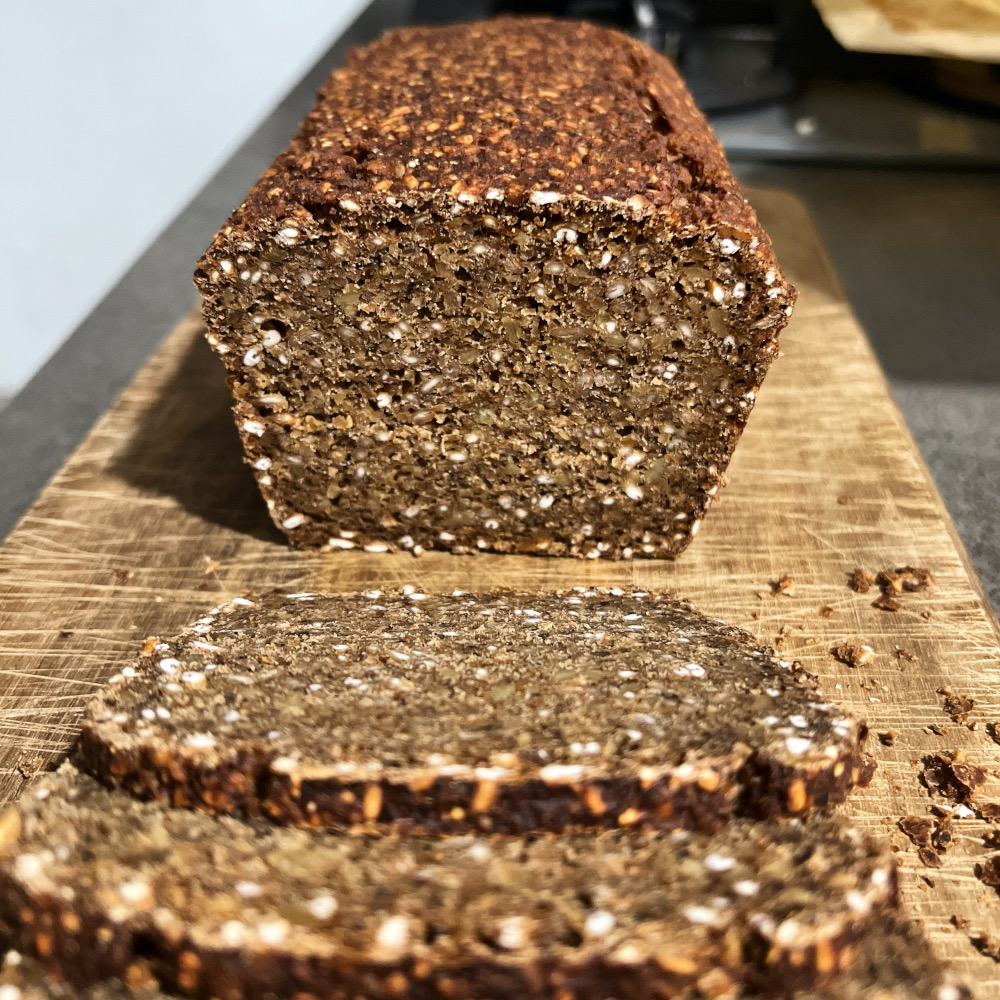
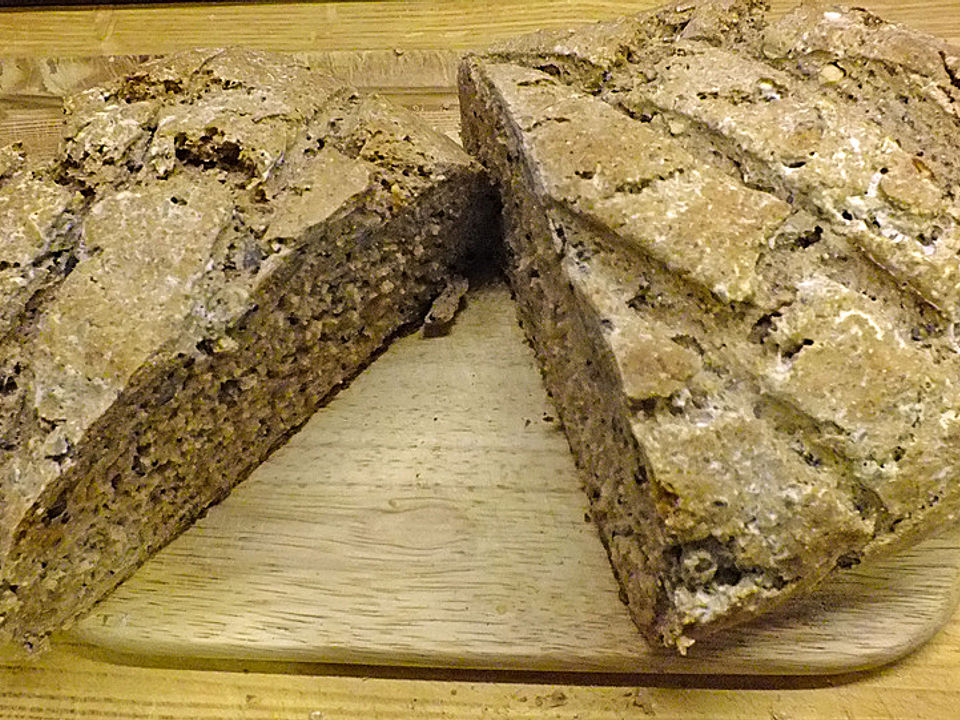
None of the breads listed there I would consider to be of the category "bread" as a German, and what I would be looking for when I wanted one.
Yes, a French baguette-type soft white bread is formally "bread", but it is treated as a different/single category here, as "white bread". With examples of typical bread being, say: https://www.hofpfisterei.de/download/Hofpfisterei-Sortiment-... And I don't think the images really carry across the difference (and variety) in texture and density, to someone who simply never had this kind of "non-soft" bread. You can spread cold butter from the fridge on it without breaking it, maybe that gives away a hint towards the difference. Also note the variety of grain: rye, spelt, wheat, barley, oats, in different compositions and degrees of fineness. And this is just one brand/bakery.
Some more "typical German bread" images. I picked types that maybe convey the difference to "white bread" the best in viewing:
Five years ago it was a rarity (in fact the first place I can clearly recall being asked was a Five Guys, when I said I didn't want a bun - no gluten problems, thanks, just don't need the extra calories). Nowadays I'd say it's more common than not at full-service restaurants.
Southern US; I live in a modest-size metro of about 400k and spend plenty of time in bigger cities.
Yep. My child was just accepted into a G&T program; it replaces gym period once a week, and I believe the teacher is responsible for all the G&T classes in the entire district (3 elementary schools, 1 middle, 1 high) - so if she stopped teaching G&T and started teaching an additional class, it would help exactly one school's grade level. Maybe better than nothing, but not by much.
You are right but this is a fairly new development, driven by activist lawsuits. It doesn’t have to be this way, these sort of changes are not irreversible.
Not necessarily a good idea. Dealing with disagreements, distractions, conflicts, low and high performers around you, that's all part of social education. It's not explicitly on the curriculum, but if you just give everybody a super sheltered cotton-clad education environment until they are 18 then they will be better at using the pythagorean theorem or discussing Shakespeare, but they will utterly fail on the street and will scream hate crime the first time somebody disagrees with them at the workplace.
I'm obviously exaggerating, but it's not purely good to remove "distracting elements".
I wonder, have you personally been in a university environment recently? Within the past ten or fifteen years? I ask because, as someone who attended a supposedly "good" university in the USA, before going I had an interest in the humanities but was quickly discouraged by the number of individuals who seemed to be possessed by propaganda. I mentioned in another comment, for example, that I saw another student have as their desktop background a photo of Mao and the cultural revolution. So this is the backdrop against which Jordan Peterson is saying, you know, there actually are Western intellectuals worth reading and listening to and thinking about. And yes, on a personal level, I did get to read some of those writers you mentioned. It did not surprise me that they turn out to be much deeper than Jordon Peterson himself, but I don't think he ever claimed to be a revolutionary thinker? I consider him more of an evangelist than anything else. How many intellectuals can we say have truly had an impact with their ideas? The number is small. I think the reason Jordan Peterson suddenly became a phenomenon is because he was at least brave enough to call out ridiculousness when he saw it (at least at the very beginning of his celebrity, I cannot speak for his recent comments because I stopped paying attention once he started going into politics).
The stuff Jordan says about there being some value in the classics is good. Some of his stuff about meaning is good. Little to none of it is original.
He’s also a raving misogynist. I have two daughters. He can fuck right off with that shit. I mean it would bother me if I didn’t have two daughters, but that makes it more personal.
Peterson is one of those people who sounds reasonable and even compelling at first, but as you keep listening eventually you get to the part where he starts clucking like a chicken. Unfortunately that is his original stuff.
People who start reasonable then lead into nonsense always make me think of the Monty Python lumberjack song skit. They had several skits with that premise. The woman who does Philomena Cunk is a modern comedian who riffs on this.
His wife and his daughter are public personas. Both have Youtube channels. I like his wife's channel quite a bit, and I spent a few hours years ago listening to his daughter. Both have talked about him at length while I was listening, and neither has said anything that would suggest they are unhappy with him or his influence on their lives.
His daughter has a husband and her own income stream, i.e., is no longer economically dependent on him.
I've also listened to the man himself for at least a hundred hours. I would be interested to read an explanation in support of your statement "he’s also a raving misogynist" because I've heard nothing that would lead me to conclude it or even to suspect it.
He probably believes that marriage and motherhood are best for most women. Is that contributing to your belief that he is a misogynist?
> He probably believes that marriage and motherhood are best for most women.
I don’t want to go on a quote hunt. I’ve seen some. But this is the crux of it.
My wife is a stay at home mom. It’s something she’s wanted to do since we were dating. I’m supportive of it, and she’s become kind of the pillar of the whole extended family.
That was her choice. It’s what she wanted. Get it?
It wasn’t my choice. I’d have supported her if she wanted a career. I supported her giving it a try but it wasn’t for her.
It’s definitely not some windbag public intellectual’s choice, or the government’s. The thing you quoted sounds innocuous until a politician gets ahold of it. Then we find out what it really means.
I guess the most damning thing to me is that so many incel and Tate types like him. By its fruit shall it be known. Marxism sounds liberating but if that’s true then why does every Marxist nation turn into a dictatorship or a mafia state?
A lot of things Marx said sound innocuous until politicians and men with guns get hold of them. Then you find out what they really mean.
Any time someone says they know what other people should do with their lives and they have some grand theory of history full of great meaning and purpose all ready to slot people into their appropriate roles, run away.
I've never heard Peterson (or his wife, who also holds the opinion that most women are better off if they choose motherhood) say that any of the societal changes, e.g., access to contraception and abortion, e.g., broad acceptance of women in the workplace, should be rolled back.
I never heard him or his wife say anything that might suggest that the opinion is anything other advice to women. (And when has Marx or Lenin ever said anything that can be interpreted as nothing more than advice to any individual -- other than the advice to join the collective effort to overthrow the capitalist class?)
Peterson is not shy about criticizing some of the pronouncement of feminists, e.g., "believe all women". He will point out that 1 or 2% of women are sociopaths just like 1 or 2% of men are sociopaths and that if you give sociopaths the opportunity to profit from lying, they will take the opportunity (and a depressingly large fraction of them will take the opportunity even if the only "profit" to be had is the pleasure of ruining someone's life or reputation).
Have you ever heard them criticize authoritarian conservatives who do believe womens' rights should be rolled back?
Or are they just not saying the quiet part out loud?
Intellectuals say should, which politicians and activists turn into must when people don't listen. That's usually the progression. Marx didn't say to put people into gulags. People were put into gulags when Marxism didn't work as expected. The ideology can't be wrong, so if people aren't doing it well enough they need "encouragement." If the square peg doesn't fit in the round hole, you have to use a hammer.
I'm pretty equal opportunity here. I am deeply skeptical and suspicious of anyone, right left or otherwise, who claims to have a proscriptive Grand Theory of how human beings ought to live. Such ideas usually end up having body counts.
BTW the fact that Peterson has women echoing and support his ideas doesn't mean much. There's plenty of men who subscribe to authoritarian ideologies that involve forcing other men to do things. It's no different.
I recall more than one time when he complained about the authoritarian impulse in bureaucrats and officials though none in which he complains about conservative officials specifically. He says that everyone must constantly exercise vigilance against this authoritarian impulse.
He complained that he is required (by his commitment to speak in front of audiences) to regularly go through airports because he gets icked out by the authoritarian vibe. He says he tries to stay at mom-and-pop hotels because hotels run by corporations give an authoritarian or at least bureaucratic vibe strong enough to ick him out sometimes.
> The stuff Jordan says about there being some value in the classics is good. Some of his stuff about meaning is good. Little to none of it is original.
I don't think he ever claimed that these ideas were original?
> He’s also a raving misogynist. I have two daughters. He can fuck right off with that shit.
I feel like this is quite an extraordinary accusation. The tone of your comment reminds me of his interview with Kathy Newman. Everything he said that had even the smallest nuance was twisted into something else. What specifically did he say that makes you thing he is a misogynist?
At a pre-protest meeting of a cause I wanted to support, I noticed that the organizer had on their desktop background a kind of propagandistic poster of Mao leading the cultural revolution. Keep in mind, this is in the USA. I'm no expert in world history by any means, but the level of ignorance is astounding.